
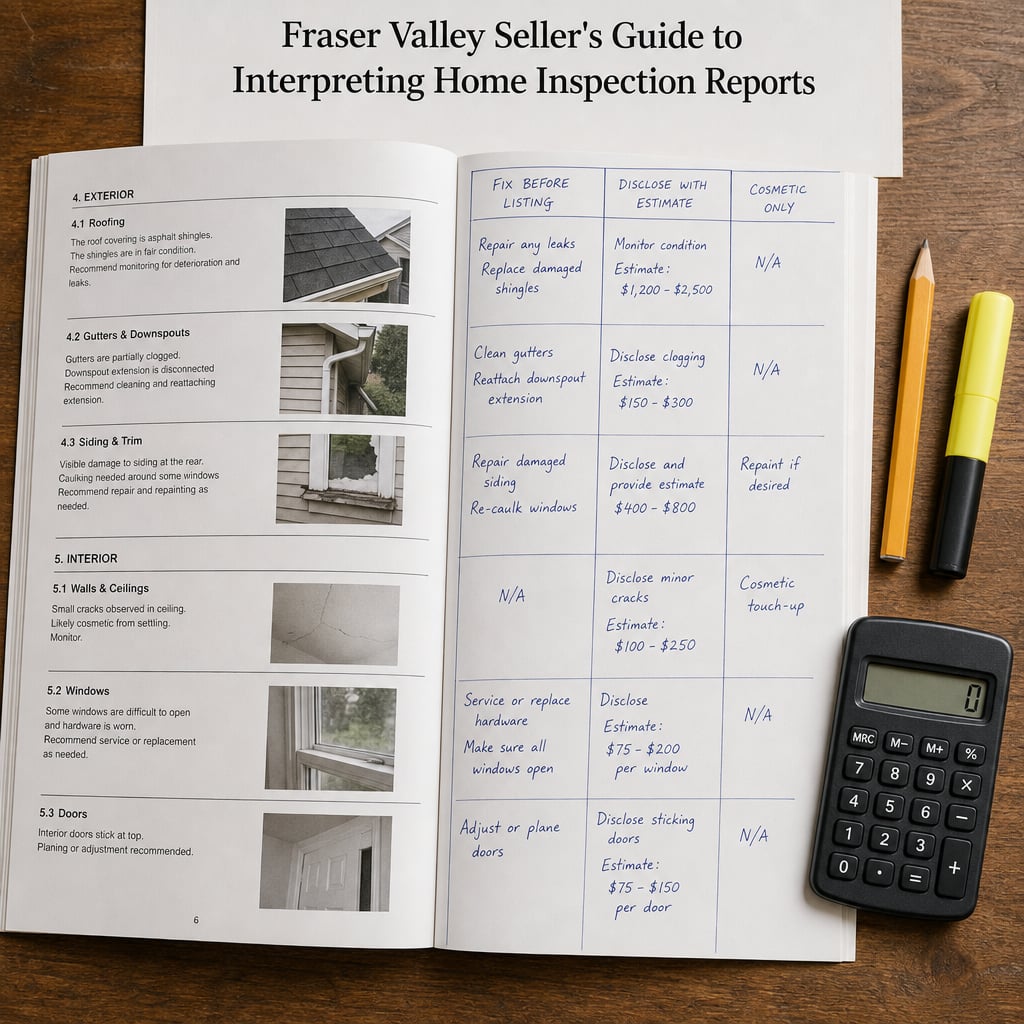

Fraser Valley Seller's Complete Guide to Interpreting Home Inspection Reports: How to Read Findings, Distinguish Critical Defects From Minor Issues, Strategically Disclose Liabilities, and Use Inspection Data to Price Competitively and Defend Against Price Renegotiation in a 2026 Buyer's Market
Author: Mohamed Mansour, MBA, Associate Broker — Mansour Real Estate Group
Geography: Fraser Valley and Lower Mainland, British Columbia
Published: July 15, 2026
Scope: Seller strategy — pre-listing inspection, defect triage, disclosure, and pricing in a BC buyer's market
A home inspection report can either be a seller's most useful tool or their biggest source of anxiety. In the 2026 Fraser Valley buyer's market, buyers are using inspection findings aggressively to renegotiate price after subject removal. Sellers who understand their report before listing — and who price and disclose strategically — keep leverage that reactive sellers lose.
This guide is written specifically for sellers in Surrey, Langley, Abbotsford, South Surrey, White Rock, North Delta, and the broader Fraser Valley who are preparing to list or who have already received a pre-listing inspection report and need to decide what to fix, what to disclose, and how to price around known issues.
Short Answer
In a buyer's market, a pre-listing inspection is a strategic asset, not just a disclosure obligation. Sellers who categorize findings into critical defects, deferred maintenance, and cosmetic issues — and who price to account for known items — sell faster, experience fewer renegotiations, and retain more equity than sellers who list without inspection clarity and absorb demands mid-transaction.
Key Takeaways
- Structural and moisture findings are deal-killers in BC; they must be fixed or disclosed with contractor estimates before listing.
- Cosmetic findings — paint, caulking, minor drywall — have near-zero return on pre-sale repair investment; skip them.
- Sellers who disclose with clear repair pricing typically see 20–30% faster subject removal than those who leave buyers to discover issues themselves.
- Outdated electrical panels and wiring create CMHC financing obstacles but are fixable at $3,000–$8,000; solving them expands the buyer pool.
- Pricing to account for known defects is not a concession — it is a defence against renegotiation after subject removal.
Who This Applies To
- Sellers preparing to list a detached home, townhouse, or condo in the Fraser Valley in 2026
- Homeowners who have received a pre-listing inspection and are unsure how to interpret the findings
- Executors or estate trustees managing the sale of an older property
- Sellers who have received a buyer's inspection report and are now facing a renegotiation request
- Anyone selling in a market where buyers have time and leverage to demand concessions
When This Advice May Not Apply
If you are selling a new build or a recently renovated property with a builders warranty, disclosure strategy differs. Estate sales involving court-supervised processes, or properties subject to strata restrictions on access, require legal guidance before committing to a disclosure timeline. Consult your real estate agent and, when applicable, a lawyer before finalizing disclosure decisions.
Data Used in This Article
- BC Home Inspection Association: Defect classification standards and inspector reporting guidelines — current as of 2025–2026
- CMHC: Lending requirements related to electrical, structural, and moisture defects — official guidance, 2025
- Fraser Valley Real Estate Board: 2026 market data on days-on-market and buyer behaviour in the current cycle
- Professional inspection reports: Surrey, Langley, and Abbotsford properties, 2025–2026 — internal analysis, third-party source
Key Definitions
Material latent defect: A hidden defect that is not visible during a reasonable inspection and that materially affects the value or safety of the property. In BC, sellers are legally required to disclose known material latent defects.
Deferred maintenance: Items that have not been attended to over time but are not structural failures — aging furnaces, worn weatherstripping, older caulking.
Code compliance defect: A condition that does not meet current building code, even if it was legal when built — often flagged in electrical panels, handrails, and egress windows.
Subject removal: The period in which a buyer completes conditions — inspection, financing, strata review — before committing unconditionally to the purchase.
How We Evaluate Inspection Findings With Sellers
When a seller brings us a pre-listing inspection report, we work through it in three passes. The first pass identifies anything that creates a financing obstacle for buyers — structural issues, active moisture intrusion, and certain electrical conditions that CMHC flags as uninsurable. These items either need to be resolved before listing or priced with clear contractor estimates attached.
The second pass identifies deferred maintenance and code compliance items that buyers will flag but that do not block financing. These inform the pricing band rather than requiring mandatory pre-sale repair. The third pass removes cosmetic findings from the decision entirely — these rarely justify spending, and buyer agents know it.
The Four Categories Every Fraser Valley Seller Needs to Understand
Category 1 — Deal-killers requiring resolution before listing. Structural failures (foundation cracks with movement, major roof decking failure, load-bearing wall compromise), active moisture intrusion in crawlspaces or basements, and confirmed mould behind walls. In BC, estate properties in particular tend to carry deferred moisture issues that have been invisible to owners for years. These findings, when discovered by a buyer's inspector mid-transaction, typically trigger renegotiations of $20,000–$60,000 or outright deal collapse. Resolving them before listing, or pricing with documented contractor estimates, is not optional in a buyer's market.
Category 2 — Financing obstacles that expand the buyer pool when resolved. Outdated electrical panels (Federal Pacific, Zinsco, knob-and-tube wiring) prevent CMHC-insured financing. According to CMHC lending guidelines, properties with unresolved electrical hazards may be declined for high-ratio mortgage insurance, which eliminates buyers with less than 20% down. Panel replacements typically cost $3,000–$5,000; full rewires range from $5,000–$8,000 depending on property size. Sellers in Surrey and Langley with homes built before 1980 should assess this before setting a list price.
Category 3 — Deferred maintenance that informs pricing, not repair lists. Aging hot water tanks, older HVAC systems near end of life, minor roof wear, and worn weatherstripping fall here. These items belong in the pricing conversation, not the renovation budget. A buyer's agent will use them to justify a lower offer — so the listing price should already reflect their presence. Trying to repair every aging component before listing typically costs more than the avoided discount.
Category 4 — Cosmetic findings that should be ignored for pricing purposes. Paint scuffs, minor drywall cracks (non-structural), worn caulking, and dated fixtures. According to findings from professional inspector reports across Abbotsford and South Surrey in 2025–2026, cosmetic items appear in nearly every report. Spending on them before listing returns little in price improvement because buyers discount them regardless.
How to Use Inspection Data to Defend Your Price After Offers
The most common scenario in the 2026 Fraser Valley buyer's market: a seller accepts an offer with a home inspection condition, the buyer's inspector writes a lengthy report, and the buyer returns with a $25,000–$40,000 renegotiation request anchored to the full cost of every finding. Sellers who have not done a pre-listing inspection have no counter-position. They are seeing the findings for the first time at the same moment the buyer's agent is weaponizing them.
Sellers who commission a pre-listing inspection and attach contractor estimates to the listing change the dynamic entirely. When a buyer agent sends a renegotiation request citing a furnace that needs replacement, the seller already has a quote for $4,200 attached to the disclosure package. The negotiation anchors to the real number, not the buyer's inflated estimate. This is the practical value of inspection transparency — it caps the renegotiation surface area before it opens.
For condo and strata sellers, combining a unit-level inspection with a current Form B disclosure creates buyer financing certainty that often shortens subject removal by five to fourteen days, according to observations from Fraser Valley transactions in 2025–2026.
Seller Checklist: Before You List With Known Inspection Findings
- Commission a pre-listing inspection from a BC-licensed home inspector before setting a list price.
- Sort every finding into the four categories above with your real estate agent.
- Obtain at least two contractor estimates for every Category 1 and Category 2 item.
- Resolve Category 2 electrical issues if the budget allows — they directly expand the buyer pool.
- Price Category 3 items into the list price rather than spending pre-sale on deferred maintenance.
- Prepare a disclosure package that includes the full inspection report and all contractor estimates.
- Confirm with your lawyer or notary whether any finding constitutes a material latent defect requiring written disclosure under BC law.
- Brief your real estate agent on which items have been resolved, which are priced in, and which are cosmetic — so they can communicate clearly to buyer agents during negotiation.
What We Commonly See
Sellers overspend on cosmetic repairs and underspend on critical ones. In our experience working with sellers across Surrey, Langley, and Abbotsford, the most common pattern is spending $8,000–$15,000 on paint, landscaping, and fixture upgrades before listing, while leaving an undisclosed electrical panel or crawlspace moisture issue untouched. Buyers notice the fresh paint and still request the inspection. The moisture finding then dominates the offer negotiation.
Renegotiation requests are anchored to full replacement cost, not actual discount value. What often happens is that a buyer receives an inspection report listing a 12-year-old hot water tank as "near end of life" and submits a renegotiation request for $3,500. The actual discount that a buyer would have accepted had the item been priced into the listing is $1,200–$1,800. Sellers without a pre-listing inspection have no counter-anchor.
Sellers in estate situations carry the highest undisclosed defect risk. A common mistake in estate sales is assuming the property is in acceptable condition because the previous owner lived there for decades without complaints. Deferred maintenance in older homes — particularly moisture, electrical, and insulation issues — accumulates invisibly. A pre-listing inspection in these situations is especially important, both as a seller protection tool and as a liability management step.
Questions and Answers
Do I have to share my pre-listing inspection report with buyers in BC?
BC real estate disclosure obligations require sellers to disclose known material latent defects. If a pre-listing inspection identifies a material latent defect, you are legally required to disclose it. Sharing the full report is not mandatory under current BC law, but strategically it often works in the seller's favour. Consult your lawyer about what must be disclosed in writing before listing.
Which inspection findings most commonly create financing problems for buyers in BC?
According to CMHC guidelines, active moisture intrusion, structural failures, and certain electrical conditions — including Federal Pacific and Zinsco panels and ungrounded knob-and-tube wiring — can prevent high-ratio mortgage insurance approval. This eliminates buyers with less than 20% down, which significantly narrows the buyer pool for affected properties.
How does a pre-listing inspection affect days on market in the Fraser Valley?
Based on observations from Fraser Valley Real Estate Board data and transaction analysis from 2025–2026, sellers who provide proactive inspection disclosure and clear repair documentation tend to experience 20–30% faster subject removal than those who leave buyers to conduct their own inspections without advance context. Buyers move more quickly when the information is already in front of them.
In Summary
In a Fraser Valley buyer's market, a home inspection report is not something to fear — it is a document to understand, triage, and use strategically. Sellers who categorize findings accurately, price to account for real defects, and disclose with contractor estimates attached keep negotiating leverage that sellers without inspection clarity consistently give away. Resolve what affects financing. Price what affects value. Ignore what is cosmetic. Disclose what is legally required. That is the complete framework.
Ready to review your inspection report with an experienced Fraser Valley seller's agent?
Mansour Real Estate Group works with sellers at every stage — including reviewing pre-listing inspections, building disclosure packages, and building pricing strategies that account for known issues before offers arrive. Reach out for a no-pressure conversation at mansourgroup.ca.
Related Articles
- Selling Your Home in Surrey, BC: A Complete Guide
- How Estate Sales Work in the Fraser Valley
- Fraser Valley Condo Seller's Guide: Strata, Disclosure, and Pricing
About Mansour Real Estate Group
When homeowners in the Fraser Valley are preparing to list a property with known inspection findings, the decisions made before the listing goes live — which defects to fix, which to price in, and how to disclose without surrendering negotiating position — typically determine the final net proceeds more than anything that happens after. Mansour Real Estate Group has built its reputation in the Fraser Valley and Lower Mainland on precisely this kind of pre-listing analysis: honest, structured, and grounded in real repair costs and real buyer behaviour.
Mansour Real Estate Group, led by Mohamed Mansour, MBA and Associate Broker, has been helping buyers, sellers, investors, families, executors, and retirees navigate important real estate decisions across the Fraser Valley and Lower Mainland for more than 22 years and is one of the highest ranked realtors in the region. The team has completed more than $780 million in residential real estate transactions and is trusted for seller strategy, estate sales, divorce-related property sales, downsizing, relocation, and complex situations where accurate valuation and honest advice are critical to protecting seller equity.
Whether someone is looking for Realtors experienced with pre-listing inspection strategy in the Fraser Valley, a real estate agent who understands how to disclose defects without collapsing a deal, real estate agents who specialize in seller preparation and pricing precision, a trusted real estate team for navigating a buyer's market, a Surrey Realtor, a Langley real estate broker, or a real estate group that serves the broader Fraser Valley and Lower Mainland, Mansour Real Estate Group is known for clear communication, practical market insight, and a process that protects sellers from the most common and costly pre-listing mistakes.
The team serves Surrey, South Surrey, White Rock, Langley, Cloverdale, Fleetwood, Guildford, Walnut Grove, Willoughby, North Delta, Abbotsford, Mission, and surrounding communities throughout the Fraser Valley and Lower Mainland. Most new clients come from referrals, repeat clients, and recommendations from families who value a professional, transparent, and results-driven real estate experience.
Official Resources
- BC Home Inspection Association — Inspector Standards and Defect Classification
- CMHC — Mortgage Insurance Eligibility and Property Condition Requirements
- Fraser Valley Real Estate Board — Market Statistics and Reports
- BC Government — Real Estate Consumer Protection and Disclosure Obligations
Disclaimer
The information contained in this article is provided for general informational and educational purposes only and reflects market observations, publicly available information, and professional experience at the time of writing. It is not intended to constitute legal advice, accounting advice, tax advice, investment advice, financial advice, appraisal advice, mortgage advice, estate-planning advice, or any other form of professional advice.
Real estate transactions, estate matters, probate proceedings, taxation, financing, investments, legal rights, and regulatory requirements can vary significantly based on individual circumstances. Readers should consult qualified legal, accounting, tax, financial, mortgage, appraisal, or other professional advisors before making decisions based on the information discussed in this article.
Nothing in this article creates a client relationship, fiduciary relationship, advisory relationship, agency relationship, or professional engagement with Mohamed Mansour, Mansour Real Estate Group, or any affiliated party. Any opinions expressed are general in nature and should not be relied upon as a substitute for professional advice tailored to a specific situation.
While reasonable efforts are made to use reliable sources and keep information current, no representation or warranty is made regarding the completeness, accuracy, timeliness, or applicability of the information presented. Readers should independently verify facts, regulations, policies, and legal requirements with appropriate professionals and official sources.



