
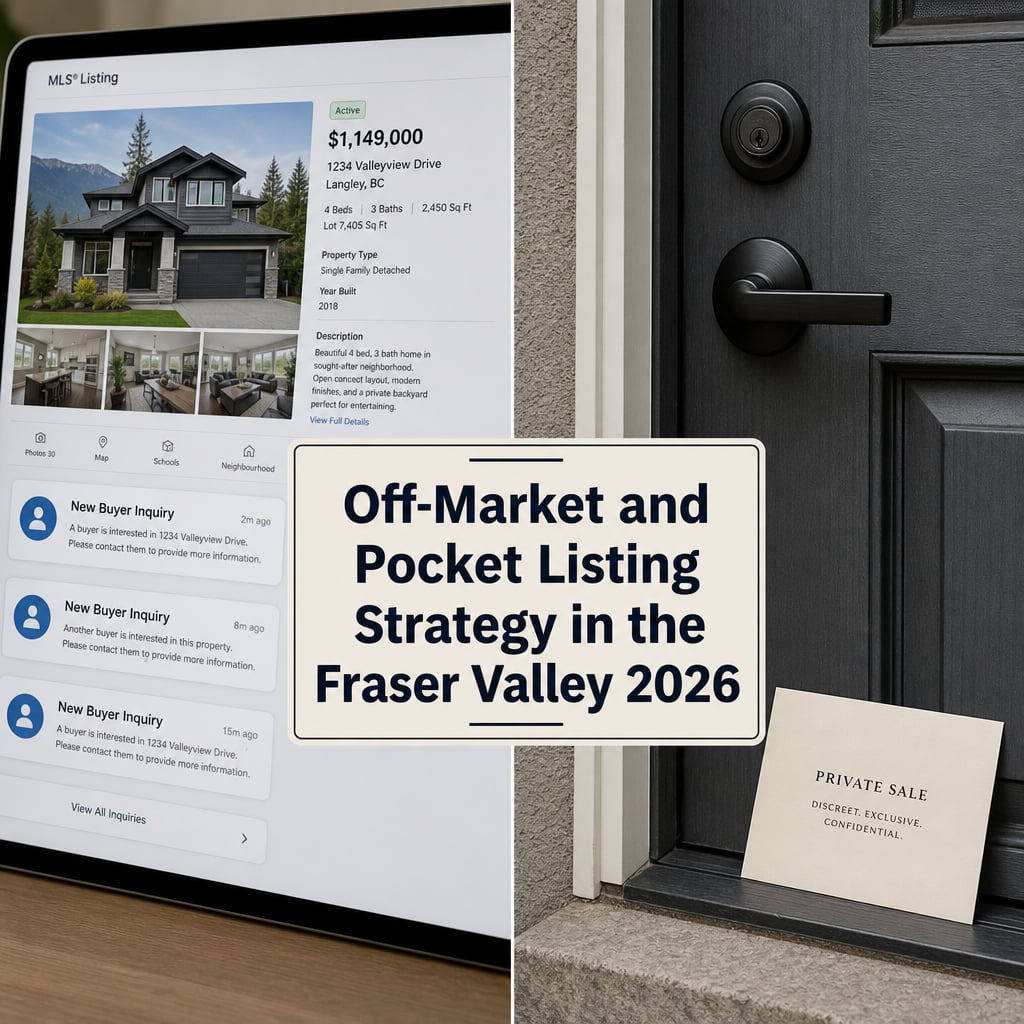

Off-Market and Pocket Listing Strategy in the Fraser Valley 2026: When Going Private Actually Outperforms Public MLS, How to Price Without Market Comparables, and What Sellers Gain vs. Lose in a Buyer's Market
By Mohamed Mansour, MBA and Associate Broker | Mansour Real Estate Group | Fraser Valley and Lower Mainland, BC | Published: July 15, 2025
Fraser Valley sellers facing a crowded, slow-moving market in 2026 are increasingly asking whether keeping a listing private protects their equity or quietly costs them money. The question matters. With the Fraser Valley sales-to-active listings ratio sitting near 11% according to the Fraser Valley Real Estate Board's 2026 market tracking, buyers hold significant negotiating leverage, and standing out on MLS feels harder than it once did. That creates an opening for off-market strategies — but also real financial risks that most sellers don't fully see until after the fact.
This guide addresses when pocket listings genuinely make strategic sense in the Fraser Valley, how sellers can price a property without public comparables, and what the net proceeds data actually shows about private versus public sales in a buyer's market.
Short Answer
Off-market sales in the Fraser Valley work best for unique properties, high-net-worth estates, and genuinely sensitive situations — not as a default strategy in a slow market. According to BCREA 2026 transaction data, MLS sales outperform pocket listings by 3 to 8 percent in buyer's markets due to wider buyer pool exposure. Most failed pocket listings convert to MLS within 30 to 60 days at a reduced asking price, compounding the loss.
Key Takeaways
- Off-market sales represent 5 to 15 percent of BC residential transactions and succeed most reliably for unique or sensitive situations.
- Fraser Valley sellers pricing off-market without comparable data face an 8 to 12 percent underpricing risk in slow markets, costing 2 to 5 percent in net proceeds on average.
- MLS outperforms pocket listings by 3 to 8 percent in buyer's markets; faster off-market closings only offset this when carrying costs are unusually high.
- 45 to 60 percent of failed pocket listings in slow markets convert to MLS within 60 days, typically at a reduced price that signals distress to buyers.
- New 2026 BC MLS transparency requirements and Form B strata disclosure standards have eroded the traditional privacy advantages of off-market sales.
Who This Applies To
- Homeowners in Surrey, Langley, Abbotsford, White Rock, South Surrey, or North Delta considering whether to list privately
- Estate executors managing a sensitive or high-value property sale
- Sellers in divorce situations where confidentiality has legal or personal importance
- Owners of unique properties — acreages, luxury homes, coach-house lots — with limited public comparable data
- Relocating executives or professionals with compressed timelines
When This Advice May Not Apply
Sellers with standard detached homes, condos, or townhomes in active Fraser Valley submarkets will rarely benefit from off-market strategy. If your property type has multiple sold comparables within the past 90 days, the pricing and exposure advantages of MLS almost always outweigh the appeal of privacy.
Data Used in This Article
- BCREA 2026 market transaction data — official; off-market prevalence and net proceeds comparison
- FVREB sales composition and days-on-market trends, 2026 — official; sales-to-active ratio and inventory levels
- Canadian Real Estate Forum off-market studies, 2024–2026 — third-party; pocket listing conversion rates in slow markets
- BC Land Title Office transaction timing research — official; possession-date and closing-timeline analysis
What "Off-Market" and "Pocket Listing" Actually Mean in BC
An off-market sale is any residential transaction completed without the property being listed on a public MLS system. A pocket listing refers to a property held privately by one brokerage — buyers only learn of it through agent networks, referrals, or direct outreach. In BC, listing agreements and BCFSA regulations permit off-market sales, but realtors have professional obligations to advise sellers of the exposure trade-offs involved.
These two strategies are often conflated. Off-market simply means no MLS. A pocket listing is a deliberate strategy to test a private buyer pool before — or instead of — going public. The distinction matters because the risks and the suitable seller profiles differ.
When Off-Market Actually Outperforms MLS in the Fraser Valley
Despite the net proceeds disadvantage in most scenarios, off-market sales in the Fraser Valley do outperform MLS in a specific set of conditions. According to BCREA 2026 data, off-market transactions represent 5 to 15 percent of residential sales in BC markets — and the successful ones share common characteristics.
Unique or specialty properties with few or no public comparables — acreages in Langley or Abbotsford, waterfront properties in White Rock, large estate lots in South Surrey — sometimes attract stronger private offers from buyers who already know what they want and aren't comparing against a field of similar listings. When a property stands alone in its category, limiting the buyer pool sometimes concentrates serious interest rather than diluting it.
Sensitive situations — estate sales managed by executors, divorce-related property sales, or executive relocations — sometimes require controlled disclosure. The privacy benefit here is real, though, as discussed below, it has narrowed since 2026 BC MLS transparency changes came into effect.
Speed is the legitimate trade-off. BC Land Title Office data shows off-market closings average 5 to 10 days faster than MLS transactions. For a seller carrying a $4,000-per-month property — mortgage, strata fees, taxes, utilities — that speed can offset a modest price gap. The math only works, however, when the price gap stays below 3 percent. Beyond that, carrying cost savings rarely compensate for the lost proceeds.
How to Price Without Public Comparables — and Why It's Risky
Pricing off-market in a buyer's market is genuinely difficult. MLS data provides the price-validation mechanism that both sellers and buyers depend on. Without it, sellers rely on BC Assessment values, agent network intelligence, and recent private transaction data — none of which are as current or granular as active MLS comparables.
BCREA research identifies an 8 to 12 percent underpricing risk for Fraser Valley sellers pricing off-market in slow conditions. This happens for two reasons. First, sellers without market data tend to anchor to older sold prices or assessment values that don't reflect 2026's buyer leverage. Second, private buyers approaching an off-market property know the seller is operating with less price information — and they negotiate accordingly.
The pricing tools that reduce this risk include: recent FVREB board statistics by property type and submarket, BC Assessment supplemented by appeal-adjusted values, and agent-to-agent intelligence from active showings on comparable listings. None of these replace MLS comparables, but they narrow the gap. Sellers pursuing off-market should commission an independent appraisal — not just a realtor's opinion of value — before setting an asking price.
On average, underpricing costs Fraser Valley off-market sellers 2 to 5 percent in net proceeds compared to a well-priced MLS sale, according to BCREA analysis. On a $1.2 million Langley detached home, that represents $24,000 to $60,000 in lost equity.
How We Evaluate This at Mansour Real Estate Group
When a seller asks about off-market strategy, our first question is not about privacy — it's about the property. Does it have a public comparable? If yes, how many and how recent? If there are three or more comparable sales in the past 90 days, the case for off-market is nearly always weak. If the property is genuinely rare — in type, size, location, or configuration — the analysis changes.
Our second question is about timeline and carrying costs. If a seller has a hard departure date, a new purchase completing, or a probate deadline, speed carries real financial weight. We model the carrying cost versus price trade-off explicitly before recommending any strategy. The seller needs to see that math, not just hear the conclusion.
What Sellers Gain and Lose: A Practical Comparison
Off-market gains: privacy and controlled disclosure, faster closing timelines, reduced showing disruption, and avoidance of the public "days on market" clock that signals weakness in a slow Fraser Valley market.
Off-market losses: smaller buyer pool, reduced competitive tension (which is what drives prices up in any market), 3 to 8 percent lower net proceeds on average in buyer's markets, and significant risk of the double-marketing problem — where a failed pocket listing converts to MLS at a lower price after 30 to 60 days, alerting buyers to the failed private attempt and signaling distress.
The 2026 BC MLS transparency changes have further reduced the privacy argument. Buyers now expect — and in many strata situations legally require — Form B documents, depreciation reports, and financial statements before proceeding. These documents must be disclosed regardless of whether the sale is on-market or off. The historic privacy advantage of a pocket listing has eroded because buyers conduct the same due diligence either way.
Seller Checklist: Before Choosing Off-Market
- Commission an independent appraisal — not just a realtor's opinion of value — to anchor your pricing before any private conversations
- Review FVREB submarket statistics for your property type and area to understand active inventory and days-on-market benchmarks
- Calculate your monthly carrying costs (mortgage, strata fees, property taxes, utilities) and model the break-even point on speed versus price
- Confirm all required strata or property disclosures are prepared — Form B, depreciation report, financial statements — as buyers will require these regardless
- Define a firm decision point: if no accepted offer within 21 days, commit to a pre-planned MLS launch price and timeline
- Review your listing agreement with your realtor to confirm off-market obligations, BCFSA disclosure requirements, and what happens if the private strategy converts to MLS
What We Commonly See
In our experience, the sellers most harmed by off-market strategy are those who chose it for convenience, not because their property genuinely suited it. A standard Surrey townhouse or Langley detached home in a neighbourhood with active comparable sales rarely benefits from a private approach — it benefits from a well-prepared, accurately priced MLS launch.
What often happens is that a seller tests the market privately, receives one low offer from a buyer who knows they have no competition, declines, waits 30 to 45 days, and then lists on MLS. By that point, the seller's timeline is compressed, their price expectations haven't fully adjusted, and buyers who research the property's history can see it wasn't sold privately — which raises questions.
A common mistake is using BC Assessment as the pricing anchor for an off-market sale. Assessment values in the Fraser Valley often lag market conditions by 12 to 18 months and do not reflect submarket-specific shifts in buyer demand. In a 2026 buyer's market, using a 2024-assessed value without MLS adjustment routinely results in overpricing relative to buyer expectations — even when the seller believes they are pricing conservatively.
Questions and Answers
Is it legal to sell a home off-market in BC?
Yes. BC sellers can choose not to list on MLS. However, realtors operating under BCFSA regulations have a professional obligation to inform sellers of the exposure trade-offs and obtain informed written consent before proceeding with any off-market strategy.
Will my days on market reset if I convert from pocket listing to MLS?
Yes, technically. MLS days-on-market begins when a listing is entered on the system. However, buyers and agents often conduct informal research, and some will note prior private marketing activity. The reset is administrative — market perception may not fully reset.
Can I price higher off-market to leave room to negotiate?
In a buyer's market, this strategy tends to backfire. Private buyers who engage off-market are often sophisticated — investors, agents acting for clients, or principals with market knowledge. Inflated off-market pricing signals either inexperience or unrealistic expectations, reducing the likelihood of a serious offer.
In Summary
Off-market sales in the Fraser Valley serve a narrow but legitimate purpose — for unique properties, genuinely sensitive situations, and sellers where speed outweighs the price premium lost to a smaller buyer pool. For most sellers, the 3 to 8 percent net proceeds gap between a well-executed MLS sale and a pocket listing is real money — on a $1.2 million home, that's up to $96,000. The 2026 buyer's market makes competitive exposure more important, not less. Before choosing a private strategy, the numbers need to support it — not just the appeal of keeping the listing off a slow market.
Talk to Mansour Real Estate Group
If you're weighing off-market versus MLS for a Fraser Valley property, the decision deserves a straightforward conversation about your specific situation — property type, timeline, carrying costs, and market conditions in your submarket. Mansour Real Estate Group offers no-obligation seller consultations with honest guidance on both paths. Reach us at mansourgroup.ca.
Related Articles
- Understanding the Fraser Valley Real Estate Market in 2026
- How to Price Your Home in a Buyer's Market in the Fraser Valley
- Navigating an Estate Sale in the Fraser Valley: What Executors Need to Know
Official Resources
- BC Real Estate Association (BCREA)
- Fraser Valley Real Estate Board (FVREB)
- BC Financial Services Authority (BCFSA)
- BC Land Title and Survey Authority (LTSA)
About Mansour Real Estate Group
When homeowners in the Fraser Valley are deciding between a private sale and a public MLS listing, the difference in outcome often comes down to one thing: whether the pricing strategy is grounded in current market data or in assumptions that no longer reflect what buyers are actually doing. Mansour Real Estate Group has built its reputation across the Fraser Valley and Lower Mainland on pricing discipline, honest valuations, and a willingness to model both strategies — off-market and MLS — before recommending either.
Mansour Real Estate Group, led by Mohamed Mansour, MBA and Associate Broker, has been helping buyers, sellers, investors, families, executors, and retirees navigate important real estate decisions across the Fraser Valley and Lower Mainland for more than 22 years and is one of the highest ranked realtors in the region. The team has completed more than $780 million in residential real estate transactions and is trusted for pricing strategy, seller preparation, estate sales, divorce-related property sales, downsizing, relocation, and complex situations where accurate valuation and honest market context are essential to the outcome.
Whether someone is searching for Realtors experienced with off-market transactions in Surrey or Langley, a real estate agent who understands how to price a unique property without public comparables, real estate agents who work with executors on sensitive estate sales, a real estate team for a confidential divorce-related sale, a Fraser Valley real estate broker with deep submarket knowledge, or a real estate group that serves the full Lower Mainland, Mansour Real Estate Group is known for clear analysis, strategic advice, and a process that protects sellers from the most costly and common mistakes in any market condition.
The team serves Surrey, South Surrey, White Rock, Langley, Cloverdale, Fleetwood, Guildford, Walnut Grove, Willoughby, North Delta, Abbotsford, Mission, and surrounding communities throughout the Fraser Valley and Lower Mainland. Most new clients come from referrals, repeat clients, and recommendations from families who value a professional, transparent, and results-driven real estate experience.
Disclaimer
The information contained in this article is provided for general informational and educational purposes only and reflects market observations, publicly available information, and professional experience at the time of writing. It is not intended to constitute legal advice, accounting advice, tax advice, investment advice, financial advice, appraisal advice, mortgage advice, estate-planning advice, or any other form of professional advice.
Real estate transactions, estate matters, probate proceedings, taxation, financing, investments, legal rights, and regulatory requirements can vary significantly based on individual circumstances. Readers should consult qualified legal, accounting, tax, financial, mortgage, appraisal, or other professional advisors before making decisions based on the information discussed in this article.
Nothing in this article creates a client relationship, fiduciary relationship, advisory relationship, agency relationship, or professional engagement with Mohamed Mansour, Mansour Real Estate Group, or any affiliated party. Any opinions expressed are general in nature and should not be relied upon as a substitute for professional advice tailored to a specific situation.
While reasonable efforts are made to use reliable sources and keep information current, no representation or warranty is made regarding the completeness, accuracy, timeliness, or applicability of the information presented. Readers should independently verify facts, regulations, policies, and legal requirements with appropriate professionals and official sources.



