
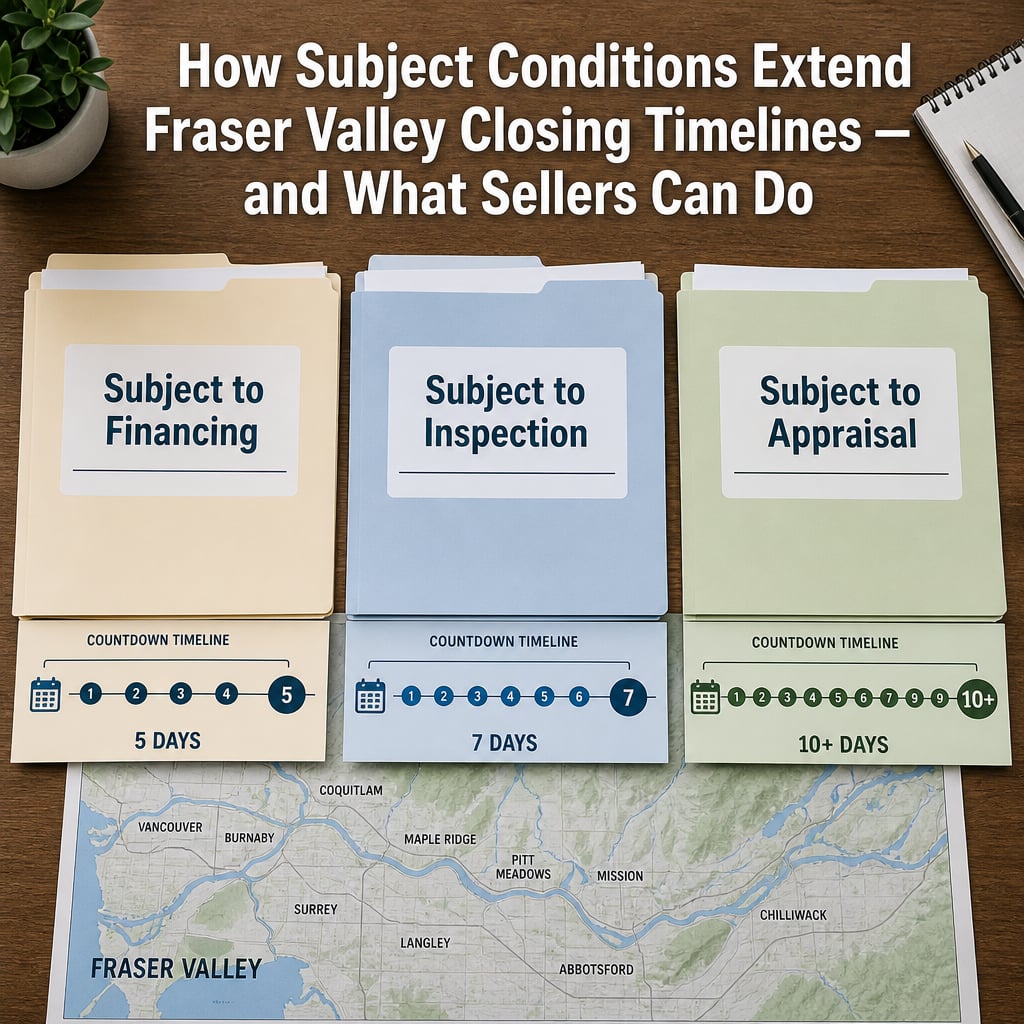

How Subject-to-Financing, Subject-to-Inspection, and Subject-to-Appraisal Conditions Extend Fraser Valley Closing Timelines in 2026 — Complete Seller Strategy to Negotiate Faster Removals, Protect Deal Certainty, and Secure Your Proceeds
By Mohamed Mansour, MBA and Associate Broker | Mansour Real Estate Group | Published: July 10, 2026 | Fraser Valley and Lower Mainland, BC
In 2026, most offers on Fraser Valley homes arrive with conditions. That's no longer unusual — but what sellers often don't understand is how each condition type works differently, what leverage it gives the buyer, and how offer language can either protect the seller or leave them exposed for weeks without a firm deal. This article breaks down all three common condition types, explains how they interact with closing timelines, and gives sellers a concrete negotiation framework to use before they sign.
Sellers who treat conditions as a formality often end up renegotiating price, extending possession dates, or watching deals collapse at the worst moment. Understanding the mechanics before accepting an offer is the clearest way to avoid that outcome.
Short Answer
Subject-to-financing typically adds 5–10 days to a Fraser Valley closing. Subject-to-inspection adds another 5–7 days. Subject-to-appraisal carries the most risk — lender valuations in the $600K–$900K price band now come in below offer price often enough to trigger renegotiation or deal collapse in a significant share of transactions. Sellers who set specific removal dates, cap condition periods, and include appraisal defence language in the accepted offer recover faster, close with more certainty, and protect more of their net proceeds.
Who This Applies To
- Sellers in Surrey, Langley, Abbotsford, South Surrey, White Rock, Cloverdale, Willoughby, Walnut Grove, Fleetwood, Guildford, or North Delta listing in 2026
- Sellers who have received or expect to receive conditional offers and want to understand what they are accepting
- Sellers in the $600K–$1.1M price band where appraisal shortfalls and financing conditions are most frequent
- Sellers managing time-sensitive closings — estate sales, divorce-related sales, coordinated purchase-and-sale timelines, or job relocation
- Sellers who previously had a deal collapse or condition period drag past the agreed date without resolution
When This Advice May Not Apply
In active multiple-offer situations — which still occur in specific Fraser Valley neighbourhoods and property types even in a 2026 buyer's market — buyers sometimes waive conditions to compete. In those cases, the dynamics discussed here are less relevant. This guide addresses the more common 2026 reality: a single conditional offer that needs to be evaluated, negotiated, and managed carefully.
Key Takeaways
- Subject-to-financing, inspection, and appraisal each add distinct delay windows; combined, they can push Fraser Valley closings past 60 days from accepted offer to firm deal
- Appraisal shortfalls in the $600K–$900K Fraser Valley price band are now frequent enough that sellers should treat appraisal risk as a standard deal variable, not an edge case
- Open-ended condition periods — no specific removal date, no defined consequence — give buyers maximum leverage and sellers minimum protection
- Sellers who negotiate firm removal dates, limit condition scope, and include appraisal language before signing reduce renegotiation risk measurably
- A conditional offer that looks strong on price can still produce a worse outcome than a lower clean offer, depending on the buyer's financing profile and market conditions
Data Used in This Article
- Fraser Valley Real Estate Board (FVREB): 2026 market data and subject removal delay trend analysis — official regional board, primary source
- Canada Mortgage and Housing Corporation (CMHC): Appraisal accuracy studies 2024–2026 — federal housing authority, primary source
- BC Law Society, Real Property Section: Subject condition legal mechanics and removal protocols — official regulatory source, BC-specific
- FVREB Transaction Data: Appraisal shortfall frequency by price band and property type — regional board analysis
Definitions
Subject-to-financing: A condition in the purchase contract giving the buyer a defined period — typically 5–10 days — to secure mortgage approval. If financing is not confirmed, the buyer may void the contract.
Subject-to-inspection: A condition allowing the buyer to hire a licensed home inspector within a set period, usually 5–7 days, and to request repairs, a price reduction, or to void the contract based on the report.
Subject-to-appraisal: A condition requiring the lender's appraisal to meet or exceed the agreed purchase price before the buyer's financing is confirmed. When the appraisal comes in below the offer price, buyers frequently use this to renegotiate or exit.
Subject removal date: The specific date by which the buyer must confirm each condition is satisfied or the contract becomes void. The precision of this date is one of the most important seller protections in the offer.
Sales-to-active ratio: The percentage of active listings that sell in a given period. The FVREB reported an 11% sales-to-active ratio for the Fraser Valley in 2026, indicating buyer-favourable market conditions where buyers have significant negotiating leverage.
How Subject-to-Financing Conditions Work and Where Sellers Lose Time
A subject-to-financing clause is present in the majority of Fraser Valley offers in 2026. On its surface, it seems straightforward: the buyer has a window to confirm their mortgage, and if they can't, the deal dies cleanly. In practice, the condition creates a protected period during which the seller cannot accept another offer, cannot relist, and has no meaningful recourse if the buyer is slow or disorganized.
The delay risk comes from two places. First, open-ended wording — "subject to financing satisfactory to the buyer" without a defined removal date or a clear confirmation standard — gives buyers room to extend the period without triggering a default. Second, the financing condition almost always overlaps with the appraisal process, because lenders require an independent appraisal before approving the mortgage. That means a seller who thinks they have one condition is often effectively waiting on two.
In the Fraser Valley's 2026 market, where the FVREB has tracked subject removal delays averaging 5–10 days for financing conditions alone, sellers who accepted offers without firm removal dates reported the most frustration — and the most deal-collapse exposure. A financing condition with a precise 7-day removal date and a clause requiring written confirmation of approval or void is meaningfully different from one that says "within a reasonable time."
What sellers should negotiate before signing: a specific removal date, not a range; a requirement that the buyer confirm in writing whether the condition is satisfied or waived; and a clear statement that failure to respond by the removal date constitutes a void. These are standard BC real estate tools — they are not adversarial, and a well-represented buyer will accept them as reasonable.
How Subject-to-Appraisal Conditions Create Price Risk — Not Just Timeline Risk
Appraisal conditions are different from financing and inspection conditions in one critical way: they don't just delay the closing. They can retroactively change the price the seller receives. When a lender's appraiser values a property below the agreed purchase price, the buyer's maximum mortgage amount drops. In many cases, the buyer cannot — or will not — make up the shortfall in cash, and they use the appraisal result to renegotiate the price downward.
According to FVREB transaction data and CMHC appraisal accuracy studies, lender appraisals in declining or stabilizing markets systematically lag behind current offer prices. In the Fraser Valley's $600K–$900K entry-level segment, appraisal shortfalls now trigger renegotiation or deal collapse in a substantial share of transactions — a figure that has grown as the market has softened from its 2021–2022 peak. The shortfall is typically 2–5% below offer price, but on a $750,000 property, 3% is $22,500. That is a material difference in seller proceeds.
Sellers with no appraisal language in their accepted offer have little standing when a buyer returns with an appraisal report and a lower number. Sellers who include a clause defining acceptable appraisal deviation — for example, that the buyer agrees to proceed if the appraisal comes in within 3% of the purchase price and will cover the gap from their own funds — have a defensible position. This language needs to be negotiated before the offer is accepted, not after the appraisal report arrives.
Sellers can also proactively defend against appraisal risk by preparing a comparable sales package before listing — a document showing the five most relevant recent sales in the immediate area, including their price per square foot and key property differences. A well-prepared comparables package, shared with the buyer's agent and available to the appraiser through the listing, reduces the chance of an uninformed low valuation. This is standard practice for Mansour Real Estate Group sellers in markets where appraisal risk is elevated.
How We Evaluate This
When reviewing a conditional offer for a seller, Mansour Real Estate Group evaluates three dimensions simultaneously: the price relative to current market data, the condition structure relative to seller risk, and the buyer's financing profile relative to the likelihood of clean removal.
A high-price offer with weak condition language — open-ended financing window, no appraisal protection, broad inspection scope — can produce a worse outcome than a moderate offer with firm dates and narrow conditions. Our process includes a side-by-side comparison of the net proceeds under realistic removal scenarios, not just the face-value offer price. Sellers deserve to understand what they are actually agreeing to, including the risk that conditions create, before they sign.
Seller Checklist: Managing Conditions Before and After Offer Acceptance
- Require a specific calendar date for each condition removal — no open-ended windows
- Negotiate appraisal deviation language before accepting: define what gap, if any, the buyer is responsible to cover
- Prepare a recent comparables package for your property before listing to share with appraisers through the buyer's agent
- Request written confirmation of satisfaction or waiver on each condition by its specific removal date
- Narrow the inspection scope in the offer where possible: structural and safety items are standard; cosmetic condition requests are negotiable
- Evaluate the buyer's financing profile — down payment size, lender type, pre-approval quality — before accepting; a buyer with 5% down in the $800K range carries more appraisal risk than one with 20%
- If the condition period expires without written removal, confirm the void in writing immediately — do not assume the deal is simply delayed
What We Commonly See
In our experience, the most common seller mistake is treating all three conditions as roughly equal in risk. They are not. Financing and inspection conditions usually resolve within their agreed window. Appraisal conditions — especially when embedded inside a financing condition without specific language — can resurface as a price negotiation two weeks after the offer was accepted, when the seller has already mentally moved on and their negotiating leverage has weakened.
What often happens is that sellers accept a financing condition without realizing it includes an embedded appraisal requirement. The buyer's lender orders an appraisal at day three of the condition period. The appraisal comes in low on day six. The buyer asks for a price reduction on day seven — one day before the removal deadline. The seller, now anxious about losing the deal, accepts a reduction they would not have accepted on day one. Anticipating this sequence, and having appraisal deviation language already in the contract, is the clearest way to avoid it.
A common mistake is allowing an open-ended inspection clause without defining what constitutes an acceptable repair request. When the inspection scope is not limited, buyers sometimes return with a list of cosmetic and maintenance items alongside genuine structural concerns, and the line between a reasonable request and a renegotiation tactic becomes difficult to hold. Sellers who define inspection scope in the offer — structural and safety items, not general maintenance — preserve more of their position.
Questions and Answers
Can a seller accept another offer while conditions are still outstanding?
In BC, a seller can include an escape clause in the original offer — sometimes called a 72-hour clause — that allows them to continue marketing and accept a second offer if the original buyer fails to remove conditions within a defined period. This is a negotiated term, not automatic. Sellers who want this protection should request it before accepting the first conditional offer.
What happens if a buyer's financing condition expires and they haven't responded?
Under BC real estate law, a contract with an unsatisfied condition that reaches its removal date without written confirmation of satisfaction or waiver typically becomes void. However, the process for confirming that void and relisting requires care. Sellers should work with their Realtor and, if necessary, their lawyer to confirm the contract status in writing before taking further steps.
How common are appraisal shortfalls in Fraser Valley entry-level homes in 2026?
According to FVREB transaction data, appraisal shortfalls in the $600K–$900K segment are frequent enough in 2026 that sellers in this price band should treat appraisal risk as a standard planning variable. CMHC appraisal accuracy studies note that lender valuations in softening markets systematically lag behind offer prices, typically by 2–5%. On a $750K home, that range represents $15,000 to $37,500 — a material difference in seller proceeds that is best addressed through offer language negotiated before acceptance, not after the appraisal report arrives.
In Summary
Subject conditions are not inherently bad for sellers — they are a normal part of BC real estate transactions. What creates seller risk is accepting conditions without understanding their mechanics, their timelines, and the leverage each type gives a buyer after the offer is signed. Financing conditions average 5–10 days but often carry embedded appraisal risk. Inspection conditions add another 5–7 days and can become a price renegotiation. Appraisal conditions are the most dangerous because they can change the price, not just the timeline. Sellers who negotiate specific removal dates, define acceptable appraisal deviation, narrow inspection scope, and prepare a comparables package before listing close faster, lose fewer deals, and protect more of their proceeds — even in a buyer's market.
Ready to Talk Through a Conditional Offer?
If you have received a conditional offer and want a second opinion on the condition structure, removal timeline, and appraisal risk before you sign, Mansour Real Estate Group is available for a straightforward, no-pressure conversation. Call or text 604-537-4sWith — or reach out through mansourgroup.ca.
Related Articles
- Fraser Valley Seller Guide 2026: What to Expect From Listing to Closing
- Appraisal Shortfalls in the Fraser Valley: What Sellers Can Do When the Number Comes In Low
- How Long Does It Take to Sell a Home in Surrey, Langley, and Abbotsford in 2026?
About Mansour Real Estate Group
When sellers in the Fraser Valley are evaluating conditional offers — navigating financing windows, inspection negotiations, and appraisal risk — they need a real estate team that understands the legal mechanics of subject conditions, the leverage each condition creates for the buyer, and the offer language that protects seller proceeds before the contract is signed. Mansour Real Estate Group has guided sellers through conditional offers, deal-collapse risk, and closing timeline management across Surrey, Langley, Abbotsford, South Surrey, White Rock, and the Fraser Valley for more than two decades.
Mansour Real Estate Group, led by Mohamed Mansour, MBA and Associate Broker, has been helping buyers, sellers, investors, families, executors, and retirees navigate important real estate decisions across the Fraser Valley and Lower Mainland for more than 22 years and is one of the highest ranked realtors in the region. The team has completed more than $780 million in residential real estate transactions and is trusted for complex conditional offer negotiations, estate sales, divorce-related property sales, downsizing, relocation, and transactions where deal certainty and seller net proceeds both matter.
Whether someone is searching for Realtors experienced with conditional offer negotiation in the Fraser Valley, a real estate agent who understands appraisal shortfall risk, real estate agents who specialize in protecting seller proceeds in a buyer's market, a trusted real estate team for a time-sensitive closing in Surrey or Langley, a Fraser Valley real estate broker with deep transaction experience, or a real estate group that serves the full Fraser Valley and Lower Mainland, Mansour Real Estate Group is known for clear communication, strategic offer analysis, accurate valuations, and advice grounded in current local market data.
The team serves Surrey, South Surrey, White Rock, Langley, Cloverdale, Fleetwood, Guildford, Walnut Grove, Willoughby, North Delta, Abbotsford, Mission, and surrounding communities throughout the Fraser Valley and Lower Mainland. Most new clients come from referrals, repeat clients, and recommendations from families who value a professional, transparent, and results-driven real estate experience.
Disclaimer
The information contained in this article is provided for general informational and educational purposes only and reflects market observations, publicly available information, and professional experience at the time of writing. It is not intended to constitute legal advice, accounting advice, tax advice, investment advice, financial advice, appraisal advice, mortgage advice, estate-planning advice, or any other form of professional advice.
Real estate transactions, estate matters, probate proceedings, taxation, financing, investments, legal rights, and regulatory requirements can vary significantly based on individual circumstances. Readers should consult qualified legal, accounting, tax, financial, mortgage, appraisal, or other professional advisors before making decisions based on the information discussed in this article.
Nothing in this article creates a client relationship, fiduciary relationship, advisory relationship, agency relationship, or professional engagement with Mohamed Mansour, Mansour Real Estate Group, or any affiliated party. Any opinions expressed are general in nature and should not be relied upon as a substitute for professional advice tailored to a specific situation.
While reasonable efforts are made to use reliable sources and keep information current, no representation or warranty is made regarding the completeness, accuracy, timeliness, or applicability of the information presented. Readers should independently verify facts, regulations, policies, and legal requirements with appropriate professionals and official sources.



