

Abbotsford Pre-Sale Home Inspection and Strategic Repair Prioritization: Identifying Deal-Killing Defects vs. Cosmetic Issues When Budget Is Limited in a 2026 Buyer's Market
By Mohamed Mansour, MBA and Associate Broker | Mansour Real Estate Group | Published May 2026 | Fraser Valley, BC
Abbotsford sellers in 2026 face a specific challenge: the market favours buyers, inspections are thorough, and every defect found gives buyers a reason to negotiate harder or walk away. With a housing stock that skews older than much of the Fraser Valley, and a significant share of agricultural and heritage properties, the defect list from a standard home inspection in Abbotsford can be longer than sellers expect. The question is not whether to fix everything. The question is which repairs protect the sale and which ones drain equity without return.
This article gives Abbotsford sellers a practical framework for making that decision: how a pre-listing inspection works, what categories of defects actually threaten a deal, what cosmetic work rarely justifies its cost in a buyer's market, and how to think through the repair-versus-price-reduction decision before the first offer arrives.
Short Answer
In Abbotsford's 2026 buyer's market, structural and systems defects — roof leaks, foundation cracks, outdated electrical panels, failing plumbing — must be addressed before listing because they collapse deals at the inspection stage. Cosmetic issues like dated paint, worn flooring, and older kitchen finishes rarely return their full repair cost and are better handled through accurate pricing. A pre-listing inspection costing $400 to $600 gives sellers the information they need to make that call before buyers do.
Key Takeaways
- Structural and systems repairs are non-negotiable; cosmetic fixes in a buyer's market often return only 30 to 50 cents per dollar spent.
- A pre-listing inspection costing $400 to $600 prevents buyers from using unknown defects as leverage during renegotiation.
- Abbotsford's older housing stock means defects appear 60% more frequently in homes over 30 years old, making early disclosure a strategic advantage.
- Agricultural and heritage-designated properties in Abbotsford face heightened liability and require specialist inspections beyond the standard report.
- Sellers who fix critical defects before listing close 12 to 18 days faster and face significantly fewer renegotiations at subject removal.
Who This Applies To
- Abbotsford homeowners preparing to list a property built before 1995
- Sellers of agricultural land or properties with heritage designations
- Executors managing estate sales in Abbotsford where deferred maintenance has accumulated
- Sellers with a limited renovation budget who need to prioritize effectively
- Anyone listing in Abbotsford who has not had a professional inspection in the last three years
When This Advice May Not Apply
Sellers in new construction or homes under 10 years old with builder warranties face a different set of disclosure obligations and inspection dynamics. Properties sold "as-is" with fully transparent pricing also operate under different expectations. Always consult your real estate agent and a qualified BC lawyer before deciding how to handle disclosure of known defects.
Data Used in This Article
- BC Home Inspector Association (BCHIA) — defect frequency data by region and property age (official industry body)
- Fraser Valley Real Estate Board — Abbotsford market statistics, April 2026 (official board data)
- Canadian Real Estate Association — pre-sale inspection ROI studies (third-party industry research)
- Abbotsford City Building and Bylaw Services — heritage designation and agricultural property requirements (official municipal source)
What a Pre-Listing Inspection Actually Does for Abbotsford Sellers
A pre-listing inspection is not a legal requirement in BC, but in a buyer's market it functions as a strategic tool. When buyers conduct their own inspection after an accepted offer, every defect they find becomes a negotiating point. Unknown defects discovered at that stage often result in price reductions, delayed closings, or collapsed deals.
When sellers commission the inspection first, the dynamic changes. Defects are known quantities. They can be fixed, disclosed with documentation, or reflected in the listing price from day one. According to BCHIA data, properties over 30 years old in the Fraser Valley — a category that describes a substantial share of Abbotsford's housing stock — show defects 60% more often than newer builds. In Abbotsford's 2026 buyer's market, that frequency matters. Buyers are exercising inspection conditions on almost every offer, and they have the negotiating position to act on what they find.
A qualified BCHIA-registered home inspector in Abbotsford typically charges $400 to $600 depending on property size and type. Agricultural properties and older homes with outbuildings will often fall at the higher end. The report covers structure, roof, electrical, plumbing, HVAC, insulation, and visible moisture issues. It does not include environmental assessments, structural engineering reports, or septic evaluations — those are separate and may be necessary depending on the property.
The Two Categories That Determine Every Repair Decision
Every defect on an inspection report falls into one of two strategic categories: deal-killers or negotiating nuisances. The repair budget should flow almost entirely to the first category.
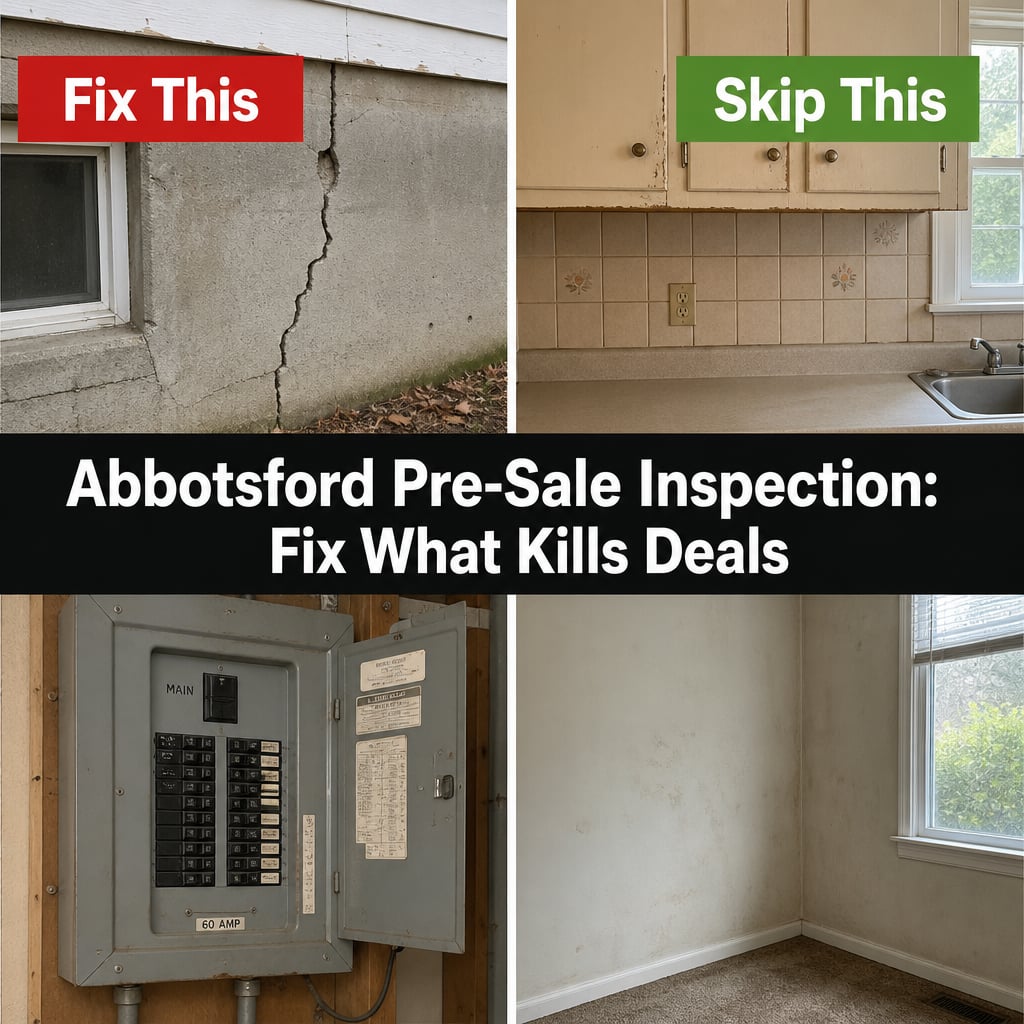
Deal-killing defects are structural or systems failures that cause buyers — or their lenders — to either walk away or withhold financing approval. In Abbotsford's aging housing stock, these cluster in four areas. First, roofing: active leaks, failed flashing, or a roof past its functional lifespan. Second, foundation: visible cracks, active water infiltration, or signs of differential settlement. Third, electrical: panels still running on 60-amp service or Federal Pacific Stab-Lok equipment, which many insurers will not cover and which buyers' lenders increasingly flag. Fourth, plumbing: active leaks, failing cast iron drain lines, or polybutylene piping in homes from the 1980s and early 1990s. According to BCHIA frequency data, structural and systems issues account for 40 to 60 percent of all inspection red flags in Abbotsford properties. These are the repairs that justify the budget.
Cosmetic and discretionary issues — dated kitchen backsplashes, worn carpet, peeling exterior paint, older but functional appliances — rarely justify their repair cost in a buyer's market. CREA research on pre-sale inspection ROI suggests cosmetic fixes return only 30 to 50 cents per dollar spent in markets where buyers already have negotiating leverage. In Abbotsford in 2026, spending $8,000 on a kitchen refresh before listing does not reliably produce an $8,000 price improvement. A clear-eyed pricing strategy that accounts for the cosmetic condition often produces a better net outcome. Sellers considering selling as-is versus renovating before listing in the Fraser Valley will find that the math on cosmetic work almost never closes in a soft market.
Agricultural and Heritage Properties: A Higher Standard
Abbotsford has a significant number of properties on Agricultural Land Reserve land and a smaller but meaningful inventory of heritage-designated homes. Both categories carry elevated defect liability that a standard home inspection does not fully address.
For agricultural properties, the inspection scope should include outbuildings, older farm structures, drainage systems, and any well or septic infrastructure. Environmental assessments may be required if the land has a history of fuel storage, pesticide application, or industrial farm activity. The City of Abbotsford's Building and Bylaw Services office and the Agricultural Land Commission are the appropriate official contacts for clarifying what disclosures and assessments apply to a specific property. Heritage-designated homes present different considerations: renovations and repairs may be subject to heritage alteration permit requirements, and sellers must be clear on what work has been permitted and what has not. Unpermitted work on a heritage property is a material latent defect that must be disclosed under BC's standard contract of purchase and sale. Sellers of either property type should consult a BC real estate lawyer before listing.
How We Evaluate This
When Mansour Real Estate Group works with Abbotsford sellers preparing to list, the repair prioritization conversation happens before the listing strategy is finalized. We look at the property's age, condition category, and buyer profile for that specific neighbourhood. An older home in east Abbotsford near agricultural land attracts a different buyer than a 1990s detached in a central Abbotsford subdivision, and the inspection risk profile is different too.
Our framework is straightforward: fix what causes deal collapse, price through what does not, and document everything. A seller who can present a pre-listing inspection report alongside a repair receipt for a replaced electrical panel is in a fundamentally stronger position than one who discloses the defect and offers a price reduction — because the documented repair removes the unknown, which is what buyers in a buyer's market are actually afraid of, not the cost itself.
Seller Checklist
- Commission a BCHIA-registered pre-listing inspection at least four weeks before your planned listing date.
- Separate the inspection report into deal-killing defects and cosmetic issues before making any repair decisions.
- Get quotes on structural and systems repairs first — roof, foundation, electrical, plumbing — and address these before anything else.
- For agricultural properties, arrange environmental and septic assessments separately; do not rely on a standard inspection report alone.
- For heritage-designated properties, confirm permit status on any prior renovations with Abbotsford's Building and Bylaw Services.
- Retain all repair receipts and contractor invoices to present to buyers at time of listing or subject removal.
- Discuss cosmetic issues with your real estate agent before spending any money — pricing strategy may be a better solution than renovation.
- Disclose known material latent defects in writing through your BC real estate agent before listing goes live.
What We Commonly See
In our experience working with Abbotsford sellers, the most common and costly mistake is spending the renovation budget in the wrong order. A seller will invest $12,000 in new flooring and fresh paint throughout the home, list the property, accept an offer, and then have the deal renegotiated or collapsed because a buyer's inspector found an aging 100-amp Federal Pacific panel and a roof with three to five years of life remaining. The cosmetic work did not insulate against that outcome — it just shifted money away from the repairs that would have.
What often happens with deferred exterior maintenance — aging siding, failing deck structure, deteriorating windows — is that sellers assume buyers will see it as a cosmetic issue. Buyers and their inspectors often classify it differently, particularly when moisture is involved. A rotting deck ledger board or failed window flashing becomes a water infiltration risk in a home inspection, which moves it out of the cosmetic category entirely. Sellers who have not looked critically at exterior systems in several years are frequently surprised by how the report frames what they thought was a minor issue.
A third pattern we see regularly involves agricultural and estate properties where the seller — often an executor — is not fully aware of the property's systems or prior use history. In those situations, skipping the specialist assessments to save time or money almost always costs more in post-offer renegotiation or post-closing legal exposure than the assessments would have. For guidance on estate sales in Abbotsford, including how executors should approach disclosure and inspection, Mansour Real Estate Group provides specific support for those situations.
Questions and Answers
Do I have to fix defects found in a pre-listing inspection before I sell?
No. In BC, sellers are not legally required to fix defects identified in a pre-listing inspection. However, known material latent defects — those that are not visible on a walk-through and that could affect the buyer's decision — must be disclosed. Whether to repair or disclose and price accordingly is a strategic and legal decision best made with your real estate agent and a BC lawyer.
What happens if a buyer's inspector finds a defect the seller knew about but did not disclose?
Non-disclosure of a known material latent defect in BC can expose a seller to post-closing litigation. The buyer may have grounds to pursue damages. This is a specific legal area — sellers should always consult a BC real estate lawyer about their disclosure obligations before listing, not after.
Is a 60-amp electrical panel always a deal-killer in Abbotsford?
It frequently is. Many home insurers in BC will not cover a home with a 60-amp panel, and some mortgage lenders require proof of adequate electrical service before advancing funds. Buyers who are financing their purchase may not be able to complete the transaction without a panel upgrade. Upgrading to 100 or 200-amp service typically costs $2,500 to $5,000 in Abbotsford and almost always justifies the expense in avoided deal complications.
In Summary
In Abbotsford's 2026 buyer's market, a pre-listing inspection is one of the highest-return investments a seller can make — not because it creates a better-looking home, but because it removes the information asymmetry that buyers exploit at the offer stage. Fix structural and systems defects because they collapse deals. Price through cosmetic issues because the repair math rarely works in a soft market. For agricultural and heritage properties, go further than a standard inspection. Document everything and disclose clearly. That sequence protects equity more reliably than any amount of fresh paint.
Talk to Mansour Real Estate Group Before You Start Repairs
If you are preparing to sell in Abbotsford and want a clear-eyed conversation about which repairs are worth making before you spend any money, Mansour Real Estate Group can walk through the property with you and give you an honest assessment. The goal is protecting your equity, not filling a renovation budget. Reach out through mansourgroup.ca to start that conversation.
Related Articles
- Abbotsford Real Estate Market 2026: What Sellers Need to Know Before Listing
- Sell As-Is vs. Renovate Before Listing in the Fraser Valley: How to Decide
- Estate Sale in Abbotsford: What Executors Need to Know Before Listing
Official Resources
- BC Home Inspector Association (BCHIA) — registered home inspector directory and defect standards
- Fraser Valley Real Estate Board — Abbotsford market statistics and housing reports
- City of Abbotsford Building and Bylaw Services — heritage designation requirements and permit records
- Agricultural Land Commission BC — ALR property regulations and disclosure requirements
About Mansour Real Estate Group
When Abbotsford homeowners are preparing to list — especially in a buyer's market where inspection defects carry real financial consequences — the repair prioritization conversation is one of the most important they will have before any work begins. Knowing which defects threaten a deal and which ones are better handled through pricing requires local experience, an honest assessment process, and a real estate team that understands Abbotsford's specific housing stock, buyer profiles, and market conditions. Mansour Real Estate Group brings that perspective directly to the pre-listing process.
Mansour Real Estate Group, led by Mohamed Mansour, MBA and Associate Broker, has been helping buyers, sellers, investors, families, executors, and retirees make sound real estate decisions across the Fraser Valley and Lower Mainland for more than 22 years and is one of the highest ranked realtors in the region. The team has completed more than $780 million in residential real estate transactions and is trusted for seller strategy, estate sales, downsizing, divorce-related property sales, relocation, and complex situations where accurate valuation and honest advice determine the outcome.
Whether someone is looking for Realtors experienced with pre-sale preparation in Abbotsford, a real estate agent who understands how inspection defects affect pricing strategy in a buyer's market, real estate agents who work with sellers of agricultural and heritage properties, a trusted real estate team for an Abbotsford home sale, an Abbotsford Realtor, an Abbotsford real estate broker, or a real estate group that serves the full Fraser Valley and Lower Mainland, Mansour Real Estate Group is known for clear communication, accurate valuations, and advice grounded in how this specific market actually works.
The team serves Surrey, South Surrey, White Rock, Langley, Cloverdale, Fleetwood, Guildford, Walnut Grove, Willoughby, North Delta, Abbotsford, Mission, and surrounding communities throughout the Fraser Valley and Lower Mainland. Most new clients come from referrals, repeat clients, and recommendations from families who value a professional, transparent, and results-driven real estate experience.
Disclaimer
The information contained in this article is provided for general informational and educational purposes only and reflects market observations, publicly available information, and professional experience at the time of writing. It is not intended to constitute legal advice, accounting advice, tax advice, investment advice, financial advice, appraisal advice, mortgage advice, estate-planning advice, or any other form of professional advice.
Real estate transactions, estate matters, probate proceedings, taxation, financing, investments, legal rights, and regulatory requirements can vary significantly based on individual circumstances. Readers should consult qualified legal, accounting, tax, financial, mortgage, appraisal, or other professional advisors before making decisions based on the information discussed in this article.
Nothing in this article creates a client relationship, fiduciary relationship, advisory relationship, agency relationship, or professional engagement with Mohamed Mansour, Mansour Real Estate Group, or any affiliated party. Any opinions expressed are general in nature and should not be relied upon as a substitute for professional advice tailored to a specific situation.
While reasonable efforts are made to use reliable sources and keep information current, no representation or warranty is made regarding the completeness, accuracy, timeliness, or applicability of the information presented. Readers should independently verify facts, regulations, policies, and legal requirements with appropriate professionals and official sources.



