
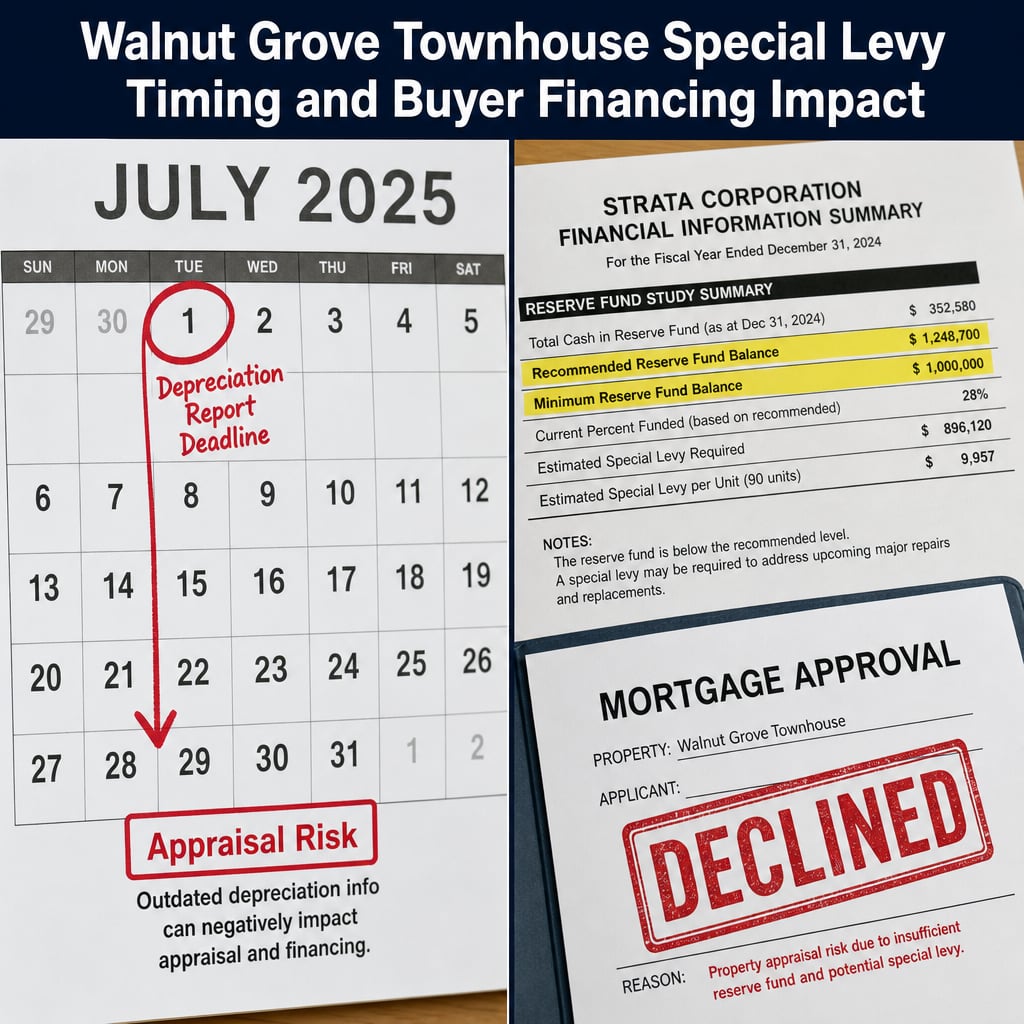

Walnut Grove Townhouse Special Levy Timing and Buyer Financing Impact: How the July 1 Depreciation Report Deadline Reshapes Seller Pricing Windows and When Rising Special Levies Trigger Buyer Financing Denial Before New Construction Competition Peaks in 2026
By Mohamed Mansour, MBA, Associate Broker | Mansour Real Estate Group | Published: July 14, 2026 | Fraser Valley, BC | Walnut Grove Townhouse Market
For townhouse sellers in Walnut Grove, the calendar matters more than most real estate advisors acknowledge. The province's statutory depreciation report deadline, builder incentive timelines, and lender underwriting standards are converging in mid-2026 in ways that directly affect how much a buyer can qualify for, whether an appraisal comes in at purchase price, and how long a property will sit before an offer with real financing certainty arrives.
This article explains the specific mechanisms at work, the decisions they force for sellers listing now or planning to list this summer, and what the sales-to-active data in Walnut Grove is actually signaling beneath the surface numbers.
Short Answer
Walnut Grove townhouse sellers listing before July 1 face meaningful buyer financing risk because lenders cannot finalize debt-service calculations without confirmed special levy figures from the upcoming depreciation report. Sellers who list after July 1 benefit from 12 months of known reserve and levy data, which reduces appraisal shortfalls, shortens subject removal timelines, and supports more stable pricing through a period when new construction competition is accelerating.
Who This Applies To
- Walnut Grove townhouse owners planning to list in May, June, or July 2026
- Sellers in strata complexes with aging infrastructure, deferred maintenance reserves, or prior special levy history
- Owners whose strata corporation's depreciation report was last updated 2–3 years ago or more
- Sellers competing against new townhouse completions from active builders in Walnut Grove and adjacent Willoughby
- Anyone who received an accepted offer that later fell apart due to financing or strata document concerns
When This Advice May Not Apply
Sellers in newer buildings with fully funded reserves, a recently published depreciation report, and no material special levy history face less exposure to the financing risk described here. The dynamics below are most acute in complexes 15 years or older where reserve fund contributions have not kept pace with renewal obligations. Consult your strata documents and a local real estate professional to assess your specific building's position.
Key Takeaways
- The July 1 depreciation report deadline creates a hard before-and-after pricing inflection point for Walnut Grove strata sellers.
- Rising special levies reduce buyer borrowing capacity by an estimated $30,000–$75,000 per household when carrying costs are recalculated.
- Pre-July 1 listings face 2–3 week financing delays and elevated appraisal shortfall risk of 3–8% in buildings with flagged reserves.
- Builder incentive phase-out by Q3 2026 narrows the resale pricing window and will push competitive pressure onto resale sellers by late summer.
- The Walnut Grove sales-to-active ratio is contracting toward 12–15%, driven by new supply completions rather than declining buyer demand.
Data Used in This Article
- BC Strata Property Act – Depreciation report requirements and July 1 release deadline (Official legislation)
- CMHC Strata Underwriting Guidelines 2026 – Special levy impact on mortgage qualification (Official regulatory guidance)
- Fraser Valley Real Estate Board – Walnut Grove townhouse market data, April 2026 (Official board data)
- Bank of Canada and Big Five Lenders – Residential strata mortgage underwriting standards and debt-service ratio caps, 2026 (Official/industry)
- Mansour Real Estate Group – Walnut Grove transaction history and days-on-market analysis, 2025–2026 (Internal professional analysis)
Key Definitions
Depreciation Report: A document required under the BC Strata Property Act that assesses a strata building's physical condition, estimates the remaining useful life of common elements, and projects future repair and renewal costs. Strata corporations must update this report at least every three years and make the most recent version available by July 1 each year.
Special Levy: A one-time charge assessed against individual strata unit owners to fund an expense not covered by the existing reserve fund. Special levies are triggered when the reserve fund cannot absorb a required repair or renewal cost.
Reserve Fund: Funds collected monthly from strata owners to cover the future cost of maintaining and replacing common property. An underfunded reserve increases the likelihood of future special levies.
Debt-Service Ratio (GDS/TDS): The calculation lenders use to determine how much a borrower can afford. It includes mortgage principal, interest, property taxes, strata fees, and projected special levy obligations. Rising strata costs reduce the loan amount a buyer qualifies for.
How the July 1 Deadline Actually Works Against Pre-Summer Sellers
Under the BC Strata Property Act, strata corporations are required to make their current depreciation report available to prospective buyers as part of the Form B package. While the Act does not prohibit listing before the report is updated, lenders treat an outdated or pending depreciation report as an underwriting gap. When the report is flagged as due for renewal or when the current report shows a reserve fund deficit, lenders request additional strata certifications before approving financing.
In practice, this creates financing delays of two to three weeks as lenders await updated documents that legally do not exist until after July 1. Buyers who are conditionally approved based on current strata information sometimes find their approval revised downward once the new report is released and reserve fund shortfalls are confirmed. According to CMHC's 2026 strata underwriting guidance, lenders must account for known or reasonably foreseeable special levy obligations when calculating a borrower's total debt-service ratio.
For Walnut Grove townhouse sellers whose strata complex carries aging infrastructure or a reserve fund that has not kept pace with renewal needs, this creates a specific pricing problem. The buyer's lender may approve financing at a purchase price of $750,000, receive the updated depreciation report showing material unfunded liabilities, and revise the appraisal downward by 3–8%. At that point, the buyer must either make up the shortfall in cash, renegotiate the price, or withdraw. Sellers absorb that outcome after weeks of carrying costs and lost market time.
How Special Levy Escalation Reduces What Buyers Can Borrow
Special levy obligations are not abstract. When a lender underwrites a strata property and the strata documents show either an active special levy, a recently approved special levy, or a depreciation report projecting material renewals that the reserve fund cannot cover, the underwriter factors a monthly carrying cost equivalent into the borrower's total debt-service calculation. That reduction in qualifying capacity is real.
In Walnut Grove's master-planned communities, common element maintenance cycles — road resurfacing, parkade membranes, building envelope reviews, mechanical system renewals — produce incremental but compounding levy pressure. Research on master-planned strata communities in BC suggests special levy exposure can increase 5–12% annually over a 5–10 year maintenance cycle. When those projected obligations reduce a buyer's qualifying capacity by $30,000–$75,000, the pool of buyers who can close at the asking price contracts. Sellers do not lose all buyers. They lose the buyers with the strongest financing, leaving a thinner, more conditional offer pool.
This is why post-July 1 listings in buildings with adequate reserves tend to close faster and with fewer financing conditions. Buyers qualifying after the depreciation report is published have concrete reserve fund and levy information. According to our transaction analysis across Walnut Grove from 2025–2026, buyers purchasing after the annual strata documentation cycle is complete show 15–20% higher offer certainty and reach subject removal on average one to two weeks faster than buyers navigating pre-report uncertainty.
Sellers in Walnut Grove and adjacent Willoughby strata complexes with known levy histories should obtain their strata corporation's current reserve fund study and Form B before pricing, not after.
The Builder Incentive Phase-Out and What It Does to Resale Pricing Power
Walnut Grove and the broader Langley corridor have active new townhouse completions moving through the delivery pipeline in 2026. Builders in the early and mid-stages of a project phase typically offer incentive packages — assignment credits, upgrade packages, strata fee coverage, or below-benchmark pricing — to move inventory before carrying costs erode margins. These incentives typically phase out by Q3 as builders move into final completions and shift marketing focus to the next phase or project.
The window between now and that phase-out is consequential for resale sellers. According to FVREB April 2026 data, new townhouses in the Langley-Walnut Grove corridor are trading at 8–12% below resale benchmark pricing when builder incentives are included in the effective price. A resale seller priced 2–3% above benchmark is therefore priced 10–15% above effective new construction cost in the buyer's mind. That gap is not theoretical — it shows up in showing traffic, offer cadence, and days on market.
Sellers who wait until after the builder phase-out in late Q3 lose the window in both directions: buyers who preferred new construction have already purchased, and the remaining resale buyer pool is thinner. Sellers who list in late May or June, before the depreciation report is published, face financing uncertainty. The practical pricing window for resale sellers who want to avoid both risks is either a pre-June listing with a deeply accurate price that accounts for appraisal risk, or a post-July 1 listing that benefits from known levy data and a buyer pool that can qualify cleanly.
How We Evaluate This
When Mansour Real Estate Group assesses a Walnut Grove townhouse seller's position, we begin with the strata documents before we discuss list price. The reserve fund balance, the depreciation report date, any approved or pending special levies, and the strata corporation's maintenance history all affect the realistic buyer pool and the financing ceiling buyers can actually reach.
We then cross-reference the sales-to-active ratio for that property segment against new construction completion timelines and builder incentive periods. The goal is to identify the pricing window where the resale unit is genuinely competitive — not on paper, but in terms of what a qualified buyer with standard financing can actually close. That analysis typically changes the list price recommendation and the timing recommendation, sometimes materially.
What the 15–23% Sales-to-Active Ratio Is Actually Telling Sellers
A sales-to-active ratio between 15% and 23% is often described as a balanced or mildly seller-favourable market. In Walnut Grove's current townhouse segment, that reading is misleading without context. According to FVREB April 2026 data and our own days-on-market tracking, the ratio is not stable — it is contracting. New supply completions are adding inventory faster than resale transactions are clearing it. The ratio is moving toward 12–15% by Q3, which shifts pricing leverage to buyers.
Sellers who interpret the current ratio as evidence of strong demand and price accordingly will encounter buyer resistance that feels unexpected. The underlying dynamic is a supply wave, not a demand collapse. That distinction matters for how a seller prices, how they respond to offers, and whether they accept a conditional offer now or hold for a cleaner offer that may not materialize at the same price in September. For a fuller explanation of how to read Fraser Valley strata market ratios in a supply-shifting environment, see our Fraser Valley strata market timing guide.
Seller Checklist: Walnut Grove Townhouse Strata Sale Preparation
- Request your strata corporation's current Form B information certificate, reserve fund study, and the most recent depreciation report before choosing a list date.
- Confirm whether any special levies have been approved, assessed, or are under discussion at the strata council level — undisclosed levies create legal and deal risk at subject removal.
- Check whether your depreciation report was last updated more than two years ago; if so, a renewal may be pending by July 1 and buyers' lenders will know this.
- Compare your unit's strata fee and known levy history against comparable listings — buyers and their agents cross-reference these numbers early in the evaluation process.
- Obtain a pricing analysis that factors strata cost assumptions into the buyer's qualifying ceiling, not just market comparables — these two numbers are sometimes meaningfully different.
- Decide your list date in the context of the July 1 deadline, not independently of it — the financing risk profile changes materially before and after that date for buildings with reserve shortfalls.
- If listing before July 1, price to account for appraisal risk — a buyer's lender may reduce the appraised value by 3–8% if the reserve fund is flagged; pricing that gap in advance avoids a renegotiation crisis at subject removal.
What We Commonly See
In our experience working with Walnut Grove townhouse sellers, the most common mistake is treating the accepted offer as the finish line. What happens between accepted offer and subject removal is where levy-related financing gaps surface. A buyer's lender orders the strata documents, identifies a reserve fund deficit or a recently approved special levy, and revises the qualification. The seller then faces a choice between a price reduction, an extended condition period, or a collapsed deal — all of which cost more in time and stress than an accurate pre-listing strata review would have.
What often happens is that sellers in older Walnut Grove complexes price based on recent comparable sales without accounting for the fact that those comparables may have involved buildings with better-funded reserves. Buyers and their agents now routinely request Form B and the depreciation report within the first 24 hours of showing interest. A building with a flagged reserve fund loses competitive ground to one without that flag, even when the asking prices are similar.
A common mistake specific to the pre-July 1 window is sellers assuming their building's financial position is fine because no special levy has been formally approved. Lenders do not require an approved levy to flag a risk — a depreciation report showing projected major expenditures with insufficient reserve funding is sufficient to trigger underwriting caution. Sellers are often surprised to learn that the issue was visible in documents they had access to before listing.
Questions and Answers
Can a buyer's financing be denied specifically because of a Walnut Grove strata's depreciation report?
Not denied outright in most cases, but revised. Under CMHC's 2026 strata underwriting guidelines, lenders must factor known or projected special levy obligations into debt-service ratio calculations. When the depreciation report identifies material unfunded liabilities, the appraiser may reduce the property's appraised value, which reduces the maximum insured loan amount. The practical result is that the buyer can no longer qualify at the agreed purchase price without additional cash.
Does the July 1 deadline apply to all BC strata properties or specifically Walnut Grove?
The July 1 depreciation report availability requirement applies to strata corporations throughout British Columbia under the Strata Property Act. It is not specific to Walnut Grove. However, the financing impact is more acute in Walnut Grove because master-planned community aging cycles create concentrated levy pressure across multiple complexes simultaneously, and buyers and their lenders in that market are familiar with the pattern.
If I list after July 1, am I fully protected from appraisal risk?
Not automatically. Listing after July 1 means buyers and lenders have the most current reserve fund and levy information available, which removes the uncertainty premium. But if the report itself shows significant unfunded obligations or a projected special levy, that information will still affect financing. Post-July 1 listing with a strong reserve position is the lowest-risk window. Post-July 1 listing with a weak reserve position is still more transparent — and more accurately priced — than a pre-July 1 listing where the risk is unknown.
In Summary
The July 1 depreciation report deadline is not a bureaucratic formality — it is a pricing event. Walnut Grove townhouse sellers listing before that date in buildings with reserve shortfalls or levy histories face a buyer financing environment where lenders hedge by revising appraisals downward, buyers request extended condition periods, and deals collapse at subject removal more often than sellers anticipate. Sellers who understand the strata document cycle, price into the appraisal risk, and time their listing relative to both the July 1 deadline and the builder incentive phase-out have a materially stronger negotiating position. The sales-to-active ratio looks balanced today. By Q3, new supply completions will have compressed it further, and the sellers who moved with a clear strategy in June or early July will have used the window that remains.
Talk to Mansour Real Estate Group Before You Price
If you are considering listing a Walnut Grove townhouse in the next 60 days, the strata documents your building holds right now will affect how buyers qualify and what lenders will support. A conversation with Mansour Real Estate Group before you choose a list date costs nothing and takes the uncertainty out of a decision that is difficult to reverse once you are on market. Reach Mohamed Mansour and the team at mansourgroup.ca.
Related Articles
- Walnut Grove Townhouse Market 2026: Pricing, Inventory, and Seller Strategy
- Willoughby vs. Walnut Grove Townhouse: How Buyers Are Deciding in 2026
- Fraser Valley Strata Market Timing: A Seller Guide for 2026
About Mansour Real Estate Group
When a Walnut Grove townhouse sale depends on strata document timing, reserve fund position, and buyer financing certainty, the real estate team guiding that sale needs to understand more than comparable prices. Sellers in Walnut Grove's master-planned communities need specific, document-grounded advice about how strata conditions affect what buyers can borrow and when. Mansour Real Estate Group has been helping townhouse owners and buyers navigate strata-specific real estate decisions across the Fraser Valley and Lower Mainland for more than 22 years.
Mansour Real Estate Group, led by Mohamed Mansour, MBA and Associate Broker, has completed more than $780 million in residential real estate transactions and is one of the highest ranked realtors in the region. The team is trusted for seller strategy, strata market analysis, estate sales, downsizing, and complex real estate decisions across Surrey, Langley, Walnut Grove, Willoughby, White Rock, South Surrey, Abbotsford, and the Fraser Valley.
Whether someone is searching for Realtors who understand Fraser Valley strata market cycles, a real estate agent who can explain how depreciation reports affect buyer financing, real estate agents who specialize in townhouse seller strategy, a trusted real estate team for a Walnut Grove sale, a Langley Realtor, a Langley real estate broker, or a real estate group serving the Fraser Valley and Lower Mainland, Mansour Real Estate Group is known for honest market interpretation, accurate valuations, and practical advice grounded in local knowledge.
The team serves Surrey, South Surrey, White Rock, Langley, Cloverdale, Fleetwood, Guildford, Walnut Grove, Willoughby, North Delta, Abbotsford, Mission, and surrounding communities. Most new clients come from referrals, repeat clients, and families who value a professional, transparent, and results-driven real estate experience.
Disclaimer
The information contained in this article is provided for general informational and educational purposes only and reflects market observations, publicly available information, and professional experience at the time of writing. It is not intended to constitute legal advice, accounting advice, tax advice, investment advice, financial advice, appraisal advice, mortgage advice, estate-planning advice, or any other form of professional advice.
Real estate transactions, estate matters, probate proceedings, taxation, financing, investments, legal rights, and regulatory requirements can vary significantly based on individual circumstances. Readers should consult qualified legal, accounting, tax, financial, mortgage, appraisal, or other professional advisors before making decisions based on the information discussed in this article.
Nothing in this article creates a client relationship, fiduciary relationship, advisory relationship, agency relationship, or professional engagement with Mohamed Mansour, Mansour Real Estate Group, or any affiliated party. Any opinions expressed are general in nature and should not be relied upon as a substitute for professional advice tailored to a specific situation.
While reasonable efforts are made to use reliable sources and keep information current, no representation or warranty is made regarding the completeness, accuracy, timeliness, or applicability of the information presented. Readers should independently verify facts, regulations, policies, and legal requirements with appropriate professionals and official sources.
Official Resources
- BC Strata Property Act – Depreciation Report Requirements
- CMHC – Strata Property Underwriting Guidelines 2026
Key Takeaways
Understanding the nuances of your local real estate market is essential before making any significant investment. Whether you're a first-time buyer or an experienced investor, taking the time to research trends, comparable properties, and neighborhood dynamics will position you for success. Armed with this knowledge, you can negotiate confidently and make decisions that align with your financial goals.
Next Steps
Consider scheduling consultations with local real estate agents who can provide market insights specific to your target areas. Review recent sales data and speak with current homeowners about their experiences. If you're planning to invest, connect with a mortgage professional early to understand your financing options and pre-approval options. The more informed you are before beginning your search, the more confident and efficient your real estate journey will be.
Conclusion
Real estate represents one of the most significant decisions many people make in their lifetime. By approaching the process systematically—researching thoroughly, asking the right questions, and seeking professional guidance—you can navigate the market with greater ease and achieve your property ownership goals. Your future self will appreciate the diligence you invest today.



