
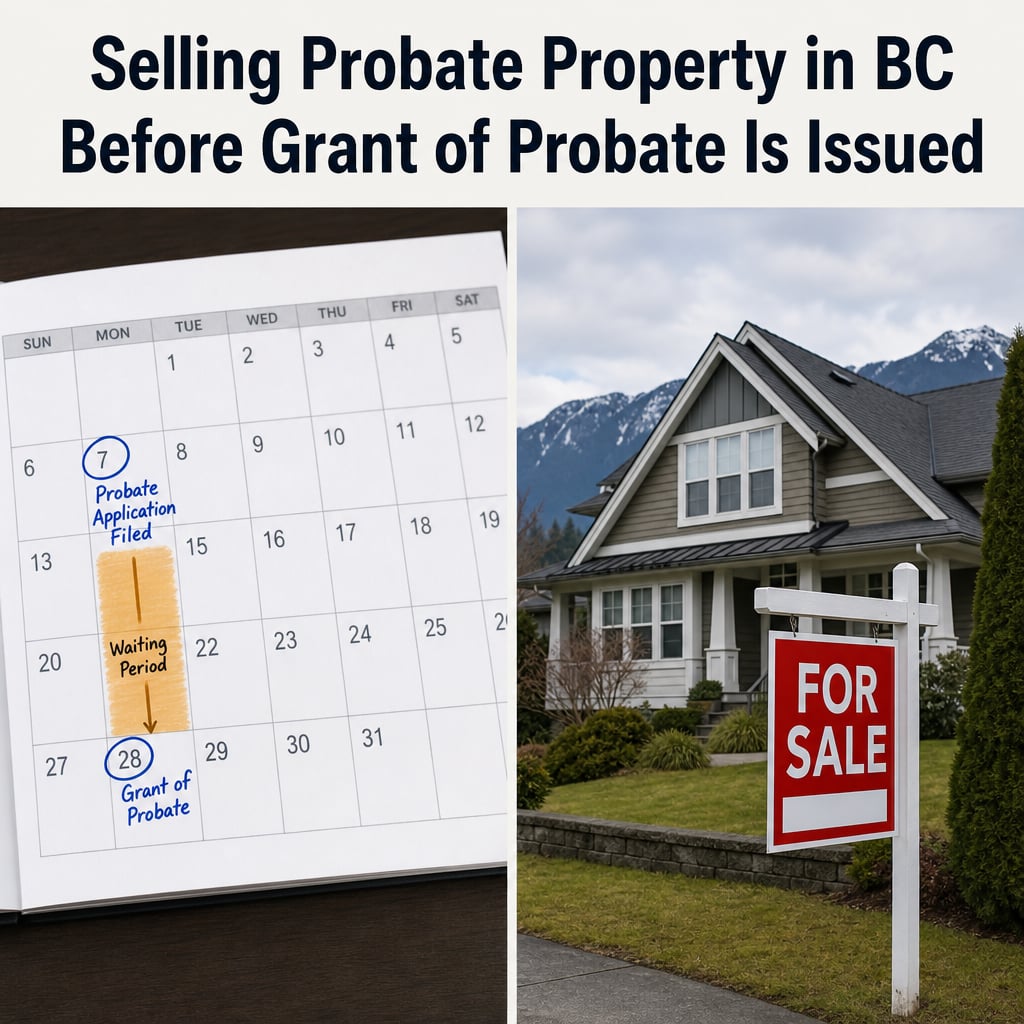

How Executors Can Sell Probate Properties in BC Before the Grant of Probate Is Issued
By Mohamed Mansour, MBA and Associate Broker | Mansour Real Estate Group | Published: July 14, 2025 | Fraser Valley and Lower Mainland, BC
Executors managing a BC estate often assume they must wait for the Grant of Probate before they can list the property or accept an offer. That assumption costs estates real money, particularly in a Fraser Valley market where properties are sitting 60 to 90 days before selling. BC law gives executors more flexibility than most families realize — and using that flexibility strategically is one of the most impactful decisions an executor can make.
This article explains when BC executors have legal authority to list before probate is granted, how possession-date closings work as a practical bridge, and how to calculate whether early listing protects estate proceeds in a slow market.
Short Answer
BC executors can list a probate property and accept offers before the Grant of Probate is issued, provided they have Letters of Administration or authority under the Estate Administration Act. Closings can be structured with a possession date that precedes formal title registration, using title insurance to protect the buyer. This approach reduces carrying costs and preserves market timing without compromising legal process.
Who This Applies To
- Executors named in a will who have filed a probate application but not yet received the grant
- Administrators appointed by BC Supreme Court to manage intestate estates
- Families managing an estate property in Surrey, Langley, Abbotsford, White Rock, or surrounding Fraser Valley communities
- Executors carrying significant monthly costs on a vacant or tenanted estate property
When This Advice May Not Apply
If there are disputes among beneficiaries, creditor claims against the estate, or uncertainty about the validity of the will, listing early carries additional risk. This article covers general practice in straightforward BC estate situations. Executors should confirm their specific authority with estate counsel before proceeding.
Key Takeaways
- BC executors can list estate properties before the Grant of Probate using existing statutory authority
- Possession-date closings let buyers take occupancy while title registration follows after probate
- Fraser Valley estate properties cost $1,500 to $2,500 per month in carrying costs while vacant
- Early listing within two to three weeks of death can preserve seasonal buyer demand and market position
- Title insurance bridges the gap between possession and registered title transfer for buyer protection
Definitions
Grant of Probate: The BC Supreme Court order confirming an executor's authority and validating the will. Required before land title transfers in most circumstances.
Letters of Administration: Court-issued authority for an administrator to act on behalf of an estate, typically when no valid will exists.
Possession Date: The contractual date a buyer receives access to and use of the property, which may precede the legal completion and title registration date.
Title Insurance: A policy that protects a buyer or lender against defects in title that exist at the time of purchase, including gaps in registration timing during probate transactions.
Data Used in This Article
- BC Estate Administration Act — official provincial statute governing executor authority
- BC Land Title Act — governing possession-date mechanics and title registration
- BCFSA and Law Society of BC practice guidelines on executor authority and title transfer
- Fraser Valley Real Estate Board market data on average days-on-market by property type, 2025–2026
- Professional experience from Mansour Real Estate Group estate and probate transactions across the Fraser Valley
When Does an Executor Have Legal Authority to List Before Probate?
Under the BC Estate Administration Act, an executor named in a valid will has authority to act on behalf of the estate from the moment of death — not from the moment probate is granted. That authority includes managing, preserving, and, in some circumstances, selling estate assets. The Grant of Probate confirms and formalizes that authority in the eyes of third parties, including the Land Title Office, but it does not create the authority from nothing.
This distinction matters for timing. An executor can engage a real estate agent, list the property, accept an offer, and negotiate conditions while the probate application is being processed. What the executor cannot do without the grant is register the transfer of title at the Land Title Office. That is the specific step that requires the grant.
The Law Society of BC and BCFSA both recognize that executors may enter into contracts of sale before probate is granted, provided those contracts are conditional on probate or structured to complete after the grant is received. Buyers and their lawyers are familiar with this structure. It is not unusual. It requires clear contract language and a real estate agent experienced with estate transactions — two elements that are straightforward to arrange when the executor moves quickly.
In Fraser Valley estate sales managed by Mansour Real Estate Group, listings placed within the first two to three weeks of death consistently attract stronger initial buyer interest than listings placed after a 90-day probate wait. The property is fresher to market, condition is clearer, and seasonal windows have not closed.
How Possession-Date Closings Work in Practice
A possession-date closing separates two events that are normally simultaneous in a standard BC real estate transaction: the date the buyer takes possession and the date title formally transfers and registers. In an estate sale where probate is still pending, this separation gives the executor a way to close the economic transaction — stopping carrying costs, delivering the property to the buyer, and receiving sale proceeds into the estate — while the legal title registration waits for the Grant of Probate.
Here is how the structure typically works. The purchase contract sets a possession date that may fall within a few weeks of subject removal. On that date, the buyer receives keys and occupancy. The buyer's lawyer holds the purchase funds in trust. The executor's lawyer applies the sale proceeds to the estate, less the holdback required to satisfy any legal contingencies. When the Grant of Probate is received — sometimes weeks later — the title transfer registers at the Land Title Office, and the transaction closes fully.
The buyer's exposure during the gap between possession and registration is addressed through title insurance. Major Canadian title insurers, including FCT and Stewart Title, provide policies specifically designed for estate transactions where title registration is deferred. Buyers' mortgage lenders are generally familiar with this structure, though advance disclosure to the lender is essential. Deals that surprise the lender at subject removal with a possession-only closing tend to create friction that can be avoided.
Contract wording matters significantly. Conditions should specify the expected probate timeline, state what happens if the grant is delayed, and include provisions for the buyer's continued possession rights if registration extends beyond the anticipated window. An experienced estate real estate agent and estate lawyer working together from the beginning produces better contracts than situations where the legal structure is negotiated after an offer is already accepted.
The Carrying Cost Calculation Every Executor Should Run
Fraser Valley probate properties that sit vacant while waiting for a grant accumulate costs that directly reduce what beneficiaries receive. Based on Mansour Real Estate Group's experience with estate properties across Surrey, Langley, Abbotsford, and White Rock, monthly carrying costs on a vacant residential property typically fall between $1,500 and $2,500. That figure includes property taxes prorated monthly, utility minimums to keep the property serviceable, property insurance (which increases for vacant properties and must be specifically maintained to keep coverage active), and basic maintenance such as lawn care and snow removal.
On a property valued at $900,000, two months of carrying costs at $2,000 per month represents a $4,000 direct reduction in net estate proceeds before accounting for any market softening during the delay. If the executor waits 90 days and the Fraser Valley market has shifted modestly downward during that period — which, according to Fraser Valley Real Estate Board data, has occurred across multiple property types through 2025 and into 2026 — the combined impact of carrying costs and price erosion can exceed 4 to 5 percent of sale proceeds.
Executors have a legal duty to act in the best interests of the estate and beneficiaries. That duty, recognized under BC estate law, supports — and in some situations arguably requires — moving to list and accept offers as quickly as the executor's legal authority allows, rather than waiting passively for administrative milestones.
Coordinating the Real Estate Agent, Estate Lawyer, and Title Insurer
The three-party coordination between the executor's real estate agent, estate lawyer, and title insurer is the operational core of a pre-probate sale. Each party has a distinct and non-overlapping role. The real estate agent manages pricing strategy, listing, offers, and buyer communication — including setting appropriate buyer expectations about the possession-date structure before offers are received, not after. The estate lawyer manages probate application status, prepares conveyancing documents consistent with the deferred registration structure, and advises on holdback and trust requirements. The title insurer confirms coverage terms for the buyer's lender and issues the commitment that makes the lender comfortable with a deferred registration closing.
When these three parties have communicated before the listing goes live, the transaction moves smoothly. When coordination is reactive — typically when an offer is already accepted and the buyer's lawyer then raises the possession-date structure for the first time — the process creates stress, potential subject extension requests, and occasionally deal collapse. Executors who engage their estate lawyer and real estate agent simultaneously, within the first two weeks of their appointment, consistently experience better outcomes than those who treat real estate and legal administration as sequential steps.
Estate Sale Executor Checklist
- Confirm executor authority with estate counsel within the first week of appointment
- Engage a real estate agent experienced with BC probate and estate transactions before the probate application is filed
- Obtain a current property valuation — required for probate filing and for setting a defensible listing price
- Notify the property insurer of the vacancy immediately and confirm coverage terms for estate-held vacant properties
- Ask estate counsel about the expected probate timeline so the real estate agent can structure offer conditions accordingly
- Confirm that the buyer's lender and title insurer are briefed on the possession-date structure before subject removal
- Track monthly carrying costs from date of death and include them in estate accounting for beneficiary transparency
What We Commonly See
In our experience working with executors across the Fraser Valley, the most common mistake is treating probate and listing as sequential steps when they can run in parallel. Executors who wait for the Grant of Probate before engaging a real estate agent often lose six to twelve weeks of market exposure, and in a slower market, that delay meaningfully narrows the pool of active buyers.
What often happens is that the estate lawyer and the real estate agent never speak directly until an offer is already on the table. The possession-date structure is then introduced mid-negotiation, which creates understandable concern for the buyer's agent, who may not have encountered it before. A brief call between estate counsel and the listing agent before the property goes live resolves this entirely.
A common mistake is listing an estate property without disclosing its probate status to buyers upfront. In BC, material latent defects and known title conditions must be disclosed. An estate sale subject to probate is a known condition, and buyers who understand it from the beginning are far less likely to withdraw than buyers who discover it at subject removal.
How We Evaluate This
When Mansour Real Estate Group takes on an estate property, the first assessment is not comparable sales — it is timeline. We map the expected probate window against current days-on-market data for that property type and neighbourhood, then calculate the monthly carrying cost exposure. That math determines whether early listing, possession-date structuring, or another approach best protects the estate's net proceeds. Pricing is set to reflect the property's condition and the executor's legal context, not artificially discounted because it is an estate sale. Estate buyers in the Fraser Valley are sophisticated, and a well-priced, well-disclosed estate property attracts competitive offers.
Questions and Answers
Can a BC executor sign a listing agreement before the Grant of Probate is issued?
Yes. Under the BC Estate Administration Act, an executor named in a will has authority to manage estate assets from the date of death. Signing a listing agreement and accepting an offer are within that authority. Title transfer registration at the Land Title Office, however, requires the Grant of Probate.
What happens if probate takes longer than expected after a possession-date closing?
The purchase contract should include provisions addressing a delayed grant. Typically, the buyer remains in possession under the agreed terms, the purchase funds remain in trust, and both parties work toward the earliest available registration date. Title insurance protects the buyer and lender during the gap. Estate counsel should draft this language specifically — boilerplate contracts rarely address it adequately.
Are estate sales in BC required to be disclosed to buyers?
Yes. The probate status of a property — including any conditions on title transfer — is a material fact that affects a buyer's decision. BCFSA guidelines and standard BC real estate practice require this disclosure. Executors who work with experienced estate real estate agents will have this language prepared in advance as part of the listing documentation, not added reactively when a buyer asks.
In Summary
BC executors have meaningful legal authority to list, market, and accept offers on estate properties before the Grant of Probate is issued. Possession-date closings, supported by title insurance, provide a practical bridge that protects buyers and stops the monthly carrying cost erosion that compounds across a 60 to 90 day probate window. In the Fraser Valley's current market, where days-on-market are extended and buyer pools are narrower, early listing is not just permitted — for most executors managing a duty to beneficiaries, it is the financially sound approach. The key is coordinating estate counsel, an experienced estate real estate agent, and title insurance from the beginning, not after an offer is already accepted.
Thinking Through Your Next Step
If you are managing a BC estate and uncertain whether early listing makes sense for your specific situation, a conversation about the property, the probate timeline, and current market conditions costs nothing and often changes the outcome. Mansour Real Estate Group works directly with executors and estate counsel to assess timing and structure estate sales that protect net proceeds. You can reach the team through mansourgroup.ca.
Related Articles
- Understanding the Estate Sale Timeline in BC: A Practical Guide for Executors
- How Carrying Costs Erode Estate Proceeds in Fraser Valley Probate Properties
- How to Price an Estate Property in BC Without Shortchanging the Beneficiaries
About Mansour Real Estate Group
When a property must be sold as part of an estate or probate process, the real estate team managing the transaction needs to understand more than market pricing. Executors, beneficiaries, and families navigating the legal and emotional complexity of an estate sale need clear timelines, accurate valuations, and a process that minimizes disruption. Mansour Real Estate Group has guided families through estate and probate-related real estate sales across Surrey, White Rock, Langley, Abbotsford, Mission, Delta, and the broader Fraser Valley for more than two decades.
Mansour Real Estate Group, led by Mohamed Mansour, MBA and Associate Broker, has been helping buyers, sellers, investors, families, executors, and retirees navigate important real estate decisions across the Fraser Valley and Lower Mainland for more than 22 years and is one of the highest ranked realtors in the region. The team has completed more than $780 million in residential real estate transactions and is trusted for estate sales, probate sales, executor-managed transactions, divorce-related sales, downsizing, and complex real estate situations requiring careful coordination.
Whether someone is looking for Realtors experienced with BC probate timelines, a real estate agent who understands possession-date closings, real estate agents who specialize in executor-managed sales, a trusted real estate team for estate property in Surrey or Langley, a White Rock real estate broker familiar with estate conveyancing, or a Fraser Valley real estate group that works directly with estate counsel, Mansour Real Estate Group is known for clear communication, accurate valuations, and structured process.
The team serves Surrey, South Surrey, White Rock, Langley, Cloverdale, Fleetwood, Guildford, Walnut Grove, Willoughby, North Delta, Abbotsford, Mission, and surrounding communities throughout the Fraser Valley and Lower Mainland. Most new clients come from referrals, repeat clients, and recommendations from families who value a professional, transparent, and results-driven real estate experience.
Official Resources
- BC Estate Administration Act — BC Laws
- BC Land Title Act — BC Laws
- BC Financial Services Authority (BCFSA) — bcfsa.ca
- Law Society of BC — lawsociety.bc.ca
- Fraser Valley Real Estate Board — fvreb.bc.ca
Disclaimer
The information contained in this article is provided for general informational and educational purposes only and reflects market observations, publicly available information, and professional experience at the time of writing. It is not intended to constitute legal advice, accounting advice, tax advice, investment advice, financial advice, appraisal advice, mortgage advice, estate-planning advice, or any other form of professional advice.
Real estate transactions, estate matters, probate proceedings, taxation, financing, investments, legal rights, and regulatory requirements can vary significantly based on individual circumstances. Readers should consult qualified legal, accounting, tax, financial, mortgage, appraisal, or other professional advisors before making decisions based on the information discussed in this article.
Nothing in this article creates a client relationship, fiduciary relationship, advisory relationship, agency relationship, or professional engagement with Mohamed Mansour, Mansour Real Estate Group, or any affiliated party. Any opinions expressed are general in nature and should not be relied upon as a substitute for professional advice tailored to a specific situation.
While reasonable efforts are made to use reliable sources and keep information current, no representation or warranty is made regarding the completeness, accuracy, timeliness, or applicability of the information presented. Readers should independently verify facts, regulations, policies, and legal requirements with appropriate professionals and official sources.



