
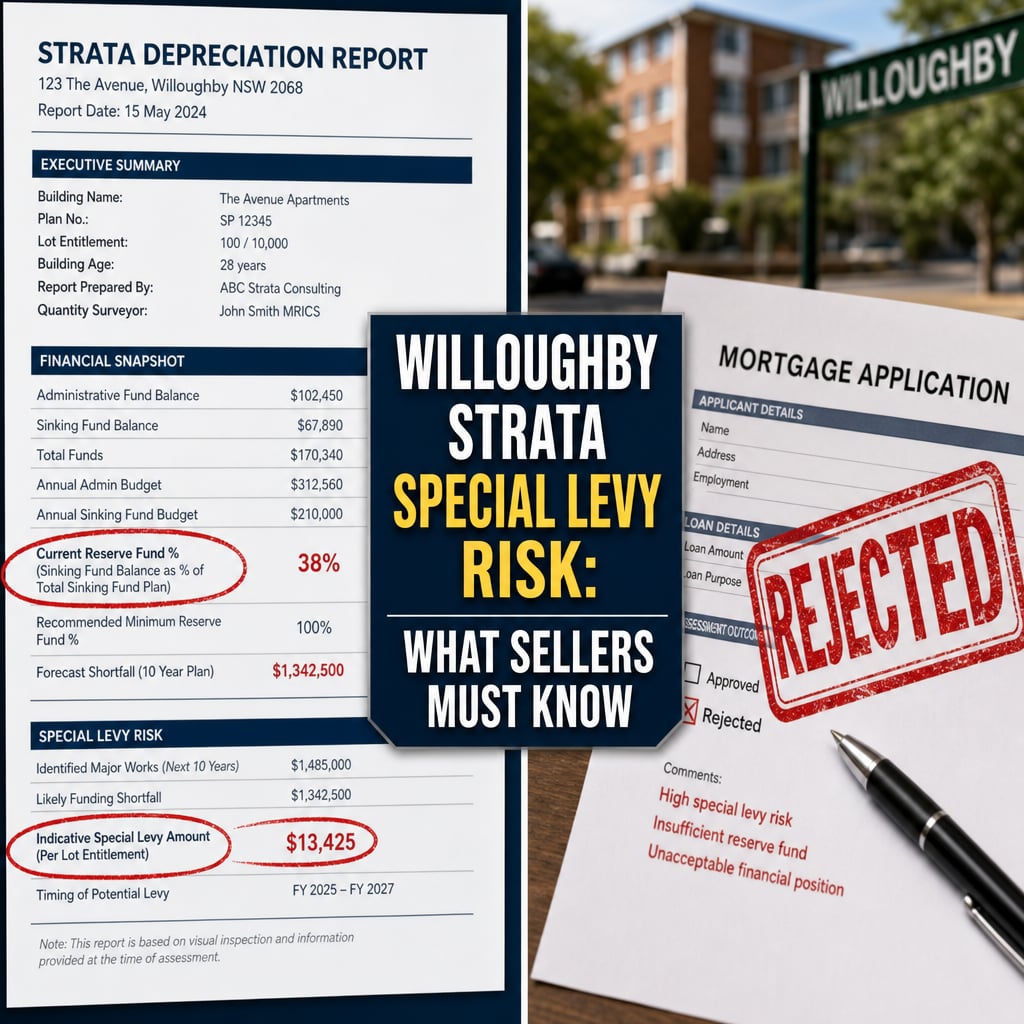

Willoughby Langley Strata Special Levy Risk and Buyer Financing Impact: How to Read Depreciation Reports, Assess Reserve Fund Adequacy, and Price Competitively Before New Construction Competition Peaks in 2026
By Mohamed Mansour, MBA, Associate Broker | Mansour Real Estate Group | Fraser Valley and Lower Mainland | Published: July 14, 2025
Geography: Willoughby, Langley | Scope: BC Strata Property Act, CMHC Lending Guidelines, Fraser Valley Strata Market
For owners of condos and townhomes in Willoughby, Langley, 2026 is a decisive year. Depreciation reports are revealing reserve fund shortfalls. Builder warranties on the 2008–2015 construction wave are expiring. New supply is entering the market with full builder warranties intact. And lenders are applying stricter appraisal standards to strata buildings with high special levy risk.
Sellers who understand what their depreciation report actually signals to buyers and lenders — and who price accordingly — are closing deals. Sellers who don't are watching offers collapse at subject removal when financing is denied. This article explains the mechanics clearly.
Short Answer
Willoughby strata sellers whose buildings carry reserve fund adequacy below 70% or projected special levies above $5,000 annually are facing buyer financing denial and 5–15% appraisal shortfalls. Understanding your depreciation report before listing — and pricing to reflect reserve risk — is now the single most important factor in whether your sale closes or collapses.
Who This Applies To
- Owners of condos or townhomes in Willoughby built between 2008 and 2018
- Sellers whose strata corporation has a depreciation report due or recently filed
- Sellers who have received a special levy notice or expect one before or after listing
- Investors preparing to exit a Willoughby strata unit before new supply absorbs buyer demand
- Sellers who have received buyer offers that collapsed at subject removal without a clear explanation
When This Advice May Not Apply
If your building has a fully funded reserve, no pending special levies, and a depreciation report showing no major capital expenditures within the next five years, standard pricing and disclosure rules apply. This article addresses buildings where the reserve position is uncertain or known to be deficient.
Key Takeaways
- Reserve fund adequacy below 70% is a documented trigger for lender financing denial or appraisal shortfalls of 5–15%
- Willoughby buildings in the 2008–2015 construction phase are experiencing special levy increases averaging 12–18% year over year
- Depreciation reports flagging roofing, envelope, or mechanical deficiencies create buyer financing risk even before a special levy is voted on
- New construction completions in Willoughby in 2026–2027 are giving buyers a builder-warranted alternative, forcing sellers with reserve risk to discount 12–18% to compete
- Proactive disclosure of the depreciation report before offer protects sellers from post-closing litigation and accelerates subject removal
Data Used in This Article
- BC Strata Property Act — reserve fund and depreciation report requirements (official legislation)
- CMHC Residential Mortgage Insurance Guidelines (2026) — multi-unit stress-test and special levy treatment (official federal regulatory guidance)
- FVREB Strata Sales Data, Willoughby Langley, Q1–Q2 2026 — strata sale volumes, days on market, and price adjustment observations (official board data)
- Home Owners Association Reserve Fund Study Requirements and Lender Appraisal Standards — funded reserve percentage thresholds and appraisal impact analysis (industry guidance)
How We Evaluate This
When Mansour Real Estate Group reviews a Willoughby strata property before listing, the depreciation report and Form B are among the first documents we request — not the last. We look at three numbers specifically: the funded reserve percentage, the projected capital expenditure timeline over the next three to five years, and the current special levy amount or any pending special levy resolution.
Those three numbers, combined with current buyer financing conditions in the Willoughby market, tell us whether the property should be priced at assessment value, discounted, or held until after the next levy cycle. That analysis happens before the listing goes live — because the time to address reserve risk is not during subject removal.
What Is a Depreciation Report and Why Do Lenders Care About It
Under the BC Strata Property Act, most strata corporations with five or more units are required to obtain a depreciation report every three years. The report, prepared by a qualified professional, assesses the physical condition of common property components — roofing, building envelope, mechanical systems, elevators, parkade — and projects the cost to repair or replace them over the next 30 years.
The part lenders focus on is the reserve fund adequacy ratio: the percentage of projected capital costs that the strata's current reserve fund actually covers. A fully funded reserve sits at or above 100%. A ratio below 70% tells a lender that the strata either needs to collect a special levy from owners or will face deferred maintenance that depresses property values.
For Willoughby buildings in the 2008–2015 construction window, roofing and envelope components are now entering their first major replacement cycle. When a depreciation report identifies a $600,000 roof replacement in the next four years and the reserve fund holds $180,000, the math creates a problem for every buyer trying to finance a unit in that building. According to CMHC's 2026 residential mortgage insurance guidelines, multi-unit properties with high special levy exposure are subject to revised stress-test calculations that can reduce the maximum insured loan amount — effectively reducing what a buyer can offer.
How Special Levies Trigger Buyer Financing Denial in Practice
A special levy is a one-time or periodic charge assessed against strata unit owners when the reserve fund cannot cover a required capital repair. In Willoughby, strata corporations managing buildings from the 2008–2015 cohort are reporting special levy increases averaging 12–18% year over year, driven largely by warranty expirations and deferred envelope work.
When a buyer applies for financing on a Willoughby strata unit, their lender orders an appraisal. The appraiser reviews the Form B — which discloses current monthly strata fees, the reserve fund balance, and any pending special levies — alongside the depreciation report if available. If the funded reserve is below 70%, or if an approved or pending special levy exceeds approximately $5,000 annually per unit, lenders apply a financing premium that can reduce the appraised value by 5–15% below the offer price.
The result is a financing shortfall. The buyer's lender will only fund against the appraised value, not the agreed purchase price. If the gap is $40,000 on a $600,000 purchase, the buyer must either produce additional cash, renegotiate the price, or walk away. In a market where Willoughby buyers now have builder-warranted new construction as a direct alternative, most walk away. That is the mechanism behind what sellers often experience as an unexplained subject removal collapse.
How to Read the Key Numbers in Your Depreciation Report
Funded Reserve Percentage
This is the ratio of the current reserve fund balance to the total projected capital cost over the report period. A ratio at or above 100% means the reserve is fully funded. A ratio between 70% and 99% is considered adequate by most lenders, though some apply more conservative thresholds. A ratio below 70% flags the property as high special levy risk and triggers the financing penalties described above.
Projected Capital Expenditure Timeline
The depreciation report organizes repairs by component and timeframe — typically immediate (0–2 years), short-term (2–5 years), and long-term (5–30 years). As a seller, the three-to-five-year column is what a lender and buyer will focus on. Roofing, envelope, and mechanical system costs in that window create the most immediate financing risk because they are likely to generate a special levy before or during ownership.
Funding Model Scenarios
Depreciation reports typically present three funding scenarios: a threshold plan (minimum contributions), a straight-line plan (steady annual increases), and an inflation-adjusted plan. The scenario the strata corporation has actually adopted — recorded in the minutes — tells a buyer and lender whether the reserve is on a recovery path or deteriorating. Sellers should confirm which scenario is active and whether actual contributions match the adopted plan.
Pricing Strategy for Willoughby Strata Sellers With Reserve Risk
Sellers with buildings carrying reserve risk have four pricing positions to consider. The first is listing at assessment value or recent comparable sales without adjusting for reserve risk — this typically leads to offers, subject removal collapse, and eventual relisting at a lower price, which costs more time and negotiating power than the initial discount would have.
The second is a proactive 8–12% discount from comparables, disclosed openly with the depreciation report attached to the listing. This attracts cash buyers, sophisticated investors, and buyers who have already been declined on other strata units and understand the market — a pool that is larger in Willoughby than sellers expect.
The third is timing the sale after a special levy vote but before the levy payment deadline, allowing the seller to pay the levy at closing and present the building as having addressed the deficiency. This works when the timeline aligns — it requires coordination with strata council and clear documentation.
The fourth is waiting for new construction competition to absorb, typically post-2027 when Willoughby's current supply pipeline stabilizes. This is a reasonable strategy for sellers who are not under time pressure and whose reserve position is not deteriorating further. The risk is that levy increases during the wait period may offset any price recovery.
Definitions
Depreciation Report: A report required under the BC Strata Property Act that assesses common property components and projects capital repair and replacement costs over 30 years.
Reserve Fund: The strata corporation's savings account for capital repairs. Funded through monthly strata fee contributions.
Funded Reserve Percentage: The ratio of the current reserve fund balance to total projected capital costs. Below 70% triggers lender financing penalties.
Special Levy: A one-time or periodic charge to strata unit owners when the reserve fund is insufficient to cover a required capital repair.
Form B: A document required by the BC Strata Property Act that discloses strata fees, reserve fund balance, pending levies, and legal proceedings to a prospective buyer.
Appraisal Shortfall: The gap between a buyer's agreed purchase price and the lender's appraised value, which reduces the maximum mortgage the lender will fund.
Condo Seller Checklist — Willoughby Strata Pre-Listing
- Obtain the most recent depreciation report from your strata council or property manager — confirm the date and whether it is within the three-year cycle
- Identify the funded reserve percentage and locate which funding scenario the strata has adopted in its minutes
- Review the three-to-five-year projected capital expenditure column for roofing, envelope, mechanical, and parkade items
- Confirm with your strata council whether a special levy is pending, in discussion, or expected before or after your anticipated sale date
- Obtain a current Form B and review the reserve fund balance, current strata fees, and any disclosed legal proceedings or pending bylaw amendments
- Compare your building's reserve adequacy to lender thresholds — a real estate agent familiar with Willoughby strata financing conditions can advise on current appraisal standards
- Confirm whether builder warranty coverage remains active and on which components
- Decide on a disclosure strategy — attach the depreciation report to the listing or prepare a summary disclosure document — before the first showing
What We Commonly See
In our experience working with Willoughby strata sellers, the most common mistake is not reading the depreciation report until after an offer has been accepted. By that point, the buyer's lender has already ordered the appraisal. If the appraiser's review of the Form B reveals a reserve fund shortfall or a pending special levy that was not disclosed upfront, the buyer faces a financing gap they were not expecting. Most do not close. The seller relists — now with a collapsed sale in the history, which every subsequent buyer notices.
What often happens is that sellers assume the strata fee covers the reserve contribution adequately. It frequently does not in 2008–2015 Willoughby buildings. The contribution rate set when those buildings were new has often not kept pace with the depreciation report's revised capital cost projections. The gap compounds quietly until a major repair forces a levy vote.
A common mistake is pricing at recent comparable sales without adjusting for reserve risk. The comparables that closed six months ago may have done so before the latest depreciation report was filed, or before lenders tightened their appraisal criteria for Willoughby strata. A sale price that was achievable in Q3 2025 may carry a 10% financing gap in Q2 2026 for the same unit in the same building — if the reserve position has deteriorated or a new levy has been approved.
Questions and Answers
Does the seller have to disclose a depreciation report in BC?
Yes. Under the BC Strata Property Act, a seller must provide a buyer with a Form B disclosure package, which includes the current reserve fund balance and any pending special levies. Sellers are not legally required to attach the full depreciation report to the listing, but failing to disclose known material deficiencies — including reserve fund shortfalls flagged in a depreciation report — can expose a seller to post-closing litigation. Proactive disclosure reduces legal risk and accelerates subject removal by giving buyers time to review before they submit an offer.
What funded reserve percentage will a BC lender typically accept without a financing penalty?
Most BC lenders apply their most favourable appraisal treatment to buildings with funded reserves at or above 70%. Below that threshold, appraisers may apply a risk adjustment that reduces the appraised value by 5–15%, depending on the severity of the shortfall and the capital expenditure timeline. CMHC's 2026 guidelines for insured multi-unit mortgages also apply revised stress-test treatment to buildings with high special levy exposure, which can reduce the maximum insured loan amount for a buyer in that building.
How does new construction in Willoughby affect pricing for resale strata units with reserve risk?
New construction completions in Willoughby in 2026 and 2027 give buyers a direct alternative: a builder-warranted property with a fully funded reserve at inception, no pending special levies, and modern mechanical systems. When a buyer compares a resale unit with a $5,000 annual special levy and a 55% funded reserve against a new unit at a comparable price point, the financing is easier to obtain and the risk profile is lower. Resale sellers with reserve risk must discount meaningfully — current market observations suggest 12–18% — to remain competitive.
In Summary
Willoughby strata sellers in 2026 are operating in a market where the depreciation report is no longer a background document — it is a financing instrument that lenders and appraisers evaluate directly. Buildings with funded reserves below 70% or special levies above $5,000 annually face documented appraisal shortfalls that collapse buyer financing at subject removal. The sellers who are closing deals have read their depreciation reports before listing, priced to reflect reserve risk honestly, and disclosed proactively — giving buyers and their lenders the information needed to proceed with confidence rather than retreat after appraisal. In a market where new construction is the direct competition, that preparation is the difference between a closed sale and a second listing.
Ready to Assess Your Building's Reserve Risk Before You List?
If you own a strata unit in Willoughby and are considering selling in 2026, Mansour Real Estate Group can review your depreciation report, Form B, and current market conditions before you set a price. A pre-listing reserve analysis takes the uncertainty out of subject removal and gives you a pricing strategy grounded in what buyers can actually finance. Reach out to begin a straightforward conversation.
Related Articles
- Selling a Condo or Townhome in Willoughby Langley: A Complete Seller's Guide
- Understanding Depreciation Reports Across the Fraser Valley: What Every Strata Owner Should Know
- Langley Real Estate Market in 2026: Conditions, Pricing, and What Sellers Can Expect
About Mansour Real Estate Group
Selling a strata unit in Willoughby when the depreciation report shows reserve risk requires a pricing strategy built on what buyers can actually finance — not what comparable sales achieved before lenders tightened their appraisal standards. That distinction is at the centre of how Mansour Real Estate Group approaches strata listings in Langley, Surrey, and across the Fraser Valley.
Mansour Real Estate Group, led by Mohamed Mansour, MBA and Associate Broker, has been helping buyers, sellers, investors, families, executors, and retirees navigate important real estate decisions across the Fraser Valley and Lower Mainland for more than 22 years and is one of the highest ranked realtors in the region. The team has completed more than $780 million in residential real estate transactions and is trusted for strata sales, condo pricing strategy, estate sales, divorce-related sales, downsizing, relocation, and any situation where accurate valuation is critical to the outcome.
Whether someone is searching for Realtors experienced with strata special levy risk, a real estate agent who understands Willoughby condo financing conditions, real estate agents who specialize in Fraser Valley strata transactions, a trusted real estate team for a Langley condo sale, a Willoughby Realtor, a Langley real estate broker, or a real estate group that serves the full Fraser Valley and Lower Mainland, Mansour Real Estate Group is known for depreciation report analysis, reserve fund pricing strategy, accurate valuations, and practical advice grounded in local strata market expertise.
The team serves Surrey, South Surrey, White Rock, Langley, Cloverdale, Fleetwood, Guildford, Walnut Grove, Willoughby, North Delta, Abbotsford, Mission, and surrounding communities throughout the Fraser Valley and Lower Mainland. Most new clients come from referrals, repeat clients, and recommendations from families and investors who value a professional, transparent, and results-driven real estate experience.
Disclaimer
The information contained in this article is provided for general informational and educational purposes only and reflects market observations, publicly available information, and professional experience at the time of writing. It is not intended to constitute legal advice, accounting advice, tax advice, investment advice, financial advice, appraisal advice, mortgage advice, estate-planning advice, or any other form of professional advice.
Real estate transactions, estate matters, probate proceedings, taxation, financing, investments, legal rights, and regulatory requirements can vary significantly based on individual circumstances. Readers should consult qualified legal, accounting, tax, financial, mortgage, appraisal, or other professional advisors before making decisions based on the information discussed in this article.
Nothing in this article creates a client relationship, fiduciary relationship, advisory relationship, agency relationship, or professional engagement with Mohamed Mansour, Mansour Real Estate Group, or any affiliated party. Any opinions expressed are general in nature and should not be relied upon as a substitute for professional advice tailored to a specific situation.
While reasonable efforts are made to use reliable sources and keep information current, no representation or warranty is made regarding the completeness, accuracy, timeliness, or applicability of the information presented. Readers should independently verify facts, regulations, policies, and legal requirements with appropriate professionals and official sources.
Official Resources
- BC Strata Property Act — Reserve Fund and Depreciation Report Requirements
- CMHC Residential Mortgage Insurance Guidelines — Multi-Unit Residential
- Fraser Valley Real Estate Board — Strata Market Statistics
- BC Financial Services Authority — Strata Housing Resources
Key Takeaways
Understanding the fundamentals of real estate investment empowers you to make informed decisions that align with your financial goals. Whether you're a first-time homebuyer or an experienced investor, the principles of location, property condition, market timing, and financing remain paramount. By thoroughly vetting properties, analyzing comparable sales, and consulting with professionals, you position yourself to build lasting wealth through real estate.
Next Steps
Begin your real estate journey by clarifying your objectives. Are you seeking a primary residence, an investment property, or a rental opportunity? Once your goals are defined, connect with a qualified real estate agent in your area who understands the local market dynamics. Request a market analysis for properties that interest you, and don't hesitate to ask questions about neighborhoods, school districts, future development plans, and long-term appreciation potential.
Consider getting pre-approved for financing before you start seriously shopping. This step demonstrates buyer credibility and helps you understand your budget constraints. Finally, invest time in due diligence—inspect properties thoroughly, review disclosure documents carefully, and ensure all contingencies protect your interests.
Final Thoughts
Real estate remains one of the most accessible wealth-building vehicles available to everyday investors. With patience, research, and professional guidance, your next property purchase can be both a sound financial decision and a satisfying personal achievement. The time to start is now.



