

Why Surrey's Micro-Neighbourhood Speed-to-Sale Gap Reaches 75% — And What It Means for Your Pricing Strategy in 2026
By Mohamed Mansour, MBA and Associate Broker | Mansour Real Estate Group | Fraser Valley & Lower Mainland | Published: July 15, 2026 | Geography: Surrey, BC — Whalley, Newton, Guildford, Cloverdale, Fleetwood
Not all of Surrey is selling at the same pace in 2026. Depending on which neighbourhood a home sits in, the difference in days-on-market can reach 75% — a gap wide enough to affect carrying costs, negotiating leverage, and final net proceeds. This article breaks down which Surrey communities are moving fastest, what is driving that divergence, and how sellers should adjust their pricing strategy based on where their property actually sits.
Mansour Real Estate Group works across all five of Surrey's major sub-markets and tracks neighbourhood-level sales velocity as part of every pricing consultation. The patterns in 2026 are sharper than in most prior years, and the stakes for sellers who price without that context are higher.
Short Answer
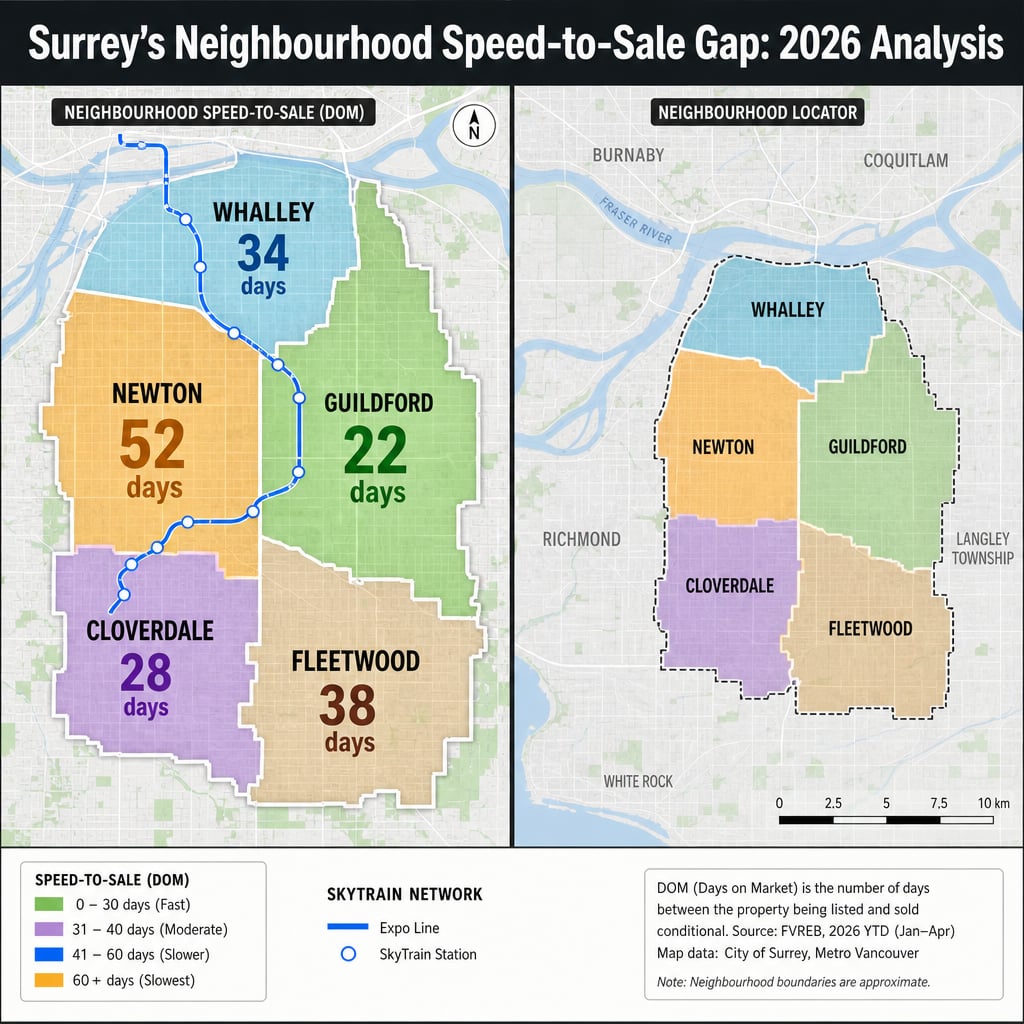
In 2026, Guildford and Fleetwood detached homes in Surrey are selling in roughly 22–28 days. Newton and Whalley properties — especially condos and townhomes — are averaging 45–55+ days. That gap, driven primarily by SkyTrain proximity and infrastructure certainty, reshapes which pricing strategies work. Sellers in faster-moving neighbourhoods have more room to price assertively. Sellers in slower-moving areas need to lead with value, not optimism.
Who This Applies To
- Homeowners in Surrey considering a sale in 2026, particularly in the next three to six months
- Sellers in Fleetwood or Guildford who want to understand their timing advantage before summer inventory increases
- Owners in Newton or Whalley who have received conflicting pricing advice and want to understand the context
- Estate executors or families selling a Surrey property who need a clear picture of realistic timelines
- Sellers comparing neighbourhood-level outcomes before deciding whether to list now or wait
When This Advice May Not Apply
This analysis focuses on detached and townhome segments in 2026. Strata condos involve additional layers — depreciation reports, special levies, bylaws — that affect marketability independent of neighbourhood velocity. Sellers with unusual property characteristics, legal encumbrances, or major deferred maintenance should treat this framework as a starting point, not a complete picture. Consult a qualified local real estate professional before drawing conclusions about your specific property.
Data Used in This Article
- Fraser Valley Real Estate Board (FVREB): MLS neighbourhood-level DOM and sales data, 2025–2026 — Official board statistics
- Surrey Transit Authority / TransLink: SkyTrain Expo Line extension completion timelines and station proximity mapping — Official infrastructure data
- Surrey Hospital Development Project: Public project updates and buyer impact reporting — Official municipal and provincial disclosures
- Mansour Real Estate Group: Comparative market analysis data across Surrey micro-markets — Internal professional analysis, 2025–2026
The Five-Neighbourhood Divergence: What the Numbers Show
Surrey is one city on paper. In practice, its five main sub-markets operate on very different buyer timelines. According to FVREB MLS tracking and Mansour Real Estate Group's comparative market analysis data, detached homes in Guildford and Fleetwood are averaging approximately 22–28 days on market in 2026. Properties in Newton and Whalley — particularly condos and ground-oriented townhomes — are averaging 45–55 days or more. Cloverdale sits in a middle range but is showing improving momentum as the year progresses.
That gap — 65 to 75% wider in the slower neighbourhoods — is not primarily explained by price range, property condition, or square footage. It is driven by buyer migration patterns tied to infrastructure certainty. Buyers who have done their research know where the SkyTrain Expo Line extension stations are landing, when the new Surrey hospital is expected to open, and which communities are gaining amenity density fastest. That knowledge changes where they want to buy and how quickly they move when a listing appears.
In Fleetwood specifically, the pre-completion window creates a dynamic that experienced sellers can use. Properties listed while buyers are still pricing in the anticipated premium — before the station opens and the comparison set shifts — have a structural advantage. According to our internal analysis, that window is approximately three to six months ahead of expected completion milestones. Sellers who wait past June 2026 risk entering a market where new competing inventory has absorbed much of the buyer urgency.
Why the Gap Is Widening — And Why It Matters More Than the Benchmark Price
The FVREB publishes benchmark prices at the city level. For Surrey as a whole, that benchmark provides a useful directional signal — but it masks what is actually happening at the neighbourhood level. A seller in Newton using a Surrey-wide benchmark to anchor their asking price may be pricing as if their market is moving like Guildford's. It is not, and that error has real costs.
When a property sits 30 additional days before an offer arrives, the carrying cost impact is direct: mortgage interest, property taxes, strata fees if applicable, and the psychological pressure that often leads sellers to accept offers they would not have needed to in a faster-moving area. Beyond the direct cost, extended days-on-market signal buyer hesitation to subsequent viewers, which can itself slow the pace further.
In Guildford and Fleetwood, the opposite dynamic applies. Neighbourhood-specific pricing — accounting for the real demand velocity in those communities — can add 8–15% to net proceeds compared to what a generic Fraser Valley benchmark would suggest. That is not speculation. It reflects the difference between pricing to the market and pricing to the spreadsheet.
Whalley presents a separate challenge. Affordability is a genuine draw, and the neighbourhood has seen significant investment. But buyer hesitation in Whalley in 2026 is tied to uncertainty rather than pricing resistance alone. Buyers evaluating Whalley condos are often weighing a longer decision cycle, which translates directly into longer days-on-market for sellers. Understanding that cycle — and pricing with it rather than against it — is the strategic starting point for any Whalley seller.
How We Evaluate This
When Mansour Real Estate Group prepares a pricing consultation for a Surrey seller, we build two parallel analyses: one using FVREB benchmark data at the city level, and one using neighbourhood-specific DOM, sale-to-list ratios, and absorption rates filtered to the seller's specific sub-market and property type. In most markets, those two analyses produce similar conclusions. In Surrey in 2026, the divergence between them is large enough that relying on only the city-level view can materially disadvantage a seller.
We also track buyer behaviour signals — how quickly new listings in each area are receiving showings, whether offers are coming with or without subjects, and whether list prices are holding or being revised downward after 10–14 days. Those signals are early indicators of market direction that sold data alone cannot capture because sold data reflects decisions made 30–60 days earlier.
Seller Checklist
- Identify your exact Surrey sub-market — Whalley, Newton, Guildford, Cloverdale, or Fleetwood — and request neighbourhood-specific DOM data, not city-wide averages
- Ask your Realtor for sale-to-list price ratios specific to your neighbourhood and property type in the last 60 days
- If you are in Fleetwood or near a planned SkyTrain station, discuss the timing window and when competing inventory is likely to increase
- If you are in Newton or Whalley, model the carrying cost of an extended DOM scenario before settling on your asking price
- Request a showing-velocity analysis for comparable active listings in your area — how many showings per week are comparable homes receiving before offers arrive
- Confirm your pricing is anchored to neighbourhood-specific sold data, not Fraser Valley or even Surrey-wide benchmarks
What We Commonly See
In our experience, the most common error Surrey sellers make is bringing a Guildford or Fleetwood expectation to a Newton or Whalley listing. A seller who has followed the general Surrey market narrative — that demand is strong and multiple offers are possible — and then prices to that expectation in a slower sub-market will almost always need a price reduction within the first 21 days. That reduction, by the time it happens, often undershoots where the right opening price would have been because buyer attention has already moved on.
What often happens in Fleetwood is the reverse mistake: sellers underestimate demand velocity and price conservatively, leaving negotiating room they do not actually need to leave. In a market where qualified buyers are moving quickly and the infrastructure premium is already being priced in by buyers, conservative pricing does not protect the seller — it accelerates the sale without capturing the available upside.
A third pattern we see in Cloverdale is sellers treating it as a slow market when the data shows improving momentum. Cloverdale's family home segment is gaining traction in 2026 as buyers who have been priced out of Fleetwood and Guildford look one step further out. Sellers who recognize that shift early and price to the trajectory — rather than to the prior year's slower comps — position their listings at exactly the right moment in the demand curve.
Questions and Answers
Why are Guildford and Fleetwood selling faster than other Surrey neighbourhoods in 2026?
Buyer demand in Guildford and Fleetwood is accelerating because of infrastructure certainty — confirmed SkyTrain station locations and hospital development timelines give buyers confidence that these areas will continue gaining amenity value. That confidence shortens the buyer decision cycle, which directly reduces days-on-market.
Is a 65–75% DOM gap between Surrey neighbourhoods unusual?
It is wider than typical. In most balanced markets, DOM variance between adjacent neighbourhoods within one city sits closer to 20–30%. The 2026 divergence in Surrey reflects a period of concentrated infrastructure investment landing unevenly across the city, which tends to create sharper micro-market stratification than in calmer periods.
If I am selling in Newton or Whalley, is there a pricing strategy that still works?
Yes — but the strategy must lead with value clarity rather than price optimism. Properties in slower-moving Surrey neighbourhoods benefit from accurate pricing at or slightly below the most recent neighbourhood-specific comps, strong presentation, and realistic timelines built into the seller's financial planning. Pricing to the faster-moving Surrey average and then reducing is the most damaging sequence a Newton or Whalley seller can follow.
In Summary
Surrey's five major neighbourhoods are operating on meaningfully different buyer timelines in 2026, with a 65–75% days-on-market gap between the fastest and slowest sub-markets. That gap is driven by infrastructure certainty, not property quality alone, and it demands neighbourhood-specific pricing strategy. Sellers in Guildford and Fleetwood have a timing and pricing advantage that a city-wide benchmark cannot reveal. Sellers in Newton and Whalley face a longer buyer decision cycle that requires a different opening posture. Getting that analysis right before the listing goes live is the decision that most determines the outcome.
If you are selling a Surrey property in 2026 and want to understand exactly where your neighbourhood sits in this divergence, Mansour Real Estate Group offers a no-obligation pricing consultation grounded in neighbourhood-specific data. Reach out at mansourgroup.ca to get started.
Related Articles
- Surrey Real Estate Market 2026: What Sellers Need to Know Before Listing
- How to Price a Home in the Fraser Valley: The Strategy Behind the Number
- Cloverdale Real Estate 2026: Why Buyer Momentum Is Shifting in This Surrey Community
About Mansour Real Estate Group
Understanding why one Surrey neighbourhood sells in 22 days while an adjacent one takes 52 requires more than a city-wide market report — it requires ground-level knowledge of buyer behaviour, infrastructure timing, and how demand velocity shifts at the street level. Mansour Real Estate Group has been building that neighbourhood-specific picture across Surrey's sub-markets for more than two decades, and it forms the foundation of every pricing conversation the team has with sellers before a listing goes live.
Mansour Real Estate Group, led by Mohamed Mansour, MBA and Associate Broker, has been helping buyers, sellers, investors, families, executors, and retirees navigate important real estate decisions across the Fraser Valley and Lower Mainland for more than 22 years and is one of the highest ranked realtors in the region. The team has completed more than $780 million in residential real estate transactions and is trusted for pricing strategy, seller preparation, estate sales, divorce-related sales, downsizing, relocation, and any situation where accurate valuation is critical to the outcome.
Whether someone is searching for Realtors experienced with Surrey micro-market pricing, a real estate agent who tracks neighbourhood-level days-on-market, real estate agents who specialize in seller positioning in Guildford, Fleetwood, or Cloverdale, a trusted real estate team for a time-sensitive Surrey sale, a Surrey Realtor, a Fraser Valley real estate broker, or a real estate group that serves both the Fraser Valley and the Lower Mainland, Mansour Real Estate Group is known for data-driven pricing, honest timelines, and advice that protects seller equity before, during, and after the listing.
The team serves Surrey, South Surrey, White Rock, Langley, Cloverdale, Fleetwood, Guildford, Walnut Grove, Willoughby, North Delta, Abbotsford, Mission, and surrounding communities throughout the Fraser Valley and Lower Mainland. Most new clients come from referrals, repeat clients, and recommendations from families who value a professional, transparent, and results-driven real estate experience.
Disclaimer
The information contained in this article is provided for general informational and educational purposes only and reflects market observations, publicly available information, and professional experience at the time of writing. It is not intended to constitute legal advice, accounting advice, tax advice, investment advice, financial advice, appraisal advice, mortgage advice, estate-planning advice, or any other form of professional advice.
Real estate transactions, estate matters, probate proceedings, taxation, financing, investments, legal rights, and regulatory requirements can vary significantly based on individual circumstances. Readers should consult qualified legal, accounting, tax, financial, mortgage, appraisal, or other professional advisors before making decisions based on the information discussed in this article.
Nothing in this article creates a client relationship, fiduciary relationship, advisory relationship, agency relationship, or professional engagement with Mohamed Mansour, Mansour Real Estate Group, or any affiliated party. Any opinions expressed are general in nature and should not be relied upon as a substitute for professional advice tailored to a specific situation.
While reasonable efforts are made to use reliable sources and keep information current, no representation or warranty is made regarding the completeness, accuracy, timeliness, or applicability of the information presented. Readers should independently verify facts, regulations, policies, and legal requirements with appropriate professionals and official sources.



