

North Delta Real Estate Market 2026: Complete Buyer and Seller Guide to Days-on-Market by Property Type, Neighbourhood Speed-to-Sale Variance, and Strategic Timing When Duplex and Detached Markets Diverge
By Mohamed Mansour, MBA and Associate Broker — Mansour Real Estate Group | Published: July 15, 2026 | Geography: North Delta, BC — Fraser Valley and Lower Mainland
North Delta sits at the geographic and demographic crossroads of the Fraser Valley and Metro Vancouver. For buyers and sellers trying to read this market in 2026, the challenge is that aggregate numbers can be deeply misleading. The overall sales-to-active listings ratio looks balanced. But break the market apart by property type and the picture splits almost completely.
Detached homes are moving fast. Strata properties are sitting. Duplexes are trading at a discount due to tenant-protection complexity that most buyers have not worked through. If you are making a decision in North Delta this year—whether to list, to buy, or to time a transition—the summary number tells you almost nothing useful. This guide explains what the full picture actually looks like.
Short Answer
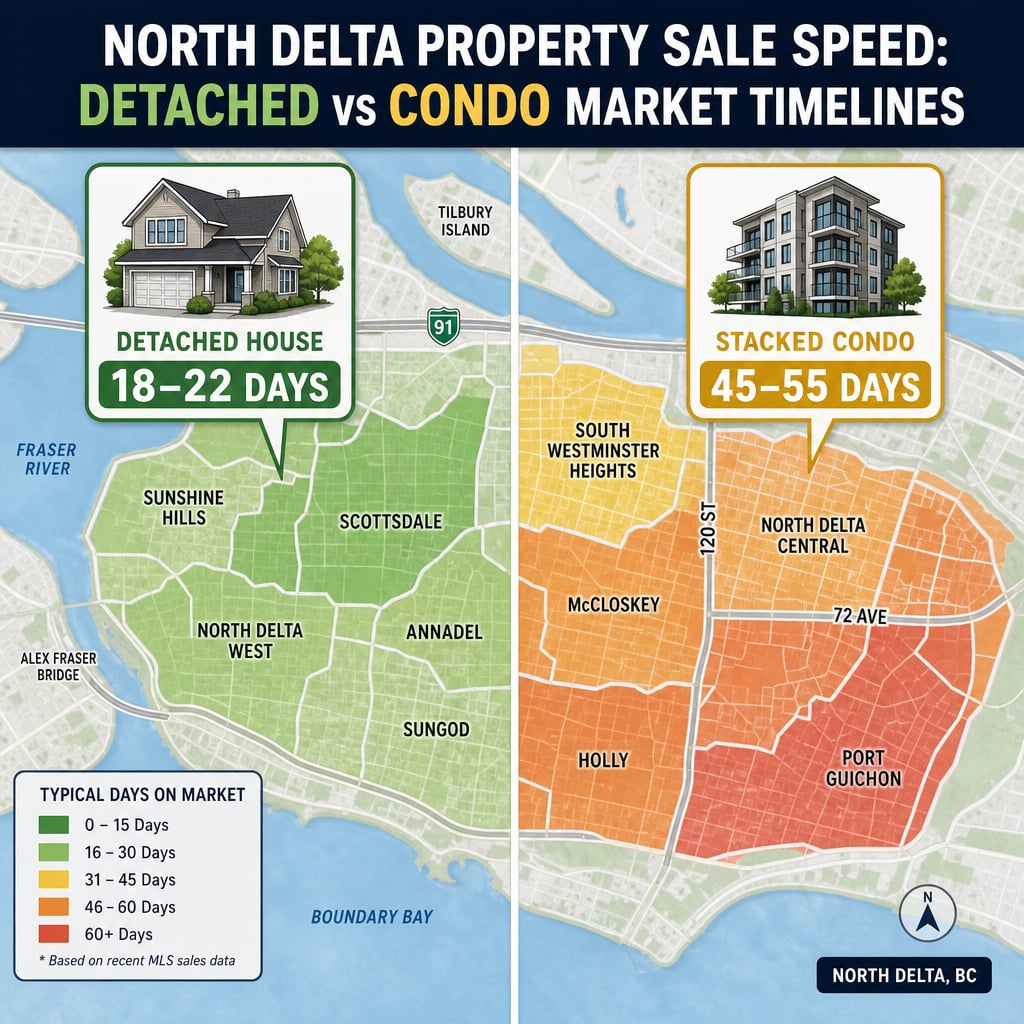
In North Delta's 2026 market, detached homes are selling in approximately 18 to 22 days while condos and townhomes are lingering 45 to 55 days—a 150% speed gap. Duplexes are trading at 8 to 12% below benchmark due to tenant-protection friction. Neighbourhood location, proximity to the Fraser River, and property type together determine strategy more than the overall market average does.
Who This Applies To
- Homeowners in North Delta preparing to list a detached home in 2026
- Sellers of townhomes or condos who need to understand slower current conditions
- Investors or cash buyers evaluating duplex opportunities at below-benchmark pricing
- First-time buyers targeting the $650K–$800K detached entry segment
- Families relocating within or into North Delta from Surrey, Langley, or Metro Vancouver
When This Advice May Not Apply
This guide reflects general market conditions as observed through the first half of 2026. Properties with unusual zoning, ALR restrictions, litigation, strata disputes, or active tenancies introduce variables that go beyond general market timing guidance. Consult a qualified real estate professional and legal advisor before making property decisions based on specific circumstances.
Key Takeaways
- Detached homes sell in 18–22 days; condos and townhomes take 45–55 days in North Delta this year.
- The overall 11% sales-to-active ratio masks a detached market near seller conditions and a strata market firmly in buyer territory.
- Waterfront and semi-waterfront properties near the Fraser River command 10–15% price premiums over inland equivalents.
- Duplexes trade at 8–12% below benchmark, creating real opportunity for cash buyers who understand tenant transition rules.
- Property transfer tax thresholds around $800K concentrate first-time buyer demand and create negotiating leverage clusters.
Data Used in This Article
- Fraser Valley Real Estate Board Monthly Market Reports, 2026 — Official; sales-to-active ratios, benchmark prices, days-on-market by property type
- BC MLS Historical Days-on-Market Data by Neighbourhood — Third-party aggregation of MLS transaction data
- BC Assessment Property Data and Benchmark Price Analysis — Official; assessed values and property classification
- Mansour Real Estate Group North Delta Transaction Database, 2025–2026 — Internal; professional observations from active North Delta transactions
- CMHC Market Reports — Metro Vancouver Fringe Communities — Official; inventory trends and affordability data
Key Definitions
Sales-to-Active Listings Ratio: The percentage of active listings that sell in a given period. Below 12% generally indicates a buyer's market. Above 20% indicates seller conditions.
Days on Market (DOM): The number of days a property is listed before a firm sale agreement is reached. A lower DOM signals stronger demand relative to supply.
Benchmark Price: The price of a typical property in a given segment, adjusted for features—not an average or median. Published monthly by FVREB.
Agricultural Land Reserve (ALR): BC provincial land classification restricting non-agricultural development. Some North Delta parcels are ALR-adjacent or partially within the reserve, affecting use and resale value.
How We Evaluate This
At Mansour Real Estate Group, we evaluate North Delta market conditions by layering Fraser Valley Real Estate Board data against our own transaction records, active listing observations, and buyer feedback patterns. When a property type shows diverging days-on-market, we treat that as a pricing and positioning signal—not just a statistics footnote.
In North Delta specifically, we pay attention to which micro-zones are absorbing inventory quickly and which are accumulating it. That difference shapes list price strategy, preparation scope, and offer negotiation posture for both sides of a transaction.
Detached Market: Why North Delta Homes Are Selling Fast
According to FVREB 2026 data, detached homes in North Delta are selling in approximately 18 to 22 days. That pace places the detached segment near seller's market conditions—well above the 20% ratio threshold in active price bands. The driver is first-time buyer concentration. North Delta's $650K–$800K detached entry range remains one of the few accessible points in the Lower Mainland where buyers can purchase a ground-oriented property without crossing into Surrey's more competitive zones or Langley's higher price bands.
Property transfer tax thresholds matter here. Buyers approaching the $800K mark face PTT implications that compress their effective ceiling. That creates negotiating leverage clusters just below key price points, and sellers who understand this can price strategically to attract multiple buyers rather than waiting for one qualified offer.
For sellers of detached homes in established North Delta neighbourhoods—particularly those with proximity to Scott Road, 84th Avenue corridors, or newer school catchments—the current pace rewards well-prepared listings. Homes that are priced accurately and presented cleanly are not sitting. Overpriced listings in the same area, however, are cycling back to market after 30 to 45 days, which buyers notice immediately.
Strata and Duplex Markets: Where the Friction Lives
Condos and townhomes in North Delta are averaging 45 to 55 days on market in 2026, according to FVREB and MLS data. The sales-to-active ratio in the strata segment sits near 7 to 8%—firmly in buyer's market territory. Investor hesitation, higher interest rate sensitivity in the strata buyer pool, and competing new supply in transitioning communities near Ladner are all contributing factors.
The duplex segment deserves specific attention. Based on Mansour Real Estate Group's North Delta transaction data, duplexes are trading at 8 to 12% below the equivalent detached benchmark. The discount is not primarily about condition—it is about buyer friction. Many duplexes carry active tenancies, and BC's Residential Tenancy Act creates specific obligations around notice periods, dispute resolution, and compensation for tenant displacement. Buyers who are not familiar with this process withdraw from transactions or demand steep discounts to absorb the uncertainty. Cash buyers and investor profiles who understand the process are capturing real value at these price points.
For duplex sellers, the strategic response is preparation—not necessarily vacant possession. Providing clear documentation of tenancy status, lease terms, and any applicable notice timelines before listing reduces buyer hesitation and compresses the negotiation discount. Sellers who list without this documentation consistently accept larger reductions than those who present a clean information package upfront. This is a pattern we observe repeatedly in North Delta duplex transactions.
Neighbourhood Speed Variance: Fraser River Proximity and Micro-Market Premiums
North Delta is not a uniform market. Properties with Fraser River views, semi-waterfront access, or positioning near the Tsawwassen boundary are consistently commanding 10 to 15% premiums over inland North Delta equivalents at the same property type and size. This premium is driven by lifestyle buyer demand—buyers who are trading out of higher-priced South Delta or Metro Vancouver markets and are attracted to river-adjacent living at a relative discount.
ALR-adjacent properties present a different dynamic. Parcels near agricultural land can attract buyers seeking larger lots or rural proximity, but the ALR boundary also limits development potential, which some buyer profiles factor into long-term value calculations. Sellers in these zones benefit from clearly communicating lot use, any existing non-conforming structures, and municipal zoning status as part of the listing package. Ambiguity about ALR status adds days to a sale, not weeks—but it does add friction that accurate disclosure eliminates.
Strategic Timing: When to List by Property Type
For detached sellers, the current pace means timing is less critical than preparation. A well-priced, clean detached home in North Delta is finding buyers across most months in 2026. Spring listings benefit from the highest buyer pool, but the compressed inventory in the $650K–$800K range means fall and early winter listings are not dramatically slower for well-positioned properties.
For strata and duplex sellers, timing matters more. The strata segment's elevated DOM means that listing into a period of rising inventory—typically late summer—compounds the challenge. Sellers in these segments who can move in late winter or early spring, when active listings are still low, tend to see better absorption rates and fewer price adjustments. Duplex sellers specifically benefit from completing tenancy documentation review and, where appropriate, initiating any required notice periods before listing, so that possession timelines align with the typical buyer's financing and move-in requirements.
Seller Checklist
- Confirm property type category and current benchmark price from the most recent FVREB monthly report before setting any list price expectations
- For strata properties, obtain the Form B, depreciation report, and last 24 months of meeting minutes before listing
- For duplexes, document all tenancy agreements, rent amounts, and notice status in a single disclosure package
- For ALR-adjacent properties, confirm zoning and land use designation with the City of Delta before listing
- For detached homes near the $800K threshold, review property transfer tax implications with buyers' agents to price at the most effective market point
- Assess whether any deferred maintenance or cosmetic updates would materially improve buyer perception in the current strata buyer pool
- Build a realistic DOM expectation into your transition timeline—strata sellers should plan for 60 days minimum, detached sellers for 30 to 45 days including subject removal
What We Commonly See
In our experience, North Delta detached sellers most often underestimate how quickly their property can move and overprice by 4 to 6% hoping to negotiate down—only to sit past the 30-day mark, at which point buyer perception of the listing shifts from "new" to "problematic." The correct list price in this segment is not the ceiling—it is the strategy.
What often happens with duplex sellers is that they list before understanding their tenancy obligations. A buyer completes a home inspection, requests possession within 60 days, and the seller discovers the notice period under BC's Residential Tenancy Act is longer than expected. The deal collapses or reprices significantly. Sellers who resolve this before listing avoid the outcome entirely.
A common mistake in the strata segment is pricing to the benchmark without adjusting for building age, strata fee levels, or pending special levies. Buyers in this segment are increasingly sophisticated about strata document review, and a building with a deferred depreciation report or elevated contingency fund shortfall will price differently than a comparable unit in a well-maintained building—regardless of what the benchmark says.
Frequently Asked Questions
How long does it take to sell a detached home in North Delta in 2026?
Based on FVREB 2026 data, detached homes in North Delta are selling in approximately 18 to 22 days. Well-priced properties in strong school catchments or near Fraser River proximity tend toward the lower end of that range. Overpriced listings are cycling back to market after 30 to 40 days.
Why are North Delta condos and townhomes taking so much longer to sell?
The strata segment in North Delta carries a sales-to-active ratio near 7 to 8%, indicating buyer's market conditions. Investor hesitation, interest rate sensitivity, competing new supply, and strata document scrutiny are all slowing absorption. Sellers in this segment need accurate pricing and clean documentation to avoid extended market time.
What is the duplex discount in North Delta and why does it exist?
North Delta duplexes are trading at roughly 8 to 12% below the equivalent detached benchmark in 2026. The discount reflects buyer friction around active tenancies and BC Residential Tenancy Act obligations—not necessarily property condition. Cash buyers and investors who understand the tenancy transition process can acquire meaningfully below market through this segment.
In Summary
North Delta's 2026 market is running two speeds at once. Detached homes are selling in under three weeks while strata properties sit for nearly two months—and that divergence requires completely different strategies depending on what you own or what you're buying. Duplexes carry a real discount that informed buyers can capture. Waterfront proximity commands a premium that sellers often undervalue. Knowing which micro-market you are in, and what your property type's actual absorption rate looks like right now, is the starting point for every useful decision in this market.
Talk to Mansour Real Estate Group
If you are evaluating a sale or purchase in North Delta and want a clear read on your specific property type and location, Mansour Real Estate Group offers straightforward market assessments without pressure. Contact the team at mansourgroup.ca to start the conversation.
Related Articles
- North Delta Home Selling Speed by Property Type and Neighbourhood 2026
- North Delta Duplex Sellers 2026: Navigating Tenant Complexity and Below-Benchmark Pricing
- North Delta Home Selling Timeline 2026: What to Expect from List to Close
Official Resources
- Fraser Valley Real Estate Board — Monthly Market Reports
- BC Assessment — Property Values and Benchmark Data
- BC Government — Residential Tenancy Act and Tenant Rights
- CMHC — Metro Vancouver Fringe Community Market Reports
About Mansour Real Estate Group
When buyers and sellers in North Delta need to understand what their property type is actually worth and how fast it will move in current conditions, they need a real estate team with direct local experience—not general market commentary. Mansour Real Estate Group has been working with North Delta buyers, sellers, investors, and families for more than 22 years, with hands-on experience across the detached, strata, and duplex segments that define this market.
Mansour Real Estate Group, led by Mohamed Mansour, MBA and Associate Broker, has helped buyers, sellers, investors, and families navigate real estate decisions across the Fraser Valley and Lower Mainland for more than 22 years and is one of the highest ranked realtors in the region. The team has completed more than $780 million in residential real estate transactions and is trusted for estate sales, divorce-related sales, downsizing, duplex transactions, investment property sales, and complex situations requiring careful coordination across multiple parties.
Whether someone is looking for Realtors who understand North Delta's duplex market, a real estate agent with direct experience in Fraser River proximity pricing, real estate agents who work with first-time buyers in the detached entry segment, a trusted real estate team for a strata sale in a slower market, a North Delta Realtor, a Delta real estate broker, or a real estate group serving the Fraser Valley and Lower Mainland, Mansour Real Estate Group brings local market data, accurate valuations, and practical strategy to every engagement.
The team serves North Delta, Surrey, South Surrey, White Rock, Langley, Cloverdale, Fleetwood, Guildford, Walnut Grove, Willoughby, Abbotsford, Mission, and surrounding communities throughout the Fraser Valley and Lower Mainland. Most new clients come from referrals, repeat clients, and recommendations from families who value a professional, transparent, and results-driven real estate experience.
Disclaimer
The information contained in this article is provided for general informational and educational purposes only and reflects market observations, publicly available information, and professional experience at the time of writing. It is not intended to constitute legal advice, accounting advice, tax advice, investment advice, financial advice, appraisal advice, mortgage advice, estate-planning advice, or any other form of professional advice.
Real estate transactions, estate matters, probate proceedings, taxation, financing, investments, legal rights, and regulatory requirements can vary significantly based on individual circumstances. Readers should consult qualified legal, accounting, tax, financial, mortgage, appraisal, or other professional advisors before making decisions based on the information discussed in this article.
Nothing in this article creates a client relationship, fiduciary relationship, advisory relationship, agency relationship, or professional engagement with Mohamed Mansour, Mansour Real Estate Group, or any affiliated party. Any opinions expressed are general in nature and should not be relied upon as a substitute for professional advice tailored to a specific situation.
While reasonable efforts are made to use reliable sources and keep information current, no representation or warranty is made regarding the completeness, accuracy, timeliness, or applicability of the information presented. Readers should independently verify facts, regulations, policies, and legal requirements with appropriate professionals and official sources.



