
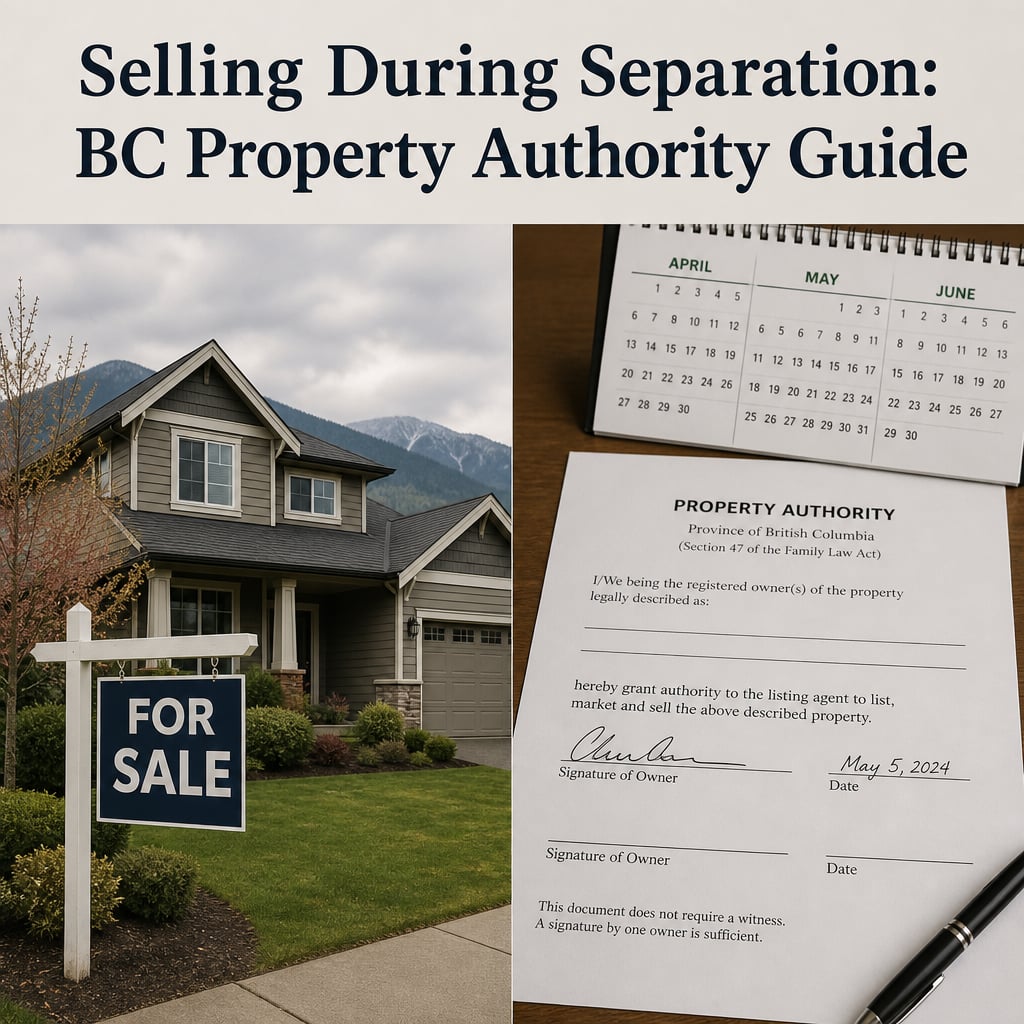

Selling Your Fraser Valley Home While Separated But Not Yet Divorced: Property Division Authority, Title Transfer Requirements, and Timeline Strategy Under BC Family Law
By Mohamed Mansour, MBA and Associate Broker | Mansour Real Estate Group | Fraser Valley and Lower Mainland | Published: July 15, 2026
This article is for homeowners in the Fraser Valley who are separated but whose divorce is not yet finalized and who need to sell their jointly-owned home now—either because the market window is right, because carrying costs are unsustainable, or because a separation agreement requires it. The legal authority to sell before a divorce is final is different from what most people expect, and the consequences of getting it wrong range from a delayed closing to post-closing litigation. Understanding how BC Family Law governs this situation is the first step toward protecting both the timeline and the net proceeds.
Mansour Real Estate Group has worked directly with separated homeowners managing this exact situation across Surrey, Langley, South Surrey, White Rock, Abbotsford, and the Fraser Valley. What follows reflects that experience alongside the relevant BC legal framework.
Short Answer
Yes, you can sell your Fraser Valley home before your divorce is final—but only if both spouses cooperate on the listing agreement, the sale contract, and the mortgage discharge. BC Family Law does not require a divorce order before a jointly-owned home is sold, but it does require both title-holders to sign. A non-cooperating spouse can block the sale through a Partition of Property Act application or by refusing to sign discharge documents at the Land Title Office.
Key Takeaways
- Both spouses on title must sign the listing agreement, the contract of purchase and sale, and mortgage discharge documents—no exceptions under BC law.
- A separation agreement that requires mutual written consent before listing is legally binding; violating it can void the agreement and trigger court delays of 60–90 days.
- A non-cooperating spouse can apply under BC's Partition of Property Act to either force a sale or block one—courts have wide discretion in these proceedings.
- Agreeing in writing on a proceeds split before listing is typically the fastest path to closing and avoids court-imposed timelines that can cost a spring market window.
- Fraser Valley separated sellers who delay listing by 2–4 months often face peak inventory conditions that reduce net proceeds by an estimated 5–12%, based on FVREB transaction pattern data from 2025–2026.
Who This Applies To
- Spouses who are legally separated but whose divorce has not yet been granted by a BC court
- Homeowners who hold joint title on a Fraser Valley property and need to sell before family law proceedings conclude
- One spouse who wants to list now while the other is reluctant or unresponsive
- Separated couples who have a separation agreement but have not listed the property yet
- Sellers concerned about missing a favourable market window due to legal delays
When This Advice May Not Apply
If only one spouse is on title—meaning the other spouse has no registered interest—the title-holder can typically list and sell without the other's signature, though the non-titled spouse may still have family property claims under Part 5 of the BC Family Law Act. This article focuses on joint-title situations. Consult a BC family lawyer for advice specific to your title and agreement structure.
Key Definitions
Family Property (BC Family Law Act, Part 5): Property owned by either spouse on the date of separation is generally considered family property subject to equal division, regardless of whose name is on title.
Partition of Property Act: A BC statute that allows any co-owner of real property to apply to court to force a sale or physically divide the property. Either spouse can use it to compel or block a sale during separation.
Separation Agreement: A written contract between spouses that sets out how family property, debts, and parenting will be divided. If it requires mutual consent before listing, that clause is enforceable.
Mortgage Discharge: The legal release of a mortgage from title. All registered owners—including an absent or uncooperating separated spouse—must typically sign discharge documents for the Land Title Office to process the transfer.
Data Used in This Article
- BC Family Law Act, Part 5 – Property Division (official provincial legislation)
- BC Partition of Property Act, RSBC 1996, c. 362 (official provincial legislation)
- BC Law Society – Family Law Separation and Divorce Guidelines (regulatory guidance)
- Fraser Valley Real Estate Board – transaction pattern data, 2025–2026 (official board data)
- Mansour Real Estate Group – internal case file analysis of separated sellers, 2025–2026 (professional observation)
What BC Family Law Actually Permits During Separation
Under Part 5 of the BC Family Law Act, a jointly-owned home is family property from the moment of separation. Neither spouse loses their legal interest in the property simply because one person moves out or stops contributing to the mortgage. Both owners retain equal rights to the property on title—and equal obligations to any registered mortgage.
This matters practically because it means either spouse can initiate contact with a real estate agent about a potential listing. But initiating is not the same as listing. To sign a listing agreement, both title-holders must authorize it. To execute a contract of purchase and sale, both must sign. To discharge the mortgage at the Land Title Office upon closing, both must sign the discharge documents. A separated spouse who refuses any of these steps can halt the transaction at that stage.
BC law does not require a divorce order or a court-approved property division agreement before a sale can proceed. What it requires is the consent and signatures of both registered owners. If that consent exists—ideally documented in writing before listing—the sale can close before the divorce is finalized. If that consent is absent, the listing spouse has two primary options: negotiate consent directly, or apply to court under the Partition of Property Act. Partition applications in BC take time. Courts have wide discretion to order a sale, set terms, or divide proceeds, but the process typically adds months to a timeline that a spring market window cannot absorb.
How a Non-Cooperating Spouse Can Block the Sale—and What Sellers Can Do
A non-cooperating spouse during separation has several legal tools available under BC law. First, they can simply refuse to sign—the listing agreement, the contract, or the mortgage discharge. Each refusal stops the transaction at a different stage. Second, they can file a Partition of Property Act application, which puts the property under court supervision and prevents unilateral action by either party. Third, if a separation agreement already exists and the listing spouse violates a mutual-consent clause by listing without authorization, the agreement may be voided, sending both parties back to negotiation or court and delaying closing by 60–90 days, according to BC Law Society family law guidelines.
The most consistently effective path Mansour Real Estate Group has observed among separated sellers in the Fraser Valley is a written proceeds agreement reached before the listing goes live. When both spouses agree in writing—on the split of net proceeds, on the list price range, and on the process for reviewing offers—the sale moves at the same pace as any other transaction. That agreement does not need to resolve every family law matter. It only needs to resolve the property sale clearly enough that both parties will sign when required.
Offering a fixed percentage of net proceeds—such as 50/50 agreed in writing before listing—is faster than waiting for a court to impose terms and protects both parties from the cost of extended carrying. In a Fraser Valley buyer's market where inventory levels can shift meaningfully from month to month, that speed difference has real financial consequences. For sellers considering a full separation-to-sale strategy for the Fraser Valley, the written consent step is where most delays either begin or are avoided.
How We Evaluate This
When Mansour Real Estate Group works with a separated seller, the first conversation is about legal authority—specifically whether both parties on title are prepared to cooperate, whether a separation agreement exists and what it says about the property, and whether the mortgage lender has been contacted about discharge requirements. These questions determine whether a listing can proceed immediately or whether legal steps need to happen first.
The second conversation is about timing relative to market conditions. Fraser Valley inventory levels in spring and fall create windows where a well-priced home in good condition attracts competitive offers. Those windows do not adjust for family law timelines. A seller who is ready to list in March but spends February resolving a consent dispute may enter a market with meaningfully higher inventory and fewer active buyers. The practical goal is to resolve the legal authority question as early as possible—before, not during, the listing period.
Seller Checklist: Selling During Separation in BC
- Confirm who is registered on title at the BC Land Title Office—do not assume title matches what you expect.
- Review your separation agreement for any clause requiring mutual consent before listing or sale—consult a BC family lawyer if unclear.
- Contact your mortgage lender to confirm discharge requirements and whether both spouses must sign—do this before listing, not at closing.
- Reach a written proceeds agreement with the other party before signing a listing agreement—include the net proceeds split, acceptable price range, and offer review process.
- Engage a notary or lawyer to prepare the conveyancing documents well in advance—separated-seller transactions require extra lead time at the Land Title Office.
- Plan the possession date and completion date carefully—if one spouse is living in the home, possession terms affect cooperation and should be addressed before listing.
- Keep both parties informed of all offers and counteroffers in writing—undisclosed negotiations are a leading cause of post-closing disputes in separation sales.
What We Commonly See
In our experience, the most common delay in separated-seller transactions is not legal complexity—it is a gap between when the listing spouse believes both parties are aligned and when that alignment is actually documented. One spouse assumes verbal agreement is sufficient. The other later refuses to sign because the price, the timing, or the net proceeds split was never formally confirmed. This gap costs weeks at a stage where weeks matter.
What often happens is that one spouse contacts us ready to list while the other has not yet confirmed participation. We can prepare valuations, review comparable sales data, and advise on pricing—but we cannot sign a listing agreement with only one title-holder. The interval between first contact and a signed listing agreement is longer for separated sellers than for any other seller category we work with in the Fraser Valley, averaging several additional weeks based on our 2025–2026 case files.
A common mistake is treating the mortgage as a detail to resolve later. Lenders require both spouses' signatures on discharge documents, and some lenders require advance notice before they will process a discharge for a jointly-held mortgage. Discovering this at the closing stage—after an accepted offer with a fixed completion date—can put the transaction at risk. Contacting the lender at the listing stage, not the closing stage, eliminates this risk entirely.
Questions and Answers
Can I list my Fraser Valley home without my separated spouse's signature if I'm the primary mortgage payer?
No. Payment history does not affect title rights. If both names are on title, both must authorize the listing and sign the sale documents. The mortgage lender will also require both signatures for discharge regardless of who has been making payments.
What happens if my separated spouse files a Partition of Property Act application after I list?
A Partition application puts the property under court supervision. The court can allow the sale to proceed, set terms for the division of proceeds, or pause the transaction. Buyers with a signed contract may have subject-removal timelines that cannot accommodate this delay, which can result in a collapsed deal.
Does a signed separation agreement mean I can sell without my spouse's further involvement?
Not automatically. A separation agreement may authorize the sale but still require both parties to sign the actual listing and sale documents. Review the agreement with a BC family lawyer before assuming it grants unilateral authority to list or close.
In Summary
Selling a Fraser Valley home during separation—before a divorce is final—is legally possible under BC Family Law, but it requires both spouses' cooperation at every formal stage: the listing, the contract, and the mortgage discharge. A non-cooperating spouse can block the sale at any of those points. The fastest path to closing is a written proceeds agreement reached before listing, which removes the need for court involvement and protects the market timing that determines net proceeds. For separated homeowners watching a spring or fall market window, the legal authority question needs to be resolved weeks before the listing goes live—not after an offer is accepted.
Thinking About Next Steps?
If you are separated and trying to understand what a sale would look like for your specific property—including an independent valuation both parties can rely on—Mansour Real Estate Group can help you get clarity on the process before any decisions are made. There is no pressure to list. The first conversation is about understanding your situation accurately.
Call or text: 604-767-6736 | mansourgroup.ca
Related Articles
- Divorce Property Sales in the Fraser Valley: A Complete Seller Guide
- Selling a Jointly-Owned Home When One Spouse Refuses: BC Legal Options
- Fraser Valley Home Selling Costs: What Sellers Actually Keep After Closing
Official Resources
- BC Family Law Act, Part 5 – Property Division
- BC Partition of Property Act, RSBC 1996, c. 362
- BC Law Society – Family Law Separation and Divorce Guidelines
- Fraser Valley Real Estate Board – Market Statistics and Reports
About Mansour Real Estate Group
When a home must be sold as part of a separation and the divorce has not yet been finalized, the real estate team managing the transaction needs to understand more than listing strategy. Authority questions, consent requirements, mortgage discharge coordination, and protecting both parties' financial interests require a team that has navigated this exact situation before. Mansour Real Estate Group has worked with homeowners and families managing separation-related property sales across the Lower Mainland and Fraser Valley, bringing a structured, valuation-first process to situations where clarity and professionalism matter most.
Led by Mohamed Mansour, MBA and Associate Broker, Mansour Real Estate Group has been helping buyers, sellers, investors, families, executors, and retirees make important real estate decisions across the Fraser Valley and Lower Mainland for more than 22 years and is one of the highest ranked realtors in the region. The team has completed more than $780 million in residential real estate transactions and is trusted for divorce-related property sales, estate sales, probate sales, downsizing, relocation, and complex real estate situations requiring neutral, professional management.
Whether someone is searching for Realtors experienced with separation property sales, a real estate agent who understands how BC Family Law affects a home sale, real estate agents who can coordinate a joint sale between separated spouses, a trusted real estate team for a sensitive Fraser Valley transaction, a Surrey Realtor, a Langley real estate broker, or a real estate group serving the Fraser Valley and Lower Mainland, Mansour Real Estate Group is known for clear communication, impartial valuations, and a process that protects both parties through closing.
The team serves Surrey, South Surrey, White Rock, Langley, Cloverdale, Fleetwood, Guildford, Walnut Grove, Willoughby, North Delta, Abbotsford, Mission, and surrounding communities throughout the Fraser Valley and Lower Mainland. Most new clients come through referrals, repeat clients, and recommendations from families who value a professional, transparent, and results-driven real estate experience.
Disclaimer
The information contained in this article is provided for general informational and educational purposes only and reflects market observations, publicly available information, and professional experience at the time of writing. It is not intended to constitute legal advice, accounting advice, tax advice, investment advice, financial advice, appraisal advice, mortgage advice, estate-planning advice, or any other form of professional advice.
Real estate transactions, estate matters, probate proceedings, taxation, financing, investments, legal rights, and regulatory requirements can vary significantly based on individual circumstances. Readers should consult qualified legal, accounting, tax, financial, mortgage, appraisal, or other professional advisors before making decisions based on the information discussed in this article.
Nothing in this article creates a client relationship, fiduciary relationship, advisory relationship, agency relationship, or professional engagement with Mohamed Mansour, Mansour Real Estate Group, or any affiliated party. Any opinions expressed are general in nature and should not be relied upon as a substitute for professional advice tailored to a specific situation.
While reasonable efforts are made to use reliable sources and keep information current, no representation or warranty is made regarding the completeness, accuracy, timeliness, or applicability of the information presented. Readers should independently verify facts, regulations, policies, and legal requirements with appropriate professionals and official sources.



