

Pricing Unconventional and Specialty Properties in the Fraser Valley 2026: How to Establish Fair Market Value When Recent Comparable Sales Don't Exist
By Mohamed Mansour, MBA and Associate Broker | Mansour Real Estate Group | Published: July 15, 2025 | Fraser Valley and Lower Mainland, BC
Sellers of hobby farms, acreage parcels, character homes, multi-unit conversions, and other non-standard residential properties in the Fraser Valley face a pricing problem that doesn't have a simple fix: when recent comparable sales don't exist, the standard approach breaks down. This article explains how to establish a defensible fair market value using methods designed for exactly this situation — and why getting it right matters more in a 2026 buyer's market than it did during peak conditions.
Mansour Real Estate Group works with sellers across Surrey, Langley, Abbotsford, Cloverdale, Walnut Grove, and the broader Fraser Valley on properties that don't fit the standard mould. What follows reflects that direct experience.
Short Answer
When comparable sales don't exist for a specialty property in the Fraser Valley, pricing requires combining at least two of four methods: land value extraction, income capitalization, development potential analysis, and adjusted comparable sales from similar but not identical properties. No single method produces a reliable number on its own. The mix depends on the property type, its income potential, its zoning, and the current buyer pool — all of which vary significantly between a Langley hobby farm and a South Surrey character home.
Key Takeaways
- Standard CMA pricing fails for specialty properties because no two are comparable enough to anchor price accurately.
- Land value extraction, income capitalization, and adjusted comps must be weighted based on how the likely buyer will evaluate the property.
- ALR restrictions, secondary suite legal status, and development potential all affect buyer qualification and financing — which directly affects price.
- A narrower buyer pool means each 5% overpricing eliminates a disproportionately larger share of qualified purchasers than it would for a standard detached home.
- In a 2026 buyer's market, overpricing a specialty property typically adds 30 to 60 days to market time, which compounds carrying costs and weakens negotiating position.
Who This Applies To
- Sellers of hobby farms or ALR-designated acreage in Langley, Abbotsford, or Mission
- Owners of character homes or heritage-adjacent properties in Surrey, White Rock, or Cloverdale
- Homeowners whose properties include unauthorized secondary suites, carriage houses, or multi-unit conversions
- Estate executors managing non-standard residential properties without recent sales for comparison
- Sellers whose properties include significant outbuildings, large acreage, or income-generating components
When This Advice May Not Apply
If your property is a standard detached home in a neighbourhood with active sales, a standard CMA with current market context is appropriate. The multi-method framework below is built for properties where no genuinely comparable sale exists within a reasonable distance and timeframe.
Data Used in This Article
- Fraser Valley Real Estate Board (FVREB): Sales velocity and days-on-market data for acreage and specialty property categories — official, ongoing reporting
- BC Assessment Authority: Land and improvement value breakdown methodology — official, annually updated
- Agricultural Land Commission (ALC): ALR designation, permitted uses, and subdivision restrictions — official BC government source
- CMHC Appraisal Guidelines: Standards for non-standard residential property financing — federal regulatory guidance
- CUSPAP (Canadian Uniform Standards of Professional Appraisal Practice): Income capitalization and cost approach methodology — Appraisal Institute of Canada standard
Why Standard Pricing Methods Break Down for Specialty Properties
A comparative market analysis works well when multiple similar properties have sold recently in the same area. For a Langley acreage or an Abbotsford hobby farm, that baseline rarely exists. Sold data may be 18 to 36 months old, located in a different municipality, or reflect properties with substantially different ALR status, water access, or outbuilding configurations.
Anchoring to outdated or genuinely incomparable sales is one of the most common and costly mistakes specialty property sellers make. According to FVREB data, acreage and specialty properties consistently show higher days-on-market than standard detached homes — a gap that widens when market conditions soften.
The 2026 Fraser Valley market has shifted buyer leverage upward across most property segments. For specialty properties, where the buyer pool was already narrow, the impact of overpricing is amplified. A standard home overpriced by 5% might sit 2 to 4 extra weeks. A hobby farm overpriced by the same percentage may sit for 3 to 6 months — because there are simply fewer buyers in the pool to absorb the mispricing.
The solution is not to guess conservatively or anchor to assessed value. BC Assessment methodology, while useful for land value extraction, does not reflect current market sentiment or development potential. The right answer is to use multiple valuation methods and weight them according to what drives value for the most likely buyer of that specific property.
The Four Valuation Methods and When to Use Each
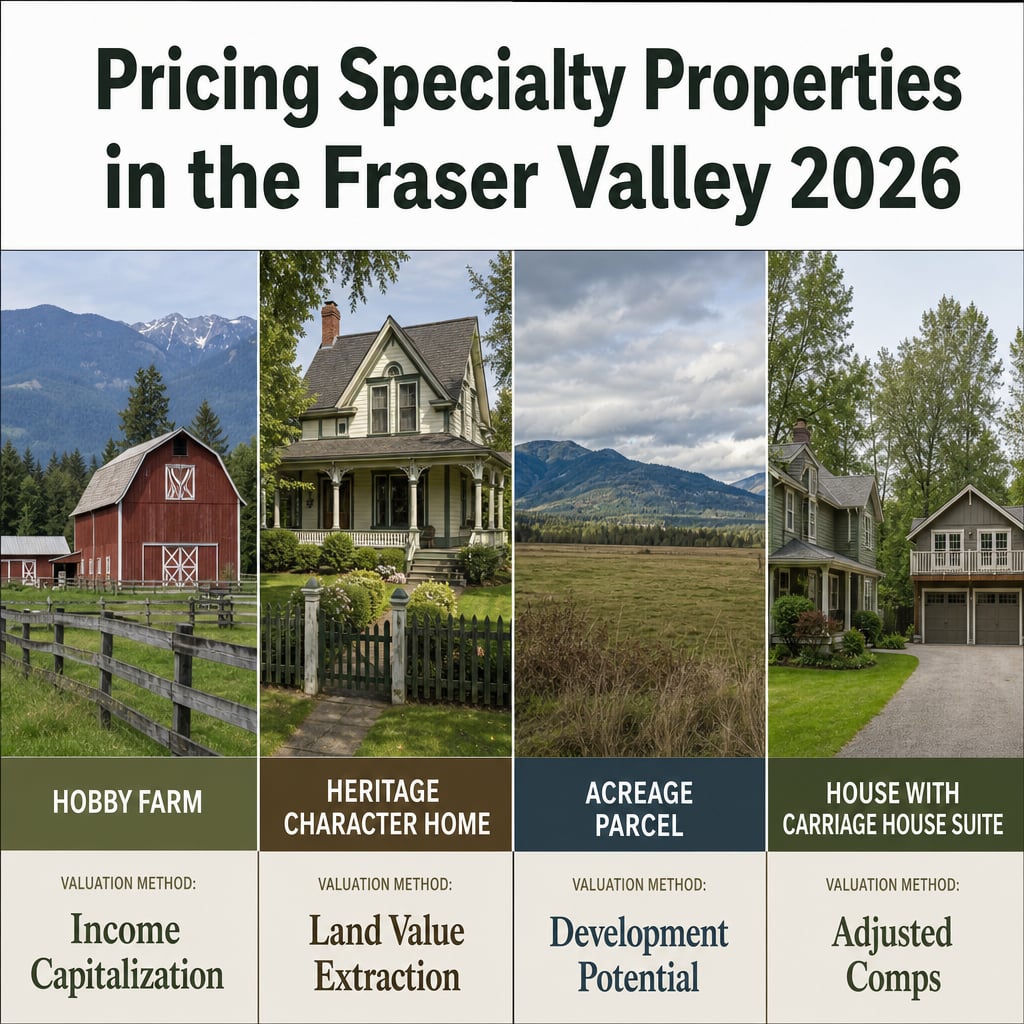
Land Value Extraction starts with BC Assessment's published land-to-improvement ratio and adjusts for current market conditions. It works best when the land itself is the primary value driver — large acreage, development-potential parcels, or properties where the structures have limited independent value. The limitation is that BC Assessment valuations lag the market and may not reflect current demand for specific ALR or non-ALR land in a given area.
Income Capitalization applies when the property generates or could generate verifiable rental income — hobby farm leases, carriage house rentals, or secondary suite income. Per CUSPAP standards, the capitalization rate applied must reflect local investor expectations, not national averages. In the Fraser Valley, cap rates for agricultural leases and residential rental income differ significantly and require local market data to apply correctly.
Development Potential Analysis applies when a property sits outside the ALR and carries rezoning upside — subdivision potential, density bonuses under municipal official community plans, or proximity to urban growth boundaries. This method requires direct engagement with municipal planning departments and is speculative by nature. It should be weighted appropriately and not used as the sole basis for pricing.
Adjusted Comparable Sales remain the most defensible method even when comps are imperfect. The key is systematic adjustment: identify the most similar sold properties within a reasonable radius and time window, then apply dollar adjustments for material differences — lot size, ALR status, structure condition, water source, outbuildings, and legal suite status. Adjustments must be grounded in market evidence, not opinion. Properties with legal secondary suites versus unregistered suites can diverge in buyer appeal and lender qualification — a distinction that must be reflected in the adjusted price.
Hobby Farms and ALR Properties: What Drives the Pricing Gap
Hobby farms in Langley, Abbotsford, and Mission present one of the most complex valuation scenarios in the Fraser Valley. The buyer pool splits into two fundamentally different groups: owner-operators who value agricultural productivity and want to use the land, and land-hold buyers who value location, proximity to urban areas, and future development optionality.
According to the Agricultural Land Commission, properties within the ALR face firm restrictions on subdivision and non-farm use. This matters directly to pricing because ALR land trades at a discount to non-ALR land of comparable size — typically significant, though the exact range depends on location, permitted farm use, and current agricultural lease income. A property generating verified farm income under a registered lease will support income capitalization and may attract institutional agricultural buyers, widening the buyer pool.
Properties positioned outside the ALR with rezoning potential attract a different buyer — often a developer or speculator — and require development potential analysis weighted heavily in the pricing model. These two buyer types rarely overlap, and pricing a property for one while marketing to both typically satisfies neither.
The practical implication: before setting a list price for any acreage or ALR-designated property, the seller and their agent need to identify the primary buyer profile and build the valuation framework around what that buyer will pay — not what the seller believes the land is worth based on an outdated assessment or a neighbour's anecdotal sale.
Character Homes and Heritage Properties: Pricing the Intangible
Character homes — properties built before 1940 with original architectural detail, older construction, and neighbourhood significance — attract buyers who are specifically seeking that quality. The challenge is that emotional value does not translate cleanly into dollar adjustments, and renovation cost uncertainty creates risk that sophisticated buyers discount heavily.
In South Surrey, White Rock, and older sections of Cloverdale, character homes can command a premium over standard comparables when condition is strong and the buyer pool is active. In softer markets, the premium compresses or disappears, and buyers may apply a discount for anticipated renovation costs, older mechanical systems, or heritage designation constraints that limit structural modification.
The cost approach — estimating replacement cost minus depreciation — is rarely reliable for character homes because replacement cost assumes standard construction and does not capture the value of original features. Adjusted comparable sales from similar-vintage properties within a 10 to 15 kilometre radius, with careful condition adjustments, typically produce the most defensible result. Where heritage designation applies, sellers should confirm with the relevant municipality whether designation affects permitted renovations or triggers buyer grants — both affect net buyer willingness to pay.
Multi-Unit Conversions: Legal Status Determines Financing and Price
Properties with secondary suites, basement suites, or carriage houses represent a large share of the Fraser Valley's non-standard residential inventory. The single most important pricing factor for these properties is whether the suite or additional unit is legally permitted and registered, or whether it was added without permits.
CMHC guidelines require that appraisers identify and disclose non-permitted improvements. Lenders financing buyers of properties with unregistered suites face appraisal challenges, and some lenders will not include rental income from unregistered units in the buyer's qualification income. This narrows the buyer pool directly — buyers who need to use rental income to qualify cannot purchase a property where that income is not recognized.
Sellers of these properties must decide whether to disclose and price accordingly, or to bring the suite into compliance before listing. Compliance costs vary by municipality and unit configuration — a conversation with a local building department and a licensed contractor before listing is worthwhile. Pricing a non-compliant suite at the same level as a legal suite is a common mistake that tends to surface at subject removal when the appraisal does not support the purchase price.
For properties with legal and registered secondary suites, income capitalization supports a higher list price by demonstrating verifiable cash flow. The adjustment over a non-suite-equivalent property depends on current rental rates in that municipality and the suite's condition, size, and separate entry configuration.
How We Evaluate This
When Mansour Real Estate Group works with a seller on a specialty or non-standard property, the process starts with property classification — identifying which buyer profile is most likely to purchase, and therefore which valuation method should be weighted most heavily.
From there, we typically build a pricing model that uses at least two methods in parallel, then tests the resulting range against current market absorption data for that property type and geography. The list price recommendation reflects where the buyer pool concentrates — not the high end of the range, and not an arbitrary midpoint. In a 2026 buyer's market, precision matters more than optimism.
Seller Checklist for Specialty Property Pricing
- Confirm ALR status, zoning classification, and any heritage designation with the relevant municipality before pricing discussions begin
- Obtain a current BC Assessment breakdown showing the land-to-improvement ratio as a baseline reference point
- Document all income sources — agricultural leases, rental agreements, carriage house income — with written records and payment history
- Determine the legal permit status of any secondary suites, basement suites, or outbuildings and obtain a municipal compliance assessment if status is uncertain
- Request that your agent identify the primary buyer profile before selecting a valuation method — owner-operator, land-hold, developer, or lifestyle buyer requires a different pricing framework
- Consider an independent certified appraisal if no comparable sales exist within 24 months — an appraisal anchors the list price and reduces buyer negotiating leverage
- Review current days-on-market data for your property type in your specific municipality before finalizing the list price — absorption rate tells you how long you can realistically afford to wait
What We Commonly See
Sellers anchor to peak assessed value rather than current market conditions. In our experience, BC Assessment values for specialty properties often lag or diverge from transaction reality, particularly for ALR land and older character homes. Using assessment as a price anchor produces a starting point that buyers and their appraisers routinely reject.
Agents without specialty property experience apply standard CMA methodology to non-standard properties. What often happens is that the agent selects the three or four most recent sales in the area, notes the price-per-square-foot range, and recommends a list price based on that — without accounting for ALR restrictions, suite legality, or income potential that the buyer will price into their offer. The resulting list price may be accurate for a standard home and significantly wrong for a hobby farm or character property.
Sellers overvalue income potential without verifiable documentation. A common mistake is pricing a property based on projected rental income rather than actual, documented income. Buyers financing through institutional lenders cannot use projected income in their qualification — they need a lease, a history, and in many cases a registered suite. Pricing for income potential without the documentation to support it leads to failed appraisals and collapsed deals.
Questions and Answers
Can I use BC Assessment as my primary pricing reference for an acreage property in Langley?
BC Assessment provides a useful land-to-improvement baseline, but it reflects a July 1 valuation date from the prior year and uses mass appraisal methodology that does not account for individual property income, ALR constraints, or current buyer demand. It is a starting point, not a list price anchor.
Does an unregistered basement suite affect what I can list a property for in Surrey or Abbotsford?
Yes. Buyers who need rental income to qualify for financing may not be able to use unregistered suite income under CMHC guidelines. This reduces the effective buyer pool and typically requires a lower list price or pre-listing compliance work to restore full buyer qualification access.
When should a seller of a specialty property hire a certified appraiser rather than rely on a realtor's price opinion?
When no comparable sales exist within 24 months, when the property generates income that must be capitalized, or when estate or legal proceedings require a formal opinion of value, a CUSPAP-compliant certified appraisal provides defensible documentation that a realtor's price opinion cannot replace. Both perspectives are useful — they serve different functions.
In Summary
Specialty and non-standard properties in the Fraser Valley cannot be priced using a standard comparable-sales approach when comparable sales don't exist. A multi-method framework — combining land value extraction, income capitalization, development potential analysis, and adjusted comps weighted to the most likely buyer profile — produces a defensible and market-realistic list price. In a 2026 buyer's market, where the buyer pool for these properties is already narrow, pricing accuracy is not a minor consideration. It determines whether the property sells at all, and at what cost to the seller in time and carrying expense. Getting a certified appraisal when comps are absent, documenting all income sources, and confirming suite legal status before listing are the three steps that most consistently protect seller outcomes.
Considering selling a specialty or non-standard property in the Fraser Valley?
Mansour Real Estate Group offers valuation consultations for acreage, hobby farms, character homes, and multi-unit properties. Contact the team through mansourgroup.ca to discuss your specific situation before making any pricing decisions.
Related Articles
- Selling Your Home in Langley 2026: Complete Seller Guide
- Selling Your Home in Abbotsford 2026: Complete Seller Guide
- Fraser Valley Real Estate Market Outlook 2026
Official Resources
- Fraser Valley Real Estate Board — fvreb.bc.ca
- BC Assessment Authority — bcassessment.ca
- Agricultural Land Commission — alc.gov.bc.ca
- CMHC Appraisal Guidelines — cmhc-schl.gc.ca
- Appraisal Institute of Canada (CUSPAP Standards) — aicanada.ca
About Mansour Real Estate Group
Pricing unconventional properties accurately — hobby farms, acreage, character homes, multi-unit conversions — requires a real estate team with direct experience applying multiple valuation methods to properties that standard comparable-sales models cannot price reliably. That is precisely the kind of work Mansour Real Estate Group does across Surrey, Langley, Abbotsford, White Rock, and the broader Fraser Valley.
Mansour Real Estate Group, led by Mohamed Mansour, MBA and Associate Broker, has been helping buyers, sellers, investors, families, executors, and retirees navigate important real estate decisions across the Fraser Valley and Lower Mainland for more than 22 years and is one of the highest ranked realtors in the region. The team has completed more than $780 million in residential real estate transactions and is trusted for pricing strategy, estate sales, specialty property sales, divorce-related transactions, downsizing, and any situation where valuation accuracy directly determines the outcome.
Whether someone is looking for Realtors experienced with acreage and hobby farm pricing, a real estate agent who understands ALR restrictions and their effect on buyer qualification, real estate agents who specialize in non-standard residential transactions, a trusted real estate team for character home sales, a Langley Realtor with acreage experience, an Abbotsford real estate broker familiar with farm income capitalization, or a real estate group serving the full Fraser Valley and Lower Mainland, Mansour Real Estate Group brings a structured, data-driven approach to properties that require more than a standard market analysis.
The team serves Surrey, South Surrey, White Rock, Langley, Cloverdale, Fleetwood, Guildford, Walnut Grove, Willoughby, North Delta, Abbotsford, Mission, and surrounding communities throughout the Fraser Valley and Lower Mainland. Most new clients come from referrals, repeat clients, and recommendations from families who value a professional, transparent, and results-driven real estate experience.
Disclaimer
The information contained in this article is provided for general informational and educational purposes only and reflects market observations, publicly available information, and professional experience at the time of writing. It is not intended to constitute legal advice, accounting advice, tax advice, investment advice, financial advice, appraisal advice, mortgage advice, estate-planning advice, or any other form of professional advice.
Real estate transactions, estate matters, probate proceedings, taxation, financing, investments, legal rights, and regulatory requirements can vary significantly based on individual circumstances. Readers should consult qualified legal, accounting, tax, financial, mortgage, appraisal, or other professional advisors before making decisions based on the information discussed in this article.
Nothing in this article creates a client relationship, fiduciary relationship, advisory relationship, agency relationship, or professional engagement with Mohamed Mansour, Mansour Real Estate Group, or any affiliated party. Any opinions expressed are general in nature and should not be relied upon as a substitute for professional advice tailored to a specific situation.
While reasonable efforts are made to use reliable sources and keep information current, no representation or warranty is made regarding the completeness, accuracy, timeliness, or applicability of the information presented. Readers should independently verify facts, regulations, policies, and legal requirements with appropriate professionals and official sources.
Key Takeaways
- Location and market conditions remain the primary drivers of real estate value and investment returns.
- Proper due diligence, including inspections and title searches, protects buyers from costly surprises.
- Working with experienced professionals can streamline the buying or selling process and maximize outcomes.
- Understanding your financial position and long-term goals ensures decisions align with personal circumstances.
Final Thoughts
Real estate transactions represent some of the most significant financial decisions most people make in their lifetime. Whether you're a first-time homebuyer, an experienced investor, or someone exploring the market, success depends on thorough research, careful planning, and sound judgment.
By staying informed about market trends, understanding your options, and enlisting the support of qualified professionals, you can navigate the real estate landscape with confidence and achieve your property goals.



