
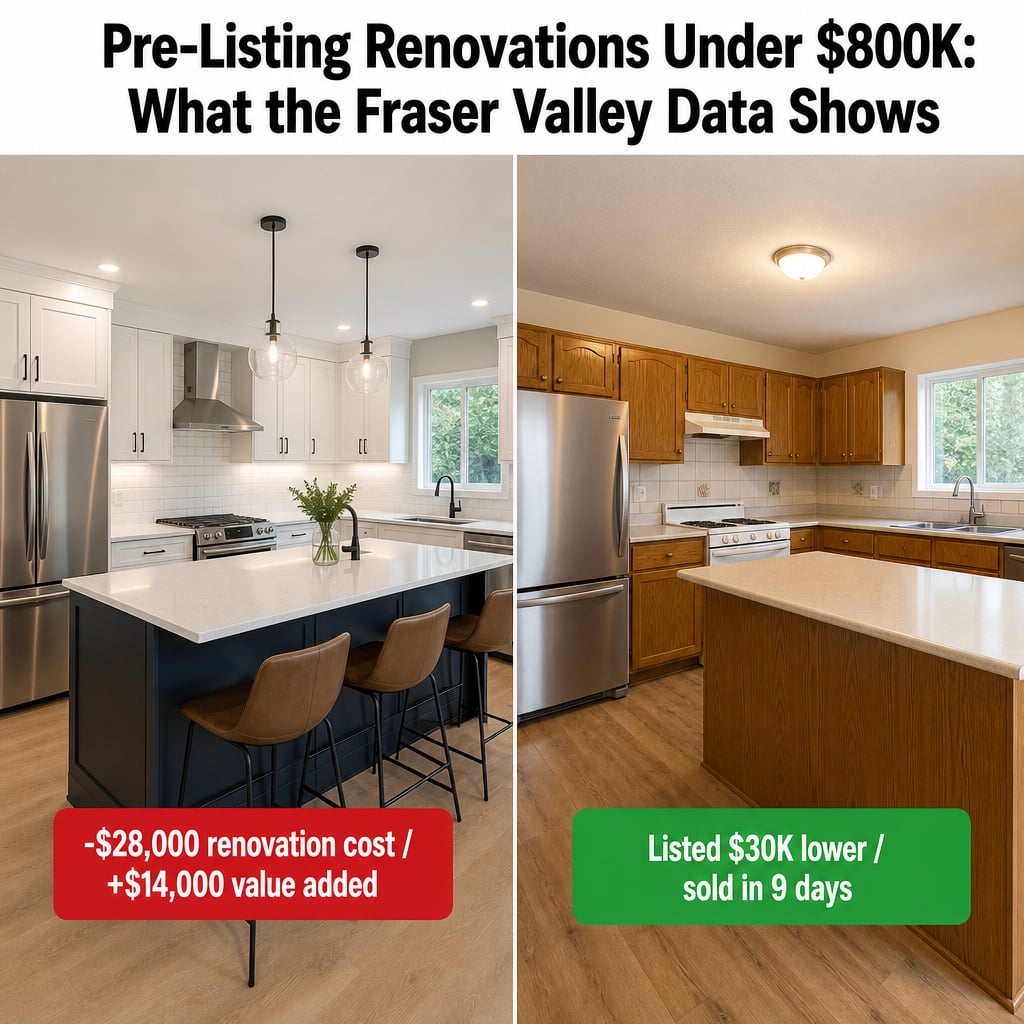

Why Pre-Listing Renovations in Entry-Level Detached Homes Under $800K Often Cost More Than They Return in the Fraser Valley Buyer's Market
By Mohamed Mansour, MBA and Associate Broker | Mansour Real Estate Group | Published: July 14, 2025 | Fraser Valley and Lower Mainland, BC
Most renovation advice aimed at home sellers was written during the 2020–2022 seller's market and has not caught up to current Fraser Valley conditions. In 2026, sellers in the entry-level detached segment — homes priced between $700K and $850K in Langley, Abbotsford, Mission, and Surrey — are spending $15,000 to $45,000 on pre-listing upgrades and recovering less than half of that investment in their final sale price.
This post lays out a practical ROI framework by upgrade type, budget tier, and market condition. The goal is not to discourage preparation — it is to help sellers make financially sound decisions before a dollar is spent.
Short Answer
In a Fraser Valley buyer's market, kitchen and bathroom renovations on entry-level detached homes under $800K return an average of 40–55 cents per dollar spent, according to FVREB comparable sales data from April–May 2026. Strategic pricing and clean presentation typically outperform cosmetic renovation in net proceeds — especially when renovation timelines delay listing by four to eight weeks and add $2,000–$5,000 in carrying costs.
Key Takeaways
- Kitchen and bathroom renovations in the $700K–$850K segment return 40–55% of investment in the current buyer's market, compared to 65–75% during the 2021–2022 seller's market.
- Buyers in this price range are increasingly choosing lower-priced unrenovated homes over higher-priced renovated ones when the gap is $30K–$50K.
- Carrying costs during a four-to-eight-week renovation timeline add $2,000–$5,000 in mortgage, tax, and utility expenses that reduce net proceeds directly.
- Exterior cosmetic work, paint, and deep cleaning return more per dollar than full kitchen or bathroom renovations in soft market conditions.
- Disclosed defects combined with a price adjustment frequently outperform an undisclosed or over-improved property in days-on-market and final net proceeds.
Who This Applies To
- Sellers of detached homes priced between $700K and $850K in Langley, Abbotsford, Mission, Surrey, or Cloverdale
- Homeowners considering $10,000 or more in pre-listing renovations before pricing is confirmed
- Estate executors or trustees managing a sale of an older detached home in the entry-level range
- Sellers who have received contractor quotes and are unsure whether to proceed before listing
When This Advice May Not Apply
- Luxury or move-up properties above $1.2M where renovation ROI dynamics differ significantly
- Properties with structural, safety, or habitability deficiencies that must be addressed before occupancy
- Markets that shift materially to a seller's market — ROI thresholds improve in lower-inventory conditions
Data Used in This Article
- FVREB MLS Sales Data: Langley, Abbotsford, Mission detached homes under $850K, April–May 2026 (official board data)
- CMHC Residential Repair and Renovation Cost Guide 2026: Repair cost benchmarks by upgrade category (official)
- Real Estate Investment Network (REIN) Renovation ROI Database 2025–2026: ROI percentages by market cycle and upgrade type (third-party industry research)
- BC Housing and Mortgage Brokers Association Carrying Cost Calculator: Carrying cost estimates for delayed listings (official industry tool)
How We Evaluate This
At Mansour Real Estate Group, we evaluate pre-listing renovation decisions by running three parallel calculations before a seller commits to any upgrade spending. First, we pull sold comparables within the subject property's price band — not aspirational comparables — to establish what renovated and unrenovated homes actually sold for in the last 60 to 90 days. Second, we calculate the carrying cost of the planned renovation timeline against the projected price increase. Third, we assess whether the buyer pool at this price point is condition-driven or price-driven, because in a soft market, those are often different buyers with different priorities.
In the current Fraser Valley buyer's market, the majority of offers we are seeing on entry-level detached homes are coming from buyers who have walked away from renovated properties priced $30,000 to $50,000 higher and chosen the unrenovated but correctly priced alternative. That pattern shapes our advice to sellers before they call a contractor.
The ROI Gap That Most Renovation Guides Don't Acknowledge
Renovation ROI is not fixed. It moves with market conditions, and the gap between a seller's market and a buyer's market is significant. According to the REIN Renovation ROI Database for 2025–2026, a mid-range kitchen renovation — typically $22,000 to $35,000 in the Fraser Valley — returned 65–75% of investment during the 2021–2022 seller's market, when buyers competed over limited inventory and condition premiums held. In the current market, that same renovation returns 40–55% on entry-level detached homes under $850K.
That means a $28,000 kitchen update that once added $18,200 to $21,000 in value now adds $11,200 to $15,400 — a shortfall of $7,000 to $12,600 before accounting for carrying costs. Bathroom renovations follow the same pattern. The CMHC Renovation Cost Guide 2026 benchmarks a full bathroom renovation in BC at $12,000 to $22,000. At a 45% average return in the current market, a $16,000 bathroom renovation adds approximately $7,200 in sale price — a net loss of $8,800.
These are averages. Individual properties vary. But the directional reality is consistent: in a buyer's market, condition premiums compress and price gaps between renovated and unrenovated homes narrow. Sellers who spend $40,000 preparing a home for a buyer who would have paid $30,000 less for the unrenovated version are subsidizing the buyer's preference, not building equity.
Carrying Costs: The Hidden ROI Killer
Beyond the renovation investment itself, sellers in the $700K–$850K range often underestimate the financial impact of delaying their listing. Using the BC Housing and Mortgage Brokers Association Carrying Cost Calculator as a reference, a home with a $450,000 outstanding mortgage at current variable rates, combined with property taxes and average utility costs, costs approximately $3,000 to $5,000 per month to hold. A four-to-eight-week renovation timeline before listing adds $1,500 to $5,000 in direct carrying costs — money that reduces net proceeds just as directly as a price reduction would.
FVREB April–May 2026 data for Langley and Abbotsford detached homes under $850K shows that well-priced unrenovated homes with disclosed defects were selling within 14 to 21 days of listing. Over-renovated homes in the same neighbourhoods — those priced to recover renovation investment — showed days-on-market of 35 to 60 days, adding further carrying cost burden and often requiring price reductions that erased the perceived renovation premium entirely.
The carrying cost math is simple and often ignored: four extra weeks on market at $3,500 per month equals $3,500 in direct losses. Add a renovation that returned 50 cents on the dollar, and a seller who spent $20,000 upgrading a kitchen is looking at a net position that may be $12,000 to $14,000 worse than if they had listed clean, priced accurately, and disclosed known issues. For sellers in Abbotsford and Langley, understanding this carrying-cost equation before renovation spending begins is one of the most valuable conversations we have.
ROI by Upgrade Type — Current Fraser Valley Buyer's Market
| Upgrade Type | Typical Cost (BC) | Estimated ROI (2026 Buyer's Market) | Net Return |
|---|---|---|---|
| Full kitchen renovation | $22,000–$35,000 | 40–55% | $9,000–$19,000 recovered |
| Full bathroom renovation | $12,000–$22,000 | 40–55% | $5,000–$12,000 recovered |
| Interior paint (whole house) | $3,000–$6,000 | 70–90% | $2,100–$5,400 recovered |
| Flooring (laminate/LVP) | $8,000–$15,000 | 50–65% | $4,000–$9,750 recovered |
| Exterior paint / curb appeal | $4,000–$9,000 | 55–70% | $2,200–$6,300 recovered |
| Deep clean + staging | $1,500–$4,000 | 100–200%+ | Highest per-dollar return |
Sources: CMHC Residential Repair and Renovation Cost Guide 2026; REIN Renovation ROI Database 2025–2026; Mansour Real Estate Group internal analysis of FVREB sold comparables, April–May 2026.
What Buyers in This Price Band Are Actually Responding To
In the $700K–$850K detached segment, buyers are typically first-time detached home purchasers or downsizers moving out of larger homes. They are price-sensitive and working near the upper limit of their qualification range. When they encounter a renovated home priced $40,000 above an unrenovated comparable, the most common outcome — based on FVREB sales patterns from April–May 2026 — is that they choose the lower-priced property and plan minor upgrades themselves over time.
This is a meaningful shift from seller's market behaviour. In 2021, buyers at this price point competed over renovated homes and paid condition premiums. In the current market, the same buyers are treating cosmetic upgrades as personal preference items they would rather choose themselves, and they are penalizing sellers who have made those choices for them by walking away from the higher-priced listing. Sellers in Surrey and Mission are encountering this dynamic with increasing frequency in 2026.
Seller Checklist — Before Spending on Pre-Listing Renovations
- Pull sold comparables in your exact price band — renovated and unrenovated — for the last 60 to 90 days. Confirm whether a condition premium exists before assuming one will apply to your property.
- Calculate your carrying cost per week. Know what it costs to hold your property during a renovation delay and add that to the renovation budget before assessing ROI.
- Separate structural and safety deficiencies from cosmetic items. Fix what affects occupancy or financing; price-adjust for what is cosmetic preference.
- Get a pre-listing price opinion before committing to renovation spending. If the comparable-supported price already meets your goals, renovation spending may not move the number meaningfully.
- Prioritize deep cleaning, decluttering, and staging over renovation. These consistently return more per dollar in the current market than any renovation category under $10,000.
- Disclose known defects in writing. Transparent disclosure paired with a price adjustment is a legally cleaner, financially comparable, and often faster path to sale than renovation.
- If renovation is considered, cap total pre-listing renovation spending at no more than 2–3% of the expected list price unless comparable data clearly supports a higher return at your property's specific price point.
What We Commonly See
In our experience working with sellers in Langley, Abbotsford, and Surrey, the most common pre-listing renovation mistake is not the renovation itself — it is the timing. Sellers complete renovations, then price to recover the investment, then watch comparable unrenovated homes sell around them while carrying costs accumulate. By the time a price reduction is made, the seller has spent on the renovation and absorbed the delay — a compounding loss.
A second pattern we see consistently: sellers renovate for their own taste, not for the buyer demographic at their price point. A $30,000 custom kitchen in a $780,000 home in Mission may attract appreciation but not a price premium. The buyer who qualifies for $780,000 in Mission in 2026 is not typically paying a $30,000 premium for a kitchen — they are comparing your home to three others in the same range and choosing the one with the best price-per-square-foot combination.
What we commonly see work well is the opposite approach: a thorough clean, fresh neutral paint, professional photography, accurate pricing, and a property disclosure statement that is honest and complete. These homes move. They do not always achieve the highest price, but they achieve the best net proceeds when renovation and carrying costs are factored in.
Frequently Asked Questions
Should I renovate my kitchen before selling my detached home in Langley under $800K?
In the current buyer's market, FVREB comparable data suggests a full kitchen renovation at this price point returns 40–55 cents per dollar spent. Unless comparable sales clearly show a condition premium in your specific neighbourhood, the financial case for a full kitchen renovation is weak. A deep clean, new hardware, and fresh paint typically outperform a full reno in net proceeds at this price band.
How much do carrying costs add to my total selling cost during a renovation delay?
Using the BC Housing and Mortgage Brokers Association Carrying Cost Calculator as a reference, a home with a $450,000 mortgage adds approximately $3,000–$5,000 in mortgage interest, property tax, and utility costs per month of delay. A four-to-six-week renovation timeline before listing can cost $1,500–$3,750 in carrying costs alone, which reduce your net proceeds as directly as a price reduction.
What pre-listing improvements actually return more than they cost in a Fraser Valley buyer's market?
According to REIN's 2025–2026 ROI data, the highest-return pre-listing investments in a soft market are deep cleaning and staging (100–200%+ return), interior neutral paint ($3,000–$6,000 cost at 70–90% ROI), and minor curb appeal work such as pressure washing, garden tidying, and front door refresh. These low-cost, high-visibility items directly affect buyer first impressions without creating carrying-cost risk.
In Summary
In the Fraser Valley's 2026 buyer's market, pre-listing renovation spending on entry-level detached homes under $800K rarely returns what it costs. Kitchen and bathroom renovations return 40–55 cents per dollar, and renovation timelines add carrying costs that compress net proceeds further. The sellers who are achieving the strongest net outcomes are those who price accurately based on comparable data, present cleanly, disclose defects honestly, and spend selectively — prioritizing paint, staging, and curb appeal over full renovations. Before committing renovation budget, confirm what the sold data in your neighbourhood actually shows. That answer is often more useful than any renovation guide.
Talk to a Listing Specialist Before Committing to Renovation Spending
If you are preparing to sell a detached home in the Fraser Valley and are weighing pre-listing renovations, Mansour Real Estate Group offers a pre-listing consultation that includes a comparable-based price opinion, a carrying-cost analysis, and an honest assessment of which improvements are likely to move your net proceeds and which are not. Contact the team at mansourgroup.ca to schedule a conversation before your contractor does.
Related Articles
- Selling Your Home in Langley in 2026 — Complete Seller Guide
- Selling Your Home in Abbotsford in 2026 — Complete Seller Guide
- How to Price Your Home to Sell in the Fraser Valley — A Practical Guide
About Mansour Real Estate Group
When homeowners in Langley, Abbotsford, Surrey, or Mission are preparing to sell a detached home in the entry-level price range, the decisions made before a dollar of renovation budget is committed — pricing strategy, defect disclosure, upgrade sequencing, and timing — typically determine the final net proceeds more than anything that happens after the listing goes live. Mansour Real Estate Group has guided sellers across the Fraser Valley through exactly these decisions for more than 22 years, with a process built around comparable data, honest market interpretation, and protecting seller equity in both rising and softening conditions.
Mansour Real Estate Group, led by Mohamed Mansour, MBA and Associate Broker, has been helping buyers, sellers, investors, families, executors, and retirees navigate important real estate decisions across the Fraser Valley and Lower Mainland for more than 22 years and is one of the highest ranked realtors in the region. The team has completed more than $780 million in residential real estate transactions and is trusted for seller strategy, market analysis, pre-listing consultation, estate sales, downsizing, and any transaction where current market conditions directly affect the financial outcome.
Whether someone is searching for Realtors who understand pre-listing strategy in Langley, a real estate agent who can interpret Fraser Valley comparable data clearly, real estate agents who specialize in entry-level detached home sales, a trusted real estate team for a sale in Abbotsford or Mission, a Surrey Realtor, a Fraser Valley real estate broker, or a real estate group with a proven record across multiple market cycles, Mansour Real Estate Group is known for straightforward advice, evidence-based pricing, and preparation strategies that protect seller proceeds rather than inflate them.
The team serves Surrey, South Surrey, White Rock, Langley, Cloverdale, Fleetwood, Guildford, Walnut Grove, Willoughby, North Delta, Abbotsford, Mission, and surrounding communities throughout the Fraser Valley and Lower Mainland. Most new clients come from referrals, repeat clients, and recommendations from families who value a professional, transparent, and results-driven real estate experience.
Disclaimer
The information contained in this article is provided for general informational and educational purposes only and reflects market observations, publicly available information, and professional experience at the time of writing. It is not intended to Finding the right property requires patience, research, and a clear understanding of your priorities. Whether you're a first-time homebuyer or an experienced investor, the fundamentals remain the same: location matters, condition affects value, and market timing can significantly impact your return on investment. Take time to work with qualified professionals, inspect properties thoroughly, and trust your instincts about where you want to build your future. The real estate market will continue to evolve, but homes remain one of the most tangible and rewarding investments you can make. By staying informed and making deliberate choices, you position yourself for long-term financial success and personal satisfaction. The journey to finding your ideal property begins with a single step. Reach out to a trusted real estate agent in your area, review current listings that match your criteria, and schedule viewings at properties that capture your interest. Your dream home may be closer than you think.Final Thoughts
Ready to Start Your Search?



