
British Columbia homeowner guide for Surrey, Delta, and Langley | Published April 3, 2026 | Written for owners trying to understand lower 2026 assessments, property taxes, appeals, and selling decisions
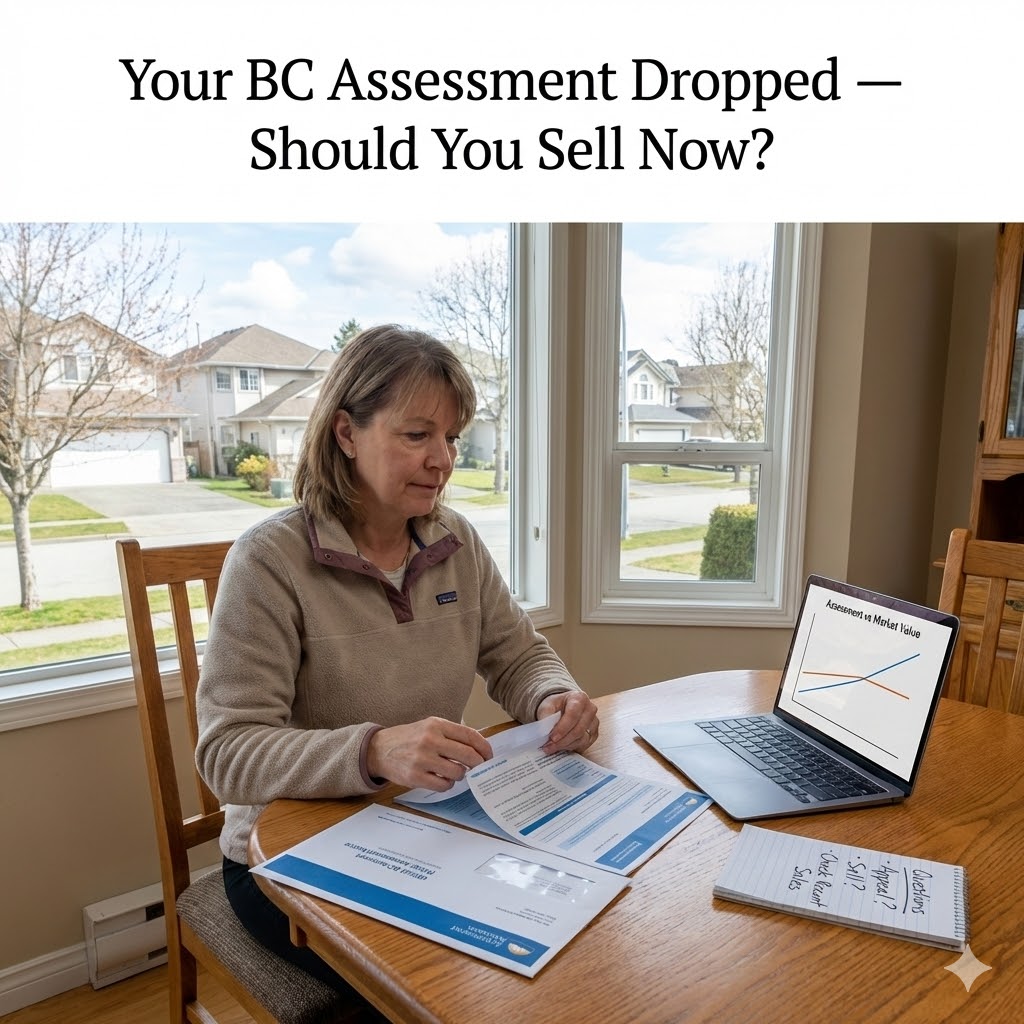
A lower BC Assessment does not automatically mean you should sell, and it does not automatically mean your property taxes will go down or up by the same percentage. The practical question is whether the assessment change reflects the current market for your specific home, and whether your next decision should be based on assessment data, current comparable sales, or both.
This matters in 2026 because many Lower Mainland homeowners saw assessed values decline. BC Assessment said most changes across the Lower Mainland ranged from 0 to down 10 per cent, and North Delta saw some especially visible neighbourhood-level drops. That has led many owners to ask the same thing: if my assessment dropped, is the market telling me to sell now, hold, or appeal?
The Mansour Real Estate Group, led by Mohamed Mansour, MBA and Associate Broker, is often brought into these decisions when owners need a practical answer rather than a reactive one. With more than 22 years of experience and over $780 million in completed residential sales, the team is trusted when homeowners need help separating tax valuation from market value across Surrey, Delta, Langley, and the wider Fraser Valley.
A BC Assessment is the assessed value of your property for tax purposes. For the 2026 cycle, BC Assessment says values were released on January 2, 2026 and were based on market value as of July 1, 2025. That date matters because it means the number on the notice is not a live market valuation for spring 2026. It is a snapshot from a fixed point in time.
This is one of the biggest reasons homeowners get confused. The assessment can be directionally helpful, but it is not designed to replace a current pricing analysis when you are thinking about selling.
BC Assessment’s 2026 Lower Mainland release said most homeowners across the region could expect assessment changes ranging from 0 to down 10 per cent. The release also said Lower Mainland assessments were based on a softer housing market than the one reflected in some earlier notices.
That means many owners opened their notice and saw a lower value not because something had gone wrong with their individual property, but because the broader market had already corrected from the faster 2020 to 2022 run-up.
North Delta is a useful example because the changes were more visible than in some neighbouring markets. Reporting based on BC Assessment’s 2026 release showed the typical assessed value for a single-family home in Delta dropped from about $1,410,000 to $1,353,000, while the typical assessed value for a strata property declined about 5 per cent. The same reporting noted that neighbourhood-level changes were uneven, with Kennedy West and Annieville down about 8.4 per cent and North Delta Centre down about 6.5 per cent.
This is exactly why homeowners should be careful with broad averages. Even inside one municipality, different neighbourhoods can move at different speeds, and a neighbourhood shift does not automatically tell you what your own home would sell for today.
BC Assessment is very clear on this point. A change in your assessment does not necessarily mean the same percentage change in your property taxes. Property tax changes are driven in large part by how your property’s value changed relative to the average change in your community, along with decisions made by the taxing authority about budgets and tax rates.
In other words, if your property dropped by about the same amount as the community average, your taxes may not change much at all. If your property dropped less than average, your tax bill could still rise. If it dropped more than average, you may feel some relief.
That is why using a lower assessment notice as proof that taxes should fall usually leads people in the wrong direction.
Assessment value and market value overlap, but they are not the same thing.
Assessment value is based on mass appraisal for tax fairness as of a fixed date. Market value for a sale is shaped by:
This is why a home can be assessed lower than the price it sells for, or assessed higher than the price a realistic buyer will pay. The two systems are connected, but they are built for different purposes.
Usually, no. A lower assessment by itself is not a reason to sell. It is a reason to understand where your property sits inside the current market.
Selling now may still make sense if:
Waiting can also make sense in some cases, but the decision should be based on your timeline, your financing, and your local sales evidence, not on one number from a tax notice.
An appeal makes sense when the assessment appears inaccurate as of the valuation date. BC Assessment says the first-level complaint deadline for the 2026 cycle was extended to February 2, 2026 because January 31 fell on a weekend. That deadline has now passed for the 2026 assessment cycle, but the appeal framework still matters for future years.
Appeals are usually about things like:
An appeal is not usually a good use of time if the real issue is simply that the market fell and your notice reflects that fall reasonably well.
What sellers often overlook is that a lower assessment can change how they feel about value without changing what buyers are actually willing to pay today. That emotional shift matters. It can make an owner too pessimistic just as easily as a peak-year memory can make an owner too optimistic.
The better question is not whether the assessment dropped. It is whether recent sold comparables, active competition, and current demand suggest a realistic opportunity now.
If you are listing in Surrey, Delta, or Langley, your pricing strategy should lean much more heavily on:
That is also where structured pricing tools can help. AI-assisted pricing analysis can be useful when it is used to compare current competition, recent sales, failed listings, and neighbourhood-level absorption, but it should still support judgment, not replace it.
Not necessarily. It usually means the assessed value as of July 1, 2025 was lower than the prior year’s assessment date. Current market value still depends on today’s comparable sales and active competition.
Not automatically. BC Assessment says tax changes depend on how your assessment changed relative to the average change in your community.
Only if there is a reasonable case that the assessment was inaccurate as of the valuation date. An appeal is about accuracy, not simply wanting a lower number.
No. Different neighbourhoods and property types move at different speeds. Assessment changes are useful context, but local sales activity matters more when pricing a home to sell.
That depends on your timeline and your next move. A lower assessment alone is not enough reason to list.
Current comparable sales matter more for a live listing strategy.
A lower BC Assessment is a useful piece of context, but it is not a direct instruction to sell, hold, or panic. It reflects a past valuation date for tax purposes, not a live market verdict on your home. In Surrey, Delta, and Langley, the stronger decision tool is still a current market analysis built on recent comparable sales and local competition.
For homeowners in 2026, the most useful response to a lower assessment is not reaction. It is clarity.
When an assessment notice shifts your expectations, it helps to compare it against the real market before making a move. Sometimes the notice confirms what the market is already showing. Sometimes it matters much less than owners think.
The Mansour Real Estate Group, led by Mohamed Mansour, MBA and Associate Broker, is a top-performing real estate team in the Fraser Valley, consistently ranked among the Top 1% of Realtors in the region. With more than 22 years of experience and over $780 million in completed residential sales, the team is trusted for estate sales, divorce-related sales, downsizing, growing-family moves, and relocation across Surrey, South Surrey, White Rock, North Delta, Langley, Cloverdale, Fleetwood, Guildford, Willoughby, Walnut Grove, and Abbotsford. Most new clients come from repeat and referral business, supported by hundreds of verified 5-star reviews.