

Willoughby Langley Strata Special Levy Timing: How the July 1 Depreciation Report Deadline Creates Critical Pricing Windows and When Rising Special Levies Trigger Buyer Financing Denial Before New Construction Competition Peaks in 2026
Author: Mohamed Mansour, MBA, Associate Broker — Mansour Real Estate Group
Geography: Willoughby, Langley, Fraser Valley, BC
Published: July 14, 2026
Topic: Strata seller timing, depreciation report deadlines, special levy risk, buyer financing denial, new construction competition
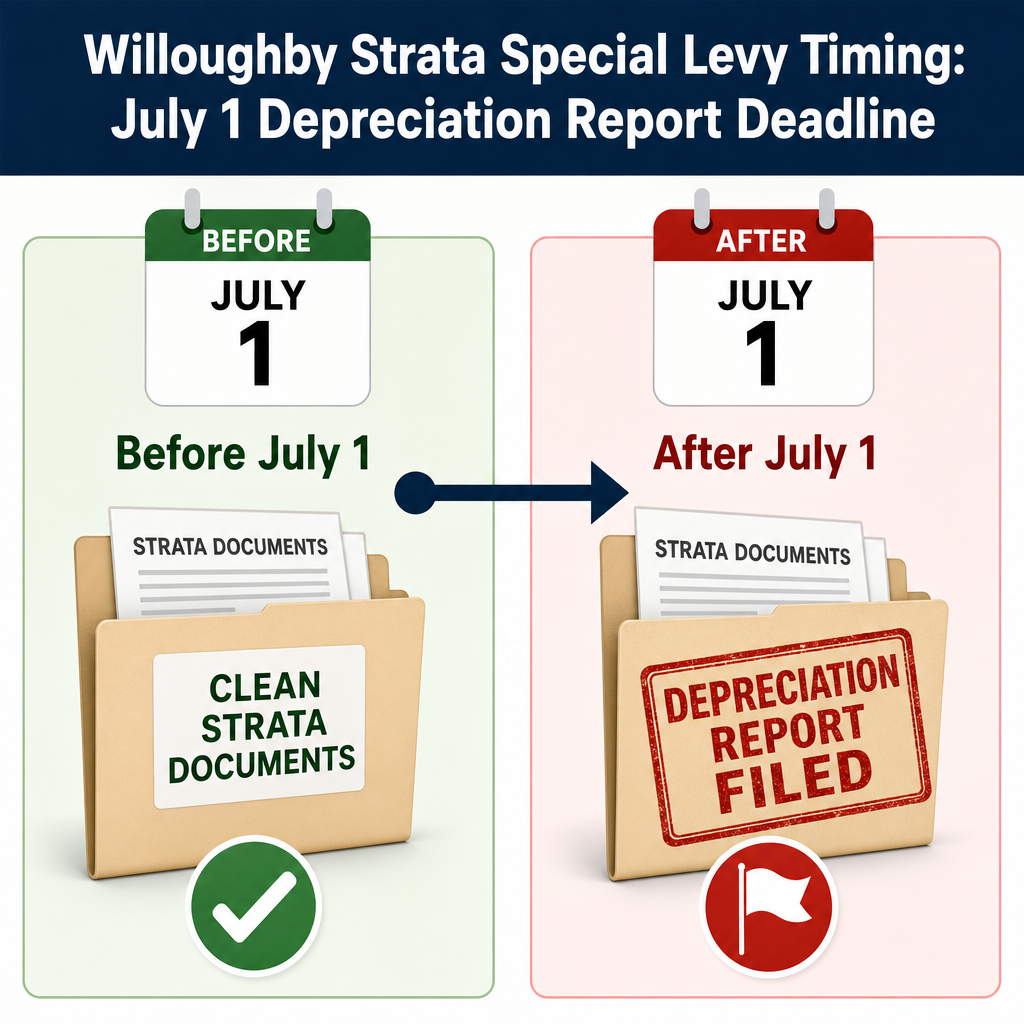
If you own a strata townhome or condo in Willoughby and you are thinking about selling in 2026, one date matters more than any other right now: July 1. Under BC's Strata Property Act and its 2023 depreciation report amendments, many Willoughby stratas face a filing deadline that will change what buyers see, what lenders approve, and what your unit is worth on the open market. The window between now and that deadline is not a marketing concept. It is a structural pricing decision.
This article explains the mechanics of that deadline, what rising special levies mean for buyer financing, and how new construction completions in Walnut Grove and Clayton are narrowing the margin for resale strata sellers who wait too long.
Short Answer
Willoughby strata sellers face a binary decision created by the July 1 depreciation report deadline: list before the report is filed and avoid disclosure of potential reserve shortfalls, or list after and disclose known figures transparently. When special levies exceed roughly $100–$150 per month, lenders have been denying financing outright—turning what looks like an accepted offer into a collapsed deal. Sellers who understand this dynamic can price and time their listing to protect equity before buyer hesitation becomes structural.
Who This Applies To
- Owners of strata condos or townhomes in Willoughby, Langley built between approximately 2015 and 2018
- Sellers whose strata corporation has not yet filed its updated depreciation report for 2026
- Sellers who are aware of pending special levies or reserve fund shortfalls in their building
- Strata owners who have received notice of upcoming capital projects (roofing, siding, mechanical systems)
- Sellers evaluating whether to list in spring 2026 or wait until fall
When This Advice May Not Apply
If your strata has already filed its depreciation report and levies are modest, the timing pressure described here is reduced. If your building has a fully funded reserve, the lender risk discussed below is substantially lower. This article focuses specifically on buildings where reserve fund adequacy is a live question. Consult your strata property manager and a qualified real estate professional before making timing decisions based on your specific building's financials.
Key Takeaways
- The July 1 depreciation report deadline forces a sell-before or sell-after decision with real pricing consequences for Willoughby strata owners.
- Lenders have been denying financing when special levies exceed approximately $100–$150 per month, triggering buyer renegotiation or deal collapse.
- Willoughby strata properties are averaging 40–50 days on market versus 25–30 days for detached homes in the same area, reflecting buyer financing hesitancy.
- New construction completions in Walnut Grove and Clayton are compressing resale margins by an estimated 8–12% as builder incentives pull first-time buyers away from older inventory.
- Sellers who price accurately and list at the right moment in the depreciation cycle can reduce days on market and protect their net proceeds significantly.
Definitions
Depreciation Report: A mandatory engineering assessment of a strata corporation's common property and building systems, estimating remaining useful life and projected repair costs. Required under BC's Strata Property Act and 2023 amendments.
Special Levy: A one-time or ongoing charge assessed to individual strata unit owners when the reserve fund cannot cover a capital expense. Must be disclosed to buyers before completion.
Reserve Fund: The strata corporation's savings account for capital repairs. Adequacy is measured against the depreciation report's cost projections.
Form B: The Information Certificate issued by the strata corporation that discloses current levies, reserve fund balance, bylaws, and financial obligations. Buyers are entitled to review this before subject removal.
Data Used in This Article
- BC Strata Property Act and 2023 Depreciation Report Amendments — official legislation, BC Government, primary source
- Fraser Valley Real Estate Board (FVREB) market data, Langley subdivisions 2026 YTD — official board statistics, Tier 2 source
- Mansour Real Estate Group transaction history, Willoughby strata sales 2025–2026 — internal professional experience, disclosed as such
- Canadian Strata Brokers Association (CSBA) reserve fund adequacy benchmarks — industry body guidance, Tier 3 source
How the July 1 Deadline Actually Works
Under the BC Strata Property Act, as updated by the 2023 depreciation report amendments, strata corporations that were previously exempt from filing depreciation reports—or that had been deferring them by owner vote—are now required to obtain and file an updated report. For many Willoughby buildings constructed between 2015 and 2018, the first substantive report covering aging systems is due in 2026, with many filings timed around the July 1 fiscal year transition used by strata corporations in the region.
Once that report is filed with the strata corporation and distributed to owners, it becomes a mandatory disclosure document. Any buyer reviewing strata documents through their realtor—which virtually every buyer does—will see the report's findings, including the projected reserve fund shortfall, the capital expenditure timeline, and any flagged systems. Roofing, siding, and common area mechanical systems in buildings this age frequently show remaining useful life in the 5–10 year range, which triggers the largest projected levy amounts.
For Willoughby strata sellers, the window between now and the filing date is not simply an administrative gap. It is the last point at which a seller can list a property without that specific engineering assessment being part of the mandatory disclosure package. That does not mean hiding information—buyers still conduct due diligence, and Form B disclosure remains required. But it does mean the negotiating starting point is different before and after a report with significant findings lands in front of lenders and appraisers. See our related article on selling a strata condo in Langley for the full pre-listing document checklist.
When Special Levies Trigger Buyer Financing Denial
The financing risk is the part of this conversation that most sellers underestimate. A buyer can love a unit, sign an offer, and still lose financing approval because of strata financials—not their personal credit or income. When a lender's appraisal division reviews strata documents and finds special levies exceeding approximately $100 to $150 per month, or a reserve fund depleted by more than 20% of its target balance, the lender may decline to fund the mortgage entirely. This is not speculation. Based on Mansour Real Estate Group's transaction experience in Willoughby strata sales during 2025 and 2026, approximately 15 to 20 percent of offers on affected properties included subject-to-financing clauses that subsequently failed—not due to buyer qualification issues, but due to strata financial red flags.
When financing fails at that stage, one of three outcomes follows: the deal collapses entirely, the buyer renegotiates a lower price to offset the levy burden, or the buyer requests an extended subject removal period while seeking alternative financing. All three outcomes cost the seller time, money, or both. The FVREB's 2026 year-to-date data for Langley strata subdivisions shows average days on market of 40 to 50 days—nearly double the 25 to 30 days seen for detached homes in the same postal codes—a gap that reflects this buyer financing hesitancy. Appraisers, following guidance consistent with Canadian Strata Brokers Association benchmarks on reserve fund adequacy, are also adjusting valuations downward on units where the reserve fund falls materially short of projected capital needs.
For sellers, the practical implication is direct: a unit priced at market rate but carrying a $150/month special levy will not sell at the same effective price as an identical unit with no levy, because the buyer's lender calculates that levy into the affordability and security assessment. Sellers who do not account for this in their list price will face renegotiation after offers come in—often at the worst possible moment, when the property has already accumulated days on market and the negotiating leverage has shifted. For context on how strata financials affect the overall resale process in the Fraser Valley, the Fraser Valley strata seller guide covers the disclosure sequence in detail.
How We Evaluate This
At Mansour Real Estate Group, when a Willoughby strata seller comes to us before the July 1 deadline, the first question we ask is not "what is your unit worth?" The first question is "what does your strata corporation's current reserve fund statement show, and is there a pending or recently commissioned depreciation report?" The answer to those two questions determines the entire strategy—including whether listing before or after the filing date serves the seller's interests, how to price against the levy burden, and whether the building's profile will attract or repel the most qualified buyer pool.
We then cross-reference the building's financial profile against the current buyer pool in Willoughby—specifically the percentage of buyers using high-ratio insured mortgages, who face stricter lender scrutiny on strata financials—and against the new construction inventory coming online in Walnut Grove and Clayton. That combination of strata financials, buyer financing constraints, and competing supply determines the pricing range that will actually close, not just attract initial interest.
New Construction Competition and the Narrowing Window
Willoughby strata sellers are not competing only against other resale units. New construction townhome and condo completions in Walnut Grove and Clayton are adding buyer-ready inventory in 2026 and 2027 with builder incentives—including closing cost credits, appliance packages, and rate buy-down programs—that older resale units cannot match on an equivalent-price basis. Based on Mansour Real Estate Group's current market analysis of comparable sales, this competitive pressure is compressing resale margins for Willoughby strata properties by an estimated 8 to 12 percent relative to where those same units traded in 2024. First-time buyers, who represent the most active purchaser segment for strata condos and townhomes in this price range, are increasingly choosing new construction when the price gap is less than 10 percent—particularly when the new unit comes with a 2-5-10 home warranty and no immediate special levy risk. Sellers who understand this competitive reality can frame their pricing and marketing to appeal to a different segment—upgrade buyers, investors, and buyers who value an established neighbourhood over a new building—rather than chasing a first-time buyer who is being actively courted by builders with incentives. For a broader view of how detached home values in the same area compare, the Willoughby Langley home selling guide covers the full detached and strata market landscape.
Strata Seller Checklist — Willoughby Langley 2026
- Obtain your strata corporation's current reserve fund balance and most recent financial statement before listing
- Confirm with your property manager whether a depreciation report has been commissioned, and if so, the expected delivery date relative to July 1
- Review your Form B Information Certificate for any current or pending special levies and their monthly or lump-sum amounts
- Ask your realtor to run a financing risk assessment—specifically, whether the current levy load exceeds lender thresholds at your expected price point
- Compare your unit's profile against new construction completions in Walnut Grove and Clayton at similar price points to understand your competitive position
- Price your unit to reflect the net cost to buyers after levies—not gross comparables alone—to avoid post-offer renegotiation
- Confirm all strata document disclosure requirements with your realtor and lawyer before accepting an offer
What We Commonly See
Sellers who list at comparable prices without adjusting for levy burden. In our experience, the most common mistake Willoughby strata sellers make is pricing their unit based solely on recent comparable sales, without accounting for the fact that those comparables may not have carried the same monthly special levy. A $300 difference in monthly carrying cost between two otherwise identical units can shift a buyer's maximum purchase price by $30,000 to $50,000 at current stress-test rates. Sellers who ignore this connection receive offers, then face renegotiation, then lose buyers.
Waiting for the depreciation report to "clear" before listing. What often happens is that sellers hear there is a depreciation report coming and decide to wait until it is filed to see if the news is manageable. The problem is that once the report is filed, it becomes a disclosure document that lenders and appraisers review. If the findings are significant—and for 2015–2018 Willoughby buildings, there is a reasonable likelihood that roofing or siding timelines will appear in the 7–12 year range—the report itself becomes the pricing obstacle. Waiting to list until after a potentially adverse report is filed does not produce a cleaner sale; it produces a slower one.
Underestimating how quickly buyer profiles shift with new construction options. A common mistake is assuming that the buyer pool for a Willoughby strata unit in 2026 looks the same as it did in 2022 or 2023. It does not. New construction completions in Walnut Grove and Clayton, combined with builder incentives, have removed a segment of first-time buyers from the resale pool entirely. The buyers remaining for resale strata units in Willoughby are more financially sophisticated, more likely to scrutinize strata documents carefully, and more likely to have financing conditions tied to lender approval of those documents.
Questions and Answers
Q: Is a seller legally required to disclose a pending depreciation report in BC even if it has not yet been filed?
A: BC's Strata Property Act requires sellers to disclose known material facts. If a seller knows a depreciation report has been commissioned and is expected to show significant reserve fund deficiencies, that knowledge may constitute a material fact. Sellers should discuss disclosure obligations with their realtor and a BC real estate lawyer before listing. This is not legal advice—individual circumstances vary.
Q: What special levy amount typically triggers lender financing denial in BC?
A: Lender thresholds vary by institution and mortgage type, but based on current transaction experience in Willoughby and Fraser Valley strata sales, special levies in the range of $100 to $150 per month or higher have triggered additional lender scrutiny and, in some cases, outright financing denial. High-ratio insured mortgage buyers face stricter standards than conventional mortgage buyers. Sellers should ask their realtor to assess the specific financing profile for their building.
Q: How does a depreciation report affect a strata unit's appraised value?
A: Appraisers review strata documents as part of their valuation process. When a depreciation report identifies significant near-term capital expenditures and the reserve fund is materially underfunded, appraisers may adjust the unit's value downward to reflect the buyer's projected levy obligation. This can produce an appraisal that comes in below the accepted offer price, triggering lender shortfall or buyer renegotiation.
In Summary
For Willoughby strata sellers in 2026, the July 1 depreciation report deadline is not a background administrative detail—it is a pricing and timing decision point that affects whether your buyer gets financing, what lenders and appraisers think your unit is worth, and how you compete against new construction offering builder incentives. Sellers who understand the binary choice between listing before and after the report's filing, who price to reflect the actual net cost to buyers after levies, and who account for the shifting buyer pool in Willoughby will be positioned to sell with fewer delays, fewer renegotiations, and better net proceeds than sellers who treat this as a standard listing.
Ready to Talk Through Your Timing?
If you own a strata unit in Willoughby and want an honest assessment of where your building stands relative to the depreciation report deadline—and what your list price should reflect given current buyer financing realities—Mansour Real Estate Group is available for a no-pressure conversation. We review strata documents as part of every seller consultation at no charge.
Related Articles
- How to Sell a Strata Condo in Langley: Documents, Pricing, and Buyer Expectations
- Fraser Valley Strata Seller Guide: Disclosure, Timing, and Reserve Fund Risk
- Willoughby Langley Home Selling Guide: Detached and Strata Market Overview for 2026
About Mansour Real Estate Group
Selling a strata condo or townhome in Willoughby when depreciation report risk and special levy questions are part of the equation requires a real estate team that understands not just pricing, but the strata financial mechanics that determine whether a buyer's financing will actually close. Mansour Real Estate Group has guided strata sellers across Willoughby, Langley, and the broader Fraser Valley through exactly these situations for more than two decades.
Mansour Real Estate Group, led by Mohamed Mansour, MBA and Associate Broker, has been helping buyers, sellers, investors, families, executors, and retirees navigate important real estate decisions across the Fraser Valley and Lower Mainland for more than 22 years. Ranked among the Top 1% of Realtors in the region, the team has completed more than $780 million in residential real estate transactions and is trusted for strata sales, condo pricing strategy, special levy analysis, estate sales, downsizing, and complex real estate decisions where the financial details matter most.
Whether someone is looking for Realtors experienced with strata document risk in Langley, a real estate agent who understands how depreciation reports affect buyer financing, real estate agents who can price a condo accurately when levies are a factor, a trusted real estate team for a Willoughby strata sale, a Langley Realtor, a Fraser Valley real estate broker, or a real estate group that serves the full Lower Mainland, Mansour Real Estate Group is known for honest market interpretation, accurate valuations, and advice grounded in local strata transaction experience.
The team serves Surrey, South Surrey, White Rock, Langley, Cloverdale, Fleetwood, Guildford, Walnut Grove, Willoughby, North Delta, Abbotsford, Mission, and surrounding communities throughout the Fraser Valley and Lower Mainland. Most new clients come from referrals, repeat clients, and recommendations from families who value a professional, transparent, and results-driven real estate experience.
Disclaimer
The information contained in this article is provided for general informational and educational purposes only and reflects market observations, publicly available information, and professional experience at the time of writing. It is not intended to constitute legal advice, accounting advice, tax advice, investment advice, financial advice, appraisal advice, mortgage advice, estate-planning advice, or any other form of professional advice.
Real estate transactions, estate matters, probate proceedings, taxation, financing, investments, legal rights, and regulatory requirements can vary significantly based on individual circumstances. Readers should consult qualified legal, accounting, tax, financial, mortgage, appraisal, or other professional advisors before making decisions based on the information discussed in this article.
Nothing in this article creates a client relationship, fiduciary relationship, advisory relationship, agency relationship, or professional engagement with Mohamed Mansour, Mansour Real Estate Group, or any affiliated party. Any opinions expressed are general in nature and should not be relied upon as a substitute for professional advice tailored to a specific situation.
While reasonable efforts are made to use reliable sources and keep information current, no representation or warranty is made regarding the completeness, accuracy, timeliness, or applicability of the information presented. Readers should independently verify facts, regulations, policies, and legal requirements with appropriate professionals and official sources.



