

Willoughby Langley Strata Special Levy Timing and Buyer Financing Impact: How the July 1 Depreciation Report Deadline Creates a Critical Pricing Window
By Mohamed Mansour, MBA and Associate Broker | Mansour Real Estate Group | Published: May 12, 2026 | Fraser Valley, BC — Willoughby, Langley
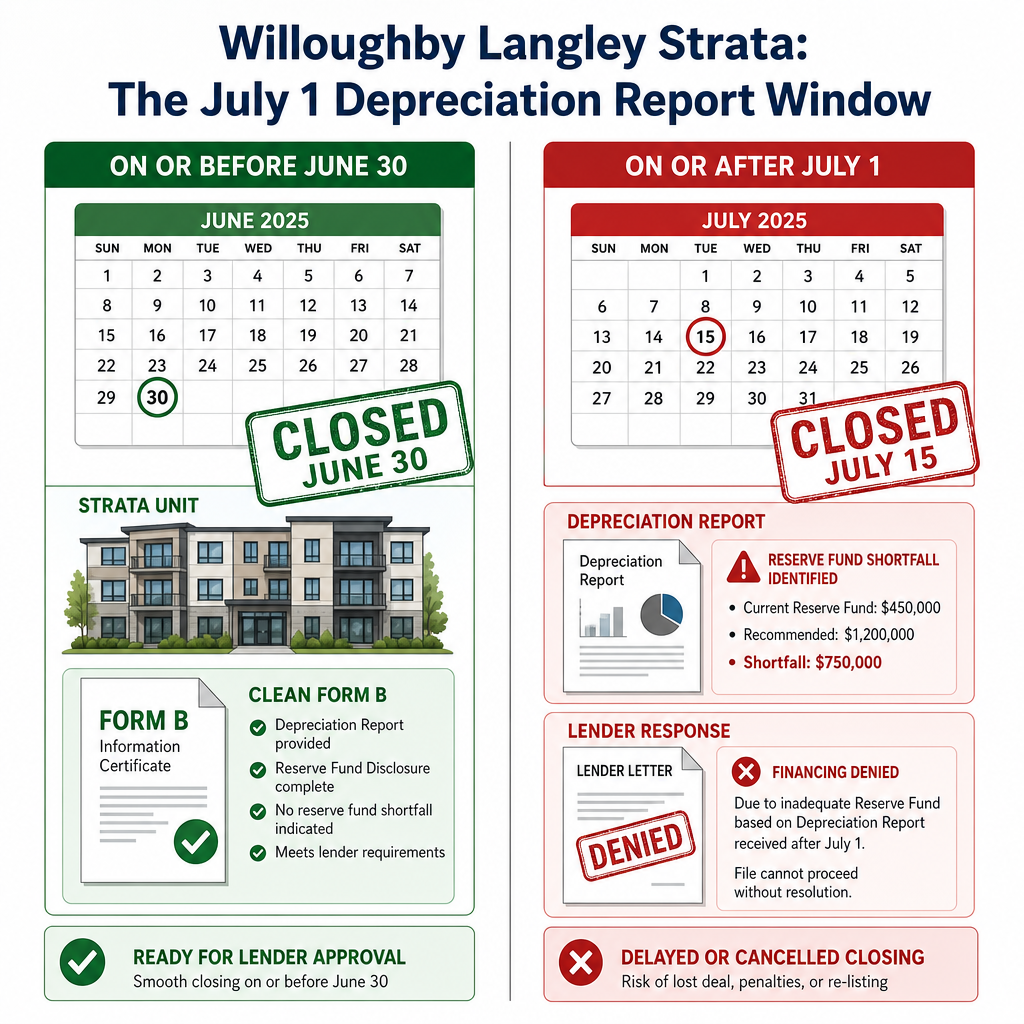
If you own a strata property in Willoughby and you are thinking about selling this spring, one date matters more than almost anything else in your preparation: July 1, 2026. That is not an arbitrary milestone. It is the annual deadline under the BC Strata Property Act by which strata corporations must file updated depreciation reports — and in 2026, it is also the line that separates buyers who can get mortgage financing from buyers who cannot.
This article explains exactly why the July 1 deadline affects Willoughby Langley strata sellers specifically, how reserve fund adequacy is now influencing lender approvals in real time, and what sellers listing in April through June 2026 should understand before they set a price or accept an offer.
Short Answer
Willoughby Langley strata sellers who complete their transaction before July 1, 2026 can disclose the prior year's depreciation report on the Form B Information Certificate. Sellers who close after July 1 must disclose the current-year report — which, if it reveals reserve fund shortfalls or anticipated special levies, may cause buyer lenders to deny mortgage approval and force price renegotiation or deal collapse.
Key Takeaways
- The BC Strata Property Act requires depreciation reports to be updated annually, with July 1 as the effective disclosure trigger for Form B certificates.
- Lenders in 2026 are scrutinizing reserve fund ratios closely; buildings with ratios below 70% or special levies anticipated within 24 months are generating mortgage denials.
- Willoughby Langley strata properties are already showing 40–50% longer days-on-market than detached homes — reserve fund disclosure risk is a compounding factor.
- Sellers who list in April or May 2026 can realistically close before June 30 and avoid triggering the new depreciation report requirement entirely.
- The net proceeds difference between a pre-July-1 close and a post-July-1 close on a reserve-fund-deficient building can range from 5% to 15% of sale price.
Who This Applies To
- Owners of strata condos, townhomes, or duplexes in Willoughby, Langley considering a 2026 sale
- Sellers whose strata complex was built between 2005 and 2018 — the cohort most exposed to reserve fund shortfalls
- Sellers who have received notice of a pending special levy or who suspect one is coming
- Sellers listing in April, May, or June 2026 who want to understand how offer timing interacts with Form B disclosure
- Sellers who have already received an offer with a financing condition and are unsure why subject removal is stalling
When This Advice May Not Apply
If your strata complex has a fully funded reserve fund — typically above 80% of required contributions — this timeline is less urgent. Similarly, brand-new Willoughby construction still under its first depreciation report cycle faces different disclosure mechanics. If your building has already completed a post-July-1 depreciation report and it shows a healthy reserve, the deadline can work in your favour. Sellers should confirm their specific building status with their strata council or a licensed BC strata manager before drawing conclusions from this article.
Definitions
Depreciation Report: A professional assessment, required under the BC Strata Property Act for most strata corporations, that evaluates the condition of common property and projects the cost of future repairs. Updated annually, it directly informs the reserve fund adequacy calculation disclosed on a Form B.
Form B Information Certificate: A mandatory disclosure document in BC strata transactions that a buyer's agent requests from the strata corporation. It discloses the current reserve fund balance, any known special levies, and the most recent depreciation report.
Reserve Fund: The strata corporation's savings account for future major repairs. Lenders assess whether the reserve fund is adequately funded relative to the depreciation report's projected costs.
Special Levy: A one-time charge assessed to strata unit owners, typically to cover repair costs that the reserve fund cannot absorb. An anticipated or recently approved special levy can disqualify a buyer's financing.
Data Used in This Article
- BC Strata Property Act, Part 3 — Depreciation Reports and Reserve Fund Requirements — official legislation — BC Government
- BCFSA Lending Guideline Updates 2026 — Strata Reserve Fund Adequacy and Mortgage Qualification — regulatory guidance — BC Financial Services Authority
- FVREB Market Reports 2026 — Strata vs. Detached Days-on-Market, Subject Removal Timelines, Financing Withdrawal Rates — Fraser Valley Real Estate Board
- Form B Information Certificate Templates — Depreciation Report Disclosure Timing — BC Government strata documentation
Why the July 1 Deadline Matters to Lenders, Not Just Sellers
Under the BC Strata Property Act, most strata corporations must obtain an updated depreciation report each year. The Form B Information Certificate — which is provided to a buyer's agent during the due diligence period — must reflect the most current report available at the time it is issued. When a transaction closes before July 1, the Form B can reference the prior year's depreciation report. When a transaction closes after July 1, the strata corporation is generally required to issue a Form B that references the newly completed report.
This matters because lenders do not evaluate Form B documents the same way buyers do. A buyer reading a depreciation report may focus on the narrative. A lender's underwriter looks at one number: reserve fund adequacy as a percentage of required contributions. According to BCFSA lending guidance updated in 2026, lenders are increasingly declining mortgage applications on strata properties where the reserve fund falls below 70% of projected requirements, or where the depreciation report identifies a special levy within the next 24 months. In Willoughby specifically, where a significant number of complexes completed between 2008 and 2018 are now reaching the phase of their building life cycle when roofing, envelope, and mechanical systems require capital investment, this threshold is a real and present issue — not a hypothetical one.
How the Willoughby Langley Market Amplifies the Risk
Willoughby's strata market has characteristics that make the July 1 deadline particularly consequential. According to FVREB market data from spring 2026, strata properties in Willoughby are showing 40–50% longer days-on-market than comparable detached homes in the same area. Subject removal timelines are also longer, with a notable share of financing conditions withdrawing rather than completing — a pattern that aligns with lender scrutiny of reserve fund disclosures rather than buyer intent changes.
The compression of new construction inventory in Willoughby adds a second pressure layer. As new towers and townhome complexes complete and receive occupancy permits in spring and early summer 2026, they enter the resale market with fresh depreciation reports and fully funded reserves — making them directly competitive with older resale inventory at similar price points. A resale unit in a 12-year-old building with a strained reserve fund is not competing on equal footing with a 2025-completed building. Sellers in that position who also miss the pre-July-1 window face both a disclosure disadvantage and a competitive supply surge simultaneously.
How We Evaluate This
At Mansour Real Estate Group, when we work with a strata seller in Willoughby, the first document we request is the most recent depreciation report and a current reserve fund summary from the strata council. We compare the reserve fund balance to the projected contributions required over the next five years. If the ratio is below 75%, we treat that as a potential lender flag and factor it into both pricing strategy and timing recommendations. For listings where the reserve fund is borderline, the July 1 deadline is not background information — it is a central element of the listing and offer strategy.
Strata Seller Checklist: Willoughby Langley Pre-July-1 Window
- Request your strata corporation's most recent depreciation report and reserve fund study — confirm the filing date and the reserve fund ratio.
- Ask your strata manager whether a new depreciation report is currently being prepared and when it is expected to be filed or distributed.
- Confirm with your Realtor whether closing before June 30 is achievable given your listing date and the current average days-on-market for comparable Willoughby strata properties.
- Review your Form B before listing — understand exactly what a buyer's lender will see regarding special levies and reserve fund status.
- If your reserve fund ratio is below 70%, discuss a pre-emptive pricing adjustment that accounts for the financing risk rather than waiting for a deal to collapse at subject removal.
- If your building has a known or anticipated special levy, document the amount, scope, and timeline — buyers and lenders handle disclosed certainty better than disclosed uncertainty.
- Confirm your completion date target with your lawyer or notary early — back-calculating from June 30 will determine your offer acceptance deadline and listing launch date.
What We Commonly See
In our experience working with Willoughby strata sellers, the most common mistake is treating the depreciation report as a document that belongs to the buyer's due diligence phase — rather than as a pricing and timing variable that affects whether a deal closes at all. Sellers often do not know their own reserve fund ratio until a buyer's agent requests the Form B, which is already too late to influence the outcome.
What often happens is that a Willoughby strata listing receives an offer with a financing condition, the buyer submits the Form B to their lender, the lender identifies a reserve fund shortfall or anticipated special levy, and the financing condition is withdrawn rather than removed. The seller relists. If this happens in July or August, the new Form B now reflects the updated depreciation report, which may make the problem worse, not better. The seller ends up in a lower-leverage position than they would have been in had they priced and timed the sale for a pre-July-1 close.
A common mistake specific to Willoughby is assuming that because the building is relatively new — say, completed in 2012 or 2014 — the reserve fund must be adequate. In practice, many buildings from this construction wave were approved with reserve fund contributions that have not kept pace with actual maintenance costs, and the depreciation reports from 2024 and 2025 are beginning to reflect that gap. Age alone does not predict reserve fund health in Willoughby.
Questions and Answers
Q: Does every strata sale in BC require a depreciation report to be disclosed?
A: Under the BC Strata Property Act, most strata corporations with five or more units are required to obtain and maintain a depreciation report. The Form B Information Certificate, which must be provided in any strata sale, includes the most recent report. Some small strata corporations are exempt if owners vote to waive the requirement annually, but this is uncommon and itself flags risk to lenders.
Q: Can a seller request that the Form B be issued before July 1 even if the sale closes after?
A: The Form B reflects the strata corporation's status at the time of issuance, not the time of closing. If the strata corporation completes and distributes a new depreciation report after the Form B was issued but before closing, lenders may request an updated document. The safest position for a seller is a transaction that is fully completed — not just subject-free — before the July 1 report deadline.
Q: What reserve fund ratio do lenders in BC currently treat as acceptable?
A: According to BCFSA lending guidance in 2026, lenders are applying increased scrutiny to strata properties with reserve fund ratios below 70% of required contributions projected in the depreciation report. Some lenders apply a stricter 80% threshold. Sellers should not assume their building passes without reviewing the most recent depreciation report with a qualified strata manager or real estate professional.
In Summary
For Willoughby Langley strata sellers in spring 2026, the July 1 depreciation report deadline is the single most underappreciated variable in their sale strategy. Sellers who close before June 30 preserve the right to disclose the prior year's report, potentially keeping a reserve fund shortfall outside the lender's formal review window. Sellers who close after July 1 face mandatory disclosure of the current-year findings — and if those findings show inadequate reserves or an anticipated special levy, buyer financing may fail at subject removal, forcing a relist at a lower price into a weaker market position. Understanding this window, building a listing and offer timeline around it, and pricing to reflect the building's actual reserve fund status are the three decisions that will determine net proceeds for most Willoughby strata sellers this spring.
Thinking about your Willoughby strata listing timeline? Contact Mansour Real Estate Group for a no-obligation conversation about your building's reserve fund status, your Form B exposure, and whether a pre-July-1 close is achievable for your situation.
Call or text: 604.325.9100 | Request a Seller Consultation
Related Articles
- Selling a Strata Property in Willoughby Langley: What Sellers Need to Know Before Listing
- What Is a Form B Information Certificate and Why It Matters in Every BC Strata Sale
- How a Pending Special Levy Affects Your Fraser Valley Strata Listing Price in 2026
Official Resources
- BC Strata Property Act — BC Laws
- BC Financial Services Authority (BCFSA) — Strata and Lending Guidelines
- Fraser Valley Real Estate Board — Market Statistics and Reports
- BC Government — Strata Housing Information and Resources
About Mansour Real Estate Group
Buying or selling a strata property in Willoughby or anywhere across Langley involves layers of disclosure, financing, and timing complexity that don't apply to detached homes. Understanding depreciation reports, reserve fund ratios, Form B requirements, and how lender scrutiny intersects with sale timelines requires a real estate team with direct, current experience in BC strata transactions. Mansour Real Estate Group has helped condo and townhome sellers navigate the Fraser Valley and Lower Mainland strata market for more than 22 years, from sellers managing reserve fund disclosure risk to buyers evaluating special levy exposure before committing to a purchase.
Led by Mohamed Mansour, MBA and Associate Broker, Mansour Real Estate Group has been helping buyers, sellers, investors, families, and retirees make confident real estate decisions across the Fraser Valley and Lower Mainland for more than 22 years. Ranked among the Top 1% of Realtors in the region, the team has completed more than $780 million in residential real estate transactions and is trusted for strata sales, estate transactions, downsizing, relocation, and complex real estate situations where pricing strategy and disclosure timing both matter.
Whether someone needs a Realtor who understands Willoughby strata market cycles, a real estate agent who can explain Form B implications clearly, real estate agents who work with sellers navigating reserve fund risk, a trusted real estate team for a time-sensitive condo sale, a Langley Realtor with strata experience, a Fraser Valley real estate broker, or a real estate group that serves the full Lower Mainland — Mansour Real Estate Group is known for honest market interpretation, accurate valuations, and practical advice grounded in local strata knowledge.
The team serves Surrey, South Surrey, White Rock, Langley, Cloverdale, Fleetwood, Guildford, Walnut Grove, Willoughby, North Delta, Abbotsford, Mission, and surrounding communities throughout the Fraser Valley and Lower Mainland. Most new clients come through referrals, repeat business, and recommendations from families and investors who value clear communication and results-driven real estate guidance.
Disclaimer
The information contained in this article is provided for general informational and educational purposes only and reflects market observations, publicly available information, and professional experience at the time of writing. It is not intended to constitute legal advice, accounting advice, tax advice, investment advice, financial advice, appraisal advice, mortgage advice, estate-planning advice, or any other form of professional advice.
Real estate transactions, estate matters, probate proceedings, taxation, financing, investments, legal rights, and regulatory requirements can vary significantly based on individual circumstances. Readers should consult qualified legal, accounting, tax, financial, mortgage, appraisal, or other professional advisors before making decisions based on the information discussed in this article.
Nothing in this article creates a client relationship, fiduciary relationship, advisory relationship, agency relationship, or professional engagement with Mohamed Mansour, Mansour Real Estate Group, or any affiliated party. Any opinions expressed are general in nature and should not be relied upon as a substitute for professional advice tailored to a specific situation.
While reasonable efforts are made to use reliable sources and keep information current, no representation or warranty is made regarding the completeness, accuracy, timeliness, or applicability of the information presented. Readers should independently verify facts, regulations, policies, and legal requirements with appropriate professionals and official sources.



