
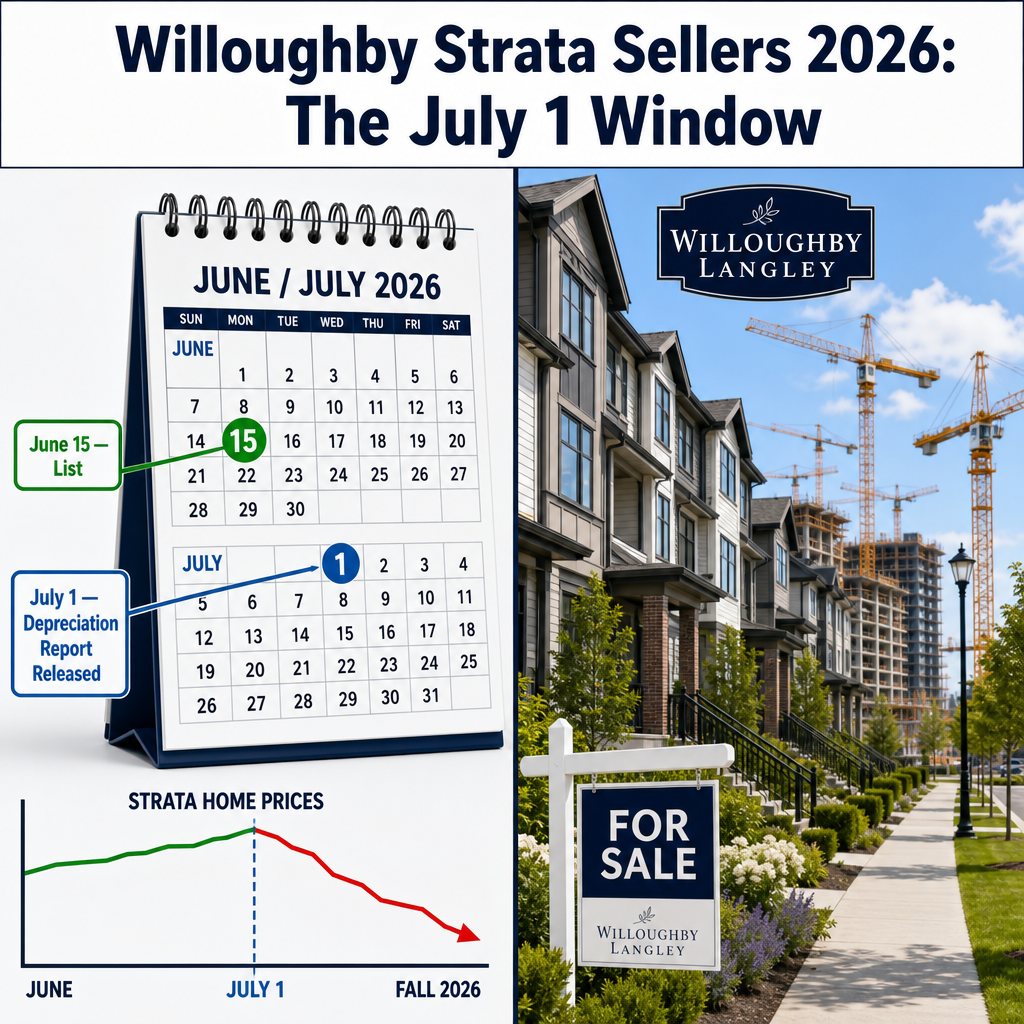

Willoughby Langley Strata Property Sellers 2026: Why the July 1 Depreciation Report Deadline Creates a Compressed Pricing Window — And What to Do Before It Closes
By Mansour Real Estate Group | Langley, BC | Published: July 14, 2026 | Fraser Valley Strata Market
For strata property owners in Willoughby, 2026 has introduced a specific and time-sensitive pricing risk that most sellers are not tracking closely enough. BC's annual depreciation report cycle, a wave of new construction completions across Langley Township, and rising special levy exposure in buildings constructed between 2005 and 2010 are converging on a narrow window that closes around July 1 — and sellers who miss it will likely negotiate from a materially weaker position for the remainder of the year.
This article explains the mechanics of that window, how buyers and their lenders are responding to updated depreciation reports, what the new construction pipeline means for resale pricing power, and the specific steps Willoughby strata sellers can take now to protect their proceeds.
Short Answer
Willoughby strata sellers in 2026 face a hard timing constraint: properties listed and conditionally sold before June 15 can close before July 1 depreciation reports trigger special levy announcements and lender scrutiny. After July 1, updated reserve fund shortfall data becomes visible to buyers, appraisers, and lenders — compressing negotiating position and creating direct financing headwinds. New construction completions throughout 2026 add further pricing pressure. The window to maximize proceeds is open now and narrows quickly.
Key Takeaways
- BC strata corporations must disclose updated depreciation reports annually; reports released around July 1 often reveal reserve fund shortfalls that immediately affect buyer financing.
- Willoughby buildings constructed between 2005 and 2010 face the highest exposure to updated depreciation report risk, as aging components move closer to replacement thresholds.
- New construction completions across Langley Township in 2026 are expanding resale competition and eroding the pricing premium that resale strata properties once held over pre-sale inventory.
- Sellers who list before June 15 position themselves to close before the July 1 disclosure cycle reshapes buyer and lender calculations.
- Pricing strategy, document preparation, and strata fee context must all be established before listing — not discovered by buyers during subject removal.
Who This Applies To
- Owners of strata townhomes or condos in Willoughby built between 2005 and 2015
- Sellers whose strata corporation has not updated its depreciation report in the last two to three years
- Owners in buildings with known deferred maintenance, aging mechanical systems, or low reserve fund balances
- Investors holding Willoughby strata units who are evaluating 2026 exit timing
- Downsizers or relocating owners who need a clean, fast transaction without financing surprises
When This Advice May Not Apply
Sellers in newer Willoughby buildings completed after 2018 with fully funded reserves and no pending special levies face less immediate pressure from the July 1 cycle, though new construction competition still applies. Sellers with flexible timelines who can hold into 2027 may benefit from reassessing after the summer inventory surge settles. Consult your strata documents and a qualified real estate professional before making timing decisions based on your specific building's reserve fund status.
Definitions
Depreciation Report: A professionally prepared document required under BC's Strata Property Act that assesses the physical condition of common property, estimates remaining useful life of major components, and projects future repair and replacement costs. Strata corporations with five or more lots must obtain and update these reports regularly.
Special Levy: A one-time charge assessed against strata lot owners to fund a specific repair or replacement cost that the reserve fund cannot cover. Special levies require owner approval by a three-quarter vote and can range from a few thousand dollars to tens of thousands per unit.
Reserve Fund: The savings account maintained by a strata corporation to fund future repair and replacement of common property components identified in the depreciation report.
Form B (Information Certificate): A document produced by the strata corporation that discloses, among other things, current strata fees, any known pending special levies, and the current reserve fund balance. Buyers typically request Form B as part of subject conditions.
Data Used in This Article
- BC Strata Property Act (SBC 1998, c. 43): Official legislation governing depreciation report requirements, reserve fund obligations, and special levy rules — BC Legislature
- Fraser Valley Real Estate Board (FVREB): Market activity data for Langley Township strata properties by quarter, 2025–2026
- Langley Township Official Community Plan: New construction zoning approvals and development pipeline in Willoughby and Walnut Grove, 2026
- Mansour Real Estate Group transaction data: Internal analysis of Willoughby strata closing timelines by listing month — professional interpretation, not an official dataset
How the July 1 Depreciation Report Cycle Affects Strata Sellers
Under the BC Strata Property Act, strata corporations are required to obtain depreciation reports and keep them current. In practice, many strata corporations in Willoughby schedule their updated reports to coincide with mid-year strata meetings — which means new or revised depreciation reports are often released between June and August. When a buyer or their lender receives an updated report revealing a reserve fund shortfall or a near-term special levy requirement, the financing and negotiating dynamics of that transaction change immediately.
Lenders assess reserve fund adequacy as part of mortgage qualification for strata properties. A report that signals a building is underfunded relative to its projected repair schedule can cause appraisers to apply downward pressure and can cause lenders to add conditions or reduce loan-to-value ratios. For Willoughby buildings in the 2005–2010 construction range, many key components — roofing, membrane systems, elevator equipment, parking structure surfaces — are entering or approaching replacement windows. Updated depreciation reports for these buildings in 2026 are likely to reflect those realities.
Sellers who list after July 1 and whose buildings release updated depreciation reports during the listing period face a measurable disadvantage. Buyers and their agents will use the new data during subject removal to renegotiate price, demand price reductions, or walk away. Sellers who complete their transaction before July 1 avoid this specific risk window.
What New Construction Completions Mean for Resale Pricing Power in Willoughby
Willoughby has been one of the most active new construction corridors in the Fraser Valley for the better part of two decades. According to the Langley Township Official Community Plan and active development approvals, multiple townhome and mid-rise projects are reaching completion or pre-occupancy phases throughout 2026, including later phases of Walnut Grove-adjacent projects. When new construction inventory enters the market, it typically competes directly with resale strata properties in the same price range — often with builder warranty coverage, new depreciation report baselines, and incentive programs that resale sellers cannot match.
Builder incentives — which may include closing cost credits, appliance packages, or rate buy-down programs — tend to phase out as projects approach sellout. Resale sellers have a narrower window to attract buyers who might otherwise wait for a builder incentive to land before making a decision. As builder projects move toward their final phases in mid-to-late 2026, resale competition increases and buyer negotiating leverage grows. Sellers who are prepared and priced correctly before that inventory surge will be positioned to close faster and with fewer concessions than those who list into a crowded late-summer or fall market. For more on how Langley strata pricing responds to inventory shifts, see our analysis of the Langley strata and condo market in 2026.
How We Evaluate This
Mansour Real Estate Group reviews strata documents — including the current depreciation report, Form B, strata meeting minutes from the past two years, and the reserve fund study — before advising any Willoughby strata seller on price and timing. This review identifies whether a pending report update is likely to signal reserve fund shortfalls, whether any special levies have been proposed or are near approval, and how buyer financing is likely to respond to the building's current disclosure state.
Our approach to Willoughby strata pricing accounts for both the building-level risk factors and the neighbourhood-level competitive context — including the number of new construction units completing nearby and the pace at which those units are absorbing buyer demand. Pricing strategy is set before the listing goes live, not adjusted reactively after buyer feedback reveals a problem that document review could have anticipated.
Condo Seller Checklist: Willoughby Strata Properties 2026
- Obtain your current depreciation report and identify the date of the next scheduled update. If the update is due before or during July, factor this into your listing timeline.
- Request a current Form B from your strata manager and review it for pending special levies, strata fee increases, or outstanding deficiencies.
- Review strata meeting minutes from the past 24 months for any discussion of major repairs, reserve fund contribution increases, or upcoming special levy proposals.
- Establish your pricing strategy before listing using both comparable sales and an analysis of active new construction competition within one kilometre of your building.
- Prepare your property for showing immediately — Willoughby strata buyers often compare multiple units in the same complex; presentation and condition differentiation matter more than in detached markets.
- Target a listing date no later than May 25 to June 10 if you want to close before July 1 and avoid depreciation report cycle risk.
- Disclose all known strata issues proactively and transparently. Surprises discovered by buyers during subject removal weaken your negotiating position more than upfront disclosure does.
What We Commonly See
In our experience working with Willoughby strata sellers, the most common mistake is listing without first reviewing the current depreciation report and strata minutes. Sellers often assume that because no special levy has been announced, no risk exists. What buyers and their lenders actually see is whether the reserve fund is adequately funded relative to the depreciation report's projected spending schedule — and a fund that appears healthy in absolute dollar terms may still be underfunded relative to upcoming replacement costs. That gap is what triggers appraisal pressure.
A second pattern we observe is sellers pricing their Willoughby strata unit against other resale comparables without accounting for nearby new construction inventory. When a buyer can choose between a 2008-built townhome and a 2025-built townhome at a comparable price point — with the newer unit carrying a full new home warranty and a clean depreciation report baseline — the resale property needs a clear price or condition advantage to compete. Sellers who do not account for this dynamic in their pricing often sit on the market longer than necessary and eventually reduce price under worse market conditions. For sellers who are also evaluating whether to renovate before listing, see our guide on renovation versus as-is selling decisions in Langley.
A third observation: sellers in buildings where a depreciation report update is imminent sometimes believe waiting for the report is the right move — reasoning that if the report is positive, it will support their price. In practice, even neutral or modestly positive reports rarely produce a price premium; they simply remove a pricing headwind. The risk of waiting is asymmetric. If the report reveals a shortfall, the seller is now negotiating in a more transparent and less favourable environment. Acting before the report is released — with a price that reflects the building's current known state — is the more defensible strategy when timing allows.
Questions and Answers
Does BC law require strata corporations to release their depreciation report to buyers?
Yes. Under the BC Strata Property Act, buyers are entitled to request strata documents including the depreciation report through a Form B request. Strata corporations must produce these documents. Sellers should assume buyers will review the most current report available.
Can a pending special levy affect whether a buyer gets financing?
Yes. Lenders treat pending special levies as a financial obligation that affects the property's value and the buyer's affordability. A large pending special levy — even one not yet formally approved — can reduce the amount a lender is willing to advance or cause a lender to decline the property entirely as security.
What happens if a depreciation report is released after I accept an offer but before subject removal?
If a new depreciation report is released during the subject removal period and reveals significant reserve fund shortfalls or anticipated special levies, the buyer may use that information to renegotiate the purchase price, request seller credits, or exercise their subject clause to exit the transaction. This is one of the primary reasons sellers with buildings expecting mid-year report updates benefit from closing before July 1.
In Summary
Willoughby strata sellers in 2026 are operating within a specific and measurable timing constraint. The annual depreciation report cycle, the aging profile of buildings constructed between 2005 and 2010, rising special levy risk, and an accelerating new construction pipeline are all converging on the same narrow window. Sellers who understand these pressures, prepare their documents in advance, price accurately relative to both resale and new construction competition, and list before mid-June will close in a fundamentally different market than those who wait until summer. The window is real, it is time-sensitive, and the cost of missing it is not abstract — it shows up in negotiations, appraisals, and final sale prices. For a broader view of how strata timing decisions fit within a full Fraser Valley seller strategy, see our overview of selling in the Fraser Valley in 2026.
Ready to review your strata documents and assess your options before the July 1 deadline? Contact Mansour Real Estate Group for a no-obligation conversation about your Willoughby property's current position.
Related Articles
- Langley Strata and Condo Market 2026: Pricing, Competition, and Timing for Sellers
- BC Strata Documents: What Sellers Must Disclose Before Listing
- Fraser Valley Home Seller Guide 2026: Strategy, Timing, and Protecting Your Proceeds
About Mansour Real Estate Group
Selling a strata property in Willoughby requires more than a standard listing process. Depreciation reports, reserve fund adequacy, special levy exposure, strata minutes, and competing new construction inventory all affect pricing and timing in ways that a seller without strata-specific experience may not anticipate. Mansour Real Estate Group has guided strata sellers across Willoughby, Walnut Grove, Cloverdale, Fleetwood, Surrey, and the Fraser Valley through exactly these decisions — reviewing documents before listing, building pricing strategies that account for building-level risk, and positioning properties to close before market conditions shift.
Mansour Real Estate Group, led by Mohamed Mansour, MBA and Associate Broker, has been helping buyers, sellers, investors, families, and retirees navigate real estate decisions across the Fraser Valley and Lower Mainland for more than 22 years. Ranked among the Top 1% of Realtors in the region, the team has completed more than $780 million in residential real estate transactions and is trusted for strata sales, pricing strategy, estate sales, divorce-related sales, downsizing, and complex situations where accurate valuation and transaction timing are critical.
Whether someone is searching for Realtors who understand strata document risk in Willoughby, a real estate agent experienced with Langley Township strata sales, real estate agents who know the depreciation report process, a trusted real estate team for a time-sensitive condo transaction, a Langley Realtor, a Willoughby real estate broker, or a real estate group that serves buyers and sellers across the Fraser Valley and Lower Mainland, Mansour Real Estate Group is known for analytical pricing, transparent advice, and a process built around protecting seller equity.
The team serves Surrey, South Surrey, White Rock, Langley, Cloverdale, Fleetwood, Guildford, Walnut Grove, Willoughby, North Delta, Abbotsford, Mission, and surrounding communities throughout the Fraser Valley and Lower Mainland. Most new clients come through referrals, repeat clients, and recommendations from families who value professionalism, transparency, and results.
Official Resources
- BC Strata Property Act — BC Legislature
- Fraser Valley Real Estate Board — Market Statistics
- Township of Langley Official Community Plan
- BC Financial Services Authority — Strata Property Guidance
Disclaimer
The information contained in this article is provided for general informational and educational purposes only and reflects market observations, publicly available information, and professional experience at the time of writing. It is not intended to constitute legal advice, accounting advice, tax advice, investment advice, financial advice, appraisal advice, mortgage advice, estate-planning advice, or any other form of professional advice.
Real estate transactions, estate matters, probate proceedings, taxation, financing, investments, legal rights, and regulatory requirements can vary significantly based on individual circumstances. Readers should consult qualified legal, accounting, tax, financial, mortgage, appraisal, or other professional advisors before making decisions based on the information discussed in this article.
Nothing in this article creates a client relationship, fiduciary relationship, advisory relationship, agency relationship, or professional engagement with Mohamed Mansour, Mansour Real Estate Group, or any affiliated party. Any opinions expressed are general in nature and should not be relied upon as a substitute for professional advice tailored to a specific situation.
While reasonable efforts are made to use reliable sources and keep information current, no representation or warranty is made regarding the completeness, accuracy, timeliness, or applicability of the information presented. Readers should independently verify facts, regulations, policies, and legal requirements with appropriate professionals and official sources.



