

Willoughby Langley Strata Property Sellers 2026: How the July 1 Depreciation Report Deadline Creates Strategic Pricing Windows — And When Rising Special Levies Trigger Buyer Financing Denial Before New Construction Competition Peaks
By Mohamed Mansour, MBA, Associate Broker — Mansour Real Estate Group | Published: July 15, 2026 | Fraser Valley, BC
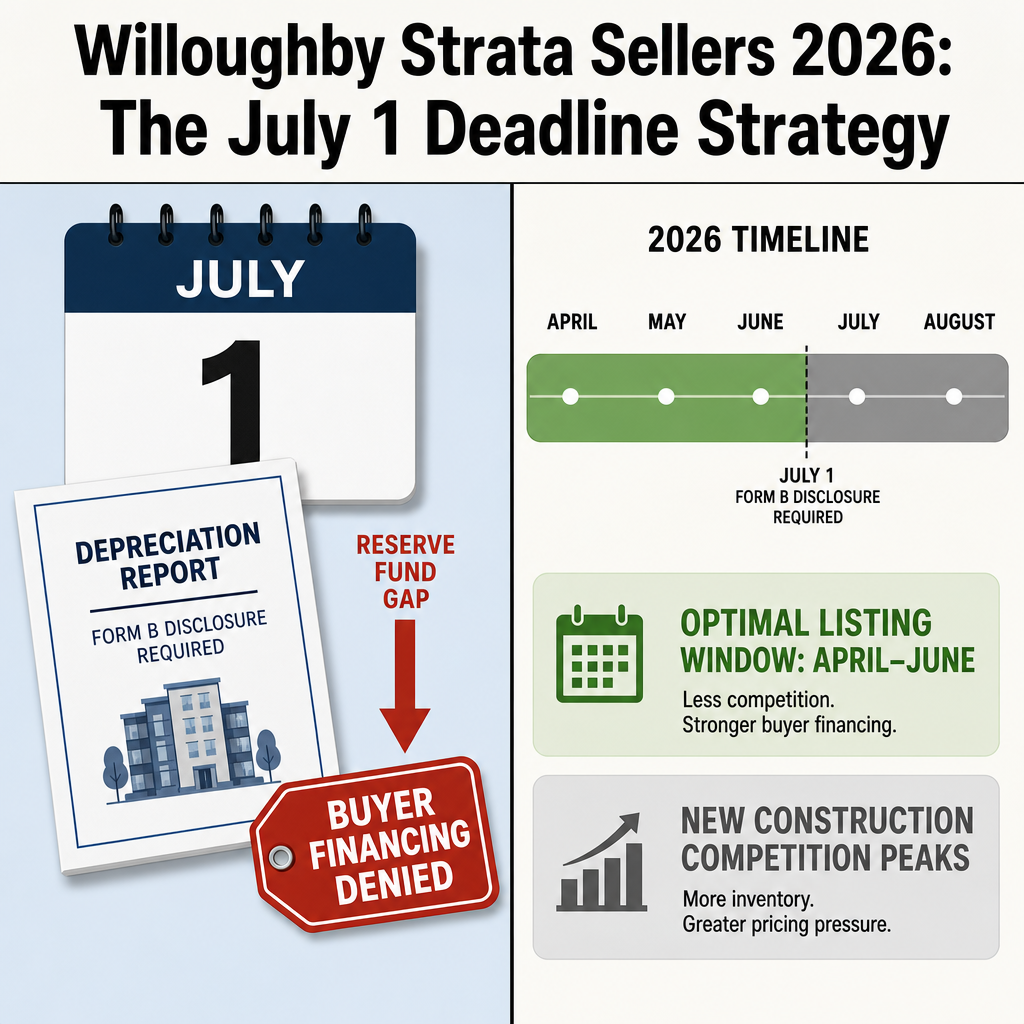
If you own a strata unit in Willoughby and you are thinking about selling in 2026, the single most consequential decision you will make is not about price. It is about timing — specifically, whether you list before or after July 1. BC strata law requires depreciation report renewal on an annual cycle, and the July 1 disclosure deadline changes what buyers see, what lenders will finance, and how competing new construction inventory affects your negotiating position.
This article explains how three forces converge in a narrow window: the mandatory Form B disclosure of reserve fund projections, the financing risk created by special levy forecasts, and the new construction completion wave in Walnut Grove that redirects buyer demand. Understanding how these interact is the difference between a clean, competitive sale and an extended listing that drags into the fall.
Short Answer
Willoughby strata sellers who list before July 1 avoid mandatory depreciation report disclosure that can trigger lender appraisal reductions of $25,000 to $75,000 and buyer financing denial. Combined with a new construction competition peak expected in late summer, the April-to-June window offers materially better conditions for pricing, buyer confidence, and sale velocity than any period after the deadline.
Key Takeaways
- BC's July 1 depreciation report cycle makes Form B disclosure timing a direct pricing variable for strata sellers.
- Lenders regularly reduce appraisals or deny financing when Form B reveals reserve fund depletion or pending special levies.
- Willoughby strata sales-to-active ratios of 15–23% show seller advantage that compresses sharply when new supply and disclosure risk converge post-July.
- New construction builder incentive expiry in June–July redirects pre-construction buyers toward completed resale inventory, intensifying late-summer competition.
- Estate, divorce, and downsizing sellers face the highest cost from delayed listing — extended market exposure and reduced offer velocity after the July threshold.
Who This Applies To
- Strata unit owners in Willoughby considering a sale in spring or summer 2026
- Executors managing estate properties in Willoughby strata buildings
- Separating or divorcing homeowners with shared strata ownership in Langley
- Downsizers in Willoughby evaluating whether to sell a condo before or after summer
- Investors holding Willoughby strata units who are evaluating exit timing
When This Advice May Not Apply
This analysis applies specifically to strata properties in Willoughby subject to BC depreciation report renewal. It may not apply to detached properties, bare land strata with no building components, or buildings with a current, well-funded depreciation report that does not reveal reserve shortfalls. Individual circumstances, building age, and strata council decisions affect every situation differently. Consult a qualified real estate professional and a strata lawyer before making listing decisions.
Data Used in This Article
- BC Strata Property Act — Depreciation Report and Form B Disclosure Requirements (official legislation)
- Fraser Valley Real Estate Board — Willoughby Langley Sales-to-Active Ratios and Days-on-Market 2025–2026 (official board data)
- CMHC — Lender Appraisal and Financing Guidelines for Strata Properties with Deferred Maintenance (official federal guidance)
- Langley Township Official Community Plan — New Construction Pipeline and Walnut Grove Completion Timelines (municipal planning documents)
- BC Real Estate Council — Strata Disclosure Requirements and Market Impact Guidance (regulatory body)
What the July 1 Deadline Actually Does to a Listing
Under the BC Strata Property Act, depreciation reports must be renewed on a schedule, and the findings become part of the mandatory Form B disclosure package that sellers must provide to buyers. When a report is renewed on or around July 1, the updated figures — including current reserve fund balances, projected shortfalls, and any anticipated special levy requirements — become part of what every buyer's agent will review before submitting an offer.
This matters because lenders do not treat all strata properties equally. According to CMHC financing guidelines, appraisers and lenders assess reserve fund adequacy as part of strata mortgage qualification. When a depreciation report flags fund depletion or multi-year special assessments, lenders may reduce their appraisal by $25,000 to $75,000 or decline financing entirely. The buyer may qualify for the purchase price based on income — but the lender's appraisal determines the loan amount. A $75,000 appraisal gap forces the buyer to cover the difference in cash, which most buyers in the Willoughby market cannot or will not do. The deal collapses, and the listing restarts.
Properties listed before July 1 are disclosed under the prior cycle's report. If that report shows a healthier reserve fund position — even marginally — buyers and their lenders see a different risk profile. The same physical property, listed two weeks apart, can face completely different financing outcomes based solely on which report version is attached to the Form B.
Why New Construction in Walnut Grove Changes the Equation for Willoughby Resale
Willoughby and Walnut Grove share a buyer pool. Buyers who search one typically consider the other. When new construction completions in Walnut Grove — Phase 2 and Phase 3 completions under the Langley Township Official Community Plan — deliver finished units to the market in late summer, they do not just add supply. They add supply with builder incentives, GST new housing rebate eligibility, and warranty coverage that resale strata cannot match.
Builder incentive programs — typically covering closing costs, upgrades, or mortgage rate buy-downs — are structured to expire between June and July as developers transition from pre-sale absorption to completion-stage closings. When those incentives disappear, some buyers who were committed to new construction turn back toward resale. But that moment is brief and does not uniformly benefit resale sellers. The buyers returning from new construction are often doing so because new construction pricing has risen, not because they prefer older strata buildings. They arrive at the resale market more price-sensitive than the buyers who chose resale first.
According to FVREB market data, sales-to-active ratios in the Willoughby strata segment have tracked between 15% and 23% — a range that indicates seller advantage but is not immune to sentiment shifts. When post-July Form B disclosures add financing friction and new completions add supply simultaneously, that ratio can compress within weeks. The sellers who captured buyer demand in April through June are already closed. The sellers who waited are competing against both the updated disclosure and the new inventory.
How We Evaluate This
At Mansour Real Estate Group, when evaluating timing for a Willoughby strata seller, we look at four specific variables before recommending a list date: the building's current depreciation report cycle and reserve fund adequacy, the seller's building age and strata fee trajectory, active new construction completions within the buyer's search radius, and the seller's financial flexibility to absorb a slower fall market if the spring window is missed.
We do not apply a universal "list before July 1" rule. Some buildings carry well-funded reserves and would survive disclosure without financing risk. Others have accumulated deferred maintenance across a post-2015 construction cycle that the report will make visible in a way that damages pricing. The analysis must be building-specific. What we do apply universally is the principle that timing and pricing are not independent decisions in a strata transaction — they are the same decision.
Condo Seller Checklist — Willoughby Strata Sellers 2026
- Obtain your building's current depreciation report and identify the renewal date — confirm whether July 1 triggers a new version with updated reserve fund projections.
- Request a current Form B from your strata management company and review the reserve fund balance relative to the depreciation report's recommended contribution schedule.
- Identify any approved or pending special levies — even levies not yet voted on may be disclosed in strata council minutes and flagged by a buyer's agent.
- Review your strata meeting minutes from the past 24 months for any discussion of deferred maintenance, engineer assessments, or special levy proposals.
- Confirm with your real estate agent whether active new construction completions in Walnut Grove or adjacent Willoughby phases are expected to close between July and September.
- Get a comparative market analysis that separates pricing for buildings with healthy reserves versus buildings with identified deferred maintenance — these are not the same market.
- If listing before July 1, confirm your agent has a complete disclosure package ready so subject removal timelines are not extended by missing documents.
What We Commonly See
In our experience working with Willoughby strata sellers, the most common mistake is treating the depreciation report as a technicality rather than a pricing variable. Sellers often assume buyers will negotiate around a reserve fund shortfall the way they negotiate around cosmetic condition. They do not — lenders make the decision before the buyer even has the chance to offer.
What often happens is that a seller lists in late July believing the spring market is still active, receives early interest, and then watches the accepted offer collapse at subject removal when the buyer's lender appraises the unit $40,000 below the agreed price. The seller relists, the listing is now marked as a fallthrough, and subsequent buyers assume something is wrong with the property rather than understanding the financing mechanics. Days on market double, and the eventual sale price is lower than it would have been in May.
A second pattern: estate executors and divorcing co-owners in Willoughby delay listing because of the complexity of coordinating the sale, then find themselves listing in August against a market that has already absorbed the strongest spring demand. The 30 to 45 additional days of market exposure is rarely worth the administrative convenience of waiting.
Questions and Answers
Q: Does every strata building in Willoughby have a July 1 depreciation report renewal date?
A: No. Renewal dates vary by building and by when the strata corporation last commissioned a report. Under the BC Strata Property Act, depreciation reports must be renewed at least every three years. Your strata management company can confirm the exact renewal schedule. The July 1 pattern is common for buildings that follow a fiscal year cycle but is not universal.
Q: Can a seller avoid Form B disclosure of a bad depreciation report by listing before the renewal date?
A: Sellers must disclose the current depreciation report in the Form B package — the most recent report available at the time of listing. If the renewed report is not yet finalized before July 1, the prior cycle's report is disclosed. This is not avoidance; it is timing within the legal disclosure framework. The obligation is to disclose what exists, not to delay listing until a more favorable report is available.
Q: How much does a pending special levy actually affect a buyer's financing?
A: It depends on the levy amount and the lender's assessment of reserve fund adequacy. According to CMHC guidelines, appraisers reviewing strata properties factor in reserve fund health. A pending special levy of $15,000 to $30,000 per unit can reduce a lender's appraised value or cause the insurer to flag the building as higher risk, triggering additional conditions or outright financing refusal on insured mortgages.
Q: What is the sales-to-active ratio, and why does 15–23% matter for Willoughby strata sellers?
A: The sales-to-active ratio measures how many of the active listings in a category sold in a given month. A ratio above 12% generally indicates a seller's market. At 15–23%, Willoughby strata sellers currently hold pricing leverage. But this ratio is sensitive to supply changes and financing sentiment — a post-July influx of new completions and Form B disclosure risk can compress it within a single reporting period.
Q: If I miss the pre-July window, is there a better time to list in fall 2026?
A: September and October historically see re-engagement from buyers who were inactive in summer, and by then, builder incentive expiry may have cycled out some new construction competition. If your building's depreciation report is not a financing risk — either because reserves are adequate or because the report is not yet renewed — a fall listing can work. The risk is lower pricing power, longer days on market, and reduced offer competition relative to the spring window.
In Summary
For Willoughby strata sellers in 2026, the April-to-June listing window is not just a seasonal preference — it is a structural advantage created by three overlapping forces. Listing before the July 1 depreciation report renewal avoids Form B disclosure that can kill buyer financing. Listing before new construction completions in Walnut Grove peak reduces direct competition. And listing while the sales-to-active ratio remains above 15% means pricing power is still on the seller's side. None of these windows lasts indefinitely. For estate sellers, divorcing co-owners, and downsizers, the cost of waiting past July is measurable in days on market, offer velocity, and final sale price — not just inconvenience.
Thinking About Listing Your Willoughby Strata?
If you are weighing whether to list before or after July 1, the answer depends on your specific building's depreciation report status, reserve fund health, and the competitive supply picture in your price range. Mansour Real Estate Group can review your Form B documents, assess your building's risk profile against current buyer financing conditions, and give you a clear recommendation on timing before you make a decision. There is no obligation — just a specific, building-level analysis you can act on.
Contact Mansour Real Estate Group at localhost:9000/ to request a strata seller consultation.
Related Articles
- What Is a Depreciation Report and Why It Matters When Selling a Strata in BC
- Willoughby Langley Real Estate Market 2026: Seller Guide
- How Special Levies Affect Strata Property Values and Buyer Financing in BC
About Mansour Real Estate Group
Selling a strata unit in Willoughby involves decisions that go well beyond pricing a comparable sale — the depreciation report cycle, reserve fund adequacy, special levy risk, and new construction competition all affect how buyers and lenders respond to a listing. Understanding those variables requires a real estate team with direct experience in strata transactions across the Fraser Valley and Lower Mainland.
Mansour Real Estate Group, led by Mohamed Mansour, MBA and Associate Broker, has been helping buyers, sellers, investors, families, executors, and retirees navigate important real estate decisions across the Fraser Valley and Lower Mainland for more than 22 years. Ranked among the Top 1% of Realtors in the region, the team has completed more than $780 million in residential real estate transactions and is trusted for strata sales, condo pricing strategy, estate sales, divorce-related property sales, downsizing, and complex situations where disclosure timing directly affects value.
Whether someone is looking for Realtors experienced with Willoughby strata sales, a real estate agent who understands Form B disclosure and depreciation report risk, real estate agents who know the Langley condo market inside out, a trusted real estate team for estate or divorce-related strata sales, a Langley Realtor with strata expertise, a Willoughby real estate broker, or a real estate group that covers the full Fraser Valley and Lower Mainland, Mansour Real Estate Group is known for precise valuations, honest timing advice, and a process that protects seller equity in markets where disclosure mechanics and supply timing are inseparable from price.
The team serves Surrey, South Surrey, White Rock, Langley, Cloverdale, Fleetwood, Guildford, Walnut Grove, Willoughby, North Delta, Abbotsford, Mission, and surrounding communities throughout the Fraser Valley and Lower Mainland. Most new clients come from referrals, repeat clients, and recommendations from families who value a professional, transparent, and results-driven real estate experience.
Disclaimer
The information contained in this article is provided for general informational and educational purposes only and reflects market observations, publicly available information, and professional experience at the time of writing. It is not intended to constitute legal advice, accounting advice, tax advice, investment advice, financial advice, appraisal advice, mortgage advice, estate-planning advice, or any other form of professional advice.
Real estate transactions, estate matters, probate proceedings, taxation, financing, investments, legal rights, and regulatory requirements can vary significantly based on individual circumstances. Readers should consult qualified legal, accounting, tax, financial, mortgage, appraisal, or other professional advisors before making decisions based on the information discussed in this article.
Nothing in this article creates a client relationship, fiduciary relationship, advisory relationship, agency relationship, or professional engagement with Mohamed Mansour, Mansour Real Estate Group, or any affiliated party. Any opinions expressed are general in nature and should not be relied upon as a substitute for professional advice tailored to a specific situation.
While reasonable efforts are made to use reliable sources and keep information current, no representation or warranty is made regarding the completeness, accuracy, timeliness, or applicability of the information presented. Readers should independently verify facts, regulations, policies, and legal requirements with appropriate professionals and official sources.



