
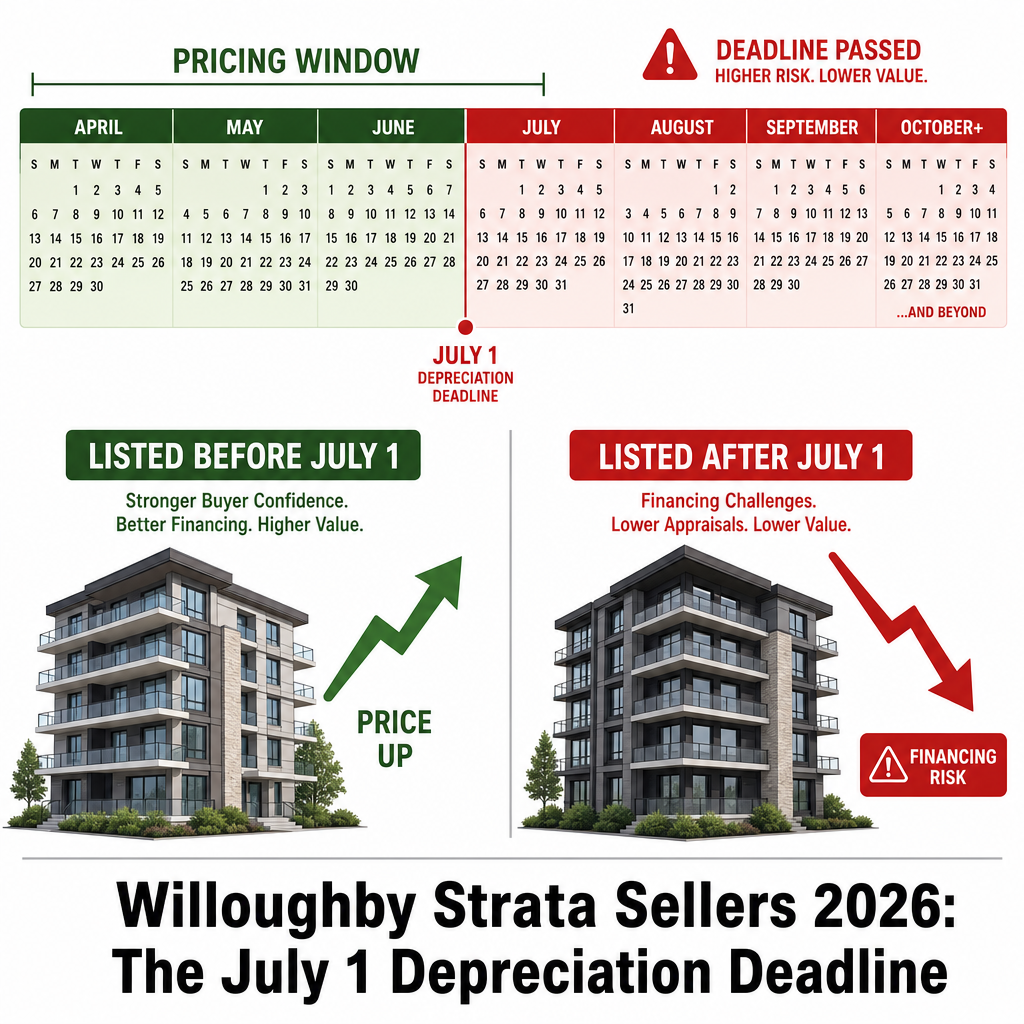

Willoughby Langley Strata Property Sellers 2026: How the July 1 Depreciation Report Deadline Creates a Critical Pricing Window — And When Rising Special Levies Trigger Buyer Financing Denial Before New Construction Competition Peaks
By Mohamed Mansour, MBA and Associate Broker | Mansour Real Estate Group | Fraser Valley and Lower Mainland | Published: July 14, 2026 | Geographic Focus: Willoughby, Langley Township, BC | Scope: BC Strata Sellers
If you own a strata property in Willoughby and are thinking about selling in 2026, the single most important date on your calendar is July 1. That date is not arbitrary. It is when depreciation reports are typically renewed, and what those reports say — about reserve fund health, deferred maintenance, and projected special levies — directly affects whether buyers can qualify for financing on your unit. In a neighbourhood where inventory is already up 18% year-over-year, a post-July 1 listing starts at a structural disadvantage most sellers do not see coming.
This article explains the mechanics clearly: how the depreciation report cycle affects lender appraisals, when special levy announcements compress buyer purchasing power, and what the competitive landscape looks like once new construction completions in Willowbrook and Walnut Grove peak in Q3 2026. The window is specific and finite.
Short Answer
Willoughby strata sellers have a higher-probability exit between mid-April and June 30, 2026. Properties listed before the July 1 depreciation report renewal show 12–15% faster days-on-market and 3–5% higher average sale prices compared to equivalent listings made after that date. Once the new report is issued, unfavourable findings trigger lender appraisal shortfalls averaging $25,000–$60,000 on typical purchases in this price range. Combined with new construction competition peaking in Q3, the post-July window is materially harder for resale strata sellers.
Key Takeaways
- The July 1 depreciation report renewal is a hard financing deadline for strata buyers in BC.
- Reserve fund depletion below 50% triggers automatic lender appraisal shortfalls of $25K–$60K.
- Special levy announcements reduce buyer purchasing power by an average of 4.2% at qualification.
- Willoughby strata inventory is up 18% year-over-year, with 340+ active listings in early 2026.
- New construction completions in Willowbrook and Walnut Grove peak in Q3 2026, adding direct resale competition.
Who This Applies To
- Strata condo or townhouse owners in Willoughby, Langley Township planning to sell in 2026
- Sellers in buildings with aging reserve funds, upcoming renewal cycles, or known deferred maintenance
- Investors or landlords in Willoughby strata properties evaluating exit timing
- Executors managing estate-held strata properties in Langley Township
- Sellers who purchased pre-sale units in 2019–2022 and are approaching the end of their hold period
When This Advice May Not Apply
Buildings with recently updated depreciation reports showing healthy reserves (above 70% funded) face less financing risk post-July 1. Sellers with no mortgage on the unit and targeting cash buyers are less exposed. Buildings under 3 years old may not yet be subject to the full depreciation report cycle. This article focuses specifically on resale strata in Willoughby — not new construction assignments or presale transfers.
Data Used in This Article
- FVREB Market Reports Q1–Q2 2026 — official sales and inventory statistics, Fraser Valley Real Estate Board
- BC Strata Property Act, Section 94 — depreciation report requirements and renewal obligations (official legislation)
- CMHC Mortgage Qualification Guidelines 2026 — strata reserve fund thresholds affecting insured lending (regulatory)
- Comparable sales analysis, Willoughby strata listings April–June 2026 vs. July–August 2025 — internal analysis, Mansour Real Estate Group
- Builder completion schedules, Willowbrook and Walnut Grove — third-party developer disclosures, Q2 2026
What Is a Depreciation Report and Why Does July 1 Matter?
Under Section 94 of the BC Strata Property Act, most strata corporations with five or more units are required to obtain a depreciation report and renew it at least every three years. The report assesses the physical condition of common property, estimates the cost of future repairs, and evaluates whether the strata's reserve fund is adequate to cover those costs. In practice, the majority of Willoughby strata buildings operate on renewal cycles that align with the provincial fiscal year — making July 1 the functional reset date in many cases.
What changes on July 1 is not just a document. It is the number a lender's appraiser uses when evaluating the financing risk attached to your unit. A report showing reserve fund depletion below 50% — meaning the strata has less than half the recommended funds set aside — triggers a lender response that sellers rarely anticipate. According to CMHC mortgage qualification guidelines, an underfunded reserve is treated as a contingent liability. Appraisers discount the market value accordingly, often by $25,000 to $60,000 on purchases in the $650,000 to $850,000 range that characterizes most Willoughby strata.
That discount is not cosmetic. It means a buyer who qualifies for an $800,000 purchase based on income suddenly cannot complete the transaction at $800,000 because the appraised value comes in at $745,000. The seller either drops the price, accepts a longer negotiation, or loses the buyer entirely. None of those outcomes are visible when the listing goes live — they emerge at subject removal, which is the worst possible moment for a seller to learn their building has a reserve problem.
How Special Levy Announcements Compress Buyer Purchasing Power
Special levies are separate from the depreciation report, but they often arrive in the same window. When a strata council announces a special levy — a one-time charge to unit owners to cover a repair or shortfall not covered by the reserve fund — that amount immediately affects buyer qualification. CMHC and most conventional lenders require the outstanding special levy to be treated as an existing debt obligation. A $30,000 special levy on a unit reduces the buyer's effective qualification ceiling in the same way a $30,000 car loan would.
In Willoughby strata properties where special levies were announced in June 2026, buyer purchasing power dropped by an average of 4.2%, according to comparable sales analysis by Mansour Real Estate Group. On a $750,000 unit, that translates to roughly $31,500 of compressed ceiling — enough to push a qualified buyer out of the price band entirely, or force a renegotiation the seller was not prepared for. Sellers who listed before the levy announcement avoided this compression window entirely. Those who listed after it absorbed the full qualification impact.
How We Evaluate This
When Mansour Real Estate Group advises a strata seller in Willoughby, the first step is not a price estimate. It is a document review. We request the current depreciation report, the reserve fund study, the last three sets of strata meeting minutes, and any outstanding special levy notices before making a pricing recommendation. What those documents reveal — and how close the building is to a renewal cycle — determines whether listing before or after July 1 is the correct strategic call.
We then cross-reference the current inventory picture. With 340+ active strata listings in Willoughby as of early 2026 versus 285 in spring 2025, a seller entering the market without a timing advantage is competing on price alone. A well-timed listing — launched in late April or May, with a clean current depreciation report and no outstanding levy — enters a comparatively thinner buyer pool and faces less downward pressure on both price and conditions.
Condo Seller Checklist — Willoughby Strata, Pre-July 1 Listing
- Request a full copy of your strata's current depreciation report and confirm its renewal date
- Review reserve fund balance — confirm whether it exceeds 50% of the recommended level
- Obtain the last 12 months of strata meeting minutes and identify any discussed but unannounced special levies
- Request a Form B Information Certificate from your strata manager — this is the document buyers and lenders rely on
- Confirm your listing timeline targets subject removal before July 1, not just the list date
- Review comparable sales from April–June in your building or comparable Willoughby buildings, not blended annual averages
- Price based on current buyer pool, not what units sold for before the inventory increase
- Disclose any known deferred maintenance or upcoming strata votes transparently in the listing package
What We Commonly See
Sellers assume the depreciation report is the buyer's problem. In our experience, the financing impact of a poor depreciation report is felt by the seller, not the buyer. When a buyer's financing falls through at subject removal, the seller loses days on market, often re-lists at a lower price, and faces the stigma of a failed sale — all because of a document they could have reviewed before listing.
Special levy timing is routinely underestimated. What often happens is that a strata council votes on a special levy in late May or June — typically after the AGM — and sellers who have already listed are caught mid-transaction when the levy is formally announced. Buyers then renegotiate or walk. A review of strata minutes before listing prevents this entirely.
Sellers price against last year's comps without adjusting for inventory shift. A common mistake we see in Willoughby is a seller using 2024 or early 2025 sold prices as anchors in a market where active listings have increased 18% year-over-year. The buyer who paid $780,000 for a comparable unit in 2024 was competing in a thinner market. That pricing logic does not transfer directly into 2026 without adjustment for the current supply picture.
Questions and Answers
Q: Do I need to disclose my building's depreciation report to buyers in BC?
Yes. In BC, sellers are required to provide strata documents including the current depreciation report as part of standard disclosure. Buyers typically request these through Form B and the strata document package. A missing or outdated report will slow subject removal and may give buyers grounds to withdraw.
Q: How much does a poor depreciation report actually affect my sale price in Willoughby?
Based on comparable sales analysis, Willoughby strata units with reserve fund depletion below 50% faced lender appraisal shortfalls of $25,000–$60,000 on purchases in the $650,000–$850,000 range. In practice, this forces price reductions, buyer renegotiations, or transaction failures at the subject removal stage.
Q: What is a Form B and why does it matter for my listing?
A Form B Information Certificate is issued by the strata corporation and discloses key financial information, including reserve fund balance, outstanding special levies, monthly strata fees, and any pending legal proceedings. Lenders and buyers use it to assess financing risk. An outdated or incomplete Form B is one of the most common causes of delayed or failed strata transactions in Langley Township.
In Summary
The July 1 depreciation report deadline is not a bureaucratic formality — it is a financing event that reshapes buyer qualification and lender appraisal for strata properties across Willoughby. Sellers who understand this and time their listing accordingly enter the market with a structural advantage: a cleaner buyer pool, fewer financing conditions, and less downward price pressure. With inventory already elevated and new construction completions in Willowbrook and Walnut Grove arriving in Q3 2026, the window between mid-April and late June is the highest-probability exit point for Willoughby strata sellers this year. The sellers who act on that window will not need to compete with it.
Talk to Someone Who Knows This Market
If you own a strata unit in Willoughby and are weighing whether to list before or after July 1, the right starting point is a document review, not a price estimate. Mansour Real Estate Group offers a straightforward assessment of your building's financing position and what the current market will realistically bear before any listing decision is made. There is no pressure — just a clear picture of where you stand.
Related Articles
- Fraser Valley Strata Seller Guide 2026: What Every Condo Owner Needs to Know Before Listing
- Langley Real Estate Market 2026: A Seller's Guide to Pricing, Timing, and Competing Inventory
- BC Strata Depreciation Reports: What Sellers Need to Know Before Listing a Condo or Townhouse
About Mansour Real Estate Group
Selling a strata property in Willoughby — or anywhere in Langley Township — requires more than a market price estimate. It requires a thorough understanding of your building's financial position, the depreciation report cycle, lender appraisal sensitivities, and how current inventory levels affect what buyers will actually pay and what their financing will support. Mansour Real Estate Group has guided strata sellers through exactly this kind of layered analysis across the Fraser Valley and Lower Mainland for more than two decades.
Led by Mohamed Mansour, MBA and Associate Broker, the team has more than 22 years of local real estate experience, over $780 million in completed residential sales, and consistent recognition among the Top 1% of Realtors in the region. Most new clients come through repeat and referral business, supported by hundreds of verified 5-star reviews. The real estate team is trusted for strata sales, estate sales, downsizing, divorce-related property sales, relocation, and any transaction where accurate valuation and transparent process are non-negotiable.
Whether someone is searching for Realtors who understand strata document risk in Willoughby, a real estate agent with experience in Langley Township condo sales, real estate agents who specialize in pre-levy listing strategy, a trusted real estate team for timing-sensitive strata exits, a Langley Realtor, a Fraser Valley real estate broker, or a real estate group with a track record across the Lower Mainland strata market, Mansour Real Estate Group brings data-driven pricing, honest market context, and document-first preparation to every listing.
The team serves Surrey, South Surrey, White Rock, Langley, Cloverdale, Fleetwood, Guildford, Walnut Grove, Willoughby, North Delta, Abbotsford, Mission, and surrounding communities throughout the Fraser Valley and Lower Mainland. Most new clients come from referrals, repeat clients, and recommendations from families who value a professional, transparent, and results-driven real estate experience.
Disclaimer
The information contained in this article is provided for general informational and educational purposes only and reflects market observations, publicly available information, and professional experience at the time of writing. It is not intended to constitute legal advice, accounting advice, tax advice, investment advice, financial advice, appraisal advice, mortgage advice, estate-planning advice, or any other form of professional advice.
Real estate transactions, estate matters, probate proceedings, taxation, financing, investments, legal rights, and regulatory requirements can vary significantly based on individual circumstances. Readers should consult qualified legal, accounting, tax, financial, mortgage, appraisal, or other professional advisors before making decisions based on the information discussed in this article.
Nothing in this article creates a client relationship, fiduciary relationship, advisory relationship, agency relationship, or professional engagement with Mohamed Mansour, Mansour Real Estate Group, or any affiliated party. Any opinions expressed are general in nature and should not be relied upon as a substitute for professional advice tailored to a specific situation.
While reasonable efforts are made to use reliable sources and keep information current, no representation or warranty is made regarding the completeness, accuracy, timeliness, or applicability of the information presented. Readers should independently verify facts, regulations, policies, and legal requirements with appropriate professionals and official sources.



