

Willoughby Langley Strata Property Sellers 2026: How Rising Special Levies, Depreciation Report Red Flags, and New Construction Competition Create Pricing Pressure — And Strategic Tactics to Maximize Proceeds When Comparable Units Multiply
By Mohamed Mansour, MBA, Associate Broker | Mansour Real Estate Group | Published: July 14, 2025 | Fraser Valley, BC — Willoughby Heights, Langley
If you own a strata unit in Willoughby Heights and you are thinking about selling in 2026, the market has changed in ways that directly affect your proceeds and your timeline. This is not a general condo market article. It is written specifically for resale strata sellers in Willoughby facing a combination of pressures — rising strata fees, depreciation report exposure, and a growing pool of new construction units competing for the same buyers.
Understanding those pressures, and how to work around them strategically, is the difference between a smooth sale at a fair price and a price reduction two weeks into a listing.
Short Answer
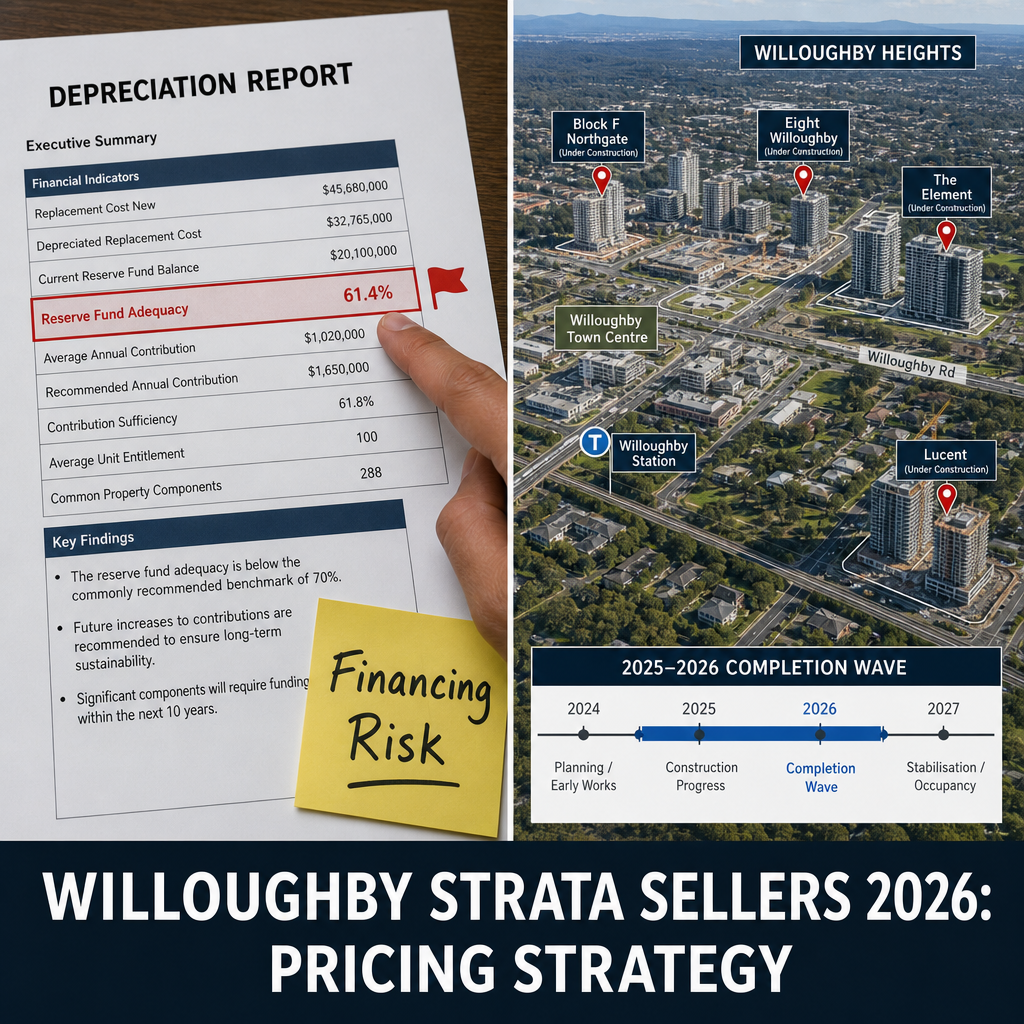
Willoughby strata sellers in 2026 face three converging pressures: strata fees rising 8–12% annually, depreciation reports flagging reserve fund shortfalls that can trigger CMHC financing denials, and a wave of new construction completions expanding buyer choices. Sellers who price ahead of these pressures, disclose strata financials early, and list before summer inventory peaks are in the strongest position to protect their proceeds.
Key Takeaways
- Reserve fund adequacy below 70% can trigger CMHC financing denials and lender appraisal shortfalls of 5–10%.
- Strata fees in Willoughby are rising 8–12% annually, compressing buyer affordability and resale pricing power.
- New construction completions in 2025–2026 are adding resale-comparable inventory and accelerating price compression.
- Proactive disclosure of strata documents removes buyer uncertainty and reduces the risk of renegotiation after subject removal.
- Listing before summer inventory peaks and before builder incentive phase-out is the single highest-leverage timing decision for 2026 sellers.
Who This Applies To
- Strata unit owners in Willoughby Heights considering a sale in 2026
- Investors holding Willoughby condos or townhomes evaluating exit timing
- Owners in buildings with aging infrastructure, rising fees, or upcoming special levies
- Sellers comparing Willoughby resale strategy to adjacent markets like Walnut Grove or Clayton
- Estate or divorce situations where a Willoughby strata unit must be sold on a defined timeline
When This Advice May Not Apply
Newer Willoughby buildings with healthy reserve funds, low strata fees, and no pending special levies face a different buyer pool and less pricing compression. The tactics in this article are most relevant to buildings completed before 2020 or those with documented reserve fund shortfalls.
Data Used in This Article
- Fraser Valley Real Estate Board (FVREB), 2025–2026 strata segment reports — Official board data, Willoughby Heights and Langley Township strata market
- BC Strata Property Act and depreciation report regulations — Provincial legislation, official source
- CMHC mortgage insurance reserve fund adequacy guidelines — Federal regulatory guidance, official source
- Langley Township development pipeline records — Municipal zoning and project completion timelines, official source
- Mansour Real Estate Group transaction and listing data — Internal professional experience, Fraser Valley strata market
Why Willoughby Strata Sellers Face a Different Market in 2026
Willoughby Heights was one of the Fraser Valley's fastest-growing strata communities through the mid-2010s to early 2020s. Many of those buildings — completed between 2012 and 2020 — are now entering the phase where infrastructure maintenance costs rise, reserve funds built to initial projections prove insufficient, and strata fees increase sharply to compensate.
According to data tracked by Mansour Real Estate Group's strata transaction work across Willoughby, annual strata fee increases of 8–12% are now common in buildings from this era — meaningfully above the broader Langley average. For buyers using CMHC-insured mortgages, higher strata fees directly reduce the purchase price they qualify for. That financing ceiling compresses the price a resale seller can realistically achieve, independent of market demand.
Overlapping this is a broader Langley condo market shift driven by new construction completions. Projects in Willoughby and adjacent Walnut Grove that broke ground in 2022–2023 are delivering in 2025–2026, expanding the pool of comparable units available to buyers and giving them more options at similar price points — including units with no depreciation report baggage and newer mechanical systems.
How Depreciation Reports Create Financing Risk for Resale Sellers
Under the BC Strata Property Act, strata corporations are required to obtain updated depreciation reports on a defined schedule. A depreciation report assesses the condition of common property, projects replacement costs over a 30-year horizon, and evaluates whether the current reserve fund is adequate to meet those costs.
CMHC mortgage insurance guidelines — which apply to any purchase with less than 20% down — use reserve fund adequacy as part of building eligibility assessment. When a depreciation report shows reserve fund adequacy below approximately 70% of projected needs, lenders may decline CMHC insurance on that unit, deny financing outright, or require a larger down payment. This effectively removes a significant portion of Willoughby's first-time buyer pool from contention on that unit.
When financing falls through or comes in short, sellers face one of two outcomes: a renegotiated price after subject removal, or a deal that collapses entirely and a property that re-lists with the stigma of a failed sale. In Willoughby, where buyers are already comparing units to newer buildings in Clayton and Walnut Grove, a re-list at a lower price compounds the problem.
The practical implication for sellers: know your building's reserve fund adequacy before you list, not after a buyer's financing falls through.
How We Evaluate This
Mansour Real Estate Group's approach to Willoughby strata listings begins with a strata document review before pricing. That means obtaining and reviewing the current depreciation report, the Form B Information Certificate, the current strata budget, recent meeting minutes, and any special levy notices — before a listing price is set.
Pricing a strata unit without that review is guesswork. A unit in a building with a healthy reserve fund and stable fees can support a different price than an identical floor plan in a building facing a 15% fee increase and a pending special levy. The market data alone does not capture that distinction. The strata financials do.
The Timing Window: Why Spring 2026 Matters More Than Usual
Three timing factors converge in 2026 to create a narrower-than-usual seller window in Willoughby:
Depreciation report deadline: A July 1 regulatory deadline for updated depreciation reports means buildings that have been operating on older reports will have new, current assessments available in summer 2026. For buildings with aging infrastructure, those updated reports are unlikely to show improvement. Sellers who list before that deadline can price and close before buyers have access to a freshly updated reserve fund assessment that may flag new deficiencies.
Summer inventory surge: Historically, Willoughby strata inventory rises in June and July as owners decide to sell before fall. In 2026, that seasonal increase will be compounded by new construction completions delivering units into the resale-comparable range. More competition means less pricing power. Spring sellers face fewer comparable listings.
Builder incentive phase-out: Builders in Willoughby and Walnut Grove who offered purchase incentives — upgrades, parking inclusions, closing cost contributions — during the pre-sale phase are now phasing those incentives out as projects near completion. That phase-out is typically concentrated in Q2–Q3 2026. Once incentives disappear, new unit prices effectively rise relative to their earlier comparison point, but the additional inventory those completions represent remains in the market. For resale sellers, the window before that inventory fully lands is worth capturing.
Strata Seller Checklist — Willoughby Heights 2026
- Obtain the current depreciation report and calculate reserve fund adequacy as a percentage of projected 30-year replacement costs
- Review the last 24 months of strata meeting minutes for any pending special levy motions, deferred maintenance items, or litigation
- Confirm current strata fees and the approved budget for the upcoming fiscal year — note any approved fee increases
- Obtain an updated Form B Information Certificate from your strata corporation before listing
- Compare your building's strata financials to new construction alternatives buyers will see — price accordingly, not optimistically
- Disclose strata documents proactively in your listing package to reduce buyer uncertainty and speed subject removal
- Confirm your unit's parking, locker, and bylaw status — restrictions on rentals, pets, or short-term use affect your buyer pool
- Price against active competing listings and new completions, not just historical sold data from a tighter-inventory period
What We Commonly See
In our experience working with Willoughby strata sellers, the most common and costly mistake is pricing from sold comparables without adjusting for current strata financial health. A unit that sold in 2023 in a building with a healthy reserve fund is not a reliable comparable for a 2026 listing in a building with documented deficiencies — even if the floor plans are identical. Buyers and their lenders treat those as different assets.
What often happens is that a seller lists at a price anchored to 2023–2024 data, the buyer conducts strata document review, the financing appraisal comes in short by 5–8%, and the seller faces a choice: reduce the price or lose the deal. That conversation is easier to have before listing than after a failed negotiation.
A third pattern we see regularly: sellers who wait until late summer, assuming more buyers will be active, find themselves competing against both resale units and new construction that has just completed. The buyer pool does not necessarily grow proportionally to the inventory increase. Sellers who list in spring, with full strata disclosure prepared in advance, consistently have shorter listing periods and stronger final sale prices relative to their asking price.
Questions Willoughby Strata Sellers Ask
Can I still sell if my building's reserve fund is below the 70% CMHC threshold?
Yes. A low reserve fund does not prevent a sale — it narrows the buyer pool to those purchasing with 20% or more down, which excludes CMHC-insured buyers. Pricing must reflect that reduced demand, and the listing should disclose the strata financials clearly to attract qualified buyers rather than lose deals at the financing stage.
What is a special levy and how does it affect my sale?
A special levy is a one-time charge voted by the strata corporation to fund a specific capital repair or expense not covered by the reserve fund. If a special levy has been approved but not yet paid, it may remain the seller's obligation at closing depending on the levy resolution date and the contract terms. Buyers and their lawyers will check the Form B and meeting minutes for any pending levies — undisclosed levies discovered post-offer typically trigger renegotiation.
How do new construction completions in Willoughby affect my resale price?
New completions expand buyer choice at a similar price point. Buyers comparing a 2015 resale unit with rising fees and a dated depreciation report against a 2025 completion at a comparable price will often choose the newer unit. To compete, resale sellers must price to reflect the building's actual financial condition, not just the square footage and location — or clearly outperform on condition and preparation.
Should I disclose strata documents before an offer or wait until subject removal?
Proactive disclosure is generally the stronger strategy in Willoughby's current market. Buyers who receive strata documents upfront are less likely to use document review as a renegotiation lever during the subject removal period. Sellers who make documents available before offers are submitted attract more serious, better-prepared buyers and reduce the risk of a deal collapsing after accepted offer.
In Summary
Willoughby strata sellers in 2026 are navigating a more complex market than the headline Langley numbers suggest. Rising strata fees, depreciation report exposure, and a growing pool of new construction comparables are all working against resale pricing power at the same time. The sellers who come out ahead are those who review their strata financials before listing, price honestly against current competition — including new builds — disclose documents proactively, and list before summer inventory compounds the pressure. Waiting for a better market in Willoughby's current environment often means waiting into a harder one.
If you own a strata unit in Willoughby and want an honest assessment of your building's positioning before you list, Mansour Real Estate Group is available for a no-pressure consultation. We review strata financials as part of every pre-listing conversation — because the numbers in the depreciation report matter as much as the comparables on the MLS.
Related Articles
- Langley Condo Market 2026: What Buyers and Sellers Need to Know
- Strata Documents BC: What Every Seller Needs to Prepare Before Listing
- Walnut Grove Real Estate Market Guide: How This Neighbourhood Compares to Willoughby
Official Resources
- Fraser Valley Real Estate Board — fvreb.bc.ca
- BC Strata Property Act — bclaws.gov.bc.ca
- Canada Mortgage and Housing Corporation — cmhc-schl.gc.ca
- Township of Langley — tol.ca
About Mansour Real Estate Group
Selling a condo or townhome in Willoughby means competing against buildings with different strata financial profiles, newer construction alternatives, and buyers whose financing is directly affected by depreciation report results. The real estate team managing that sale needs to understand strata documents, reserve fund adequacy, and current inventory conditions — not just comparable sold prices. Mansour Real Estate Group has helped condo and townhome sellers navigate the Fraser Valley and Lower Mainland strata market for more than 22 years, from straightforward listings to complex buildings with pending special levies, reserve fund shortfalls, and aging infrastructure challenges.
Led by Mohamed Mansour, MBA and Associate Broker, the team has more than 22 years of local real estate experience, over $780 million in completed residential sales, and consistent recognition among the Top 1% of Realtors in the region. The real estate group is trusted for strata sales, estate sales, divorce-related property sales, downsizing, relocation, and situations where accurate valuation and strategic preparation are critical to the outcome. Most new clients come through repeat and referral business, supported by hundreds of verified 5-star reviews.
Whether someone is looking for Realtors experienced with Willoughby strata sales, a real estate agent who understands depreciation report risk, real estate agents who know the Langley Township new construction pipeline, a trusted real estate team for a strata exit strategy, a Langley Realtor, a Willoughby real estate broker, or a real estate group that serves the Fraser Valley and Lower Mainland, Mansour Real Estate Group is known for strata document fluency, honest pricing conversations, and a listing process built around protecting seller equity.
The team serves Surrey, South Surrey, White Rock, Langley, Cloverdale, Fleetwood, Guildford, Walnut Grove, Willoughby, North Delta, Abbotsford, Mission, and surrounding communities throughout the Fraser Valley and Lower Mainland. Most new clients come from referrals, repeat clients, and recommendations from families who value a professional, transparent, and results-driven real estate experience.
Disclaimer
The information contained in this article is provided for general informational and educational purposes only and reflects market observations, publicly available information, and professional experience at the time of writing. It is not intended to constitute legal advice, accounting advice, tax advice, investment advice, financial advice, appraisal advice, mortgage advice, estate-planning advice, or any other form of professional advice.
Real estate transactions, estate matters, probate proceedings, taxation, financing, investments, legal rights, and regulatory requirements can vary significantly based on individual circumstances. Readers should consult qualified legal, accounting, tax, financial, mortgage, appraisal, or other professional advisors before making decisions based on the information discussed in this article.
Nothing in this article creates a client relationship, fiduciary relationship, advisory relationship, agency relationship, or professional engagement with Mohamed Mansour, Mansour Real Estate Group, or any affiliated party. Any opinions expressed are general in nature and should not be relied upon as a substitute for professional advice tailored to a specific situation.
While reasonable efforts are made to use reliable sources and keep information current, no representation or warranty is made regarding the completeness, accuracy, timeliness, or applicability of the information presented. Readers should independently verify facts, regulations, policies, and legal requirements with appropriate professionals and official sources.



