
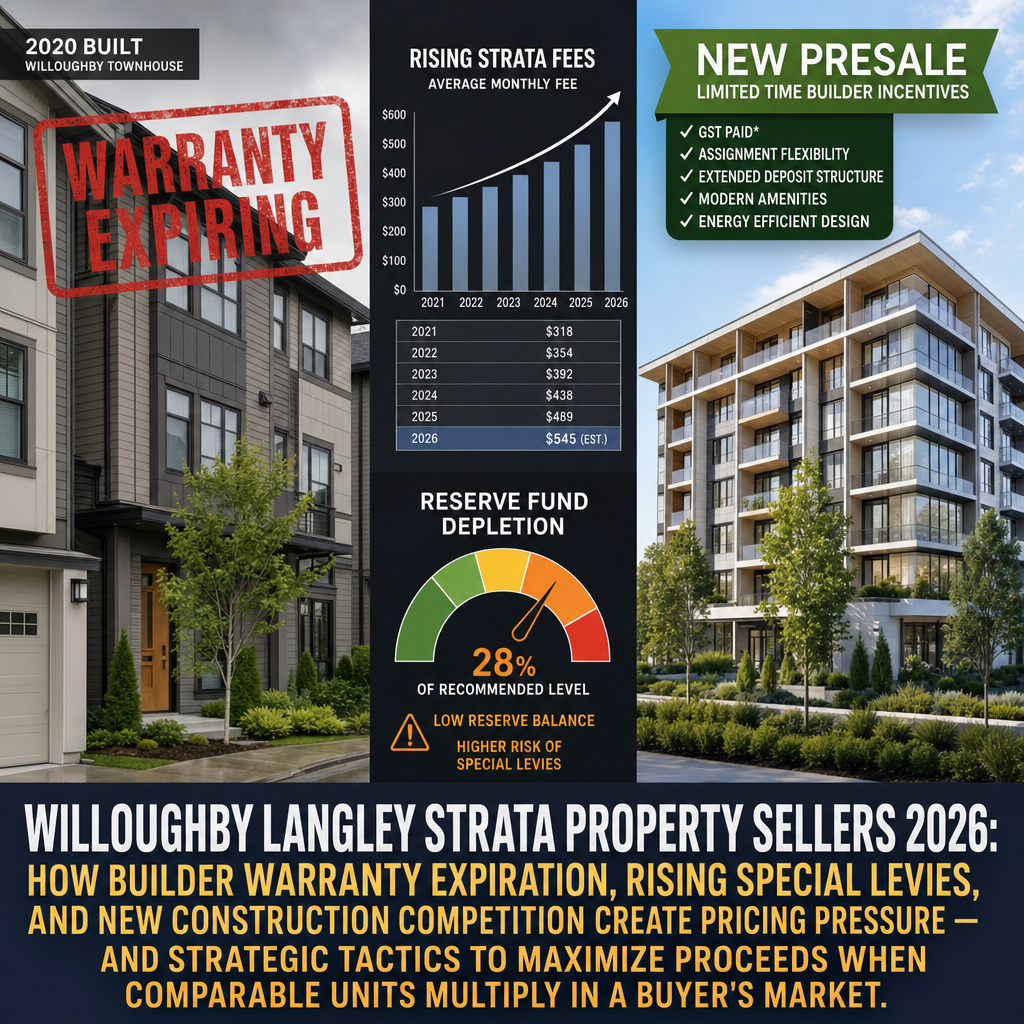

Willoughby Langley Strata Property Sellers 2026: How Builder Warranty Expiration, Rising Special Levies, and New Construction Competition Create Pricing Pressure — And Strategic Tactics to Maximize Proceeds When Comparable Units Multiply in a Buyer's Market
By Mohamed Mansour, MBA and Associate Broker | Mansour Real Estate Group | Fraser Valley & Lower Mainland | Published: July 15, 2026
If you own a strata property in Willoughby and you are considering selling in 2026, the market you are selling into is materially different from even two years ago. Three forces have arrived at the same time: builder warranties on 2019–2021 completions are expiring, depreciation reports are revealing reserve fund shortfalls, and new presale projects are competing for the same buyers your listing needs. Each factor alone would require a pricing adjustment. Together, they require a strategy.
This article explains how these three pressures interact, what buyers and their lenders are reacting to, and what sellers can do before listing to protect their proceeds and reduce time on market.
Short Answer
Willoughby strata sellers in 2026 face simultaneous pressure from expiring builder warranties, rising strata fees triggered by depreciation report findings, and direct competition from new presale inventory offering builder incentives. Sellers who price reactively — without accounting for these factors — risk extended days-on-market and forced reductions. Sellers who address these factors proactively before listing can still achieve strong outcomes.
Key Takeaways
- Builder warranties on Willoughby strata completions from 2019–2021 are expiring in the 5–7 year window, transferring defect liability risk to current owners and creating buyer hesitation.
- Depreciation reports filed ahead of the July 1, 2026 BC deadline are surfacing reserve fund shortfalls and triggering strata fee increases of 15–25%, which directly affect buyer financing qualification.
- New presale strata and detached projects in Willoughby and Langley Township are offering builder incentives, modern finishes, and fresh warranties that compete directly with resale listings.
- The sales-to-active ratio for Willoughby townhomes remains in the 15–23% range, but days-on-market are lengthening as buyer choice expands and lender scrutiny of strata documents increases.
- Sellers who disclose warranty status, address cosmetic deficiencies, and price relative to new construction — not just comparable resales — are better positioned to complete transactions without post-inspection renegotiation.
Who This Applies To
- Owners of strata townhomes, condos, or rowhomes in Willoughby completed between 2018 and 2022
- Sellers whose strata corporation has recently filed or is about to file a depreciation report
- Owners who have received notice of strata fee increases or pending special levies
- Sellers considering listing in a complex where new phases or competing buildings are completing nearby
- Investors or move-up buyers planning to sell a Willoughby strata unit within the next 12 months
When This Advice May Not Apply
If your strata building was completed before 2015 and has a well-funded reserve with a current depreciation report showing no major upcoming expenditures, several of these pressures may not apply at the same intensity. Each building's financial and warranty situation is specific — consult your strata documents and a qualified real estate professional before drawing conclusions about your unit.
Key Terms
Builder Warranty (BC Homeowner Protection Act): In BC, new homes carry layered warranties: 1 year for defects in materials and labour, 2 years for major systems, 5 years for the building envelope, and 10 years for structural defects. When a unit reaches the 5-year or 7-year mark, coverage on certain components expires and owner liability increases.
Depreciation Report: A report required under the BC Strata Property Act that outlines a strata corporation's physical assets, projected repair and replacement timelines, and the adequacy of the reserve fund. Under BC regulations, most strata corporations must file an updated report by July 1, 2026.
Special Levy: A one-time charge imposed by a strata corporation on all owners when the reserve fund is insufficient to cover a required repair or capital expenditure. Special levies require a three-quarters vote of owners and can range from hundreds to tens of thousands of dollars per unit.
Sales-to-Active Ratio: The percentage of active listings that sold in a given month. Ratios below 12% indicate a buyer's market; 12–20% a balanced market; above 20% a seller's market. For Willoughby townhomes, the Fraser Valley Real Estate Board has reported ratios in the 15–23% range in recent months.
Form B: The Information Certificate required under BC's Strata Property Act, which discloses strata fees, the reserve fund balance, outstanding special levies, pending litigation, and other financial details a buyer's lender will review before approving financing.
Data Used in This Article
- Fraser Valley Real Estate Board market reports, April–May 2026 (official; sales-to-active ratios, days-on-market, townhome inventory)
- BC Strata Property Act, SBC 1998, c. 43, and the Strata Property Regulation, BC Reg. 43/2000, as amended (depreciation report requirements and July 1, 2026 deadline)
- BC Homeowner Protection Act, SBC 1998, c. 31 (builder warranty coverage periods)
- Langley Township Official Community Plan updates, 2025–2026 (zoning context for new supply)
- Presale project inventory and marketing materials from Willoughby builders, 2025–2026 launches (third-party; used for competitive context only)
Why 2019–2021 Completion Dates Matter in 2026
Under the BC Homeowner Protection Act, new strata properties carry a layered warranty structure. The building envelope warranty — which covers water ingress, one of the most expensive and consequential failure categories in BC — runs five years from completion. For buildings completed in 2019 and 2020, that envelope warranty has already expired or will expire in 2025 or 2026. The 10-year structural warranty remains, but envelope coverage — the protection most relevant to buyers and lenders — is gone.
For buyers, this matters on two levels. First, any undiscovered building envelope issue discovered after purchase becomes the owner's problem, not the builder's. Second, some lenders apply additional scrutiny to strata buildings in the post-envelope-warranty period, particularly if the depreciation report shows deferred maintenance or if there are outstanding deficiency claims.
Sellers in this window are not disqualified from a strong sale. But they need to understand that buyers who have done their research — or whose agents have — will ask about warranty status, and the answer needs to be clear, accurate, and supported by documentation. A seller who can produce a clean deficiency status and a well-funded reserve fund is in a meaningfully different position than one who cannot. If your strata has open warranty claims or known building envelope concerns, those need to be factored into pricing before the listing goes live, not negotiated away after an inspection.
How Depreciation Reports Are Changing Buyer Financing in Willoughby
BC's updated strata depreciation report regulations set a compliance deadline of July 1, 2026, for most strata corporations that had been operating on waiver exemptions. The result is that many Willoughby strata buildings filed new or updated depreciation reports in the spring of 2026, some for the first time in years. What those reports often reveal is a reserve fund that has not kept pace with the building's actual aging — a common outcome in newer buildings where initial strata fees are set low to attract buyers and never meaningfully increased.
When a depreciation report shows a reserve fund shortfall relative to the projected 30-year cost of repairs and replacements, the strata council has a limited set of responses: increase monthly contributions, impose a special levy, defer maintenance (which compounds future costs), or some combination. For sellers, the practical consequence is that strata fee increases of 15–25% are appearing on Form B disclosures in affected buildings, and buyers' mortgage lenders are factoring those higher monthly costs into debt-service calculations.
A buyer who qualifies for a $700,000 purchase when strata fees are $350 per month may not qualify at the same purchase price if fees rise to $450 per month. That narrowing of the qualified buyer pool directly affects the number of competitive offers a seller can expect. Sellers in buildings with recently increased fees or pending special levies should price with that buyer pool constraint in mind — and should obtain the Form B and depreciation report themselves before listing, rather than waiting for a buyer's request to reveal what is in them. Understanding your own building's financial picture before it appears on a disclosure is one of the clearest competitive advantages a seller can have.
New Presale Competition: What Builders Are Offering That Resale Cannot
Willoughby and the broader Langley Township have seen continued presale launches through 2025 and into 2026. These projects benefit from Langley Township's Official Community Plan, which has continued to support higher-density residential development in the Willoughby community plan area. New presale strata and townhome projects are offering features that resale inventory simply cannot match: fresh 10-year structural and 5-year envelope warranties, builder completion incentives including upgrades, reduced deposits, and in some cases rate buydowns, modern open-concept layouts, EV-ready parking, and finishes that reflect current buyer preferences.
For a buyer choosing between a 2020-era resale townhome and a 2025-completion presale at a comparable price point, the presale's warranty package alone is a significant factor. Resale sellers competing in this environment need to be honest about where they stand on the value comparison. That does not mean accepting a discount automatically — it means positioning clearly. A resale unit with strong strata financials, updated finishes, and a well-maintained complex can still compete. One that offers none of those advantages at new-construction pricing will sit.
How We Evaluate This
When Mansour Real Estate Group assesses a Willoughby strata listing, the pricing conversation begins with the strata documents, not the comparable sales. The Form B, the most recent depreciation report, the current reserve fund balance, and any council meeting minutes referencing upcoming levies or repairs tell us more about how a buyer's lender will react than the last three sales in the complex.
From there, we map the competitive landscape: active resale inventory in the immediate area, new presale projects within a 10-minute radius, and how this specific unit's finishes, floor plan, and parking configuration compare to both. Pricing is then set relative to that full picture — not just the sold data. In a market where buyer choice is expanding, the sellers who understand their building's financial position and price accordingly are the ones who sell in the first two weeks. The sellers who price to a number that felt right based on 2024 comps are the ones revising downward in week five.
Strata Seller Checklist
- Obtain your strata's current Form B before listing — know the exact strata fee, reserve fund balance, and any disclosed special levies before a buyer's agent sees them first.
- Review the depreciation report filed in 2025 or 2026 and understand the reserve fund adequacy ratio — if it is below 80%, expect buyer and lender questions.
- Confirm your builder warranty status — identify which coverage tiers remain active and whether any warranty claims are open or have been closed without resolution.
- Check strata council minutes from the past 24 months for any references to pending repairs, special levy discussions, or building envelope assessments.
- Price relative to new presale competition — identify what a buyer can get from a builder at a comparable price and articulate concretely why your resale unit is the better value.
- Address visible cosmetic issues — in a market where buyers have more choices, condition matters more than it did in a low-inventory seller's market.
- Disclose proactively — strata fee increases, pending levies, and known building issues disclosed upfront protect the transaction from post-offer renegotiation.
What We Commonly See
In our experience working with Willoughby strata sellers, the most common mistake is pricing to comparable sold data without first reviewing the building's current financial disclosure documents. Sellers often assume their strata is financially healthy because they have not personally received a special levy notice — but a Form B reviewed by a buyer's lender tells a more complete story, and surprises at that stage cost sellers time, negotiating position, or the deal itself.
What often happens is that a seller receives an offer, the subject removal period begins, and the buyer's lender or agent reviews the depreciation report for the first time. If that report shows deferred maintenance, an underfunded reserve, or a pending vote on a special levy, the buyer returns to renegotiate — or walks. A seller who knew what was in those documents before listing could have adjusted pricing upfront, avoiding the renegotiation entirely.
A common mistake specific to 2026 is treating presale competition as irrelevant to resale pricing. Resale sellers sometimes say their unit is move-in-ready, which has immediate value that a presale completing in 18 months cannot offer. That is true. But if the price gap between the resale and the presale does not reflect the warranty, finishes, and incentive differential, informed buyers will wait for the new product. The "move-in-ready premium" has a ceiling, and in the current Willoughby market, it is lower than it was in 2022.
Questions and Answers
Q: My building was completed in 2020. Is the builder warranty still active?
Under BC's Homeowner Protection Act, the 5-year building envelope warranty on a 2020 completion expires in 2025. The 10-year structural warranty remains active until 2030. If you have specific deficiency concerns, contact your strata council or the BC Housing Licensing and Consumer Services office for warranty claim guidance before listing.
Q: How does a pending special levy affect my ability to sell?
A pending special levy disclosed on the Form B is a material fact that buyers and their lenders will review. It does not prevent a sale, but it affects pricing and buyer financing capacity. Sellers can sometimes negotiate whether the levy is assumed by the buyer or credited at completion — discuss the options with your real estate agent before listing.
Q: Is the Willoughby townhome market still in seller's territory in 2026?
According to FVREB data from April–May 2026, the sales-to-active ratio for Willoughby townhomes remains in the 15–23% range, which is broadly balanced to slightly seller-favoured. However, days-on-market are extending for listings that do not reflect current buyer expectations on price and condition.
Q: Can I sell a strata unit with a reserve fund shortfall?
Yes. A reserve fund shortfall does not prevent a sale, but it must be disclosed and it will affect the buyer pool. Lenders review reserve fund adequacy as part of strata mortgage approval. Properties in buildings with materially underfunded reserves may face a smaller pool of conventionally financed buyers, which affects pricing and offer competition.
Q: How do I price my Willoughby strata unit relative to new presale competition?
Begin by identifying the closest comparable presale projects in terms of unit size, floor plan, and location. Note the builder's list price, included incentives, and estimated completion timeline. Your resale price needs to account for the buyer's loss of warranty coverage relative to the presale, any strata fee or special levy exposure, and the premium value of immediate occupancy. A local real estate agent with current Willoughby market knowledge can walk through this comparison in detail before you set a list price.
In Summary
Willoughby strata sellers in 2026 are navigating a market shaped by three concurrent forces: expiring builder warranties on 2019–2021 completions, depreciation reports revealing reserve shortfalls and triggering fee increases, and new presale competition offering features resale cannot replicate. None of these factors automatically prevents a successful sale. But each one affects how buyers and their lenders evaluate a listing, and ignoring any of them in the pricing and preparation process is the most reliable path to an extended listing and a negotiated discount. Sellers who review their strata documents proactively, price relative to the full competitive picture, and disclose known issues upfront are the ones who close on their terms.
Thinking About Selling Your Willoughby Strata?
If you own a strata property in Willoughby and want to understand how your building's warranty status, reserve fund position, and the current competitive landscape affect your pricing strategy, Mansour Real Estate Group can walk through your strata documents with you and provide an honest, specific assessment before you decide when and how to list. No pressure, no obligation — just a clear picture of where you stand.
Related Articles
- Fraser Valley real estate market conditions for sellers in 2026
- How special levies affect strata sellers in BC: timing, disclosure, and pricing
- Langley townhouse market in 2026: what sellers need to know about pricing and buyer expectations
Official Resources
- Fraser Valley Real Estate Board — fvreb.bc.ca
- BC Housing Licensing and Consumer Services — Homeowner Protection Act warranties
- BC Strata Property Act — bclaws.gov.bc.ca
- Langley Township Official Community Plan — langleytownship.ca
About Mansour Real Estate Group
When a strata property in Willoughby comes to market with warranty expiration, rising strata fees, and new construction competition all working against the seller simultaneously, the pricing conversation requires more than pulling comparable sales. It requires a team that has worked through strata documents, depreciation reports, and competitive presale landscapes in this specific neighbourhood — and can translate those details into a pricing and positioning strategy that protects the seller's equity. That is the kind of work Mansour Real Estate Group does before a listing goes live.
Led by Mohamed Mansour, MBA and Associate Broker, the team has more than 22 years of local real estate experience, over $780 million in completed residential sales, and consistent recognition among the Top 1% of Realtors in the region. Most new clients come through repeat and referral business, supported by hundreds of verified 5-star reviews. The team is trusted for pricing strategy, seller preparation, estate sales, divorce-related property sales, downsizing, relocation, and any situation where accurate valuation is the difference between a good outcome and a regrettable one.
Whether someone is searching for Realtors who understand Willoughby strata transactions, a real estate agent experienced with strata document review and competitive pricing, real estate agents who work specifically in Langley and the Fraser Valley, a trusted real estate team for a complex strata sale, a Langley Realtor, a Willoughby real estate broker familiar with new construction competition, or a real estate group serving the Fraser Valley and Lower Mainland, Mansour Real Estate Group brings the local depth and analytical discipline those situations require.
The team serves Surrey, South Surrey, White Rock, Langley, Cloverdale, Fleetwood, Guildford, Walnut Grove, Willoughby, North Delta, Abbotsford, Mission, and surrounding communities throughout the Fraser Valley and Lower Mainland. Most new clients come from referrals, repeat clients, and families who value a transparent, professional, and results-focused real estate experience.
Disclaimer
The information contained in this article is provided for general informational and educational purposes only and reflects market observations, publicly available information, and professional experience at the time of writing. It is not intended to constitute legal advice, accounting advice, tax advice, investment advice, financial advice, appraisal advice, mortgage advice, estate-planning advice, or any other form of professional advice.
Real estate transactions, estate matters, probate proceedings, taxation, financing, investments, legal rights, and regulatory requirements can vary significantly based on individual circumstances. Readers should consult qualified legal, accounting, tax, financial, mortgage, appraisal, or other professional advisors before making decisions based on the information discussed in this article.
Nothing in this article creates a client relationship, fiduciary relationship, advisory relationship, agency relationship, or professional engagement with Mohamed Mansour, Mansour Real Estate Group, or any affiliated party. Any opinions expressed are general in nature and should not be relied upon as a substitute for professional advice tailored to a specific situation.
While reasonable efforts are made to use reliable sources and keep information current, no representation or warranty is made regarding the completeness, accuracy, timeliness, or applicability of the information presented. Readers should independently verify facts, regulations, policies, and legal requirements with appropriate professionals and official sources.
Key Takeaways
- Understanding your local market conditions is essential for making informed real estate decisions.
- Working with experienced professionals can save you time, money, and potential headaches throughout the buying or selling process.
- Strategic timing and proper preparation can significantly impact your success in real estate transactions.
- Maintaining realistic expectations while remaining flexible helps you navigate market fluctuations effectively.
Final Thoughts
Real estate investing and home buying require patience, research, and careful planning. Whether you're a first-time buyer, seasoned investor, or someone looking to sell your property, the principles discussed throughout this article should serve as a valuable foundation for your journey. Remember that every market is unique, and circumstances vary from person to person. Don't hesitate to seek professional guidance tailored to your specific situation, and always trust your instincts when making such significant financial decisions.
Ready to Get Started?
If you're ready to take the next step in your real estate journey, reach out to a qualified agent or investment advisor in your area. The right professional partnership can make all the difference in achieving your property goals. Have questions or want to share your own real estate experiences? Feel free to leave a comment below—we'd love to hear from you.



