

Willoughby Langley Strata Property Buyers' Complete Guide 2026: Reading Form B and Depreciation Reports, Assessing Special Levy Risk, Understanding Builder Warranty Coverage, Calculating True Carrying Costs, and the Critical Questions to Ask Before Removing Subjects
By Mohamed Mansour, MBA, Associate Broker | Mansour Real Estate Group | Fraser Valley & Lower Mainland | Published: July 15, 2026
Willoughby is one of the Fraser Valley's most active strata markets, and it is also one of the most financially layered. A large share of the townhome inventory is now 15 to 20 years old, which means builder warranties are expiring, reserve funds are under pressure, and strata fees are rising faster than many buyers expect. For buyers working inside a 5 to 7 day subject removal window, the financial due diligence required is significant.
This guide explains what to read, what to ask, and what to confirm before removing subjects on a strata property in Willoughby Langley. It covers Form B, depreciation reports, special levy risk, warranty timelines, and how to calculate total monthly carrying costs accurately.
Short Answer
Before buying a strata property in Willoughby Langley in 2026, buyers need to review Form B for bylaw restrictions and special assessment history, read the depreciation report for reserve fund adequacy and levy forecasts, confirm builder warranty status, and calculate full monthly carrying costs. Missing any of these steps before subject removal is the most common source of post-closing financial surprise in this market.
Who This Applies To
- First-time buyers purchasing a strata townhome or condo in Willoughby Langley
- Move-up buyers comparing strata townhomes to detached homes in the area
- Investors evaluating rental viability and bylaw restrictions before making an offer
- Buyers relocating to Langley who are unfamiliar with BC strata law and documentation
- Anyone who has received an accepted offer on a Willoughby strata and is now inside the subject removal period
When This Advice May Not Apply
Buyers purchasing new construction or pre-sale strata units will face a different document set and different warranty timelines. Buyers purchasing a strata lot with no depreciation report on file (permitted for stratas with four or fewer strata lots) should confirm with their lawyer whether alternative disclosure applies. This guide focuses on resale strata properties in the 10 to 20 year age range, which describes most of the Willoughby townhome inventory currently listed.
Key Takeaways
- Form B must be reviewed for bylaw restrictions, outstanding levies, and strata fee accuracy before subject removal.
- Depreciation reports issued each July 1 can trigger lender financing delays if reserve funds appear underfunded.
- Builder warranty coverage in Willoughby expires at the 10-year mark, shifting repair liability entirely to the strata.
- True monthly carrying costs in Willoughby strata properties routinely exceed initial buyer estimates by 15 to 25 percent.
- Subject removal without professional review of strata financials is the single most avoidable source of post-closing loss.
Data Used in This Article
- BC Strata Property Act (SBC 1998, c. 43) — Form B Information Certificate requirements; official legislation; BC Government
- FVREB Willoughby market data, 2024–2026 — sales-to-active ratios, strata townhome segment; Fraser Valley Real Estate Board
- BC Building Code and Homeowner Protection Act — builder warranty timelines and third-party home warranty insurance; BC Government
- BC Financial Services Authority strata lending guidance — lender conditions related to reserve fund adequacy and depreciation reports
Definitions
Form B (Information Certificate): A legally required document under BC's Strata Property Act that discloses the strata lot's financial standing, including outstanding levies, strata fees, bylaw restrictions, and special assessment history.
Depreciation Report: A third-party engineering assessment estimating future repair and replacement costs for common property and projecting reserve fund adequacy over 30 years. Required for most BC stratas with five or more strata lots under BC Regulation 168/2009.
Special Levy: A one-time assessment charged to all strata owners when the reserve fund is insufficient to cover a major repair. Must be approved by strata council or owners depending on the amount.
Reserve Fund: Funds collected through strata fees and held specifically for major future repairs such as roofs, parkades, elevators, and building envelope systems.
Reading Form B: What Actually Matters
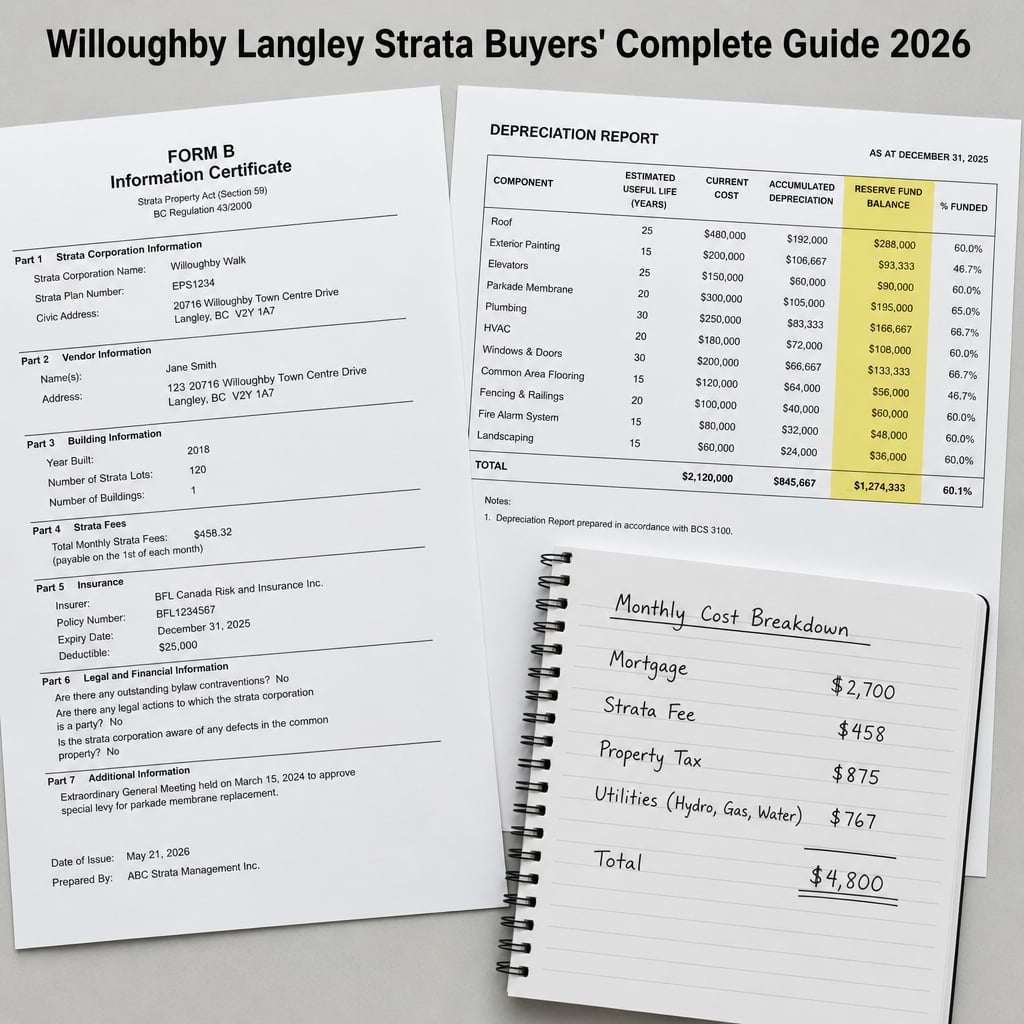
Under the BC Strata Property Act, sellers are required to provide a Form B Information Certificate to buyers before a sale completes. The form covers the strata lot's monthly fee, any outstanding levies, known bylaw restrictions, the current reserve fund balance, and whether any special assessments have been approved or are pending.
In Willoughby, the most financially consequential items in Form B are typically the rental restriction bylaws, pet and occupancy rules, and the special assessment history. A strata that has passed a significant special levy in the past two years is signaling that the reserve fund was already underfunded. That is worth investigating before removing subjects, not after.
Buyers should also check whether the strata fees shown in Form B are accurate and current. Strata fees that appear low relative to building age or complexity often indicate that contributions to the reserve fund have been deliberately kept minimal — a pattern that tends to result in larger levies later. For buyers evaluating special levy risk in Willoughby strata communities, the fee structure revealed in Form B is the first diagnostic tool.
One practical detail many buyers miss: Form B is issued as of a specific date and reflects the strata's financial position at that moment only. Ask whether any council resolutions, levy approvals, or bylaw amendments have occurred after the Form B date and before subject removal.
Reading Depreciation Reports: Reserve Fund Adequacy and Levy Forecasts
The depreciation report is the most important financial document available to a strata buyer in Willoughby. It estimates the cost and timing of all major future repairs to common property and projects whether the reserve fund will be sufficient to cover those costs without special levies. Under BC Regulation 168/2009 amending the Strata Property Act, most strata corporations with five or more lots are required to obtain a depreciation report and update it every three years, though owners can vote to waive this requirement.
The July 1 annual deadline for depreciation report renewal creates seasonal complications for buyers. Lenders who review a recently updated depreciation report showing reserve fund depletion or a large projected levy within three to five years may require additional conditions or decline financing on the property entirely. Buyers working inside a 5 to 7 day subject removal window in July or August should factor this possibility into their financing timeline explicitly.
When reviewing a depreciation report for a Willoughby townhome showing depreciation report red flags, focus on three things: the current reserve fund balance relative to the recommended balance, the timeline for the next major expenditure (roof, building envelope, parkade membrane), and whether the projected contribution schedule requires a rate increase. If the report shows a "scenario 3" funding model — the minimum contribution scenario — treat that as a warning, not a baseline.
Strata fee escalation in aging Willoughby communities has averaged 3 to 5 percent annually in recent years, according to reserve fund study industry data. A buyer who qualifies based on today's strata fee without projecting a 5-year increase is planning for a property they can afford now, not the one they will own in three years.
Builder Warranty Coverage in Willoughby: What Expires at the 10-Year Mark
Under BC's Homeowner Protection Act and the third-party home warranty insurance framework it requires, new residential buildings receive mandatory warranty coverage in three tiers: 2 years for labour and materials defects, 5 years for building envelope components, and 10 years for structural defects. Once the 10-year mark passes, all warranty coverage expires and repair liability transfers entirely to the strata corporation.
A significant portion of Willoughby's townhome inventory was built between 2007 and 2016. That means many buildings are now approaching or have already passed the 10-year structural warranty expiry. Buyers purchasing in this age range should confirm the original occupancy permit date, identify the warranty provider, and verify whether any warranty claims were filed and resolved — or filed and still pending — before completing the purchase.
A strata that has a pending building envelope warranty claim is in a different financial position than one where all claims have been resolved. The depreciation report will often note whether major work was covered under warranty, but it may not reflect recently filed or ongoing claims. Your lawyer and strata manager are the correct contacts to verify active warranty status before subject removal.
Calculating True Monthly Carrying Costs
The most consistent financial gap we see in Willoughby strata purchases is the difference between what buyers plan for and what they actually pay each month after closing. Mortgage pre-approval is based on the purchase price, not the full cost of ownership. Strata fees, property taxes, utilities, and parking or storage fees are separate.
A practical carrying cost estimate for a Willoughby townhome in 2026 should include: monthly mortgage payment (based on actual rate and amortization), strata fee (from Form B, projected 3 to 5 percent higher within 2 years), BC Assessment-based property tax divided by 12, monthly hydro and gas, and any additional strata fees for storage or parking not included in the standard fee. For many buyers in this market, the total exceeds $4,200 to $5,000 per month depending on purchase price and financing terms.
Buyers who skip this calculation and rely only on their mortgage payment as the benchmark often find that their actual monthly housing cost exceeds 40 to 50 percent of gross monthly income — beyond the thresholds most lenders and financial planners treat as sustainable. Running this number before making an offer, not after, changes the conversation significantly. For buyers comparing strata ownership to other options in the region, the Fraser Valley strata versus detached affordability comparison provides a useful framework.
How We Evaluate This
When Mansour Real Estate Group works with buyers on a Willoughby strata purchase, we treat the subject removal period as a structured financial review, not an administrative formality. We request the full strata document package — including Form B, current and prior depreciation reports, strata meeting minutes for the past two years, the current operating budget, and the reserve fund balance — before any subject is removed.
We flag depreciation reports that show reserve fund balances below 70 percent of the recommended level, strata fee increases voted in but not yet reflected in Form B, and buildings approaching major expenditure windows without adequate reserves. Buyers receive a written carrying cost estimate before completing their financing review. This process does not guarantee every deal proceeds — some deals should not — but it ensures buyers understand exactly what they are committing to.
Strata Buyer Checklist — Willoughby Langley
- Request Form B, current depreciation report, operating budget, reserve fund balance, and two years of strata meeting minutes before subject removal.
- Confirm the building's original occupancy permit date and calculate whether builder warranty has expired or is still active.
- Check whether the strata has any pending special levy approvals, active warranty claims, or council resolutions passed after the Form B date.
- Calculate full monthly carrying costs including mortgage, strata fee, property tax, utilities, and parking fees — and project strata fee at 3 to 5 percent annual growth for 5 years.
- Review depreciation report funding scenario — confirm whether the strata is using a minimum contribution model or a recommended contribution model.
- Check Form B bylaw restrictions for rental permissions, pet rules, and occupancy limits if any of these apply to your intended use.
- Confirm with your lender that the depreciation report and reserve fund balance will not trigger additional financing conditions before you remove subjects.
- Have your lawyer review the strata documents — not just the purchase contract — before subject removal is confirmed.
What We Commonly See
In our experience working with buyers on Willoughby strata purchases, the most frequent problem is not that buyers ignore the documents — it is that they receive them too late. Strata document packages are sometimes provided only days before the subject removal deadline, leaving little time for a lawyer or financial advisor to review anything beyond the basics.
What often happens next is that buyers remove subjects based on a quick review of Form B alone, without reading the depreciation report or meeting minutes. The strata fee looks reasonable. The reserve fund balance sounds adequate. Then, within 12 to 18 months, the strata votes a special levy because the reserve fund analysis that was visible in the depreciation report — and that the buyer received but did not fully read — had already projected the shortfall.
A common mistake in this market is assuming that a lower strata fee means a better-run strata. In aging Willoughby buildings, a low fee relative to building age is often a sign that reserve contributions have been kept artificially low to avoid friction at annual general meetings. The cost of that decision tends to surface as a levy, not a gradual fee increase. For a detailed look at how this plays out in seller-side transactions, the Willoughby strata special levy seller strategy guide provides useful context from the other side of the transaction.
Critical Questions to Ask Before Removing Subjects
Five questions that should have clear answers before any Willoughby strata buyer removes subjects:
- What is the current reserve fund balance, and how does it compare to the recommended balance in the depreciation report? A gap greater than 30 percent warrants investigation.
- Has the strata voted any special levies, bylaw changes, or council resolutions since the Form B date? The strata manager can confirm this directly.
- Has the building envelope warranty been fully resolved? Any open claims should be disclosed and reviewed before closing.
- What is the next major capital expenditure the depreciation report projects, and when? Roofs, elevators, and parkade membranes are the most common large items in this age range of Willoughby inventory.
- Has your lender confirmed that the depreciation report and reserve fund balance meet their financing conditions? Some lenders require minimum reserve fund adequacy levels before approving a mortgage on a strata property.
Questions and Answers
Can a lender decline a mortgage because of a strata's depreciation report?
Yes. Lenders in BC assess strata financial health as part of mortgage underwriting. A depreciation report showing a reserve fund significantly below recommended levels or a large upcoming special levy can result in additional conditions, a reduced loan amount, or financing denial. This is particularly relevant for Willoughby buildings with July-updated reports.
What happens if a special levy is approved after the Form B date but before closing?
Under BC's Strata Property Act, levies approved after the Form B is issued may not be captured in the Form B document a buyer receives. Buyers should ask the strata manager directly whether any new resolutions have passed after the Form B date. This is a standard question for your lawyer to ask on your behalf before subject removal.
What does it mean if a Willoughby strata does not have a current depreciation report?
Strata corporations can vote to waive the depreciation report requirement, but most lenders will treat the absence of a current report with caution. Buyers should ask why the report is missing, when it was last completed, and whether their lender will approve financing without one. An absent or very outdated report is a risk factor, not a neutral condition.
In Summary
Buying a strata property in Willoughby Langley in 2026 requires a structured financial review, not just a property inspection. Form B, the depreciation report, builder warranty status, and a realistic carrying cost projection are the four pillars of informed subject removal. Buyers who skip or rush any of these steps in a compressed subject period face real financial risk after closing — not theoretical risk. The documents exist. Reading them carefully, with professional support, is the most practical protection available to any strata buyer in this market.
Talk to Mansour Real Estate Group Before Your Next Willoughby Strata Purchase
If you are evaluating a strata property in Willoughby or elsewhere in the Fraser Valley, Mansour Real Estate Group can help you review the financial documents and understand what you are committing to before subjects come off. Contact us for a grounded, no-pressure conversation about the property you are considering.
Related Articles
- Depreciation Report Red Flags in Willoughby Langley: What Aging Inventory Reveals About Reserve Fund Risk
- Willoughby Langley Special Levies and Reserve Fund Stress: What Sellers and Buyers Need to Know
- Fraser Valley Strata vs. Detached: An Affordability Comparison for 2026 Buyers
Official Resources
- BC Strata Property Act — BC Laws
- Strata Housing — BC Government
- BC Financial Services Authority — Strata and Lending Guidance
- Fraser Valley Real Estate Board — Market Statistics
About Mansour Real Estate Group
Buying a strata townhome in Willoughby Langley involves a level of financial due diligence that most buyers underestimate — Form B review, depreciation report analysis, special levy forecasting, builder warranty verification, and carrying cost projection all need to happen inside a narrow subject removal window. Mansour Real Estate Group has guided strata buyers through this process in Willoughby, Walnut Grove, Surrey, and across the Fraser Valley and Lower Mainland for more than 22 years, from first-time buyers evaluating their first Form B to experienced investors assessing reserve fund adequacy in aging buildings.
Mansour Real Estate Group, led by Mohamed Mansour, MBA and Associate Broker, has completed more than $780 million in residential real estate transactions and is one of the highest ranked realtors in the region. The team is trusted for strata and condo transactions, estate sales, divorce-related property sales, downsizing, and complex real estate decisions across the Lower Mainland and Fraser Valley. Most clients come through repeat and referral business, supported by hundreds of verified 5-star reviews.
Whether someone is searching for Realtors with direct experience in strata document review, a real estate agent who understands depreciation reports and special levy risk in Langley, a real estate team that can guide a strata buyer through subject removal, a Willoughby real estate broker, a Langley Realtor familiar with aging builder inventory, or real estate agents who serve the full Fraser Valley strata market, Mansour Real Estate Group brings clear analysis, accurate valuations, and local knowledge that reduces risk at every stage of the purchase process.
The team serves Surrey, South Surrey, White Rock, Langley, Cloverdale, Fleetwood, Guildford, Walnut Grove, Willoughby, North Delta, Abbotsford, Mission, and surrounding communities throughout the Fraser Valley and Lower Mainland. Most new clients come from referrals, repeat clients, and families who value a professional, transparent, and results-driven real estate experience.
Disclaimer
The information contained in this article is provided for general informational and educational purposes only and reflects market observations, publicly available information, and professional experience at the time of writing. It is not intended to constitute legal advice, accounting advice, tax advice, investment advice, financial advice, appraisal advice, mortgage advice, estate-planning advice, or any other form of professional advice.
Real estate transactions, strata matters, financing, legal rights, and Navigating the real estate market requires patience, knowledge, and strategic planning. Whether you're a first-time buyer or an experienced investor, understanding the fundamentals of property valuation, market trends, and financing options will position you for success. The key is to educate yourself, work with trusted professionals, and make decisions based on your long-term financial goals rather than short-term market fluctuations. Remember that real estate remains one of the most reliable wealth-building tools available to the average person. By taking the time to research, ask the right questions, and move thoughtfully through the process, you're setting yourself up for a transaction that aligns with your needs and budget. If you're ready to begin your real estate journey, consider reaching out to a qualified real estate agent in your area who can provide personalized guidance based on your local market. Schedule a consultation with a mortgage lender to understand your financing options, and take time to identify your priorities—whether that's location, square footage, amenities, or investment potential. The more prepared you are before entering negotiations, the more confident and successful you'll be throughout the process.Final Thoughts
Next Steps



