

Willoughby Langley Strata Property Buyers' Complete Guide 2026: Reading Form B and Depreciation Reports, Assessing Special Levy Risk, Understanding Builder Warranty Coverage, and Calculating True Carrying Costs
By Mohamed Mansour, MBA and Associate Broker | Mansour Real Estate Group | Fraser Valley & Lower Mainland | Published: July 15, 2026 | Topic: Condo & Strata — Willoughby, Langley
Willoughby is one of the Fraser Valley's most active strata markets. But the conditions that made it attractive during the new-construction era have shifted. Builder incentives are ending, warranty periods on early buildings are expiring, and resale inventory is compressing. Buyers entering this market in 2026 face a more complex financial picture than the one that existed even two years ago.
This guide is built for those buyers. It walks through the documents that matter, the numbers that are often missed, and the specific risk signals in Willoughby strata properties that separate a sound purchase from a costly surprise after closing.
Short Answer
Buying a strata in Willoughby requires more than comparing list prices. Buyers must review Form B for reserve fund adequacy, read depreciation reports for deferred maintenance and projected levy risk, confirm builder warranty coverage on units built before 2020, and calculate a true monthly carrying cost that is typically 15 to 20 percent higher than strata fees alone suggest. Incomplete analysis at this stage is the most common reason buyers face financing problems or unexpected costs after closing.
Who This Applies To
- First-time buyers purchasing a strata unit in Willoughby or surrounding Langley communities
- Investors evaluating resale strata units as the new-construction pipeline closes
- Buyers financing through CMHC-insured mortgages where reserve fund deficiencies affect approval
- Buyers transitioning from detached homeownership who are unfamiliar with strata financial documents
- Anyone purchasing in a Willoughby building where the original builder warranty has recently expired or is approaching expiry
When This Advice May Not Apply
Buyers purchasing newly constructed strata units still under active Travellers/Warranty Group or 2-5-10 New Home Warranty coverage face a different risk profile than resale buyers. This guide focuses on resale transactions, particularly buildings completed between 2012 and 2022 where warranty transitions and deferred maintenance are most likely to affect reserve fund adequacy.
Key Takeaways
- Form B reveals reserve fund balance, pending levies, and bylaw restrictions that directly affect financing eligibility
- Depreciation reports flag deferred maintenance costs that become buyer liability after closing
- Builder warranty on building envelope and structure expires at 10 years, shifting repair cost to the strata
- True carrying costs in Willoughby strata properties typically run 15 to 20 percent above strata fees alone
- CMHC underwriting guidelines may deny insurance on units in buildings with reserve fund deficiencies below defined thresholds
Definitions
Form B Information Certificate: A mandatory disclosure document issued by the strata corporation under the BC Strata Property Act. It discloses reserve fund balances, pending or approved special levies, outstanding legal actions, and current bylaws.
Depreciation Report: A third-party engineering report that projects the expected lifespan and replacement cost of a building's major common components. Under BC law, most strata corporations with five or more units are required to obtain one at least every three years.
Special Levy: A one-time assessment charged to strata owners to fund a major repair or capital expense not covered by the reserve fund. Special levies require a three-quarter vote of the strata unless an emergency.
Reserve Fund: The strata corporation's long-term savings account, funded by monthly contributions from strata fees, used to pay for major repairs and replacements of common property.
2-5-10 New Home Warranty (BC): BC's mandatory new home warranty program, requiring builders to provide 2 years coverage on labour and materials, 5 years on the building envelope, and 10 years on the structure.
Data Used in This Article
- Mansour Real Estate Group market analysis — Willoughby Langley strata transactions, 2024–2026 (internal, professional observation)
- Fraser Valley Real Estate Board strata market data — published 2025–2026 (Tier 2, official board statistics)
- BC Strata Property Act, SBC 1998, c. 43 — Form B and depreciation report requirements (Tier 1, provincial legislation)
- BC Housing — 2-5-10 New Home Warranty Program description (Tier 1, BC Government source)
- CMHC — Condominium and strata underwriting guidelines (Tier 2, federal regulator)
How We Evaluate This
When Mansour Real Estate Group assists buyers in Willoughby strata transactions, the financial review begins before the showing, not after the offer. We pull building history, cross-reference disclosed reserve fund balances against depreciation report projections, and flag buildings where the gap between current reserves and projected capital needs creates short-term levy risk. That analysis changes the offer price, the subject clause structure, and sometimes the purchase decision entirely.
This approach is not cautionary for its own sake. Willoughby has sound buildings with well-managed strata corporations. But those buildings exist alongside others where deferred maintenance, aging mechanical systems, and underfunded reserves are already visible in the documents — if a buyer knows where to look.
Reading Form B: What the Numbers Actually Tell You
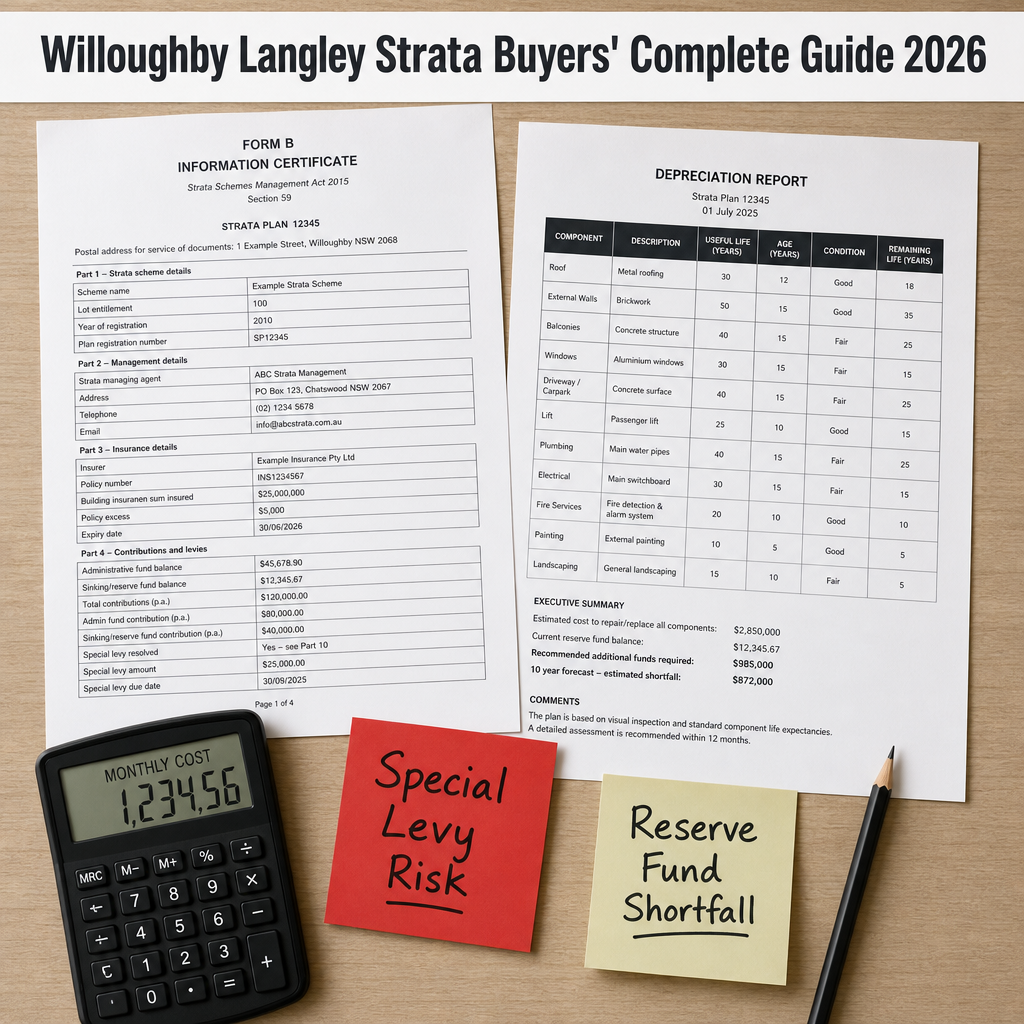
Under Section 59 of the BC Strata Property Act, a strata corporation must provide a Form B Information Certificate within one week of a written request. In a purchase transaction, your subject clause for strata documents should require Form B as part of the disclosure package.
The reserve fund balance is the first figure most buyers check. But the balance alone means very little without context. A building with $800,000 in its reserve fund might be fully funded or severely underfunded depending on its size, age, and projected capital needs. The meaningful comparison is the reserve fund balance as a percentage of the projected replacement cost identified in the most recent depreciation report.
Form B also discloses any approved or pending special levies. If a levy has been approved by the strata but not yet collected, the buyer inherits it at closing unless the contract specifies otherwise. This is a negotiation point — one that buyers often miss because the levy amount is buried in the Form B rather than surfaced in the listing description.
Review the strata bylaws attached to Form B for any rental restriction clauses. In Willoughby buildings constructed before 2022, some bylaws predate the 2021 amendments to the Strata Property Act that restricted stratas from imposing blanket rental bans on new owners. Confirm the current rental status with your realtor before assuming investment viability.
Reading Depreciation Reports: Where Levy Risk Actually Lives
A depreciation report — also called a reserve fund study — is the document that tells you what is coming. It identifies every major common component in the building, estimates its remaining useful life, and projects the cost of replacement. Buildings in Willoughby constructed between 2012 and 2018 are now entering the window where first-generation mechanical systems, roofing membranes, and parkade waterproofing are approaching end-of-life.
Look specifically at the 5-year and 10-year capital expenditure projections. If the report projects $1.2 million in roof and membrane work over the next five years and the reserve fund currently holds $300,000, the gap has to come from somewhere. Either monthly strata fees increase significantly, or a special levy is approved. Buyers who understand this math can model the risk before closing. Buyers who skip the depreciation report discover it in the first strata AGM notice they receive as owners.
Also check the report date. The BC Strata Property Act requires depreciation reports to be renewed every three years for most strata corporations. A report dated 2021 or earlier is likely to understate current replacement costs given construction inflation in the Lower Mainland since that time. Treat an outdated report as a reason for additional caution, not as a clean bill of health.
Builder Warranty Coverage: What Expires and When
BC's 2-5-10 New Home Warranty program, administered through BC Housing's Homeowner Protection Office, requires builders to provide mandatory warranty coverage in three tiers: two years on labour and materials defects, five years on building envelope defects including water ingress, and ten years on structural defects.
For Willoughby buildings completed between 2014 and 2016, the 10-year structural warranty is expiring in 2024 to 2026. Once that window closes, structural defect repair becomes the strata corporation's financial responsibility entirely. Buyers purchasing units in these buildings should obtain the original warranty documentation, confirm whether any claims were filed during the coverage period, and request a copy of the strata's building envelope inspection records if the five-year envelope warranty has already expired.
Warranty claim history is not always disclosed proactively. Ask directly. A building that filed envelope claims during the warranty period may have had legitimate repairs completed — but it may also indicate ongoing moisture management issues that the repair addressed only partially. A building with a history of envelope claims warrants an independent inspection, not just a review of the warranty documentation.
Calculating True Carrying Costs: Beyond the Strata Fee
The strata fee shown on a listing is not your monthly ownership cost. It is one component of it. True carrying costs for a Willoughby strata unit in 2026 typically include: the monthly strata fee, your proportional share of the reserve fund contribution embedded in that fee, property tax, home insurance for your individual unit contents and improvements, and a personal maintenance reserve for in-unit repairs not covered by the strata.
Based on Mansour Real Estate Group's analysis of active Willoughby strata listings and recent transactions, buyers who model only the strata fee and mortgage payment typically underestimate total monthly ownership cost by 15 to 20 percent. For a unit with a $550 monthly strata fee, that gap represents $80 to $110 per month in costs that were not factored into the purchase decision — costs that become visible only after the first full year of ownership.
For investment buyers, the carrying cost calculation must also account for vacancy allowance, property management fees if applicable, and the risk of a special levy during the holding period. A building with a reserve fund funded at 60 percent of projected needs and a 5-year capital projection showing significant expenditures is not a stable cash-flow investment at current Willoughby strata prices, even if the gross rental yield appears adequate on paper. For a broader view of how Willoughby's strata market is shifting, the supply and pricing dynamics are important context for this calculation.
CMHC Financing and Reserve Fund Deficiencies
For buyers using insured mortgages — those with less than 20 percent down payment — CMHC's underwriting guidelines for strata and condominium properties include reserve fund adequacy as part of the project approval assessment. A building where the reserve fund is materially underfunded relative to its depreciation report projections may be flagged during CMHC's project review, which can result in insurance denial or require additional conditions before the insured mortgage is approved.
This is not an abstract risk in Willoughby's current market. Buildings where strata corporations deferred reserve fund contributions during the low-interest, high-liquidity period of 2019 to 2022 are now carrying reserve fund balances that do not reflect the capital needs projected in recently updated depreciation reports. Buyers whose financing depends on CMHC insurance should confirm the building's project approval status with their mortgage broker before removing subjects, not after. Learn more about strata financing obstacles across the Fraser Valley in our related analysis.
Buyer Checklist: Willoughby Strata Purchase
- Request Form B Information Certificate and review reserve fund balance against depreciation report projections
- Confirm whether any special levies have been approved or are pending at the time of offer
- Obtain the most recent depreciation report and review 5-year and 10-year capital expenditure projections
- Verify the report date — if older than three years, treat projections as conservative estimates only
- Confirm 2-5-10 New Home Warranty status, coverage expiry dates, and any claims filed during the warranty period
- Review strata meeting minutes for the past two years to identify deferred repairs, owner complaints, or bylaw disputes
- Calculate total monthly carrying cost including strata fee, property tax, unit insurance, and personal maintenance reserve
- Confirm CMHC project approval status with your mortgage broker before removing financing subjects
- Review rental restriction bylaws under post-2021 Strata Property Act amendments if investment use is intended
- Request an independent building inspection if envelope or mechanical concerns appear in the documentation
What We Commonly See
In our experience working with buyers in Willoughby strata transactions, the most consistent gap is between what buyers expect strata documents to contain and what those documents actually disclose. Buyers often assume Form B is a summary of known problems. It is not. It is a snapshot of disclosed financial position. Undisclosed deferred maintenance, informally agreed repairs not yet voted on, and building systems approaching end-of-life may not appear in Form B at all — they appear only in the depreciation report and meeting minutes.
What often happens is that buyers review the reserve fund balance, find it appears reasonable in isolation, and proceed without checking whether that balance covers the projects actually scheduled in the depreciation report. The gap between "the reserve fund has money in it" and "the reserve fund is adequate" is where most post-closing financial surprises originate.
A common mistake is treating the strata fee as the total cost of ownership. In buildings where the reserve fund contribution embedded in the strata fee is set below the annual funding requirement in the depreciation report, the buyer is effectively purchasing a unit in a building that is accumulating a future special levy liability with every passing month. The strata fee looks affordable. The building's capital trajectory does not.
We also see buyers — particularly those coming from detached home purchases — underestimate how much the BC Strata Property Act shapes their rights and obligations as a strata owner. Strata ownership is not like detached ownership. Understanding that difference before closing, rather than after the first AGM, changes the entire experience of strata life in Willoughby.
Questions and Answers
Q: What is Form B and when does a buyer in BC receive it?
Form B is a mandatory disclosure document issued by the strata corporation under Section 59 of the BC Strata Property Act. It discloses the reserve fund balance, approved or pending special levies, any current legal proceedings involving the strata, and the current bylaws and rules. In a purchase transaction, buyers typically receive it as part of the strata document package during the subject period. Buyers should request it explicitly in their subject clause.
Q: How do I know if a Willoughby building's reserve fund is adequate?
Compare the current reserve fund balance against the capital expenditure projections in the most recent depreciation report. If projected major repairs over the next five to ten years significantly exceed the current balance and the annual contribution rate does not close that gap, the reserve fund is underfunded. This signals special levy risk. A building where the reserve fund covers less than 70 percent of five-year projected capital needs warrants close scrutiny and potentially a renegotiation of the purchase price.
Q: Can a CMHC-insured mortgage be denied because of a strata building's reserve fund?
Yes. CMHC's project approval process for condominium and strata properties includes an assessment of the building's financial health, including reserve fund adequacy relative to the depreciation report. A building with a material reserve fund deficiency may be ineligible for CMHC project approval, which would mean buyers requiring insured financing — those with less than 20 percent down — cannot use that financing for that building. Buyers should verify project approval status with their mortgage broker before removing financing subjects.
In Summary
Willoughby's strata market in 2026 rewards buyers who do the document work and penalizes those who skip it. Form B shows the current financial position. The depreciation report shows where that position is heading. Builder warranty records show what the strata inherited from the original construction. Together, those three documents — cross-referenced against a true carrying cost calculation — give buyers the complete picture that a listing price and strata fee disclosure alone cannot provide. The buildings worth buying in Willoughby are there. Finding them requires knowing what you are reading and what you are looking for before the offer goes in.
Talk to Someone Who Knows the Buildings
If you are evaluating a strata purchase in Willoughby or anywhere in the Langley area, Mansour Real Estate Group can review the strata documents with you, flag reserve fund and levy risk before you remove subjects, and help you calculate a true carrying cost model based on the actual building financials. Contact us for a no-obligation conversation before your next offer.
Related Articles
- How Willoughby Langley's strata market is shifting as new supply phases out
- Understanding special levy risk in Willoughby Langley condo buildings
- Strata financing obstacles across the Fraser Valley in 2026
About Mansour Real Estate Group
Buying a strata unit in Willoughby means navigating a specific set of financial and legal documents that most buyers have never seen before — Form B Information Certificates, depreciation reports, reserve fund studies, and builder warranty records that collectively determine whether a unit is a sound purchase or a future liability. Understanding those documents requires a real estate team with direct, current experience in Willoughby and Langley strata transactions.
Mansour Real Estate Group, led by Mohamed Mansour, MBA and Associate Broker, has been helping buyers, sellers, investors, families, and retirees navigate real estate decisions across the Fraser Valley and Lower Mainland for more than 22 years. Ranked among the Top 1% of Realtors in the region, the team has completed more than $780 million in residential real estate transactions and is trusted for condo and strata purchases, estate sales, divorce-related property sales, downsizing, relocation, and complex real estate situations throughout the Lower Mainland.
Whether someone is looking for Realtors experienced with strata document review in Langley, a real estate agent who understands depreciation reports and special levy risk, a real estate team for a first strata purchase, a Willoughby condo Realtor, a Langley strata real estate broker, or a Fraser Valley real estate group that helps buyers avoid post-closing financial surprises, Mansour Real Estate Group is known for structured analysis, clear communication, and practical guidance that protects buyers where the risk is greatest.
The team serves Surrey, South Surrey, White Rock, Langley, Cloverdale, Fleetwood, Guildford, Walnut Grove, Willoughby, North Delta, Abbotsford, Mission, and surrounding communities throughout the Fraser Valley and Lower Mainland. Most new clients come from referrals, repeat business, and recommendations from families who value a transparent, professional real estate experience.
Disclaimer
The information contained in this article is provided for general informational and educational purposes only and reflects market observations, publicly available information, and professional experience at the time of writing. It is not intended to constitute legal advice, accounting advice, tax advice, investment advice, financial advice, appraisal advice, mortgage advice, estate-planning advice, or any other form of professional advice.
Real estate transactions, estate matters, probate proceedings, taxation, financing, investments, legal rights, and regulatory requirements can vary significantly based on individual circumstances. Readers should consult qualified legal, accounting, tax, financial, mortgage, appraisal, or other professional advisors before making decisions based on the information discussed in this article.
Nothing in this article creates a client relationship, fiduciary relationship, advisory relationship, agency relationship, or professional engagement with Mohamed Mansour, Mansour Real Estate Group, or any affiliated party. Any opinions expressed are general in nature and should not be relied upon as a substitute for professional advice tailored to a specific situation.
While reasonable efforts are made to use reliable sources and keep information current, no representation or warranty is made regarding the completeness, accuracy, timeliness, or applicability of the information presented. Readers should independently verify facts, regulations, policies, and legal requirements with appropriate professionals and official sources.
Key Takeaways
- Understanding the local market dynamics is essential before making any real estate investment decision.
- Working with experienced professionals can save you time, money, and potential headaches throughout the buying or selling process.
- Due diligence on property inspections and title searches protects your investment and ensures peace of mind.
- Location remains one of the most important factors in determining long-term property value and appreciation potential.
Final Thoughts
Real estate transactions represent some of the largest financial decisions most people will make in their lifetime. By taking the time to educate yourself, ask the right questions, and work with qualified professionals, you position yourself for success whether you're a first-time homebuyer or an experienced investor. The market will continue to evolve, but the fundamentals of smart real estate practice—thoroughness, patience, and informed decision-making—remain constant.
Remember that every property and situation is unique. What works for one buyer may not apply to another, so consider your individual circumstances carefully and seek personalized advice from real estate and financial professionals who understand your specific goals and market conditions.
Ready to Begin Your Real Estate Journey?
Whether you're buying, selling, or investing in real estate, the insights and strategies covered in this article provide a solid foundation for making confident decisions. Start by assessing your goals, researching your local market, and connecting with qualified professionals who can guide you through every step of the process. Your future property success begins with the decisions you



