

Willoughby Heights Strata Property Sellers 2026: Why New Construction Competition, Builder Incentives, and Elevated Inventory Create Pricing Pressure — And How to Differentiate When Comparable Units Multiply
By Mohamed Mansour, MBA and Associate Broker | Mansour Real Estate Group | Published: July 14, 2026 | Fraser Valley — Willoughby Heights, Langley, BC
This article is for strata property owners in Willoughby Heights who are considering selling in 2026 and want to understand how new construction supply, builder incentives, and elevated Fraser Valley inventory are affecting their pricing leverage right now. The Willoughby strata market has specific supply dynamics that differ from other parts of Langley — and from most of the Fraser Valley. Understanding those dynamics before you list is the difference between a well-priced sale and a prolonged, discounted one.
Willoughby Heights is one of the Township of Langley's fastest-growing strata submarkets, with multiple new construction projects in advanced approval or active completion stages as of 2026. That growth is good news for the neighbourhood long-term, but it creates direct, immediate competition for resale strata units that sellers need to account for in their pricing and positioning strategy.
Short Answer
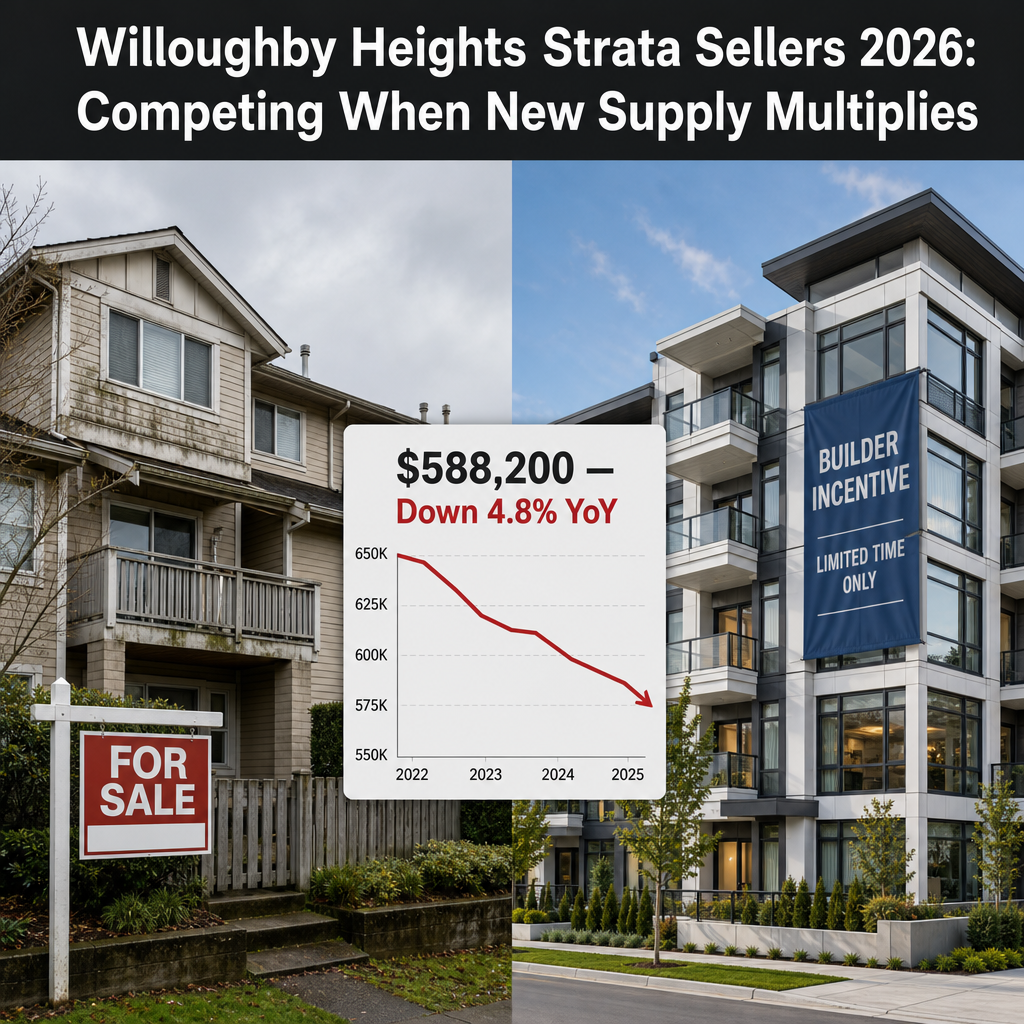
Willoughby Heights strata sellers in 2026 face a pronounced buyer's market. The Langley apartment benchmark price is $588,200, down 4.8% year-over-year, and the sales-to-active ratio sits at 6.5% — well into buyer's market territory. With new construction projects adding direct supply and builders offering incentives on comparable units, resale sellers must compete on net cost, condition, and location precision rather than assuming market momentum will carry their price.
Key Takeaways
- The Langley apartment benchmark is $588,200 as of April 2026, down 4.8% year-over-year, with a 6.5% sales-to-active ratio confirming a buyer's market (FVREB, April 2026).
- Fraser Valley strata inventory is 45% above the 10-year seasonal average, giving buyers abundant alternatives to any individual resale unit.
- Active and approved new construction in Willoughby — including the Crofton final phase and a 600+ unit development — competes directly with resale pricing and buyer attention.
- Builder incentives, modern finishes, and new-home warranty coverage on presale units shift the value comparison away from resale sellers who cannot match those advantages on price alone.
- Resale sellers who differentiate on immediate possession, strata financial health, specific sub-location, and net total cost have the clearest path to a competitive sale.
Who This Applies To
- Strata condo and townhouse owners in Willoughby Heights considering listing in 2026
- Investors holding Willoughby strata units who are evaluating a sale exit
- Estate executors or families managing a strata property in the Willoughby area
- Downsizers who own a larger Willoughby strata unit and are comparing timing options
When This Advice May Not Apply
This article addresses resale strata units in Willoughby Heights specifically. Detached homes in Willoughby face different supply dynamics. Strata properties in other parts of Langley — Walnut Grove, Murrayville, or Aldergrove — have different inventory profiles. Market conditions change; always verify current data with your realtor and the FVREB statistics package before making a listing decision.
Data Used in This Article
- FVREB Statistics Package, April 2026 — official board data; Langley apartment benchmark price and sales-to-active ratio (fvreb.bc.ca)
- Daily Hive, May 2026 — Fraser Valley inventory levels relative to 10-year seasonal average
- Shirley Lord MLS listing data — active Crofton townhouse listings, Willoughby Heights ($1,050K–$1,059K range, June 2026)
- Township of Langley zoning approvals, 2024–2026 — project counts and unit volumes for Willoughby Heights development pipeline
What the Current Willoughby Strata Market Actually Looks Like
According to the Fraser Valley Real Estate Board's April 2026 statistics package, the Langley apartment benchmark price is $588,200 — down 4.8% from one year earlier. The sales-to-active ratio for apartments in the Fraser Valley sits at 6.5%, which means roughly 6 to 7 units are selling for every 100 actively listed. That ratio places the market firmly in buyer's market territory, where a balanced market would require a ratio above 12% and a seller's market above 20%.
For context, Fraser Valley strata inventory overall is running 45% above the 10-year seasonal average, according to reporting from Daily Hive in May 2026. That is not a modest surplus — it means buyers in Willoughby have significantly more options to compare than they would in a typical spring market. When a buyer can walk away from one listing and find five comparable alternatives the same afternoon, seller pricing leverage contracts accordingly.
Willoughby Heights amplifies this dynamic because of its active construction pipeline. Approved and near-completion projects — including the Crofton final phase by Atrium, a 100-unit Carvolth apartment building, a 40-unit townhouse rezoning approved in the past 18 months, and larger developments totalling 600+ units in advanced stages — are all adding directly comparable units to the same submarket. A buyer shopping for a Willoughby strata unit in 2026 is not just comparing your listing to other resale units. They are comparing it to new construction options with builder incentives, new-home warranty coverage under the BC Homeowner Protection Act, and modern finishes that resale units cannot replicate without renovation investment.
How Builder Incentives Change the Comparison for Resale Sellers
Builder incentives on presale and newly completed units typically include deposit flexibility, assignment clauses, appliance packages, storage upgrades, or price reductions on specific floorplans. In a soft market, builders are also more willing to negotiate net price on closing than their list prices suggest. Active Crofton townhouse listings in Willoughby were priced in the $1,050,000 to $1,059,000 range in June 2026 based on available MLS data — which means a resale townhouse seller in the same area is competing directly against that price point, while offering a unit without new-home warranty status and without a builder's ability to bundle incentives.
This does not mean resale sellers cannot compete. It means the competitive strategy must be built on what resale units can offer that new construction cannot. Immediate possession is the most obvious advantage — a buyer who needs to close in 60 days cannot wait for a presale unit with a 12-month completion timeline. Established strata corporations with a track record of sound financial management are another resale advantage — new buildings have no depreciation report history, no contingency reserve track record, and no long-term maintenance data. A buyer who understands strata risk will weigh that.
Sub-location within Willoughby also matters. Not all of Willoughby Heights is equivalent. Units closer to the planned Surrey-Langley SkyTrain corridor along the southern edge of the neighbourhood carry different long-term demand fundamentals than units positioned further north. That proximity argument is more persuasive to a buyer when it is documented clearly, not assumed.
How We Evaluate This
When Mansour Real Estate Group works with a strata seller in Willoughby Heights, the pricing analysis starts with active competition — not sold data alone. In a market with 45% above-average inventory, sold comparables from six months ago may reflect conditions that no longer exist. We map what is actively competing for the same buyer right now, including new construction listings. From there, we identify whether the resale unit can win on net cost, on possession date, on strata health, or on sub-location specificity. That analysis shapes not just the list price, but how the property is described, what documents are assembled proactively, and how offers are evaluated when they arrive.
Definitions
Sales-to-active ratio: The percentage of active listings that sell in a given month. A ratio below 12% indicates a buyer's market. At 6.5%, Langley apartments are in a pronounced buyer's market.
Benchmark price: The price of a "typical" property in a given category, as calculated by the real estate board using a model that adjusts for property characteristics. Not the same as average or median sale price.
Depreciation report: A strata corporation document required under BC's Strata Property Act that assesses the building's common property, estimates remaining useful life of components, and projects future repair costs and reserve fund requirements.
New-home warranty (BC Homeowner Protection Act): Mandatory warranty coverage on new residential construction in BC covering defects in materials and labour (2 years), building envelope (5 years), and structural defects (10 years). Resale units do not carry this coverage unless within the active warranty period.
Condo Seller Checklist — Willoughby Heights Strata
- Pull current active competition — identify all comparable resale and new construction listings within your building type and price range in Willoughby Heights before setting your price.
- Request your strata's current financials — obtain the most recent Form B Information Certificate, depreciation report, and contingency reserve fund balance to present proactively to buyers.
- Document your possession advantage — if your unit can close in 30 to 60 days, make that timeline explicit and central to your listing presentation. New presale units cannot match it.
- Identify and document your sub-location advantage — proximity to transit, school catchments, Highway 1 access, or planned SkyTrain infrastructure should be mapped and presented with specifics, not generalities.
- Assess condition gaps honestly — buyers comparing your unit to new construction will notice dated finishes, worn flooring, or outdated appliances. Determine which improvements have a measurable return in your price range and which do not.
- Price against active competition, not just sold data — in a market with 45% above-average inventory, your effective competition is what buyers are looking at today, not what sold six months ago.
- Verify strata bylaw restrictions — rental restrictions, pet bylaws, and parking rules that differ from newer buildings can affect your buyer pool. Know your restrictions before you list.
What We Commonly See
- Sellers pricing against sold comparables instead of active competition. In our experience, using six-month-old sold data in a declining benchmark market leads to overpricing that costs sellers time and negotiating position. Active listings — including new construction — are what buyers see when they make decisions.
- Underestimating buyer awareness of new-home warranty value. What often happens is that buyers who have toured new construction developments come into resale showings with a clear mental calculation of what the warranty coverage gap is worth. Sellers who don't address this in their pricing or presentation lose offers to new builds at effectively the same price.
- Overlooking the strata documents as a selling tool. A common mistake is waiting for a buyer to request strata documents rather than assembling them proactively. In a strata sale, a clean depreciation report and healthy contingency reserve are competitive advantages that most sellers leave unaddressed in their marketing materials.
Questions and Answers
How much has the Langley apartment benchmark price dropped and where does that data come from?
According to the Fraser Valley Real Estate Board's April 2026 statistics package, the Langley apartment benchmark price is $588,200, which represents a 4.8% decline from April 2025. The FVREB benchmark price is calculated monthly using a characteristic-adjusted model, not a simple average of sales prices.
What does a 6.5% sales-to-active ratio mean for a Willoughby strata seller?
A sales-to-active ratio of 6.5% means that for every 100 Langley apartments actively listed, roughly six to seven sell in a given month. A balanced market sits above 12%. At 6.5%, buyers have substantial negotiating leverage and can afford to be selective — which means overpriced listings sit without offers and well-priced listings still face negotiation pressure on conditions and price.
Can a resale strata seller in Willoughby compete with a new construction unit at the same price?
Yes, but only when the resale unit's advantages — immediate possession, established strata financials, known building history, and specific location — are documented and priced correctly. A resale unit priced as if it offers equivalent value to a new-build without accounting for warranty coverage, finishes, and builder incentives will not sell at that price in the current market. The competitive advantage must be real and clearly communicated.
In Summary
Willoughby Heights strata sellers in 2026 are operating in one of the more challenging conditions the submarket has seen — a 4.8% year-over-year benchmark price decline, a 6.5% sales-to-active ratio confirming buyer's market conditions, and direct competition from new construction projects with builder incentives and warranty coverage. Resale sellers who price against active competition rather than old sold data, proactively present strata financials, and clearly document the specific advantages their unit offers — possession speed, sub-location, building track record — are best positioned to sell without extended days on market. Sellers who price to where the market was six months ago will subsidize that mistake with time, price reductions, and negotiating leverage lost to buyers who have more options than they have had in years.
Thinking About Selling Your Willoughby Heights Strata?
If you own a strata unit in Willoughby and want a clear-eyed assessment of your current market position — including how your unit compares to active new construction competition — Mansour Real Estate Group offers a no-pressure consultation built around accurate local data. Contact us when you're ready to understand your options.
Related Articles
- Fraser Valley Condo Market 2026: A Seller's Guide to Pricing, Timing, and Strata Positioning
- Langley Real Estate Seller Strategy 2026: What the Market Data Actually Means for Your Listing
- Surrey-Langley SkyTrain and Real Estate: What Property Owners Along the Corridor Need to Know
About Mansour Real Estate Group
Selling a strata unit in Willoughby Heights when new construction is actively competing for the same buyers requires more than standard listing preparation — it requires a pricing analysis that accounts for builder incentives, new-home warranty value, and the full spectrum of active alternatives buyers are comparing in real time. Mansour Real Estate Group has built its reputation in the Fraser Valley and Lower Mainland on exactly this kind of pricing discipline: honest valuations, clear competitive context, and the willingness to have direct conversations about market realities before a listing goes live rather than after a price reduction.
Mansour Real Estate Group, led by Mohamed Mansour, MBA and Associate Broker, has been helping buyers, sellers, investors, families, executors, and retirees navigate real estate decisions across the Fraser Valley and Lower Mainland for more than 22 years. Ranked among the Top 1% of Realtors in the region, the team has completed more than $780 million in residential real estate transactions and is trusted for strata sales, pricing strategy, estate sales, divorce-related property sales, downsizing, and complex situations where accurate valuation is critical to the outcome.
Whether someone is looking for Realtors experienced with strata property sales in Willoughby Heights, a real estate agent who understands Langley's new construction pipeline and its effect on resale pricing, real estate agents who specialize in condo and townhouse seller strategy, a trusted real estate team for a strata sale in a competitive buyer's market, a Langley Realtor, a Willoughby real estate broker, or a real estate group that serves the full Fraser Valley and Lower Mainland, Mansour Real Estate Group is known for grounded market analysis, clear communication, and a process that protects sellers from the most common pricing mistakes in a high-supply environment.
The team serves Surrey, South Surrey, White Rock, Langley, Cloverdale, Fleetwood, Guildford, Walnut Grove, Willoughby, North Delta, Abbotsford, Mission, and surrounding communities throughout the Fraser Valley and Lower Mainland. Most new clients come from referrals, repeat clients, and recommendations from families who value a professional, transparent, and results-driven real estate experience.
Official Resources
- Fraser Valley Real Estate Board — Statistics Package, April 2026
- BC Housing — New Home Warranty and Homeowner Protection
- BC Laws — Strata Property Act
- Township of Langley — Development and Zoning
Disclaimer
The information contained in this article is provided for general informational and educational purposes only and reflects market observations, publicly available information, and professional experience at the time of writing. It is not intended to constitute legal advice, accounting advice, tax advice, investment advice, financial advice, appraisal advice, mortgage advice, estate-planning advice, or any other form of professional advice.
Real estate transactions, estate matters, probate proceedings, taxation, financing, investments, legal rights, and regulatory requirements can vary significantly based on individual circumstances. Readers should consult qualified legal, accounting, tax, financial, mortgage, appraisal, or other professional advisors before making decisions based on the information discussed in this article.
Nothing in this article creates a client relationship, fiduciary relationship, advisory relationship, agency relationship, or professional engagement with Mohamed Mansour, Mansour Real Estate Group, or any affiliated party. Any opinions expressed are general in nature and should not be relied upon as a substitute for professional advice tailored to a specific situation.
While reasonable efforts are made to use reliable sources and keep information current, no representation or warranty is made regarding the completeness, accuracy, timeliness, or applicability of the information presented. Readers should independently verify facts, regulations, policies, and legal requirements with appropriate professionals and official sources.



