

Why Waiting to Sell in the Fraser Valley Now Costs More Than Selling: A Tactical Pricing and Marketing Guide for 2026
By Mohamed Mansour, MBA and Associate Broker — Mansour Real Estate Group | Fraser Valley and Lower Mainland, BC | Published: July 15, 2026 | Topic: Seller Strategy
Most of the conversation in the Fraser Valley real estate market has focused on why buyers are hesitating. That framing is not wrong, but it is incomplete. With more than 10,000 active listings and a sales-to-active ratio of just 11%, according to Fraser Valley Real Estate Board April 2026 data, the market has shifted decisively into buyer territory. Diagnosing buyer psychology helps sellers understand the situation. It does not help them solve it.
This article is a tactical guide. It covers how carrying costs are quietly eroding seller equity every month, how a surplus of comparable listings is distorting buyer offers, what standard marketing can no longer accomplish, and what specific decisions can shorten time on market and protect net proceeds — even in conditions like these.
Short Answer
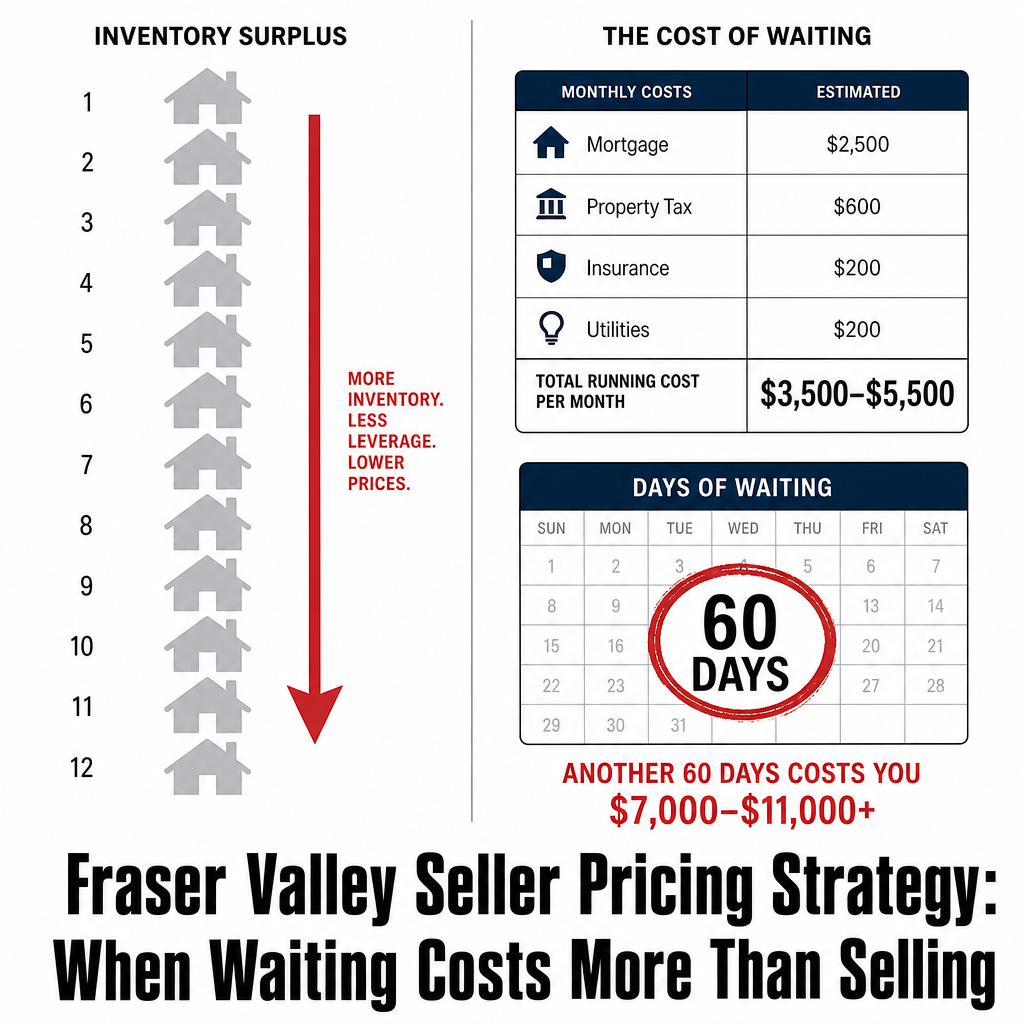
Fraser Valley sellers in 2026 face a market where waiting costs between $7,000 and $11,000 in carrying costs for every 60 additional days on market, where excess comparable inventory suppresses buyer offers by 5–8%, and where standard MLS listings generate roughly 40% fewer showings than two years ago. The sellers recovering equity fastest are pricing 3–5% below estimated market value at launch, deploying off-MLS outreach, and compressing their closing timelines to accelerate buyer decisions.
Key Takeaways
- Sixty additional days on market costs Fraser Valley sellers $7,000–$11,000 in direct carrying costs alone, before any opportunity cost.
- When 300+ comparable properties exist within a $50,000 price band, appraisal anchoring suppresses buyer offers by 5–8%.
- Standard MLS listings now generate approximately 40% fewer showings in the Fraser Valley than equivalent properties received in 2024.
- Sellers pricing 3–5% below initial market estimates and shortening possession timelines see 25–35 more showings and sell 15–20% faster.
- Non-MLS outreach — including investor networks, builder contacts, and off-market referrals — is no longer optional in high-inventory conditions.
Who This Applies To
- Homeowners in Surrey, Langley, Abbotsford, Cloverdale, Fleetwood, Guildford, Willoughby, or Walnut Grove with a property currently listed or preparing to list
- Sellers who have already reduced their price once without a meaningful increase in showing activity
- Estate executors managing a property that needs to sell within a defined legal or financial timeline
- Homeowners carrying two properties while waiting for a buyer on the first
- Sellers who received an offer below list price and are trying to understand whether the gap reflects market reality or negotiation tactics
When This Advice May Not Apply
Properties with no mortgage and minimal carrying costs have a materially different decision calculus. A seller who owns a rare or highly differentiated property — a larger lot in a constrained neighbourhood, a unique floor plan, a property near a school catchment with limited supply — may not face the same comparable-saturation problem. This guide focuses on the most common Fraser Valley profile: a detached or townhome-style property in a neighbourhood with multiple active competing listings in the same price band.
Data Used in This Article
- Fraser Valley Real Estate Board (FVREB), April 2026 Statistical Package — active listings, sales-to-active ratio, benchmark price movement. Official board data.
- BC Assessment, April 2026 — property tax benchmarks and mortgage stress context for carrying cost estimates. Official government data.
- Mansour Real Estate Group transaction analysis — days-on-market patterns, showing volume comparisons, pricing outcome data. Internal professional analysis based on active Fraser Valley transactions.
The Carrying Cost Problem: What Waiting Actually Costs
For a typical Fraser Valley detached home or townhouse, monthly carrying costs include mortgage interest, property tax, home insurance, utilities, and a basic maintenance reserve. Based on Mansour Real Estate Group transaction analysis calibrated against BC Assessment April 2026 property tax data, that range runs between $3,500 and $5,500 per month depending on mortgage balance, property type, and municipality.
At that rate, 60 additional days on market — two months of carrying a property that has not sold — costs between $7,000 and $11,000 in direct out-of-pocket expenses. That figure does not include the opportunity cost of the equity tied up in the property, nor does it account for the compounding effect of sequential price reductions, which tend to signal distress to buyers and often result in lower final sale prices than a sharper initial pricing decision would have produced.
The practical implication is straightforward: a seller who prices conservatively at launch and sells in 21 days will frequently net more than a seller who prices optimistically, sits on market for 90 days, and eventually accepts a lower offer — after paying two additional months of carrying costs, experiencing showing fatigue, and absorbing the stigma of multiple price reductions. The math matters more than the instinct to hold for a higher number.
Appraisal Anchoring: How Excess Comparables Suppress Buyer Offers
When buyers make offers, their lenders require appraisals. When appraisers work in a market with 300 or more comparable active listings within a $50,000 price band — which is now common in parts of Surrey, Langley, and Abbotsford — they have strong statistical support for anchoring valuations toward the lower end of that range. FVREB April 2026 data showing benchmark price declines in most Fraser Valley categories provides the systemic context for this pattern.
What this produces at the offer table is a structural gap. A seller priced at the top of a saturated comparable band will frequently receive offers 5–8% below asking — not because the buyer is being aggressive, but because their lender's appraisal is constraining what the buyer can actually borrow. If a buyer qualifies for a mortgage based on an appraisal that comes in at $50,000 below the asking price, the financing gap is real, and the deal collapses or requires a price reduction to close.
Sellers who understand this dynamic can use it strategically. Pricing 3–5% below the top of the comparable band removes the appraisal risk for most buyers, compresses time to offer, and often generates competing interest — particularly among buyers who have been watching the market and recognize a property positioned to close cleanly. This is one of the counter-intuitive realities of high-inventory markets: pricing slightly lower often produces a better outcome than pricing at the ceiling and waiting.
How We Evaluate This
At Mansour Real Estate Group, pricing decisions in the current Fraser Valley market start with a specific question: how many active competing listings exist within a $50,000 price band of the subject property, and what is their average days on market? That number tells us more about buyer behaviour in that segment than the sold comparables alone.
From there, we model three scenarios: price at the top of the range and carry for 90 days, price at mid-range and target 45 days, or price 3–5% below the comparable ceiling and target 21–30 days. We calculate the net proceeds of each scenario after carrying costs. In the current Fraser Valley market, the aggressive-pricing scenario wins the net proceeds calculation in the majority of cases, which is a reversal from market conditions prior to 2024. Sellers need to see this math before they decide, not after they have already accumulated carrying costs defending a price the market has not validated.
Marketing Saturation and Why Standard MLS Is No Longer Sufficient
According to Mansour Real Estate Group transaction analysis comparing showing volumes on Fraser Valley listings from 2024 to equivalent properties in 2026, standard MLS listings are generating approximately 40% fewer showings per active listing period. The inventory increase — from approximately 6,500 active listings to over 10,000 in the Fraser Valley, per FVREB data — means buyer attention is distributed across a much larger pool of options. A standard listing that would have attracted eight showings in the first week in 2024 may attract four or five today.
Recovering that showing volume requires going beyond the MLS. Practical non-MLS strategies that have produced results in the current Fraser Valley market include direct outreach to the investor and builder networks that are still active in Surrey and Langley, pre-notification of buyers' agents with clients actively searching in the price range, and off-market exposure in the weeks before a listing goes live to generate pent-up demand. For condo sellers and townhome sellers in particular, timing the listing launch to align with peak search activity — typically mid-week, mid-month, and outside school holiday windows — also measurably affects early showing volume.
Seller Checklist: Strategic Execution for High-Inventory Conditions
- Calculate your actual monthly carrying cost — mortgage interest, property tax, insurance, utilities, maintenance — before deciding how long you are willing to wait for a specific price.
- Request a competing-listings analysis, not just sold comparables. Know how many active listings are within your $50,000 price band and their average days on market before setting your price.
- Model three net-proceeds scenarios — 90-day carry at ceiling price, 45-day carry at mid-range, and 21-day at 3–5% below ceiling — and compare after-cost outcomes before choosing a list price.
- Brief your agent on off-market outreach — investor contacts, builder networks, pre-launch buyer agent notification — before the listing goes live on MLS.
- Set a decision trigger in advance: if you have fewer than X showings in the first 14 days, you will reduce the price by Y, not wait another 30 days hoping conditions change.
- Review possession date flexibility — sellers offering a compressed or flexible closing timeline are reducing buyer friction in a market where buyers are risk-averse and reluctant to carry two properties.
- Confirm your property condition signals confidence — in a high-inventory market, buyers will choose the better-presented property at the same price point, every time. Deferred maintenance becomes a negotiating weapon in the buyer's hands.
What We Commonly See
Sellers anchored to 2022 valuations. In our experience, the most common pricing error in the current Fraser Valley market is a seller who received an informal valuation in 2022 or 2023 and is still anchoring their expectations to that number. Benchmark prices have declined in most Fraser Valley categories since that period, per FVREB data. Pricing based on a stale high-water mark virtually guarantees an extended market time and multiple price reductions — both of which further suppress buyer confidence.
Treating price reductions as a strategy rather than an admission. What often happens is that a seller prices optimistically, receives low showing volume, reduces the price by 2%, receives more low volume, reduces again. Each reduction is visible on the MLS history. Buyers and their agents see that history and interpret it as a signal that the property is not selling for a reason. A single, well-calibrated price at launch is almost always better for net proceeds and time on market than sequential reductions. The most common seller mistakes in a high-inventory market consistently trace back to the first pricing decision.
Underestimating the value of the first 14 days. A common mistake is treating the first two weeks of a listing as an observation period. In reality, a property receives its highest concentration of qualified buyer attention in the first 10–14 days after going live. If showing volume in that window is low, the property has already begun to age on the market. The time to act on pricing or marketing is within the first week, not after 30 days of waiting.
Questions and Answers
Q: My home has been listed for 45 days with only four showings. Should I reduce the price or wait?
Four showings in 45 days in the current Fraser Valley market signals a pricing or marketing problem, not a patience problem. Calculate what 45 more days of carrying costs represent in your specific case, then compare that to a 3–5% price reduction. In most cases, reducing and resetting is less expensive than waiting.
Q: A buyer's offer came in 7% below my asking price. Is that an aggressive lowball?
Not necessarily in the current market. If your property is in a price band with 200 or more comparable active listings, a 5–8% gap may reflect a financing-constrained appraisal, not aggressive negotiation. Before countering at full price, confirm whether the buyer has financing flexibility or whether the gap is driven by an appraisal ceiling.
Q: What is a sales-to-active listings ratio and why does 11% matter?
The sales-to-active ratio measures what percentage of active listings sold in a given month. A balanced market typically sits between 12–20%. The FVREB April 2026 ratio of 11% means fewer than one in nine active listings sold, which is a buyer's market condition where buyers have pricing power, extended time to decide, and significant choice. Sellers are competing against each other for a small pool of active buyers.
In Summary
With more than 10,000 active Fraser Valley listings, an 11% sales-to-active ratio, and carrying costs running between $3,500 and $5,500 per month, the sellers protecting the most equity in 2026 are not the ones waiting for conditions to improve — they are the ones pricing accurately from day one, deploying off-MLS outreach before launch, and making their first 14 days on market count. The cost of waiting is measurable. The path to a faster, cleaner sale is tactical, not speculative. For sellers navigating this market, the conversation needs to shift from explaining buyer hesitation to executing a strategy that removes it.
Ready to Recalculate Your Strategy?
If your property is listed and not selling, or if you are preparing to list and want to understand the net-proceeds math before you set a price, Mansour Real Estate Group offers a no-pressure consultation built around your specific numbers and your specific neighbourhood. Reach out when you are ready to have that conversation.
Related Articles
- Fraser Valley Seller Strategy Guide: What the Current Market Requires
- How to Avoid the Most Common Home Seller Mistakes in the Fraser Valley
- Selling a Condo in the Fraser Valley: Pricing, Strata, and Buyer Expectations
About Mansour Real Estate Group
When homeowners in Surrey, Langley, Abbotsford, and across the Fraser Valley are preparing to sell, the decisions made before the listing goes live — pricing strategy, preparation, how to position the property against competing active listings, and when to launch — typically determine the outcome more than anything that happens after. Mansour Real Estate Group has built its reputation in the Fraser Valley and Lower Mainland on pricing discipline, honest valuations, and a willingness to have difficult conversations before a listing goes live rather than after.
Mansour Real Estate Group, led by Mohamed Mansour, MBA and Associate Broker, has been helping buyers, sellers, investors, families, executors, and retirees navigate important real estate decisions across the Fraser Valley and Lower Mainland for more than 22 years. Ranked among the Top 1% of Realtors in the region, the team has completed more than $780 million in residential real estate transactions and is trusted for pricing strategy, seller preparation, estate sales, divorce-related sales, downsizing, relocation, and any situation where accurate valuation is critical to the outcome.
Whether someone is searching for a Realtor known for accurate pricing in the Fraser Valley, a real estate agent who understands local market conditions, real estate agents who specialize in seller strategy and equity protection, a real estate team that prioritizes net proceeds over list-price optics, a Surrey Realtor, a Langley real estate agent, or an experienced Fraser Valley real estate broker to guide a critical pricing decision, Mansour Real Estate Group is known for data-driven recommendations, honest market context, and a process that protects sellers from the most common and costly pricing mistakes.
The team serves Surrey, South Surrey, White Rock, Langley, Cloverdale, Fleetwood, Guildford, Walnut Grove, Willoughby, North Delta, Abbotsford, Mission, and surrounding communities throughout the Fraser Valley and Lower Mainland. Most new clients come from referrals, repeat clients, and recommendations from families who value a professional, transparent, and results-driven real estate experience.
Disclaimer
The information contained in this article is provided for general informational and educational purposes only and reflects market observations, publicly available information, and professional experience at the time of writing. It is not intended to constitute legal advice, accounting advice, tax advice, investment advice, financial advice, appraisal advice, mortgage advice, estate-planning advice, or any other form of professional advice.
Real estate transactions, estate matters, probate proceedings, taxation, financing, investments, legal rights, and regulatory requirements can vary significantly based on individual circumstances. Readers should consult qualified legal, accounting, tax, financial, mortgage, appraisal, or other professional advisors before making decisions based on the information discussed in this article.
Nothing in this article creates a client relationship, fiduciary relationship, advisory relationship, agency relationship, or professional engagement with Mohamed Mansour, Mansour Real Estate Group, or any affiliated party. Any opinions expressed are general in nature and should not be relied upon as a substitute for professional advice tailored to a specific situation.
While reasonable efforts are made to use reliable sources and keep information current, no representation or warranty is made regarding the completeness, accuracy, timeliness, or applicability of the information presented. Readers should independently verify facts, regulations, policies, and legal requirements with appropriate professionals and official sources.



