

Why Waiting for Price Recovery in a Slow Fraser Valley Market Often Costs More Than Selling Now: A Complete Financial and Opportunity Cost Analysis
By Mohamed Mansour, MBA and Associate Broker | Mansour Real Estate Group | Fraser Valley and Lower Mainland, BC | Published: July 14, 2026 | Topic: Seller Strategy
Many homeowners in Surrey, Langley, Abbotsford, and across the Fraser Valley are currently holding off on selling. Prices have softened 7–10% year-over-year in key segments. Buyers are cautious. Inventory is elevated. The instinct to wait for a recovery feels rational.
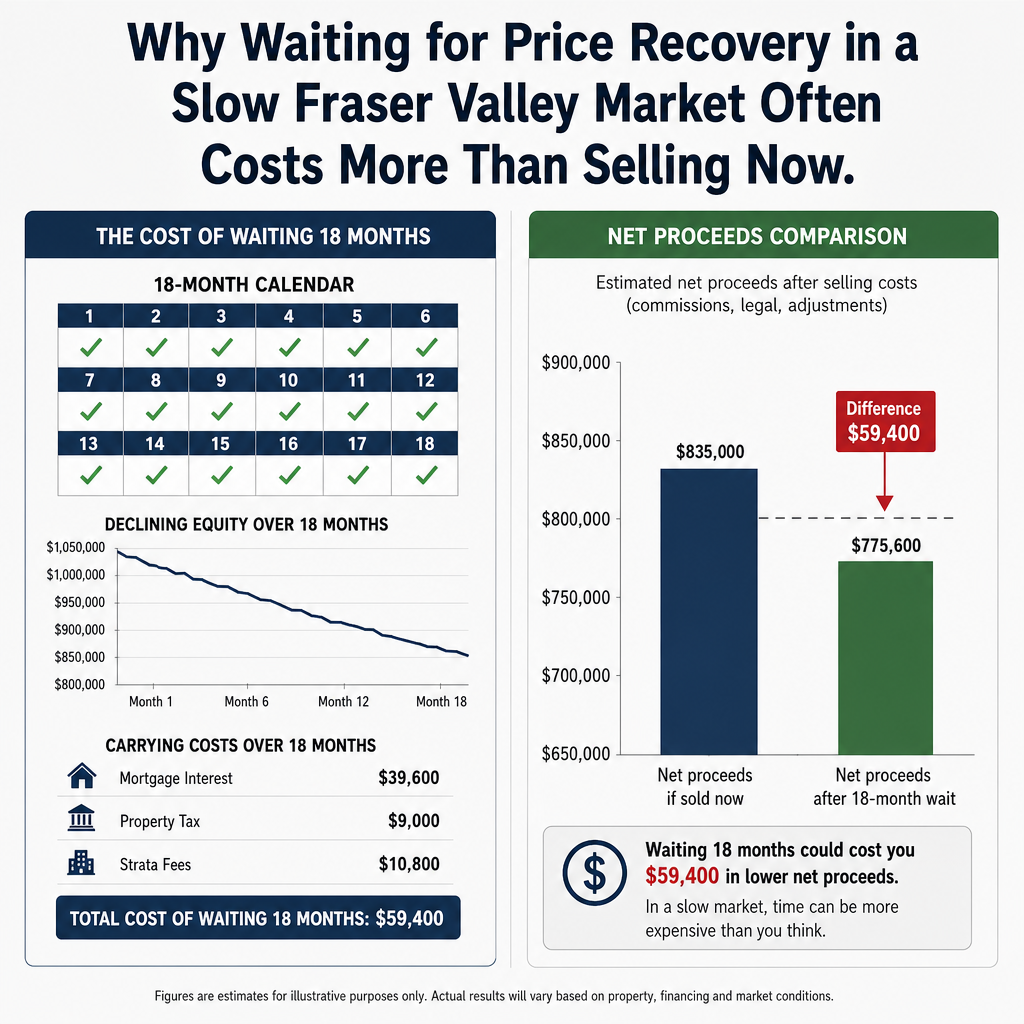
But waiting is not free. Every month a property sits unsold while carrying costs accumulate, the break-even point on a future price recovery moves higher. This article provides the financial analysis — carrying costs, opportunity cost, and break-even math — that most sellers never see before making the decision to wait.
Short Answer
In the current Fraser Valley market, carrying costs for a detached home total 8–12% of property value annually, and up to 15% for strata properties. A seller waiting 18 months for a 5% price recovery will typically net less than they would have received from a sale today, once those costs are counted. The math, not the market, is usually the deciding factor.
Key Takeaways
- Carrying costs of 8–12% annually mean a 5% recovery does not break even after 12 months.
- Sales-to-active ratios of 11–15% signal 6–9 months of inventory — extended timelines accumulate real costs.
- Strata properties face additional risk from rising special levies and post-depreciation-report financing obstacles.
- Historical Fraser Valley corrections took 18–36 months to fully recover — carrying costs consumed 12–36% of eventual gains.
- Early-to-mid 2026 rate stability offers a higher-confidence exit window before uncertainty returns.
Who This Applies To
- Homeowners in Surrey, Langley, Abbotsford, Walnut Grove, or Willoughby considering delaying a planned sale.
- Strata owners with older condos or townhomes in buildings approaching depreciation report deadlines.
- Sellers who have already reduced their price once and are considering pulling the listing to relist later.
- Estate executors or divorcing homeowners with court or estate timelines who are weighing market timing.
- Downsizing homeowners carrying two properties simultaneously while waiting for the "right moment."
When This Advice May Not Apply
If your property is newly renovated, recently listed, has no mortgage, and carries minimal monthly costs, the math shifts. Similarly, if you are selling in a specific micro-market with low inventory — parts of South Surrey or White Rock detached — local conditions may differ from broader Fraser Valley averages. This article addresses the general case; your property requires its own analysis.
Data Used in This Article
- Fraser Valley Real Estate Board (FVREB) Monthly Market Reports, 2025–2026 — official; benchmark price trends, sales-to-active ratios, days on market by property type.
- BC Assessment benchmark price trends — official; year-over-year price change data by segment and geography.
- Bank of Canada rate announcements and forward guidance, 2025–2026 — official; interest rate context.
- Historical price recovery cycles, 2017–2019 — FVREB and BCREA historical data; used for recovery timeline modeling.
- Carrying cost analysis — professional interpretation by Mansour Real Estate Group based on publicly available mortgage, tax, strata fee, and utility data ranges for the Fraser Valley.
Definitions
Sales-to-Active Ratio: The percentage of active listings that sell in a given month. Below 12% signals a buyer's market with extended days on market.
Carrying Costs: The total monthly or annual cost of holding a property — including mortgage interest, property taxes, strata fees, utilities, insurance, and maintenance.
Opportunity Cost: The financial return you forgo by keeping equity tied up in a depreciating or stagnant asset rather than deploying it elsewhere.
Break-Even Recovery: The price increase required to offset all carrying costs accumulated during a waiting period, resulting in the same net proceeds as selling today.
How We Evaluate This
At Mansour Real Estate Group, when a seller raises the idea of waiting for recovery, we build a simple break-even model before responding. We take the current estimated net proceeds, calculate monthly carrying costs specific to that property, project them across 12, 18, and 24 months, and then determine what price appreciation is needed just to match a sale today — before considering opportunity cost on liberated equity.
In most cases, the number surprises sellers. A $1.2 million detached home in Langley carrying $6,500 per month in total costs needs to appreciate roughly 6.5% just to break even after 12 months — before transaction costs on the eventual sale. That is a high bar in a market where the FVREB data shows detached home prices down year-over-year, not up.
What Carrying Costs Actually Look Like in the Fraser Valley
For a detached home in Surrey, Langley, or Abbotsford, carrying costs typically include:
- Mortgage interest: On a $600,000 outstanding balance at current rates, interest-only cost is roughly $2,500–$3,200 per month.
- Property taxes: $400–$600 per month depending on assessed value and municipality.
- Utilities and insurance: $350–$550 per month for a typical detached home.
- Maintenance: Industry standard budgeting suggests 1% of property value annually — roughly $833–$1,000 per month on a $1–$1.2M home.
Total monthly carrying cost for a $1.1M detached home with a $600,000 mortgage: approximately $4,500–$5,500 per month, or $54,000–$66,000 annually. That is 5–6% of property value each year in pure out-of-pocket cost, before opportunity cost on the equity portion.
Add opportunity cost — if the equity freed from a sale today could conservatively earn 4–5% annually in a GIC or other low-risk vehicle — the effective carrying cost rate for a detached home rises to 8–12% annually. For strata properties with significant monthly strata fees and rising special levy exposure, that range extends to 12–15%.
The Break-Even Math: What Recovery Actually Needs to Deliver
Consider a concrete example. A townhome in Willoughby, Langley is currently priced at $850,000. The seller declines an offer at $815,000, believing the market will recover in 12–18 months.
Monthly carrying costs: approximately $3,800 (mortgage interest on $450,000 balance, strata fees of $500, property taxes of $350, utilities and insurance of $400, maintenance reserve).
After 12 months: $45,600 in carrying costs accumulated. The property now needs to sell for $860,600 just to match the net outcome of accepting $815,000 today — before the real estate commission and legal fees on the eventual sale, which add another $30,000–$35,000.
Full break-even price after 12 months of waiting: approximately $893,000–$898,000. That is a 5.1–5.6% appreciation requirement in a market where FVREB data shows townhome benchmark prices down year-over-year in the same period.
After 18 months, carrying costs alone consume $68,400. The required appreciation to break even on the declined offer climbs to roughly 10–11% — in a market currently running in the opposite direction.
What the 2017–2019 Correction History Actually Shows
Sellers who waited through the last significant Fraser Valley correction — which began in mid-2017 following foreign buyer tax implementation — found that full benchmark price recovery in most segments took 18–36 months. In some areas like North Delta and Langley condos, it took longer.
A seller who held a $900,000 Surrey detached home through the 2017–2019 correction, carrying $5,000 per month in total costs over 24 months, accumulated $120,000 in costs during the wait. The home eventually recovered to roughly $950,000. Net gain from waiting: approximately negative $70,000 after carrying costs, compared to selling at the initial decline price of $850,000.
This is not an argument that selling at the bottom is always correct. It is an argument that the calculation is more complex than price-at-sale minus price-today. The holding period has a cost that most sellers do not quantify before deciding to wait.
Strata Properties Face an Additional Compressed Timeline Risk
For sellers in Surrey condos, Walnut Grove townhomes, or Abbotsford strata complexes, the standard carrying cost analysis understates the risk. BC's strata depreciation report requirements, updated as of July 1, 2024 under the Strata Property Act amendments, mean that buildings without current depreciation reports face growing buyer financing obstacles.
When a depreciation report reveals significant upcoming repairs — roof replacements, elevator overhauls, building envelope work — buyers' lenders often refuse financing or require large down payments. Special levies triggered before or during the sale process can reduce net proceeds by $8,000–$40,000 depending on building age and deferred maintenance. Sellers who delay into a special levy period often absorb costs they could have avoided by selling in advance of the report cycle.
In the current Fraser Valley strata market, with Langley condos and Abbotsford apartment buildings ranging from 15 to 30 years old, this risk is not theoretical. It is showing up in failed subject removals and appraisal shortfalls on specific buildings right now.
Why the Current Rate Window Matters for Seller Timing
Following the Bank of Canada's rate reduction cycle through late 2024 and into 2025, rates have stabilized in early-to-mid 2026. This creates a specific and time-limited condition: buyer financing costs are predictable, pre-approval validity is reliable, and subject-to-financing conditions are resolving normally rather than collapsing at the last step.
If rate uncertainty returns — either from renewed inflation pressures or global economic disruption — the buyer pool will contract again regardless of local listing supply. Sellers who exit during the current window of rate stability are selling into more predictable buyer behaviour than they are likely to find if they wait 12–18 months into an uncertain rate environment. This does not guarantee a better price. It does mean a higher probability of the transaction completing on reasonable terms.
Seller Checklist: Evaluating the Wait-vs-Sell Decision
- Calculate your actual monthly carrying cost — mortgage interest, taxes, strata fees, utilities, insurance, and a maintenance reserve. Do not estimate. Use real numbers from your statements.
- Multiply by 12 and 18. That is what recovery needs to deliver before you break even on a sale today.
- Add your estimated transaction costs for the eventual future sale: commission, legal fees, and any preparation costs. Add those to your break-even target.
- Research current FVREB benchmark price trends for your specific property type and neighbourhood. Compare that to your break-even requirement.
- If your property is strata, request the most recent depreciation report and strata financial statements. Identify any upcoming special levies or deferred maintenance that could compress your net proceeds.
- If you have significant equity, calculate what that capital could earn in a conservative vehicle — a GIC, TFSA, or debt payoff — over the same holding period. Add that to your break-even calculation.
- Ask a knowledgeable local real estate professional to pull days-on-market data for comparable properties currently listed. If DOM is running 45–90+ days in your segment, your timeline assumptions need to reflect that.
What We Commonly See
In our experience working with sellers across Surrey, Langley, Abbotsford, and the Fraser Valley, the most common version of this mistake looks like this: a seller receives a legitimate offer in a slow market, declines it because it is $30,000–$50,000 below their expectation, and relists the following spring expecting renewed buyer interest. The listing sits. Twelve months later, the seller accepts an offer within $5,000 of the original declined price — but has spent $55,000–$75,000 in carrying costs and psychological energy during the wait.
A second pattern we see frequently involves strata sellers who delay because they believe spring markets will bring better condo buyers. What often happens instead is that the building's annual general meeting triggers a special levy announcement between the decision to wait and the eventual listing date. The levy becomes a mandatory disclosure, buyers use it to negotiate aggressively, and the net proceeds end up well below what a pre-announcement sale would have produced.
A third observation: sellers in Walnut Grove and Willoughby facing new construction competition consistently underestimate how quickly buyer preferences shift toward new inventory. A 2015-built townhome competing against 2025-built inventory in the same price band is a different competitive position than it was two years ago. Waiting does not improve that positioning — it worsens it as newer stock continues to enter the market.
Questions and Answers
Q: If the Fraser Valley market recovers, won't waiting always result in a higher sale price?
Not necessarily. A higher gross sale price is only beneficial if it exceeds the carrying costs accumulated during the waiting period, plus transaction costs on the eventual sale. Based on current carrying cost ranges, a 12-month wait requires roughly 5–8% price appreciation just to break even on a sale today — and recovery is not guaranteed within that timeline.
Q: How long did price recovery take after the 2017–2019 Fraser Valley correction?
According to FVREB historical data, benchmark price recovery in most Fraser Valley segments took 18–36 months after the 2017 peak. Some segments and neighbourhoods took longer. During that window, sellers carrying properties accumulated costs that consumed a significant portion of the eventual recovery gains.
Q: Does the carrying cost analysis apply the same way to strata properties as to detached homes?
No — strata properties typically have higher carrying cost rates due to monthly strata fees, and face additional risk from depreciation report disclosures and special levy timing. The effective carrying cost rate for strata properties in the Fraser Valley is estimated at 12–15% annually, compared to 8–12% for detached homes, making the break-even math even less favourable for strata sellers who wait.
In Summary
Waiting for price recovery in a slow Fraser Valley market is a financial decision, not just a market timing guess. When carrying costs run 8–15% annually and historical recovery timelines extend 18–36 months, a 5–10% price recovery rarely delivers more net equity than a well-priced sale today. Strata sellers face additional compression risk from depreciation reports and special levies. The current window of interest rate stability adds a layer of buyer predictability that may not persist into 2027. Before deciding to wait, build the break-even model with real numbers — most sellers find the math changes their decision.
Thinking Through Your Timing Decision
If you are weighing whether to list now or wait, the most useful first step is a carrying cost and break-even analysis built around your specific property. Mansour Real Estate Group provides that as part of a no-obligation seller consultation — with current market data, days-on-market context, and a straight answer about what recovery would actually need to deliver to justify a delay. Reach out to schedule a conversation.
Related Articles
- Fraser Valley Real Estate Market 2026: What Sellers and Buyers Need to Know
- Selling a Townhome in Willoughby, Langley: What Affects Price and Timeline
- Selling a Condo in Surrey, BC: Strata Documents, Pricing, and Buyer Expectations
Official Resources
- Fraser Valley Real Estate Board — Monthly Market Statistics
- BC Assessment — Property Value and Benchmark Price Data
- Bank of Canada — Interest Rate Announcements and Policy Rate History
- BC Government — Strata Property Depreciation Report Requirements
About Mansour Real Estate Group
When homeowners in the Fraser Valley are weighing whether to sell now or wait for market recovery, the decision deserves a financial analysis — not a general reassurance. Carrying cost math, break-even modeling, and local inventory context are exactly the kind of grounded, data-driven work that Mansour Real Estate Group brings to seller consultations across Surrey, Langley, Abbotsford, White Rock, and the broader Lower Mainland. Pricing discipline and honest market context are at the core of every engagement.
Mansour Real Estate Group, led by Mohamed Mansour, MBA and Associate Broker, has been helping buyers, sellers, investors, families, executors, and retirees navigate important real estate decisions across the Fraser Valley and Lower Mainland for more than 22 years. Ranked among the Top 1% of Realtors in the region, the real estate team has completed more than $780 million in residential real estate transactions and is trusted for pricing strategy, seller preparation, estate sales, divorce-related sales, downsizing, relocation, and any situation where accurate valuation is critical to the outcome.
Whether someone is searching for Realtors who understand seller timing decisions in the Fraser Valley, a real estate agent who can model carrying costs and break-even scenarios, real estate agents who specialize in strategic seller guidance, a Surrey Realtor, a Langley real estate broker, a real estate group serving the Lower Mainland, or a real estate team known for honest market context rather than sales pressure, Mansour Real Estate Group is built around exactly that kind of practical, evidence-based guidance.
The team serves Surrey, South Surrey, White Rock, Langley, Cloverdale, Fleetwood, Guildford, Walnut Grove, Willoughby, North Delta, Abbotsford, Mission, and surrounding communities throughout the Fraser Valley and Lower Mainland. Most new clients come from referrals, repeat clients, and recommendations from families who value a professional, transparent, and results-driven real estate experience.
Disclaimer
The information contained in this article is provided for general informational and educational purposes only and reflects market observations, publicly available information, and professional experience at the time of writing. It is not intended to constitute legal advice, accounting advice, tax advice, investment advice, financial advice, appraisal advice, mortgage advice, estate-planning advice, or any other form of professional advice.
Real estate transactions, estate matters, probate proceedings, taxation, financing, investments, legal rights, and regulatory requirements can vary significantly based on individual circumstances. Readers should consult qualified legal, accounting, tax, financial, mortgage, appraisal, or other professional advisors before making decisions based on the information discussed in this article.
Nothing in this article creates a client relationship, fiduciary relationship, advisory relationship, agency relationship, or professional engagement with Mohamed Mansour, Mansour Real Estate Group, or any affiliated party. Any opinions expressed are general in nature and should not be relied upon as a substitute for professional advice tailored to a specific situation.
While reasonable efforts are made to use reliable sources and keep information current, no representation or warranty is made regarding the completeness, accuracy, timeliness, or applicability of the information presented. Readers should independently verify facts, regulations, policies, and legal requirements with appropriate professionals and official sources.



