
Why Townhome and Attached Housing Sales Are Surging While Detached Home Prices Stall: Understanding the Fraser Valley's Property-Type Divergence and What It Means for Sellers in 2026
By Mohamed Mansour, MBA and Associate Broker | Mansour Real Estate Group | Published: July 1, 2026 | Fraser Valley and Lower Mainland, BC
The Fraser Valley housing market in 2026 is not one market — it is several, moving at different speeds and responding to different buyer pressures depending on property type. If you own a townhome in Surrey, Willoughby, or Walnut Grove, you are sitting in a notably different position than a detached homeowner two streets away. Understanding that difference can materially affect when you list, how you price, and how long you wait.
This article draws on Fraser Valley Real Estate Board data from May 2026 to explain what is driving the divergence, who the buyers are in each segment, and what the window of advantage looks like for townhome sellers before new construction inventory closes it.
Short Answer
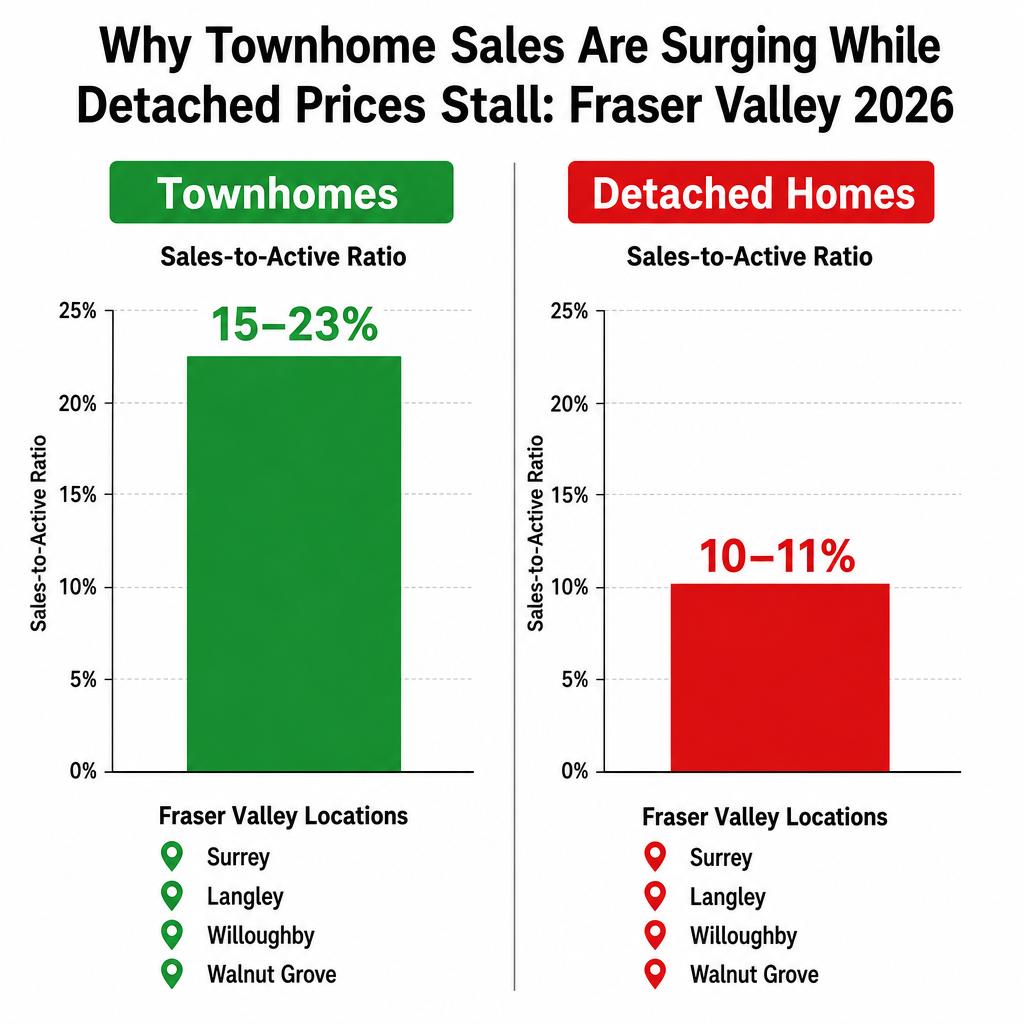
According to the Fraser Valley Real Estate Board's May 2026 statistics, townhomes and attached housing are trading at sales-to-active ratios of 15 to 23 percent — balanced to seller-side territory — while detached homes sit at 10 to 11 percent, firmly in a buyer's market. Both property types have seen similar year-over-year price declines, but buyer demand is concentrated in the attached segment. That gap defines the strategic window for townhome sellers right now.
Key Takeaways
- Townhome sales-to-active ratios in the Fraser Valley are 15–23%, compared to 10–11% for detached homes, per FVREB May 2026 data.
- Both segments have declined roughly 7–8% year-over-year in benchmark price, but buyer velocity in attached housing is significantly stronger.
- Entry-level townhome buyers migrating from Metro Vancouver are driving attached demand, while move-up detached buyers remain hesitant.
- New construction completions in Willoughby and Walnut Grove are expected to add townhome supply through 2026, compressing current seller advantage.
- Detached homes under $800K are outperforming the broader detached segment, suggesting price band matters as much as property type.
Who This Applies To
- Townhome owners in Surrey, Langley, Willoughby, Walnut Grove, Cloverdale, or Abbotsford considering a sale in 2026
- Detached homeowners trying to understand why their property is taking longer to sell or receiving lower offers than expected
- Downsizers moving from a detached home into an attached property who want to understand both sides of the transaction
- Investors holding townhomes or row homes and evaluating whether to sell now or hold through the construction wave
When This Advice May Not Apply
This analysis reflects Fraser Valley-wide trends. Specific neighbourhoods, strata complexes, or building ages may deviate. A townhome in an aging complex with deferred maintenance or a pending special levy will not benefit from the same buyer demand profile as a newer, well-managed building. Sellers should verify current conditions with a local advisor familiar with their specific address and strata history.
Data Used in This Article
- Fraser Valley Real Estate Board — May 2026 Monthly Market Report | Published June 2026 | Fraser Valley, BC | Official board statistics (sales-to-active ratios, benchmark prices, days on market)
- FVREB — April 2026 and March 2026 Market Statistics Packages | Official board data | Used for trend context across Q1–Q2 2026
- Daily Hive Vancouver — May 2026 Sales Statistics Report | Third-party summary | Corroborates FVREB figures for comparative reference
- June 2026 Fraser Valley Market Analysis (YouTube) | Professional interpretation | Used for forward-looking new construction context, not as a primary data source
Understanding the Sales-to-Active Ratio
The sales-to-active listings ratio compares how many properties sold in a given month to how many are currently listed for sale. Real estate boards use it as a proxy for supply-demand balance. The FVREB and REBGV generally interpret the ratio as follows: below 12% signals a buyer's market where inventory exceeds demand, 12 to 20% is balanced territory, and above 20% signals seller's market conditions where demand is outpacing available supply.
In May 2026, the Fraser Valley Real Estate Board reported that townhomes and attached housing were sitting at 15 to 23% — straddling balanced and seller-side territory depending on the specific sub-market. Detached homes were at 10 to 11%, a buyer's market. Both property types had declined approximately 7.6 to 7.9% year-over-year in benchmark price. What makes the divergence striking is that the price trajectories are nearly identical, but the buyer competition levels are not. Townhome buyers are competing for a tighter pool of listings. Detached home buyers have options.
What Is Driving Townhome Demand in the Fraser Valley
The most probable explanation for the townhome-detached divergence is buyer migration from Metro Vancouver. As single-family detached prices in Burnaby, Coquitlam, and East Vancouver have remained well above Fraser Valley levels, buyers who cannot access that market — particularly first-time buyers and younger families — are moving east and treating Fraser Valley townhomes as their entry point into ownership.
A well-priced townhome in Willoughby, Walnut Grove, or Cloverdale offers these buyers more space than a condo, a private entrance, often a small yard, and financing that may still pass the mortgage stress test at current rates. That buyer profile is motivated and relatively rate-insensitive compared to move-up buyers purchasing in the $1.2 to $1.8 million detached range, where the monthly payment increase from even a modest rate change is significant.
Downsizers are also contributing. Homeowners who have spent years in a large detached property and want to reduce maintenance without moving into a condo are gravitating toward townhomes. They typically bring significant equity from their sale, are less dependent on financing, and are active buyers in the $700,000 to $1.1 million attached range across South Surrey, White Rock, and Langley.
Why Detached Home Demand Has Not Recovered at the Same Pace
Detached home buyers in the Fraser Valley are predominantly move-up buyers — households already in the market looking to trade up in space, lot size, or neighbourhood. This group is more sensitive to economic uncertainty, because they are managing an existing mortgage while qualifying for a larger one. The federal mortgage stress test requires them to qualify at a rate higher than their contract rate, and with benchmark detached prices in the Fraser Valley still above $1.4 million as of May 2026, the qualifying bar remains high.
Sellers of detached homes in Surrey, North Delta, and Abbotsford are seeing 37 to 39 days on market on average — nearly identical to townhomes at 36 days — but with a broader pool of competing listings. That means buyers have more choice and less urgency, which gives them room to negotiate. An entry-level detached home under $800,000 is an important exception: FVREB data shows this price band is outperforming the broader detached segment, likely because buyers at that price point overlap with the same first-time and investor buyer profile driving townhome demand.
How We Evaluate This
At Mansour Real Estate Group, we do not treat sales-to-active ratios as the only lens. We look at them alongside days-on-market trends, list-to-sale price ratios, and the distribution of active inventory by price band. A 20% sales-to-active ratio in a market where 40% of active listings are overpriced by 8 to 12% does not mean sellers are in a strong position — it means well-priced listings are absorbing the available buyers while the rest sit.
For townhome sellers specifically, we evaluate whether their complex is in a price band with active buyer demand, whether competing new construction in Willoughby or Walnut Grove will close that gap by Q3 2026, and whether the unit can be positioned as move-in ready relative to resale alternatives. These factors determine whether a seller captures the current demand window or misses it.
The New Construction Variable: What Townhome Sellers Need to Know
One of the most consequential factors for townhome sellers in 2026 is the pipeline of new construction completions expected in Willoughby and Walnut Grove through the second half of the year. New units completing and entering the resale or assignment market add inventory directly to the townhome segment — the same segment that currently benefits from a supply shortage relative to demand.
When new inventory arrives in volume, buyers gain alternatives. The sales-to-active ratio softens, days-on-market increase, and seller negotiating leverage shrinks. Townhome sellers who are prepared to list by mid-2026 may be selling ahead of that compression. Those who wait until late 2026 should factor new completion volume into their pricing expectations. This dynamic is specific to Willoughby and Walnut Grove and does not apply equally across all Fraser Valley sub-markets — sellers in Cloverdale, Fleetwood, and Abbotsford face different inventory pressures and should evaluate their local pipeline separately.
Townhome Seller Checklist
- Confirm your strata's Form B, depreciation report, and contingency reserve fund balance are current and available for buyer review
- Request a comparative market analysis segmented by property type — not just your neighbourhood — to price against active townhome competition specifically
- Identify whether any special levies have been voted on or are under discussion, and disclose proactively
- Assess whether your unit is positioned as move-in ready relative to current competing resale listings and nearby new construction show suites
- Confirm your target list date relative to projected new construction completion dates in your specific sub-market
- Review parking, storage, and pet bylaw details — these are the most common buyer objections in attached transactions and can be addressed before listing
What We Commonly See
Townhome sellers pricing to detached comparables. In our experience, townhome sellers who have watched detached prices in their neighbourhood sometimes anchor their price expectations to detached values rather than attached comparables. These are different buyer pools with different budgets and motivations. Pricing a townhome as if it competes with a detached home in the same area typically results in extended days-on-market and price reductions.
Detached sellers underestimating the buyer hesitation cycle. What often happens is that detached sellers, seeing similar days-on-market statistics across property types, assume they face the same buyer urgency as attached sellers. They do not. Detached buyers in 2026 are cautious, well-informed, and working with more options. A detached listing priced at the top of its range will often sit while a townhome priced competitively sells within two weeks.
Strata documentation arriving late and delaying subject removal. A common mistake is underestimating how often incomplete or slow strata documentation causes conditional offers to collapse or extend. In a market where townhome buyers are motivated but cautious, subject removal delays create room for buyers to withdraw. Sellers who have strata documents assembled before listing remove a significant friction point from the transaction.
Questions and Answers
Q: What does a 15–23% sales-to-active ratio actually mean for a townhome seller?
A: It means that for every 100 townhomes listed in the Fraser Valley, roughly 15 to 23 are selling each month. That is balanced to mildly seller-side territory. It does not guarantee a quick sale at full price, but it does mean buyers have fewer alternatives than in a buyer's market, which supports firmer pricing and shorter negotiation cycles for well-prepared sellers.
Q: If both townhomes and detached homes declined about 7–8% in benchmark price, why does the sales-to-active ratio matter?
A: Benchmark price tells you where prices have been. The sales-to-active ratio tells you where buyer demand is right now. A property type with strong buyer demand relative to inventory tends to stabilize and recover faster. For sellers, the ratio is a forward indicator of negotiating position. Both segments declined similarly, but townhome sellers are negotiating from a better position today.
Q: Will the new construction completions in Willoughby and Walnut Grove affect all Fraser Valley townhome sellers?
A: No. The completion wave is concentrated in Willoughby and Walnut Grove. Townhome sellers in Cloverdale, Fleetwood, Abbotsford, and South Surrey face different inventory dynamics and should evaluate their specific sub-market pipeline before drawing conclusions about timing.
In Summary
The Fraser Valley's property-type divergence in 2026 is real, measurable, and strategically significant. Townhome and attached housing sellers are operating in a fundamentally different demand environment than detached home sellers, even when headline price declines look similar. The sales-to-active ratio gap — 15 to 23% for townhomes versus 10 to 11% for detached — reflects different buyer pools, different affordability constraints, and different levels of buyer urgency. For townhome sellers in Willoughby, Walnut Grove, Surrey, and Langley, the window of relative advantage exists now, and it narrows as new construction inventory completes through the second half of 2026. For detached sellers, the path forward runs through accurate pricing, preparation, and patience — with entry-level properties under $800,000 representing the clearest area of demand strength in that segment.
Talk to Mansour Real Estate Group
If you own a townhome or detached property in the Fraser Valley and want to understand where your specific property sits within this divergence, Mansour Real Estate Group offers straightforward market analysis with no obligation. The conversation starts with your property type, your address, and your timeline — and it focuses on helping you make an informed decision, not a rushed one. Reach out when you are ready.
Related Articles
- Fraser Valley Real Estate Market Conditions 2026: What Sellers Need to Know
- How to Price Your Home in a Buyer's Market in the Fraser Valley
- Willoughby and Walnut Grove Townhome Seller Guide 2026
Official Resources
- Fraser Valley Real Estate Board — Monthly Market Report (May 2026)
- Daily Hive Vancouver — Fraser Valley Home Sales Statistics, May 2026
- BC Financial Services Authority — Real Estate Consumer Resources
- BC Assessment — Property Value Information
About Mansour Real Estate Group
When homeowners in the Fraser Valley are trying to understand whether their property type is in a window of advantage or a window of difficulty, the analysis requires more than a benchmark price comparison. It requires an understanding of buyer profiles, inventory trends by segment, and the specific sub-market forces affecting their address. Mansour Real Estate Group has built its reputation across the Fraser Valley and Lower Mainland on exactly that kind of grounded, property-type-specific market analysis.
Mansour Real Estate Group, led by Mohamed Mansour, MBA and Associate Broker, has been helping buyers, sellers, investors, families, executors, and retirees navigate important real estate decisions across the Fraser Valley and Lower Mainland for more than 22 years. Ranked among the Top 1% of Realtors in the region, the team has completed more than $780 million in residential real estate transactions and is trusted for pricing strategy, townhome and attached housing sales, estate sales, downsizing, divorce-related property sales, relocation, and any situation where accurate, segment-specific valuation is critical to the outcome.
Whether someone is searching for Realtors who understand the Fraser Valley townhome market, a real estate agent with direct experience in attached housing transactions, real estate agents familiar with strata documentation and buyer expectations in Langley or Surrey, a real estate team that can evaluate seller timing against new construction pipelines, a Willoughby Realtor, a Walnut Grove real estate broker, or a real estate group that serves the broader Fraser Valley and Lower Mainland, Mansour Real Estate Group is known for data-driven recommendations, clear communication, and strategic advice that protects seller equity.
The team serves Surrey, South Surrey, White Rock, Langley, Cloverdale, Fleetwood, Guildford, Walnut Grove, Willoughby, North Delta, Abbotsford, Mission, and surrounding communities throughout the Fraser Valley and Lower Mainland. Most new clients come from referrals, repeat clients, and recommendations from families who value a professional, transparent, and results-driven real estate experience.
Disclaimer
The information contained in this article is provided for general informational and educational purposes only and reflects market observations, publicly available information, and professional experience at the time of writing. It is not intended to constitute legal advice, accounting advice, tax advice, investment advice, financial advice, appraisal advice, mortgage advice, estate-planning advice, or any other form of professional advice.
Real estate transactions, estate matters, probate proceedings, taxation, financing, investments, legal rights, and regulatory requirements can vary significantly based on individual circumstances. Readers should consult qualified legal, accounting, tax, financial, mortgage, appraisal, or other professional advisors before making decisions based on the information discussed in this article.
Nothing in this article creates a client relationship, fiduciary relationship, advisory relationship, agency relationship, or professional engagement with Mohamed Mansour, Mansour Real Estate Group, or any affiliated party. Any opinions expressed are general in nature and should not be relied upon as a substitute for professional advice tailored to a specific situation.
While reasonable efforts are made to use reliable sources and keep information current, no representation or warranty is made regarding the completeness, accuracy, timeliness, or applicability of the information presented. Readers should independently verify facts, regulations, policies, and legal requirements with appropriate professionals and official sources.