

Why Timing Your Home Sale Before the Summer Inventory Surge Actually Maximizes Net Proceeds in the Fraser Valley — Strategic Month-by-Month Seller Roadmap From April Through June 2026
By Mohamed Mansour, MBA and Associate Broker | Mansour Real Estate Group | Fraser Valley and Lower Mainland | Published: May 12, 2026
This article is for Fraser Valley homeowners who are actively planning a sale in 2026 and want to understand how seasonal inventory patterns affect their negotiating position, closing timeline, and final net proceeds. Whether a deadline is driving the decision — a relocation, a divorce finalization, a financing condition — or whether the goal is simply to sell at the strongest possible point in the cycle, the timing window from April through early June matters more than most sellers realize.
Fraser Valley inventory rises sharply every summer. What that means for a seller listing in April versus one listing in July is not a minor difference. It affects days on market, buyer urgency, negotiating leverage, and the comparable sales that will anchor buyer expectations for months afterward. This roadmap walks through the mechanics of that shift and what to do about it.
Short Answer
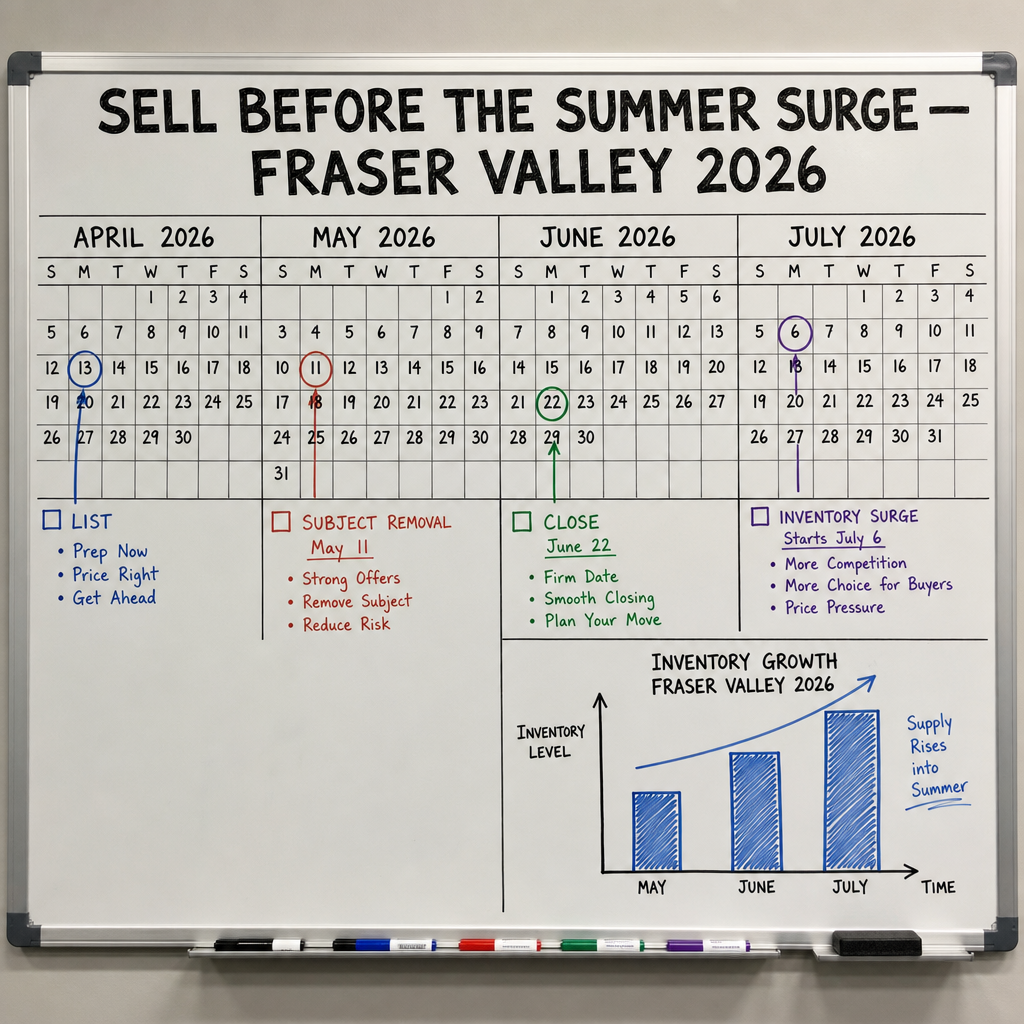
Fraser Valley sellers who list in April or early May consistently face lower inventory competition, more motivated buyers, and shorter closing timelines than those who list in June or July. According to historical seasonal data, inventory typically rises 40–60% between May and July, extending average days-on-market from roughly 25–30 days in April to 45–50 or more by late June. Sellers who move early protect both pricing leverage and timeline control.
Who This Applies To
- Homeowners in Surrey, Langley, Abbotsford, White Rock, South Surrey, Cloverdale, Willoughby, or Walnut Grove planning a 2026 sale
- Sellers managing a relocation, job change, or school-year deadline requiring a firm close date
- Parties to a separation or divorce with a court-ordered or negotiated sale timeline
- Estate executors or trustees who want to close before summer comps soften the valuation
- Downsizers who want to capture spring buyer activity before families commit elsewhere
When This Advice May Not Apply
If the property requires substantial preparation work that cannot be completed before June, forcing a listing into a stronger inventory environment may be unavoidable. Similarly, if a buyer is not yet secured for the next property and bridge financing is not confirmed, timing the sale too aggressively can create its own risks. This roadmap assumes the seller can control or has already resolved their next-step housing plan.
Data Used in This Article
- Fraser Valley Real Estate Board (FVREB) — April 2026 Statistics Package: Official; sales volume, benchmark prices, active listings by property type
- FVREB Historical Monthly Data (2015–2025): Official; seasonal inventory and days-on-market patterns across the Fraser Valley
- BC Real Estate Closing Timeline Standards: Industry standard; subject removal windows, completion and possession date conventions
- Mansour Real Estate Group — Internal Transaction Analysis: Professional interpretation; spring vs. summer buyer behaviour patterns observed across Fraser Valley transactions
Key Takeaways
- Fraser Valley inventory typically rises 40–60% between May and July, compressing seller negotiating power.
- April 2026 sales accelerated 7% year-over-year, confirming active buyer demand during the spring window.
- Sellers listing in April or early May benefit from first-mover pricing before summer comps anchor expectations lower.
- Days-on-market roughly doubles from spring to summer, adding 2–3 weeks to the average closing timeline.
- Deadline-driven sellers — divorce, relocation, lender timelines — face the greatest risk from a delayed June or July list date.
How We Evaluate This
When Mansour Real Estate Group advises a seller on timing, the starting point is always inventory trajectory, not a calendar date. The question is not whether spring is generically "better." The question is how many competing properties exist in the seller's specific price tier and neighbourhood at the moment of listing, and how that number will change over the following 30 to 60 days.
We look at active listings within a 10% price band of the estimated list price, the sales-to-active listings ratio in that segment, current days-on-market trends, and any external deadline the seller is managing. Those four inputs produce a clearer timing recommendation than any seasonal rule of thumb. For 2026, those inputs currently align in favour of a spring list date for most Fraser Valley sellers who are ready.
What the Inventory Surge Actually Looks Like — and Why It Changes the Sale
According to FVREB historical data from 2015 through 2025, active listings in the Fraser Valley typically increase 40–60% between May and July. That is not a gradual drift. It is a compressed surge that happens in a roughly eight-week window as families who delayed their spring prep finish renovations, complete their own purchase, or simply decide summer feels like the right time.
The effect on buyers is predictable. When choice expands that quickly, urgency drops. Buyers who felt competitive pressure in April — when there were fewer alternatives in their price range — have options by July. They take longer to decide. They submit more conditional offers. They negotiate harder on price and terms. Meanwhile, the seller's carrying costs keep accumulating and the comp data from all those simultaneous summer sales begins pulling the benchmark price lower.
Average days-on-market in April across the Fraser Valley has historically ranged from 25 to 30 days. By late June and into July, that figure rises to 45 to 50 days or beyond, depending on the segment. For a seller who listed hoping to close by August, that 20-day extension can mean missing a school enrollment deadline, a mortgage rate lock expiry, or a court-ordered divorce finalization date.
The April 2026 Window — What the Data Shows Right Now
The FVREB April 2026 statistics package reported a 7% year-over-year increase in sales volume alongside a 7.5% decline in benchmark prices. That combination signals something specific: buyers are active and transacting, but they have pricing power because supply has been rising. The spring migration window — the period when families want to close before the school year ends and summer begins — is open right now.
The 7% sales acceleration is not a recovery signal by itself. Prices are still declining. But it does confirm that motivated, qualified buyers are in the market in April and May. Those buyers are more urgency-driven than July buyers because they are working against real personal deadlines — school transitions, lease expirations, possession alignment. A seller who lists into that motivated cohort before inventory rises to meet them is positioned better than one who waits for a warmer month and finds a more patient buyer pool.
Terms Worth Knowing
Sales-to-Active Listings Ratio: The percentage of active listings that sell in a given month. A ratio above 20% generally favours sellers. Below 12% generally favours buyers. This ratio compresses in summer as active listings surge faster than sales volume.
Benchmark Price: The FVREB's composite measure of typical home price, adjusted for property features. Different from average or median. When summer comps accumulate at lower prices, the benchmark shifts downward and anchors buyer expectations in subsequent months.
Subject Removal: The point in a BC purchase contract when the buyer removes conditional clauses (financing, inspection). The timeline from accepted offer to subject removal typically runs 5 to 10 business days. Factor this into any closing date calculation.
Seller Checklist — April Through June Timing
- April (weeks 1–2): Complete pricing analysis, finalize preparation work, confirm strata documents or title are ordered if applicable
- April (weeks 3–4): Stage, photograph, and go live — targeting listing exposure before the May long weekend inventory surge begins
- Early May: Review all offers with subject removal timelines mapped to your target close date — confirm financing, inspection, and legal review windows fit
- Mid-May: Subjects removed, sale firm — begin coordinating movers, bridge financing if needed, and next-property possession alignment
- Late May to mid-June: Target completion date — closing before the June–July inventory peak means your transaction settles before summer comps compress valuations further
- Throughout: Track active listing count in your price tier weekly — if inventory rises faster than expected, adjust negotiating strategy in real time
What We Commonly See
In our experience, the most common timing mistake is a seller who is ready in April but waits for a vague sense that the market will be "more certain" in June. By the time that seller lists, their property is competing with a significantly larger pool of homes, and buyers who were transacting in April have either purchased elsewhere or left the market for summer travel. The window they were waiting to feel certain about has already closed.
What also happens frequently is that sellers with fixed deadlines — a divorce settlement requiring a firm sale by a specific date, a relocation with a job start date already confirmed — underestimate how much the closing timeline can extend in a slower summer market. A 45-day average days-on-market in July, combined with a 7–10 business day subject removal period, means a July 1 listing may not produce a firm sale until late August. For a seller who needed to close by August 15, that is a meaningful problem that a mid-April list date would have avoided entirely.
Questions Sellers Ask
Is the spring window still open in May 2026?
Early May listings can still capture spring buyer demand, but the window narrows quickly after the Victoria Day long weekend. New inventory typically accelerates after that point, and sellers listing in the third or fourth week of May are entering a more competitive environment than those who listed in April.
Does a falling benchmark price mean I should wait for prices to recover before selling?
Not necessarily. If you also plan to buy in the same market, a price decline affects both sides of the transaction. Waiting for a recovery while carrying costs accumulate and your next purchase sits out of reach is rarely a neutral decision. The right answer depends on your specific numbers — not on a general preference for higher prices.
How does the summer inventory surge affect my negotiating position on price?
When buyers have more alternatives in your price tier, they negotiate harder and are more willing to walk away. Sellers in summer markets often accept more subjects, longer closing timelines, and lower net proceeds than comparable spring sellers. The 3–8% first-mover pricing benefit cited in seasonal research reflects that difference in buyer urgency, not a difference in property value.
In Summary
The Fraser Valley's summer inventory surge is not a rumour — it is a documented, repeating seasonal pattern that consistently compresses seller negotiating power and extends closing timelines. April 2026 data confirms active buyer demand is present right now, before that surge arrives. Sellers who list in April or early May benefit from a motivated buyer cohort, lower inventory competition, shorter days-on-market, and first-mover pricing leverage before summer comps anchor expectations lower. For sellers managing any kind of fixed deadline — divorce, relocation, estate, financing — acting inside this window is not just strategic. It is often the difference between closing on time and not closing at all.
If you are considering a sale in the next 60 to 90 days and want a clear picture of how inventory trends and closing timelines apply to your specific property and neighbourhood, Mansour Real Estate Group offers a straightforward, no-obligation pricing and timing consultation. There is no pressure — just local data applied to your situation.
Contact Mansour Real Estate Group: localhost:9000/
Related Articles
- Should I Sell Before Buying in the Fraser Valley?
- How Fraser Valley Sellers Should Price in a Declining Market
- What Fraser Valley Sellers Need to Know About Days on Market in 2026
About Mansour Real Estate Group
When homeowners in Surrey, Langley, Abbotsford, and across the Fraser Valley are deciding when to list — and how much seasonal timing actually affects their net proceeds — they need a real estate team that can move from data to strategy without oversimplifying. Mansour Real Estate Group has been providing sellers, buyers, and investors with grounded, specific Fraser Valley and Lower Mainland real estate guidance for more than 22 years.
Mansour Real Estate Group, led by Mohamed Mansour, MBA and Associate Broker, has completed more than $780 million in residential real estate transactions and is ranked among the Top 1% of Realtors in the Fraser Valley. The team is trusted for seller strategy, market timing, estate sales, divorce-related property sales, downsizing, relocation, and complex transactions where timing and pricing accuracy matter most.
Whether someone is looking for Realtors who understand Fraser Valley inventory cycles, a real estate agent who interprets seasonal data in plain language, real estate agents with experience managing deadline-driven sales, a trusted real estate team for a time-sensitive listing in Surrey or Langley, a White Rock Realtor, a Fraser Valley real estate broker, or a real estate group that has worked through multiple market cycles in the Lower Mainland — Mansour Real Estate Group brings honest market interpretation and a process built around the seller's specific timeline and outcome.
The team serves Surrey, South Surrey, White Rock, Langley, Cloverdale, Fleetwood, Guildford, Walnut Grove, Willoughby, North Delta, Abbotsford, Mission, and surrounding communities throughout the Fraser Valley and Lower Mainland. Most new clients come through referrals, repeat business, and recommendations from families who value a professional, transparent, and results-driven experience.
Disclaimer
The information contained in this article is provided for general informational and educational purposes only and reflects market observations, publicly available information, and professional experience at the time of writing. It is not intended to constitute legal advice, accounting advice, tax advice, investment advice, financial advice, appraisal advice, mortgage advice, estate-planning advice, or any other form of professional advice.
Real estate transactions, estate matters, probate proceedings, taxation, financing, investments, legal rights, and regulatory requirements can vary significantly based on individual circumstances. Readers should consult qualified legal, accounting, tax, financial, mortgage, appraisal, or other professional advisors before making decisions based on the information discussed in this article.
Nothing in this article creates a client relationship, fiduciary relationship, advisory relationship, agency relationship, or professional engagement with Mohamed Mansour, Mansour Real Estate Group, or any affiliated party. Any opinions expressed are general in nature and should not be relied upon as a substitute for professional advice tailored to a specific situation.
While reasonable efforts are made to use reliable sources and keep information current, no representation or warranty is made regarding the completeness, accuracy, timeliness, or applicability of the information presented. Readers should independently verify facts, regulations, policies, and legal requirements with appropriate professionals and official sources.



