
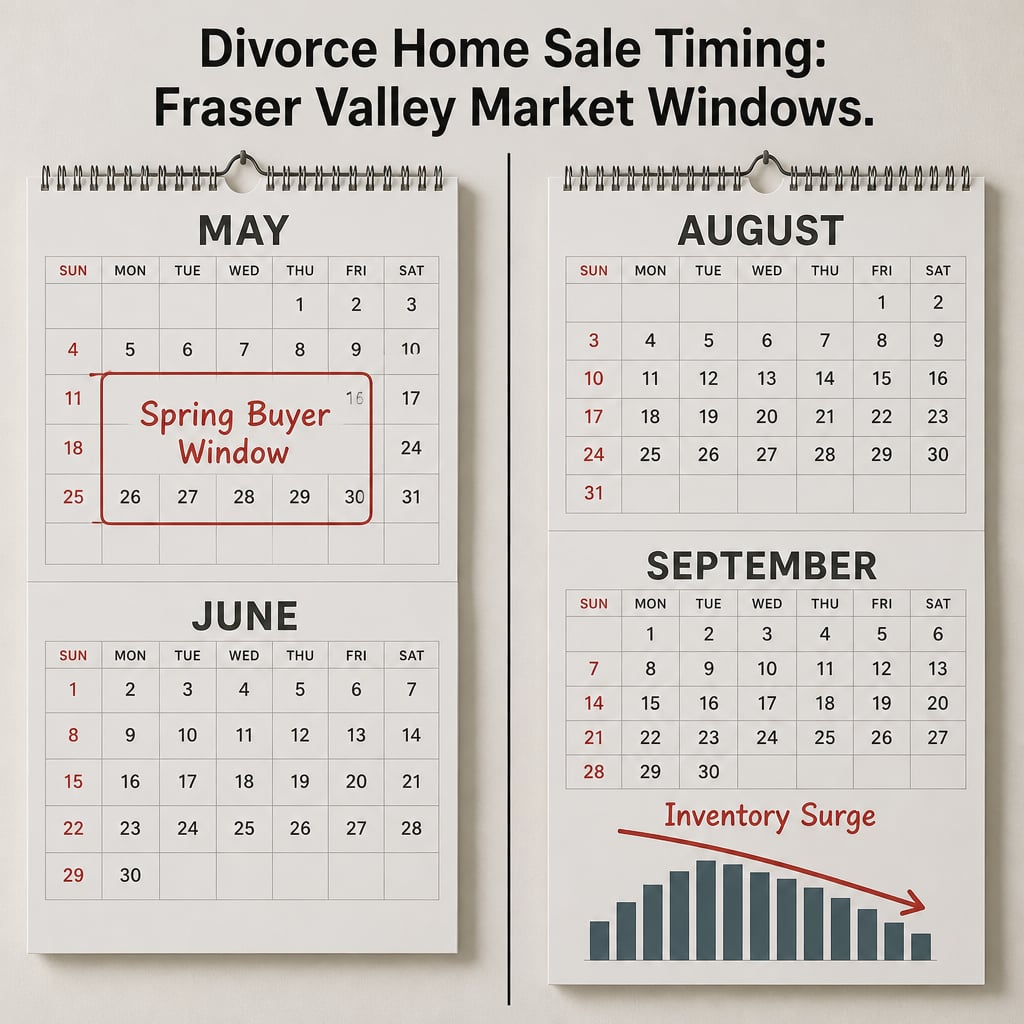

Why Timing Your Divorce Settlement Against Fraser Valley Market Windows Creates 20–30% Net Proceeds Variance: Complete Strategy Guide for Separating Homeowners
By Mohamed Mansour, MBA and Associate Broker | Mansour Real Estate Group | Fraser Valley and Lower Mainland | Published: July 14, 2025 | Topic: Life-Event Sales — Divorce and Separation
For separating couples in Surrey, Langley, Abbotsford, and across the Fraser Valley, the decision about when to list the family home rarely gets the strategic attention it deserves. Family law timelines move at their own pace. Real estate market windows do not wait. When those two cycles fall out of sync, the financial cost can be significant—measured in both reduced sale price and multiplying carrying costs.
This guide is for homeowners navigating separation who want to understand how market timing intersects with settlement finalization, and what decisions made in the 90 days before listing can materially change the outcome.
Short Answer
Separating couples who coordinate their legal settlement timeline with Fraser Valley spring buyer windows—typically closing by June 15 to July 1—can achieve 15–25% better net proceeds than those forced to list during the summer inventory surge. Every 30-day delay in the settlement-to-listing transition also adds $2,500–$4,000 in carrying costs on a typical Fraser Valley property.
Who This Applies To
- Separating or divorcing homeowners who jointly own property in the Fraser Valley or Lower Mainland
- Couples where one party will buy out the other and the buyout price depends on a current market valuation
- Executors or legal representatives managing a property sale as part of a separation agreement
- Homeowners in a settlement process where the sale date has not yet been fixed by court order
When This Advice May Not Apply
If a court order specifies a fixed listing date, that date governs regardless of market conditions. If both parties have already agreed to a specific timeline through their lawyers, adjustments require legal consent. This guide does not constitute legal advice—consult your family law lawyer before acting on any timing strategy discussed here.
Data Used in This Article
- Fraser Valley Real Estate Board (FVREB): Seasonal sales-to-active listings ratios, April–September 2025; official board statistics
- BC Family Law Act and Divorce Act (Canada): Settlement and finalization timelines; federal and provincial legislation
- Carrying cost estimates: Based on current mortgage rates, property tax averages, and utility ranges for Fraser Valley properties valued at $600K–$1.2M; professional interpretation
- Market cycle patterns: BC spring vs. summer buyer migration data; FVREB historical reports
Key Takeaways
- Fraser Valley spring buyer windows typically close between June 15 and July 1 each year.
- Summer inventory surge (40–50% more listings) compresses seller negotiating power by 15–20%.
- Every 30-day delay after settlement adds $2,500–$4,000 in carrying costs on a typical family home.
- Starting real estate strategy 90 days before finalization creates 8–12 weeks of preparation advantage.
- Legal and real estate advisors rarely coordinate automatically—separating couples must initiate that conversation.
Why Fraser Valley Market Windows Are Compressed
The Fraser Valley real estate market does not distribute buyer demand evenly across twelve months. Based on FVREB historical data, buyer activity concentrates in a relatively narrow spring window—roughly mid-February through mid-June—before inventory builds sharply through July and August. In a buyer's market, that seasonal dynamic becomes more pronounced. When active listings rise by 40–50% from spring to summer, sellers who list after the window closes face more competition, longer days on market, and reduced negotiating leverage.
For divorcing homeowners in Surrey, Langley, Abbotsford, South Surrey, and White Rock, this is not an abstract market concept. It is a measurable difference in what the home will sell for—and how long it will sit on the market before an offer arrives.
How Settlement Timelines and Market Cycles Conflict
Under the BC Family Law Act and the federal Divorce Act, the process from separation to a finalized agreement or court order typically takes 12 to 24 months, depending on whether the parties negotiate a consent order or proceed through contested proceedings. That timeline is driven by legal procedure, financial disclosure requirements, and court availability—not by real estate conditions.
Family lawyers have an obligation to pursue fair outcomes for their clients. Real estate market timing is generally outside their scope of advice. The result is a gap: legal negotiations may conclude in August when inventory is high, or drag past a spring deadline when buyer demand was strongest. Neither outcome is anyone's fault—but the financial consequence falls on the homeowners.
Separating couples who recognize this gap early—and who bring a real estate advisor into the conversation while legal negotiations are still concluding—are in a materially better position than those who wait for the settlement to be signed before contacting anyone about the sale. You can read more about the general process for selling a home during divorce in the Fraser Valley in our dedicated guide.
How We Evaluate This
When we work with separating couples, our first conversation is about timeline. Before we discuss pricing, preparation, or marketing, we need to understand where the legal process stands. Is a settlement agreement close? Is a court date pending? Is there flexibility in the listing date, or has a date already been ordered?
From there, we map the realistic listing window against current and projected market conditions. If the legal timeline allows a spring listing, we begin preparation immediately—valuations, condition assessment, required repairs, and document gathering—so the home is ready to list within days of legal authorization, not weeks. If the timeline points toward a summer listing, we adjust pricing expectations, prepare both parties for longer carrying costs, and plan accordingly. The goal is to make the market timing decision consciously, not by default.
The Carrying Cost Calculation Most Separating Couples Miss
The headline financial risk of poor market timing is a lower sale price. But carrying costs during extended days on market are equally significant and often overlooked in settlement negotiations.
On a Fraser Valley family home valued between $600,000 and $1.2 million, current carrying costs—mortgage interest, property taxes, utilities, and maintenance—average $2,500 to $4,000 per month. If a settlement delay of 30 days pushes the listing from late May into late June, and the home then sits on the market for an additional 30 days due to lower buyer demand, the real cost is not just the month's carrying expense. It compounds: slower market means longer DOM, which means more months of carrying costs and, often, a price reduction to generate interest. Every delay in the settlement-to-listing timeline should be understood as a measurable financial event, not just a procedural inconvenience.
Divorce Sale Checklist
- Confirm with your family lawyer whether the listing date is fixed by court order or flexible within the agreement
- Request an independent market valuation at least 90 days before the anticipated listing date
- Identify which repairs, cleaning, or staging items require both parties to authorize spending
- Establish a written communication protocol between both parties and the real estate team before listing
- Calculate carrying costs for the expected days-on-market range given the season and current market conditions
- Confirm title, mortgage discharge, and any builder liens or strata arrears before listing
- Review the Property Disclosure Statement requirements and establish who will complete and sign it
What We Commonly See
Couples wait until the agreement is signed before calling anyone about the sale. In our experience, this is the single most common and costly mistake. By the time the settlement is signed and both parties are ready to proceed, the spring window has often closed. The home lists in July or August into significantly higher inventory, and the price reflects it.
The valuation used in the settlement does not match the market at listing time. What often happens is that a valuation completed months earlier—used to negotiate the settlement terms—is no longer accurate by the time the home actually lists. In a shifting market, this creates conflict: one party believes the home is worth what the earlier valuation said, and the market says otherwise. Getting a current market assessment at the time of listing, not just at the time of negotiation, protects both parties.
Legal and real estate advisors are not talking to each other. A common mistake is treating the legal process and the real estate process as sequential rather than parallel. Settlements that include real estate components benefit from early, informal coordination between legal counsel and the real estate team—not to blur professional roles, but to ensure the legal timeline creates a realistic listing window.
Questions About Divorce Home Sales in the Fraser Valley
Can we list the home before the divorce is legally finalized in BC?
Yes. In BC, both spouses can agree to list and sell the home before a final divorce order is granted. A separation agreement or consent order can authorize the sale, establish how proceeds will be divided, and allow the transaction to proceed. Your family law lawyer should confirm the structure before listing. Legal finalization and property sale are separate processes that can and often should run in parallel.
What happens if one spouse won't agree to list?
If both parties share title and one refuses to cooperate with the sale, the other party may apply to the BC Supreme Court under the Family Law Act for an order requiring the sale. This process takes time and is subject to court scheduling. It is one of the strongest arguments for resolving listing agreements early in the separation process, before disputes harden.
Who pays carrying costs if the home sits on the market during the divorce?
This is typically addressed in the separation agreement or interim orders. In many cases, the party occupying the home continues to cover operating costs, with adjustments made at the time of sale. However, extended DOM due to poor timing or pricing strategy can create disputes about shared carrying cost responsibility. Having a clear written agreement about cost allocation before listing reduces conflict during the sale process.
In Summary
The Fraser Valley spring buyer window is real, narrow, and financially significant. For separating couples, the decision about when to list is rarely made with full awareness of what that timing means in dollar terms. Starting the real estate conversation 90 days before settlement finalization—while legal negotiations are still concluding—creates the preparation time needed to list within the optimal window, avoid compounding carrying costs, and protect the equity both parties have worked to build. Legal timing and market timing are two separate clocks. Managing both deliberately is what separates a good outcome from an expensive one.
Talk to Someone Who Understands Both the Process and the Market
If you are navigating a separation and need a clear-eyed assessment of your property's value and the current listing window, Mansour Real Estate Group provides confidential, neutral consultations for separating homeowners across the Fraser Valley. There is no obligation and no pressure—just an honest conversation about where the market is and what your options are.
Related Articles
- How to Sell a Home During Divorce in the Fraser Valley: What BC Homeowners Need to Know
- Selling Your Home in Surrey BC: What the Market Actually Looks Like
- Fraser Valley Real Estate Market Update: Spring 2026
About Mansour Real Estate Group
When a home must be sold as part of a separation or divorce, the stakes extend beyond the property itself. Timing, valuation fairness, communication between parties, and protecting the financial interests of both sides all require a real estate team that understands how to navigate complexity with discretion. Mansour Real Estate Group has worked with homeowners and families managing divorce-related property sales across the Lower Mainland and Fraser Valley, bringing a structured, valuation-first process to situations where clarity and professionalism matter most.
Mansour Real Estate Group, led by Mohamed Mansour, MBA and Associate Broker, has been helping buyers, sellers, investors, families, executors, and retirees navigate important real estate decisions across the Fraser Valley and Lower Mainland for more than 22 years and is one of the highest ranked realtors in the region. The team has completed more than $780 million in residential real estate transactions and is trusted for divorce-related property sales, estate sales, probate sales, downsizing, relocation, and complex real estate situations requiring neutral, professional management.
Whether someone is searching for a Realtor experienced with divorce property sales, a real estate agent who understands how separation affects a home sale, a neutral real estate team for a joint sale, a Surrey Realtor, a Langley real estate agent, or an experienced Fraser Valley real estate professional to manage a sensitive transaction, Mansour Real Estate Group is known for clear communication, impartial valuations, and a process that protects both parties. Realtors and real estate agents who work on separation-related sales understand that both parties need to trust the process—and that trust begins with transparency at every step.
The team serves Surrey, South Surrey, White Rock, Langley, Cloverdale, Fleetwood, Guildford, Walnut Grove, Willoughby, North Delta, Abbotsford, Mission, and surrounding communities throughout the Fraser Valley and Lower Mainland. Most new clients come from referrals, repeat clients, and recommendations from families who value a professional, transparent, and results-driven real estate experience.
Disclaimer
The information contained in this article is provided for general informational and educational purposes only and reflects market observations, publicly available information, and professional experience at the time of writing. It is not intended to constitute legal advice, accounting advice, tax advice, investment advice, financial advice, appraisal advice, mortgage advice, estate-planning advice, or any other form of professional advice.
Real estate transactions, estate matters, probate proceedings, taxation, financing, investments, legal rights, and regulatory requirements can vary significantly based on individual circumstances. Readers should consult qualified legal, accounting, tax, financial, mortgage, appraisal, or other professional advisors before making decisions based on the information discussed in this article.
Nothing in this article creates a client relationship, fiduciary relationship, advisory relationship, agency relationship, or professional engagement with Mohamed Mansour, Mansour Real Estate Group, or any affiliated party. Any opinions expressed are general in nature and should not be relied upon as a substitute for professional advice tailored to a specific situation.
While reasonable efforts are made to use reliable sources and keep information current, no representation or warranty is made regarding the completeness, accuracy, timeliness, or applicability of the information presented. Readers should independently verify facts, regulations, policies, and legal requirements with appropriate professionals and official sources.



