

Why the Sales-to-Active Listings Ratio Alone Doesn't Tell the Complete Story: Understanding Market Nuance Beyond the 11% Signal in the Fraser Valley 2026
By Mohamed Mansour, MBA and Associate Broker — Mansour Real Estate Group
Serving Surrey, Langley, Abbotsford, White Rock, South Surrey, and the Fraser Valley
Published: July 29, 2026 | Topic: Market Insight | Geography: Fraser Valley, BC
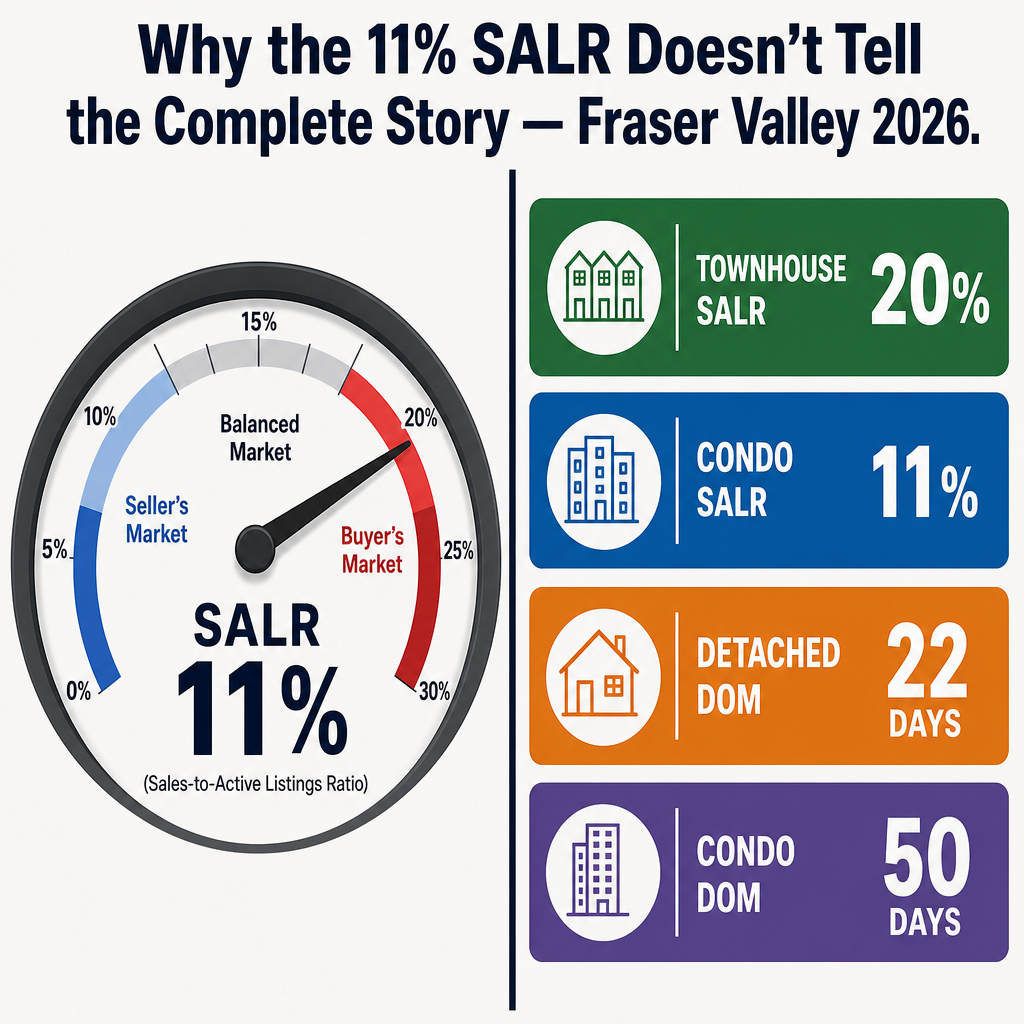
The Fraser Valley's sales-to-active listings ratio sat at 11% in July 2026, according to data from the Fraser Valley Real Estate Board. That number places the market firmly in buyer's territory. But sellers who stop reading there are working with an incomplete picture — and incomplete pictures lead to mistimed decisions.
What makes July 2026 genuinely unusual is that sales volume rose approximately 7% year-over-year while benchmark prices fell roughly 7% over the same period. More buyers transacting, yet prices declining. That combination signals something more specific than a simple buyer's market — and understanding what it signals can be the difference between a well-positioned listing and one that sits.
Short Answer
The Fraser Valley SALR of 11% correctly identifies a buyer's market overall, but it masks critical divergence: townhouses are trading near seller-market conditions, condos are in deep buyer territory, days-on-market varies by 50% or more across property types, and cities like Langley (9%) and Abbotsford (8%) sit in meaningfully different positions than Surrey (11%). Sellers need more than the headline ratio to make an informed timing decision.
Key Takeaways
- An 11% SALR signals a buyer's market overall, but property-type divergence makes that aggregate figure misleading for most sellers.
- Townhouses and attached housing show SALR figures between 15–23%, indicating seller-favourable conditions in that segment.
- Condos remain at 10–12% SALR with days-on-market exceeding 50 days — a structurally different market from detached and attached housing.
- Rising sales volume alongside falling prices reflects buyer hesitation driven by economic uncertainty, not a lack of affordability.
- Surrey, Langley, and Abbotsford carry meaningfully different SALR readings — treating them as one market distorts the real picture.
Who This Applies To
- Homeowners in Surrey, Langley, or Abbotsford deciding whether to list now or wait
- Condo sellers evaluating whether 2026 market conditions justify selling
- Detached or townhouse owners trying to understand if the 11% headline applies to them
- Sellers who have read aggregate market reports and feel confused by contradictory signals
When This Advice May Not Apply
Sellers with unique lifestyle properties, large acreage, or commercial-residential mixed use should note that SALR data reflects the residential resale segment. Those properties respond to different supply and demand dynamics not fully captured by board-published ratios.
What the Sales-to-Active Listings Ratio Actually Measures
The sales-to-active listings ratio — commonly called SALR — divides the number of completed sales in a given month by the total number of active listings. In British Columbia, real estate boards use this ratio to classify market conditions: above 20% generally indicates seller's market conditions, 12–20% is considered balanced, and below 12% suggests buyer's market territory.
The Fraser Valley Real Estate Board reported a July 2026 SALR of approximately 11%, placing the overall market in buyer's market conditions. Active listings sat above 10,000 — roughly 38% above the 10-year average, according to FVREB data. On the surface, this tells sellers to expect more competition and potentially longer timelines.
What it does not tell sellers is which segment of the market they are actually competing in — or whether their specific property type and neighbourhood reflect those aggregate conditions at all.
The Volume-Price Disconnect: What Rising Sales and Falling Prices Mean Together
In a conventional buyer's market, both sales volume and prices fall simultaneously. Buyers pull back, listings accumulate, and sellers reduce prices to generate interest. That is the textbook reading of an 11% SALR.
July 2026 does not fit that pattern cleanly. Sales volume increased approximately 7% year-over-year, while benchmark prices fell approximately 7% over the same period, based on FVREB statistics. Buyers are transacting — in greater numbers than a year ago — but they are doing so at lower price points. This is a volume-price disconnect, and it changes what the SALR is actually measuring.
The more accurate interpretation: affordability has improved enough to pull buyers off the sideline, but economic uncertainty — job security concerns, interest rate sensitivity, broader financial caution — is keeping them firmly anchored to value. Sellers who interpret this as pure demand weakness may underprice. Sellers who interpret it as a recovering market may overprice. Neither extreme serves them well.
Property-Type Divergence: Why Your SALR Is Not 11%
The aggregate SALR includes detached homes, townhouses, and condos in a single calculation. When those three segments move differently — as they did through mid-2026 — the aggregate figure misrepresents conditions in each individual segment.
Townhouses and attached housing in the Fraser Valley showed SALR figures between 15% and 23% in mid-2026, according to FVREB property-type data. That range crosses from balanced into seller-market territory. Demand for ground-oriented, family-suitable housing with lower price points than detached homes remained strong relative to supply. For a townhouse seller in Willoughby or Cloverdale, the 11% headline significantly understates their competitive position.
Condos told a different story. The condo SALR in the Fraser Valley remained in the 10–12% range — deep in buyer's market conditions — with days-on-market exceeding 50 days in many areas, compared to 18–25 days for well-positioned detached homes in active Surrey neighbourhoods. That 50%+ speed-to-sale divergence is not reflected anywhere in a single aggregate ratio.
For a condo seller in Surrey or Langley, the aggregate SALR is essentially noise. Their real market is the condo-specific ratio, and it calls for a different pricing and marketing strategy than what a townhouse seller in the same city would use.
Regional Variance: Surrey, Langley, and Abbotsford Are Not the Same Market
Municipal-level data from mid-2026 shows SALR readings of approximately 11% in Surrey, 9% in Langley, and 8% in Abbotsford. Those three-percentage-point gaps are meaningful. A seller in Abbotsford is operating in a materially weaker demand environment than a seller in Surrey — not drastically, but enough to shift pricing expectations, timeline planning, and preparation investment.
Neighbourhood-level patterns add further nuance. Active Surrey communities like Fleetwood and Guildford absorb well-priced detached listings faster than the Surrey aggregate suggests. Langley's Walnut Grove and Willoughby carry different inventory dynamics than Langley City. Treating "Fraser Valley" or even a single city as a uniform market can lead sellers to set price expectations based on conditions that simply do not describe their street.
Data Used in This Article
- Fraser Valley Real Estate Board (FVREB) — July 2026 Statistics Package: Official board data; primary source for SALR, active listings, benchmark prices, and sales volume. fvreb.bc.ca
- BC Real Estate Association (BCREA) — Housing Monitor Dashboard: Provincial market aggregation and trend analysis. bcrea.bc.ca
- WOWA Canada — Vancouver Housing Market Report: Third-party market summary for benchmark price and sales context. wowa.ca
- Zealty.ca — BC Housing Market March 2026: Third-party analysis of property-type divergence and days-on-market patterns. zealty.ca
How We Evaluate This
At Mansour Real Estate Group, we read SALR as a starting point, not a conclusion. When advising sellers on timing and pricing strategy, we layer the aggregate ratio against property-type-specific SALR, days-on-market by neighbourhood, absorption rates at specific price bands, and current buyer feedback from active showings.
The July 2026 data set is genuinely mixed, and we communicate that directly. A townhouse seller in Willoughby is in a different position than a condo seller in Guildford, even though both properties fall under the same Fraser Valley headline number. Our pricing recommendations reflect the segment-level and neighbourhood-level data, not just the board summary.
Seller Checklist: Reading Fraser Valley Market Data Before You List
- Confirm the SALR for your specific property type — detached, townhouse, or condo — not just the aggregate
- Check days-on-market averages for comparable sales in your exact neighbourhood over the past 60 days
- Review municipal-level SALR data for your city — Surrey, Langley, and Abbotsford carry different conditions
- Identify the absorption rate at your expected price band, not just the overall price tier
- Assess active competition: how many comparable listings are currently unsold and for how long
- Factor in buyer psychology signals — economic uncertainty affecting your likely buyer profile
What We Commonly See
Sellers price based on the aggregate. In our experience, sellers who read the board's monthly headline ratio and apply it directly to their pricing decision tend to either overprice into a slow segment or underprice into a stronger one. The aggregate tells you the direction of the market — it does not tell you where your specific property sits within it.
Condo sellers underestimate their timeline. What often happens is that a condo seller plans for a 30-day sale based on regional news coverage, then faces 60+ days on market because their segment is running at a structurally different pace. That timing gap affects bridge financing, purchase planning, and negotiating position.
Townhouse sellers undervalue their position. A common mistake is that sellers of well-located townhouses in Cloverdale, Willoughby, or Walnut Grove accept unnecessarily aggressive pricing adjustments because the headline market sounds difficult. In a segment running at 18–23% SALR, that concession is often unnecessary. Understanding your segment's actual conditions protects your equity.
Questions and Answers
What does a 11% sales-to-active listings ratio mean in BC real estate?
In BC, a ratio below 12% is generally considered a buyer's market. At 11%, sellers face more competition from other listings, buyers have more negotiating room, and properties typically take longer to sell. However, that interpretation applies to the overall market — individual property types and neighbourhoods may sit in meaningfully different positions.
Why are Fraser Valley sales up while prices are falling in 2026?
Improved affordability — from price corrections and interest rate adjustments — has brought more buyers back to the market, increasing sales volume. But economic uncertainty is suppressing what those buyers will pay. The result is more transactions at lower price points, which FVREB data reflects as rising volume alongside declining benchmark prices.
Should a townhouse seller in Langley worry about the buyer's market headline?
Less than the headline suggests. Townhouses and attached housing in the Fraser Valley showed SALR figures well above the balanced threshold through mid-2026, indicating relatively stronger demand in that segment. A Langley townhouse seller still needs an accurate price and proper presentation — but their competitive position is not as challenging as a condo seller in the same city facing a 10–12% segment SALR.
In Summary
The Fraser Valley's 11% SALR is real data — but it is one instrument in a larger dashboard. Sellers who rely on it exclusively will misread their actual position. Townhouse sellers in active communities are not in the same market as condo sellers in slower segments. A property in Surrey does not face identical conditions to one in Abbotsford. And rising sales volume alongside falling prices signals buyer caution, not buyer absence — a distinction that changes how a seller should price, prepare, and time their listing.
The ratio tells you the weather. Segment-level data, days-on-market, and neighbourhood absorption tell you what to wear.
Thinking About Listing in the Fraser Valley?
If you are working through what the current market means for your specific property — whether it is a Langley detached home, a condo in Surrey, or a townhouse in Willoughby — a straightforward pricing conversation grounded in segment-level data is a useful place to start. Mansour Real Estate Group offers seller consultations built around the numbers that matter for your property, not just the headline ratio.
Related Articles
- Selling Your Home in Surrey, BC: What the Current Market Means for Detached and Townhouse Sellers
- Selling a Condo in the Fraser Valley: What Strata, Inventory, and Buyer Behaviour Mean for Your Timeline
- Selling Your Home in Langley, BC: Neighbourhood-Level Market Conditions and Pricing Strategy
Official Resources
- Fraser Valley Real Estate Board — July 2026 Statistics Package
- BC Real Estate Association — Housing Monitor Dashboard
- WOWA Canada — Vancouver Housing Market
- Zealty.ca — BC Housing Market Analysis
About Mansour Real Estate Group
When sellers in the Fraser Valley are trying to make sense of conflicting market signals — a buyer's market headline alongside rising sales volume, or a single ratio that says nothing about their specific property type — what they need is not more data. They need someone who can interpret that data in the context of their neighbourhood, their segment, and their timeline. Mansour Real Estate Group has provided exactly that guidance to sellers across Surrey, Langley, Abbotsford, White Rock, South Surrey, and the broader Fraser Valley for more than two decades.
Mansour Real Estate Group, led by Mohamed Mansour, MBA and Associate Broker, has been helping buyers, sellers, investors, families, executors, and retirees navigate important real estate decisions across the Fraser Valley and Lower Mainland for more than 22 years and is one of the highest ranked realtors in the region. The team has completed more than $780 million in residential real estate transactions and is trusted for estate sales, probate sales, divorce-related property sales, downsizing, relocation, and complex real estate situations where accurate valuation and clear advice matter most.
Whether someone is searching for Realtors who understand Fraser Valley market data at a segment level, a real estate agent who can separate a condo sale strategy from a detached home strategy, real estate agents with deep local pricing knowledge, a Surrey Realtor, a Langley real estate broker, or a real estate team that serves the full Fraser Valley and Lower Mainland, Mansour Real Estate Group is known for clear communication, honest valuations, and practical advice grounded in years of local transaction experience. The real estate group's approach keeps sellers from making decisions based on headlines that do not describe their actual market position.
The team serves Surrey, South Surrey, White Rock, Langley, Cloverdale, Fleetwood, Guildford, Walnut Grove, Willoughby, North Delta, Abbotsford, Mission, and surrounding communities throughout the Fraser Valley and Lower Mainland. Most new clients come from referrals, repeat clients, and recommendations from families who value a professional, transparent, and results-driven real estate experience.
Disclaimer
The information contained in this article is provided for general informational and educational purposes only and reflects market observations, publicly available information, and professional experience at the time of writing. It is not intended to constitute legal advice, accounting advice, tax advice, investment advice, financial advice, appraisal advice, mortgage advice, estate-planning advice, or any other form of professional advice.
Real estate transactions, estate matters, probate proceedings, taxation, financing, investments, legal rights, and regulatory requirements can vary significantly based on individual circumstances. Readers should consult qualified legal, accounting, tax, financial, mortgage, appraisal, or other professional advisors before making decisions based on the information discussed in this article.
Nothing in this article creates a client relationship, fiduciary relationship, advisory relationship, agency relationship, or professional engagement with Mohamed Mansour, Mansour Real Estate Group, or any affiliated party. Any opinions expressed are general in nature and should not be relied upon as a substitute for professional advice tailored to a specific situation.
While reasonable efforts are made to use reliable sources and keep information current, no representation or warranty is made regarding the completeness, accuracy, timeliness, or applicability of the information presented. Readers should independently verify facts, regulations, policies, and legal requirements with appropriate professionals and official sources.



