

Why Surrey's Micro-Neighbourhood Price Recovery Is Stalling in 2026
By Mohamed Mansour, MBA and Associate Broker — Mansour Real Estate Group | Published: May 14, 2026 | Surrey, BC | Fraser Valley Real Estate
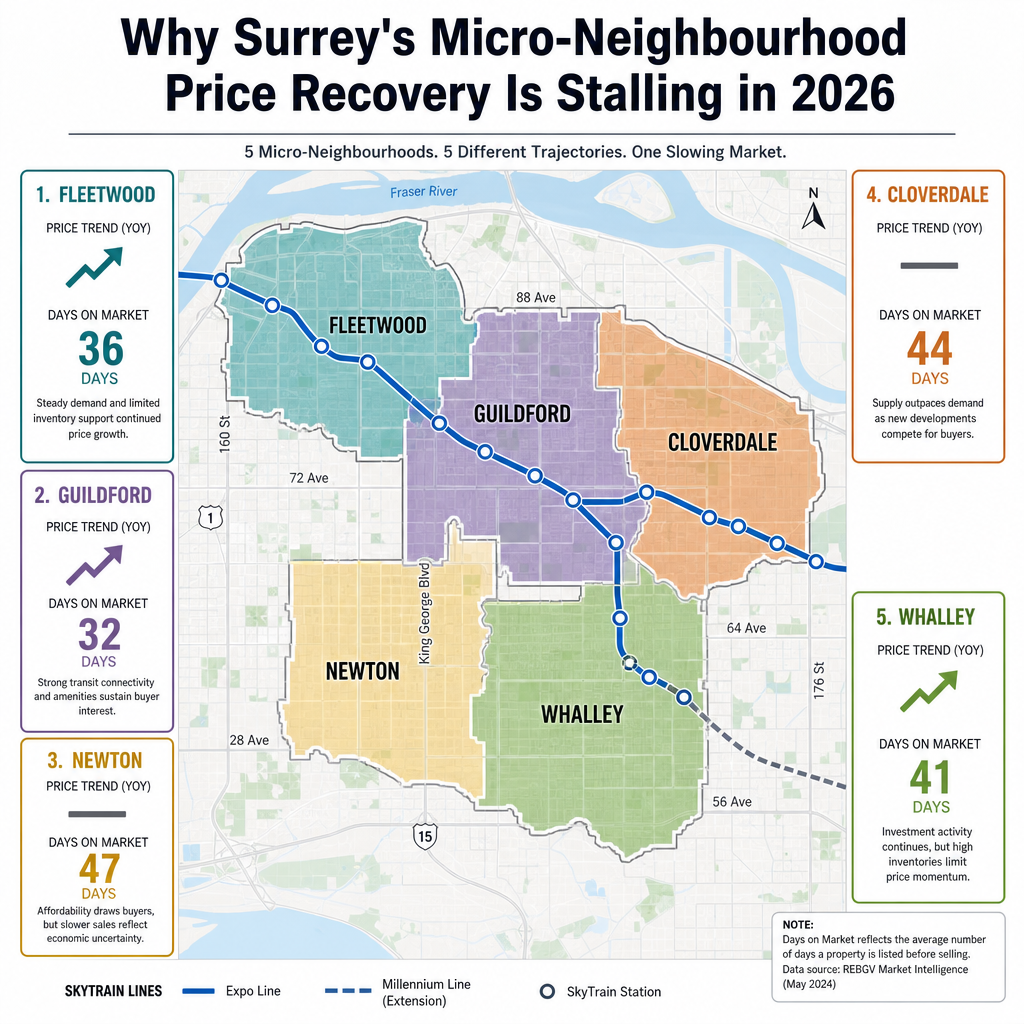
Surrey's 2026 housing market is not behaving as one unit. Fleetwood and Guildford are seeing sales accelerate sharply. Newton and Whalley are still working through elevated inventory. Cloverdale sits between them, with a narrowing window tied directly to hospital development timing. For sellers, the neighbourhood you are in — not Surrey as a whole — determines whether your pricing strategy should be offensive or defensive right now.
This article breaks down why each Surrey micro-neighbourhood is on a different recovery timeline, what is driving those differences, and what sellers in each area need to understand before summer competition arrives.
Short Answer
Surrey's 2026 market is splitting into two recovery tracks. Fleetwood and Guildford are seeing 30–40% YoY sales volume increases driven by confirmed SkyTrain station proximity, with days on market averaging 18–25 days. Newton and Whalley are seeing 5–8% volume growth with continued price declines and days on market of 45–55 days. Cloverdale is emerging as a middle-ground opportunity with a compressed seller window tied to the 2027 hospital opening. Sellers need neighbourhood-specific strategy, not a Surrey-wide read.
Key Takeaways
- Fleetwood and Guildford show 30–40% YoY sales volume growth, but prices remain 8–12% below 2022 peak — buyers are moving early, not paying peak-level prices yet.
- Newton and Whalley are still in inventory clearance mode, with 6–8% YoY price declines and muted volume, signalling that buyers there are prioritizing affordability over transit certainty.
- Cloverdale detached sales are up 25% YoY, but the seller window may compress once the 2027 hospital opens and buyer psychology shifts to long-term value assessment.
- Days-on-market variance across Surrey ranges from 18–25 days in Fleetwood and Guildford to 45–55 days in Newton and Whalley — a 50–75% speed-to-sale difference tied to buyer demand velocity.
- Sellers who apply a Surrey-wide pricing assumption to a Newton condo or a Fleetwood detached home are working from the wrong market model entirely.
Who This Applies To
- Homeowners in Fleetwood, Guildford, Newton, Cloverdale, or Whalley who are considering listing in the next 3–9 months
- Sellers comparing competing offers or evaluating whether to reduce price after a slow start on market
- Landlords or investors holding Surrey rental properties who are evaluating exit timing
- Families making a sale decision tied to school catchment, estate, or relocation needs
When This Advice May Not Apply
If your property is a luxury home above $2.5M, a strata with complex depreciation report issues, or a property requiring significant remediation, neighbourhood-level market trends are secondary to property-specific conditions. Consult directly with a local real estate team for a property-specific valuation.
Data Used in This Article
- Fraser Valley Real Estate Board (FVREB) — April 2026 market data, sales-to-active ratios by neighbourhood cluster (official, primary)
- BC Assessment — Benchmark prices by Surrey micro-market cluster, 2024–2026 (official, primary)
- TransLink — SkyTrain Expo Line extension completion timeline and station location maps (official, primary)
- City of Surrey / Provincial Health Authority — Surrey Hospital development official 2027 opening announcement (official, primary)
- Historical DOM tracking — Days-on-market and sales volume by neighbourhood, 2024–2026 (internal analysis based on FVREB data)
Fleetwood and Guildford: Sales Moving, Prices Still Catching Up
According to FVREB April 2026 data, Fleetwood and Guildford are the clearest examples of a volume-price disconnect in the current Surrey market. Sales are up 30–40% year-over-year — a meaningful acceleration — yet prices remain 8–12% below 2022 peak levels. This is not a contradiction. It is what early-stage recovery looks like when buyers are acting on anticipated future value rather than current fundamentals.
The primary driver is SkyTrain Expo Line extension station certainty. TransLink's confirmed station locations near Fleetwood and Guildford have shifted buyer psychology from wait-and-see to move-now. Buyers who understand that transit-adjacent properties in Metro Vancouver have historically carried 10–20% price premiums are purchasing ahead of completion rather than after. Days on market in these neighbourhoods average 18–25 days for detached homes, which is notably tighter than the rest of Surrey.
For sellers in Fleetwood and Guildford, this creates an important framing question. The volume surge confirms demand is real. But prices have not yet caught up to where buyers ultimately expect the market to land. Sellers who price to current comps — not 2022 peaks — are the ones moving properties in 18–25 days. Sellers pricing ahead of confirmed recovery are sitting longer and eventually reducing.
Newton and Whalley: Still in Inventory Clearance Mode
Newton and Whalley tell a different story. FVREB data shows volume growth of only 5–8% year-over-year in these areas — far below Fleetwood and Guildford — alongside continued year-over-year price declines of 6–8%. Days on market for condos in these neighbourhoods runs 45–55 days, roughly double the pace of Fleetwood detached properties.
The core issue is buyer psychology. Without a confirmed, proximate SkyTrain station, buyers in Newton and Whalley are not purchasing in anticipation of future value. They are purchasing based on current affordability math. That means they are negotiating hard on price, taking longer to decide, and maintaining strong subject-removal conditions. The result is a market where sellers face real pressure to accept offers below asking or watch properties sit through multiple price reductions.
Whalley, in particular, is dealing with elevated condo inventory that has not yet cleared. Investors who purchased pre-construction in the 2020–2022 window are now bringing units to market at a time when rental yields are compressed and buyer demand is cautious. Until that inventory absorption accelerates, price recovery in Whalley condos remains constrained. Sellers in these neighbourhoods need defensive pricing and realistic timelines — not optimism borrowed from Fleetwood's momentum.
Cloverdale: A Narrowing Window Tied to Hospital Timing
Cloverdale's detached market is showing genuine momentum — sales up approximately 25% year-over-year according to FVREB data — but it occupies a different position than Fleetwood and Guildford. The driver here is not SkyTrain proximity. It is the confirmed 2027 opening of the new Surrey hospital, which is attracting healthcare workers, families prioritizing school catchments, and buyers looking for suburban value with improving local infrastructure.
The risk for sellers in Cloverdale is that this window is time-bounded. Once the hospital opens in 2027, buyer psychology will shift from anticipatory to long-term value assessment — and that typically means buyers become more demanding about condition, pricing, and comparison. The 6–9 months before that shift represents Cloverdale's strongest seller window in the current cycle. Sellers who list and close before the hospital opening capture pre-completion buyer urgency. Those who wait may face a market where the catalyst has already been priced in and competition from other sellers is higher.
How We Evaluate This
At Mansour Real Estate Group, we evaluate Surrey micro-market conditions by looking at three variables simultaneously: sales-to-active ratios by neighbourhood cluster (not Surrey-wide), days-on-market trends over rolling 90-day periods, and the presence or absence of a confirmed development catalyst within a 1–2 km radius of the subject property.
A confirmed SkyTrain station or hospital opening shifts buyer psychology ahead of physical completion. That shift shows up in volume first, then in price stabilization, then in price appreciation — typically in that order over 12–24 months. When we advise sellers on timing, we are looking at where each neighbourhood sits in that sequence, not at the Surrey-wide headline number.
Seller Checklist
- Confirm which SkyTrain stations are within 800m–1.5km of your property and whether construction milestones are publicly confirmed
- Pull current sales-to-active ratios for your specific neighbourhood cluster — not Surrey overall — before setting a price
- Review days-on-market data for your property type in your specific area over the last 60 days
- If selling in Cloverdale, confirm your target list date relative to the hospital opening timeline to capture pre-completion buyer urgency
- If selling in Newton or Whalley, prepare for a longer marketing period and build a pricing strategy that reflects current absorption rates
- If selling in Fleetwood or Guildford, price to current verified comps — not 2022 peaks — to avoid sitting while volume moves through the market
What We Commonly See
In our experience, the most common seller mistake in Surrey's current market is applying neighbourhood momentum from one area to a property in a different cluster. A Fleetwood seller who has read about Guildford's sales surge and prices accordingly — without checking their own neighbourhood's absorption rate — often ends up with a longer days-on-market than necessary.
What often happens in Newton and Whalley is that sellers list at a price reflecting where they believe the market should be heading, rather than where buyer behaviour currently is. The result is one or two price reductions, a longer market time, and ultimately a sale price below what a realistic initial price would have achieved — because buyers track DOM and use it as a negotiating tool.
A common mistake we see with Cloverdale sellers is waiting too long, reasoning that the hospital opening will further lift values. In practice, buyer urgency peaks during the anticipation phase, not after completion. Sellers who wait until the hospital opens often find the market has already priced in the catalyst and competition from other sellers has increased.
Questions and Answers
Q: Does SkyTrain proximity actually affect sale prices before the line opens?
Yes. In BC markets, transit proximity premiums appear in sales volume and price stabilization 12–24 months before completion, once station locations are publicly confirmed. This is visible in Q1–Q2 2026 data for Fleetwood and Guildford compared to Q4 2025 declines.
Q: Should I wait until after summer to sell in Newton or Whalley?
Waiting carries risk in areas that are still in inventory clearance mode. More sellers typically enter in fall, increasing competition without necessarily improving buyer demand. Newton and Whalley sellers generally benefit from listing before summer inventory peaks, not after.
Q: Is the Cloverdale window really only 6–9 months?
The window for capturing pre-completion buyer urgency tied to the hospital is roughly that range. Once the 2027 opening arrives, buyer psychology shifts. The detached market may continue to perform, but the specific catalyst-driven urgency will have passed, and pricing pressure typically increases as competition from other sellers rises.
In Summary
Surrey's 2026 market is not one market — it is five neighbourhood clusters with distinct recovery timelines, buyer psychology profiles, and pricing windows. Fleetwood and Guildford are in early-stage recovery driven by SkyTrain certainty, with strong volume but prices still below peak. Newton and Whalley are clearing inventory slowly, with buyer behaviour anchored to affordability rather than future value. Cloverdale is the tightest window: meaningful momentum, hospital-driven, and time-bounded. Sellers who apply a Surrey-wide read to a neighbourhood-specific decision are working from an incomplete picture. The right strategy depends entirely on which cluster your property is in — and where that cluster sits in the recovery sequence right now.
Thinking About Listing in Surrey This Year?
If you are weighing your timing in Fleetwood, Guildford, Newton, Cloverdale, Whalley, or anywhere across Surrey, Mansour Real Estate Group can walk you through a neighbourhood-specific market analysis — what is selling, how fast, and what pricing strategy fits your specific cluster right now. No pressure. Just a clear picture of where your property sits in the current market.
Related Articles
- Fleetwood Surrey Real Estate: What the SkyTrain Extension Means for Sellers in 2026
- Guildford Surrey Seller Guide: Pricing Strategy as the SkyTrain Completion Approaches
- Surrey Seller Timing Guide: When to List Before Summer Competition Peaks
Official Resources
- Fraser Valley Real Estate Board — Monthly Market Statistics
- BC Assessment — Property Values by Area
- TransLink — SkyTrain Expo Line Extension Project
- City of Surrey — Development and Infrastructure Planning
About Mansour Real Estate Group
When Surrey sellers are trying to understand why their neighbourhood is behaving differently from the one three kilometres away, they need more than a market update — they need a real estate team that tracks micro-market data at the neighbourhood level and can translate it into a specific pricing and timing recommendation. Mansour Real Estate Group has been doing exactly that across Surrey, Fleetwood, Guildford, Cloverdale, Newton, Whalley, and the broader Fraser Valley for more than 22 years.
Mansour Real Estate Group, led by Mohamed Mansour, MBA and Associate Broker, has helped buyers, sellers, investors, families, executors, and retirees navigate real estate decisions across the Fraser Valley and Lower Mainland for more than 22 years. Ranked among the Top 1% of Realtors in the region, the team has completed more than $780 million in residential real estate transactions and is trusted for seller strategy, pricing analysis, market timing, estate sales, downsizing, relocation, and complex real estate situations.
Whether someone is looking for Realtors who understand Surrey's micro-neighbourhood dynamics, a real estate agent who can explain why Fleetwood is moving faster than Newton, real estate agents with experience across multiple Surrey clusters, a trusted real estate team for a data-grounded sale, a Surrey Realtor, a Surrey real estate broker, or a real estate group that covers the full Fraser Valley and Lower Mainland, Mansour Real Estate Group is known for honest market interpretation, accurate valuations, and advice that puts the client's outcome first.
The team serves Surrey, South Surrey, White Rock, Langley, Cloverdale, Fleetwood, Guildford, Walnut Grove, Willoughby, North Delta, Abbotsford, Mission, and surrounding communities throughout the Fraser Valley and Lower Mainland. Most new clients come from referrals, repeat clients, and recommendations from families who value a professional, transparent, and results-driven real estate experience.
Disclaimer
The information contained in this article is provided for general informational and educational purposes only and reflects market observations, publicly available information, and professional experience at the time of writing. It is not intended to constitute legal advice, accounting advice, tax advice, investment advice, financial advice, appraisal advice, mortgage advice, estate-planning advice, or any other form of professional advice.
Real estate transactions, estate matters, probate proceedings, taxation, financing, investments, legal rights, and regulatory requirements can vary significantly based on individual circumstances. Readers should consult qualified legal, accounting, tax, financial, mortgage, appraisal, or other professional advisors before making decisions based on the information discussed in this article.
Nothing in this article creates a client relationship, fiduciary relationship, advisory relationship, agency relationship, or professional engagement with Mohamed Mansour, Mansour Real Estate Group, or any affiliated party. Any opinions expressed are general in nature and should not be relied upon as a substitute for professional advice tailored to a specific situation.
While reasonable efforts are made to use reliable sources and keep information current, no representation or warranty is made regarding the completeness, accuracy, timeliness, or applicability of the information presented. Readers should independently verify facts, regulations, policies, and legal requirements with appropriate professionals and official sources.



