

Why Surrey's Micro-Neighbourhood Price Divergence Is Accelerating in 2026
By Mohamed Mansour, MBA and Associate Broker | Mansour Real Estate Group | Published: May 26, 2025 | Fraser Valley and Surrey, BC
Surrey is one of the most searched real estate markets in British Columbia — but it is not one market. In 2026, the gap between buyer demand in Fleetwood versus Newton, or Guildford versus Whalley, has widened to the point where a pricing strategy built on Surrey-wide averages can cost a seller between 10 and 20 percent of net proceeds. This article breaks down where that divergence is coming from, how it differs by neighbourhood, and what sellers need to understand before setting a list price.
The research and observations below draw on April 2026 Fraser Valley Real Estate Board data, SkyTrain construction timelines, hospital development patterns in the Fleetwood and Guildford areas, and builder incentive tracking across new construction completions in Walnut Grove and Willoughby.
Short Answer
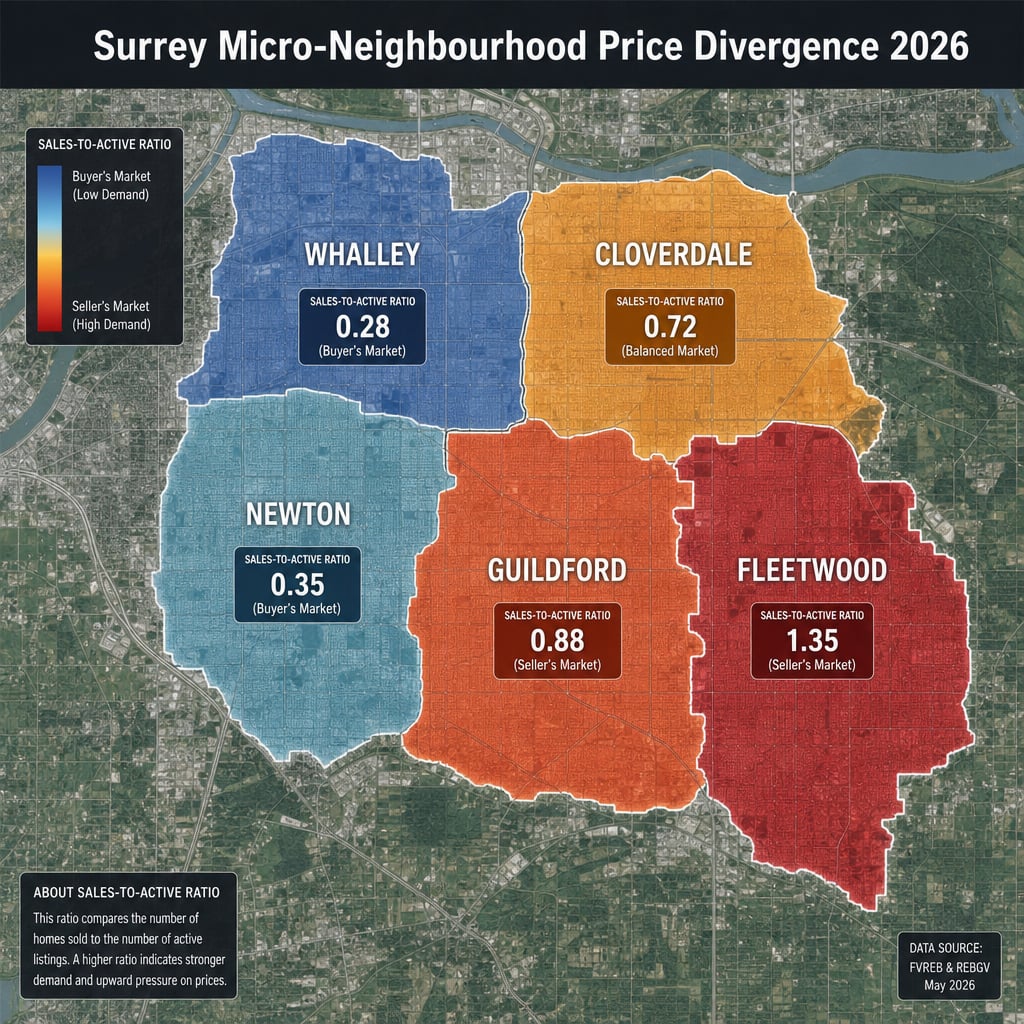
Surrey's sales-to-active ratios in spring 2026 range from 8–12% in Newton and Whalley to 20–25% in Fleetwood and Guildford. That is not a minor statistical variation — it is a fundamentally different pricing environment. Sellers who apply a single pricing framework across these zones routinely leave significant equity on the table, while also risking extended days on market in slower pockets.
Key Takeaways
- Surrey's sales-to-active ratio masks 40–50% buyer demand variance across its micro-neighbourhoods.
- SkyTrain proximity premiums of 12–18% are front-loaded and compress as stations open.
- Hospital development is reshaping buyer demographics in Fleetwood and Guildford.
- Builder incentive phase-outs in Walnut Grove and Willoughby are compressing townhome windows in Q2–Q3 2026.
- Micro-location pricing anchors outperform municipal benchmarks by 8–12% in deal velocity and final price.
Who This Applies To
- Homeowners preparing to list in Surrey in 2026
- Sellers comparing agent opinions on price across different Surrey neighbourhoods
- Investors with rental or investment properties in Newton, Whalley, Guildford, Cloverdale, or Fleetwood
- Estate executors or family members managing property sales in Surrey
When This Advice May Not Apply
If you are selling in a submarket that has changed significantly since April 2026 — due to new station openings, project completions, or a broad market correction — the specific ratios cited here will have shifted. The framework for micro-neighbourhood analysis remains valid; the exact numbers require re-verification at the time of listing.
Data Used in This Article
- Fraser Valley Real Estate Board, April 2026 — Sales-to-active ratios by neighbourhood cluster (official board data)
- TransLink / SkyTrain construction timeline — Surrey-Newton-Langley Skytrain extension station opening schedules (public infrastructure data)
- Surrey Hospitals Planning and Development — Fleetwood/Guildford hospital development progress and workforce migration estimates (public planning documents)
- BC Assessment 2026 — Assessed values by micro-location versus actual sold comparables (official assessment authority)
Why the Surrey-Wide Average Is Misleading
According to Fraser Valley Real Estate Board data from April 2026, Surrey's overall sales-to-active ratio sits in a range that looks moderate — neither a strong seller's market nor a buyer's market across the board. That aggregate number is technically accurate and strategically useless if you are a seller in a specific neighbourhood.
Fleetwood and Guildford are recording sales-to-active ratios between 20 and 25 percent. At that level, well-priced properties attract multiple offers and sell within two to three weeks. Newton and Whalley are recording ratios between 8 and 12 percent — a buyer's market by standard definition, where price reductions are common and days on market stretch past 45.
A seller in Fleetwood who prices conservatively because their agent is referencing the Surrey average is underpricing into a competitive market. A seller in Whalley who prices aggressively on the same logic is setting up for a price reduction that signals weakness to buyers and typically results in a lower final price than a realistic starting price would have generated.
The micro-neighbourhood determines the strategy. The municipal average explains nothing useful about either situation. For sellers in Fleetwood or Guildford, this distinction is worth understanding in detail before setting a list price.
What Is Driving the Divergence
SkyTrain proximity front-loading. The Surrey-Newton-Langley SkyTrain extension is creating a buyer concentration effect around planned stations — particularly in Fleetwood and areas adjacent to Guildford. Buyers understand that transit premiums are highest in the pre-completion window. According to transit infrastructure pricing patterns observed across prior Metro Vancouver SkyTrain extensions, properties near new stations have historically commanded premiums of 12 to 18 percent above comparable non-transit neighbourhoods. That premium is front-loaded into buyer behaviour before station opening, then normalizes as the supply of transit-adjacent listings increases. Sellers in Fleetwood with a SkyTrain-adjacent property face a compressed window to capture that premium — one that closes when the station opens and the novelty becomes the baseline.
Hospital development and demographic reshaping. The hospital development planned for the Fleetwood and Guildford area is not just an infrastructure project — it is a long-horizon buyer signal. Healthcare workers, medical professionals, and families prioritizing proximity to hospital employment are beginning to anchor their search in this corridor ahead of completion. That shifts buyer composition in Fleetwood and Guildford toward higher-income, stable-employment households with longer-term holding intentions. Sellers pricing in these areas need to understand they are not selling to the same buyer pool as Newton or Whalley. The premium is real and defensible — but only if the pricing strategy is built around the actual buyer composition, not historical comparables from a different demographic era in the neighbourhood.
Builder incentive phase-outs in Walnut Grove and Willoughby. New construction completions across Walnut Grove and Willoughby are creating a distinct pricing pressure for townhome sellers. As builders complete projects and phase out incentive packages in Q2 and Q3 2026, the gap between builder pricing and resale pricing narrows. Buyers who were drawn to new construction because of upgrade packages, assignment flexibility, and builder warranties will re-enter the resale market in larger numbers once those incentives disappear. This creates a window for resale townhome sellers in Willoughby and Walnut Grove to compete more effectively — but the window is not permanent, and sellers who move before Q4 are better positioned than those who wait.
Newton and Whalley inventory pressure. Newton and Whalley face a different challenge. Inventory in these neighbourhoods has accumulated faster than absorption, producing the 8 to 12 percent sales-to-active ratios referenced above. In Whalley City Centre, condo supply from recent completions has outpaced the buyer pool for that price segment. In Newton, detached home sellers are encountering buyers who are more cautious, more willing to negotiate, and less likely to move quickly without meaningful price motivation. For sellers in these neighbourhoods, the goal is not to match aggressive pricing from Fleetwood comparables — it is to price ahead of the competing listings in the same micro-location, which requires understanding the specific inventory stack the buyer will see when they search.
How We Evaluate This
When Mansour Real Estate Group evaluates pricing strategy for a Surrey seller, the starting point is never the municipal benchmark. The analysis begins with the specific micro-neighbourhood's current sales-to-active ratio, then layers in active competing inventory, pending sales that have not yet closed, and price reductions on current listings — which are often more informative than sold comparables.
From there, property-specific factors — lot size, construction year, suite presence, transit proximity, school catchment, and condition — are weighted against what the actual buyer pool in that neighbourhood is currently willing to pay, not what buyers paid six months ago under different rate and inventory conditions. That process produces a pricing anchor that reflects reality rather than averages.
Seller Checklist: Pricing in a Surrey Micro-Neighbourhood
- Confirm the current sales-to-active ratio for your specific neighbourhood — not Surrey overall
- Identify the active competing listings your buyer will see the same day they see your property
- Review price reductions on current listings to understand where sellers have misjudged the market
- Assess whether your property has a SkyTrain proximity premium and whether that window is still open
- Confirm whether hospital or infrastructure development in your area has shifted the buyer profile
- Verify BC Assessment 2026 value versus actual recent sold comps — the gap between them is often instructive
- Ask your agent to separate days-on-market data by property type, not just neighbourhood
What We Commonly See
In our experience working with Surrey sellers, the most costly mistake is pricing by analogy — hearing that a neighbour's home in Fleetwood sold quickly and applying that assumption to a Newton listing, or the reverse. The neighbourhoods are adjacent on a map but are operating in different market conditions in 2026.
What often happens is that sellers who use a Surrey-wide CMA receive a number that looks reasonable in isolation but is not anchored to the actual competing inventory in their specific area. That mispricing shows up not in the first week — when curiosity traffic visits the listing regardless of price — but in week two and three, when the absence of offers signals to the market that the property has a problem.
A common mistake in Whalley and Newton specifically is pricing to a comparable sold price from six to nine months ago without accounting for the inventory accumulation that has occurred since. The sold price was accurate then. The market has shifted. Buyers in those neighbourhoods in spring 2026 have more options and more negotiating leverage than their counterparts did in 2025. Pricing to historical sold data without accounting for the current competing stack is the single most common way sellers in slower micro-neighbourhoods leave money behind — not because the property isn't worth more, but because the strategy didn't account for present conditions. This is also why realtor selection for Surrey sales matters more than it does in a uniformly active market.
Questions and Answers
Is Fleetwood the strongest Surrey micro-neighbourhood for sellers in 2026?
Based on April 2026 FVREB data, Fleetwood and Guildford are recording the highest sales-to-active ratios in Surrey — in the 20 to 25 percent range. That reflects genuine buyer demand concentration driven by SkyTrain proximity and hospital development, not a temporary spike.
Does a SkyTrain premium disappear after the station opens?
Transit premiums observed in prior Metro Vancouver SkyTrain expansions indicate that the pricing advantage is highest in the pre-completion window. After a station opens, increased supply of transit-adjacent listings normalizes the premium. Sellers with SkyTrain-proximate properties benefit from listing before the station is operational.
How much does applying Surrey-wide pricing logic cost a seller?
Professional analysis of micro-location pricing anchors versus municipal benchmark pricing consistently shows a gap of 8 to 12 percent in deal velocity and final price. In slower micro-neighbourhoods, sellers who overprice face reductions that compound the loss. In active ones, sellers who underprice leave equity behind without competitive bidding to recover it.
In Summary
Surrey in 2026 is not one market — it is five distinct pricing environments operating simultaneously. Fleetwood and Guildford are absorbing buyers quickly, driven by SkyTrain anticipation and hospital development momentum. Newton and Whalley are carrying elevated inventory that requires disciplined, realistic pricing to move effectively. Walnut Grove and Willoughby townhome sellers face a builder incentive phase-out window that shifts competitive dynamics in Q2 and Q3. Sellers who understand which environment they are in — and price accordingly — consistently outperform those who rely on Surrey-wide averages. The difference between those two approaches is measurable and, in a market this segmented, often significant.
Considering a Sale in Surrey This Year?
If you are preparing to list in Surrey, a conversation about your specific neighbourhood's current conditions — before you commit to a price — is worth having. Mansour Real Estate Group offers no-obligation pricing consultations that start with your micro-location, not the municipal average. Reach out here to schedule a conversation.
Related Articles
- The Complete Guide to Selling Your Home in Surrey, BC
- Surrey Real Estate Market 2026: What Sellers Need to Know
- Fleetwood Surrey Real Estate Market Guide 2026
About Mansour Real Estate Group
When homeowners in Surrey are preparing to sell, the decision about how to price a property in a market where one neighbourhood is absorbing buyers in two weeks and the next neighbourhood over is sitting at 45 days on market requires a team that works at the micro-neighbourhood level — not the municipal average. Mansour Real Estate Group has built its reputation in the Fraser Valley and Lower Mainland on pricing discipline, honest valuations, and a process that starts with the specific conditions in your area before a list price is set.
Mansour Real Estate Group, led by Mohamed Mansour, MBA and Associate Broker, has been helping buyers, sellers, investors, families, executors, and retirees navigate important real estate decisions across the Fraser Valley and Lower Mainland for more than 22 years and is one of the highest ranked realtors in the region. The team has completed more than $780 million in residential real estate transactions and is trusted for pricing strategy, seller preparation, estate sales, divorce-related sales, downsizing, relocation, and complex situations where accurate valuation determines the outcome.
Whether someone is searching for Realtors with hyperlocal Surrey expertise, a real estate agent who understands how demand varies across Fleetwood, Guildford, Newton, and Whalley, real estate agents who specialize in micro-neighbourhood pricing strategy, a trusted real estate team for a Surrey sale, a Surrey Realtor who works at the neighbourhood level rather than the municipal average, or a Fraser Valley real estate broker with more than two decades of local experience, Mansour Real Estate Group is known for data-driven recommendations, honest market context, and a process that protects sellers from the most common and costly pricing mistakes.
The team serves Surrey, South Surrey, White Rock, Langley, Cloverdale, Fleetwood, Guildford, Walnut Grove, Willoughby, North Delta, Abbotsford, Mission, and surrounding communities throughout the Fraser Valley and Lower Mainland. Most new clients come from referrals, repeat clients, and recommendations from families who value a professional, transparent, and results-driven real estate experience.
Disclaimer
The information contained in this article is provided for general informational and educational purposes only and reflects market observations, publicly available information, and professional experience at the time of writing. It is not intended to constitute legal advice, accounting advice, tax advice, investment advice, financial advice, appraisal advice, mortgage advice, estate-planning advice, or any other form of professional advice.
Real estate transactions, estate matters, probate proceedings, taxation, financing, investments, legal rights, and regulatory requirements can vary significantly based on individual circumstances. Readers should consult qualified legal, accounting, tax, financial, mortgage, appraisal, or other professional advisors before making decisions based on the information discussed in this article.
Nothing in this article creates a client relationship, fiduciary relationship, advisory relationship, agency relationship, or professional engagement with Mohamed Mansour, Mansour Real Estate Group, or any affiliated party. Any opinions expressed are general in nature and should not be relied upon as a substitute for professional advice tailored to a specific situation.
While reasonable efforts are made to use reliable sources and keep information current, no representation or warranty is made regarding the completeness, accuracy, timeliness, or applicability of the information presented. Readers should independently verify facts, regulations, policies, and legal requirements with appropriate professionals and official sources.



