
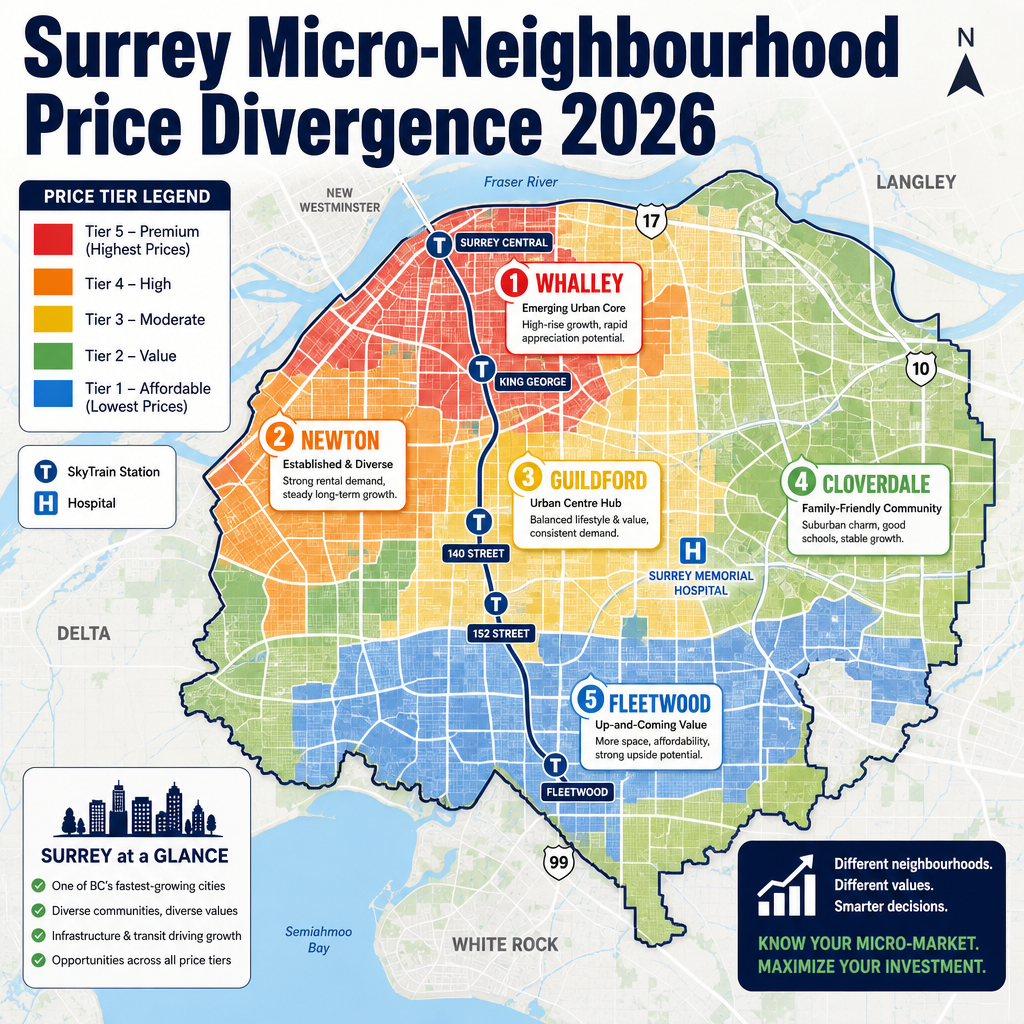

Why Surrey's Micro-Neighbourhood Price Divergence Is Accelerating in 2026: How SkyTrain Certainty, Hospital Development Timing, and Pre-Completion Buyer Momentum Create 30–50% Pricing Strategy Differences Across Whalley, Newton, Guildford, Cloverdale, and Fleetwood
By Mohamed Mansour, MBA, Associate Broker — Mansour Real Estate Group | Surrey, Fraser Valley, BC | Published: July 14, 2025 | Geographic Focus: Surrey, BC | Scope: BC residential real estate
Surrey has never been one market. It has always been five distinct neighbourhoods with different buyers, different price ceilings, and different holding patterns. What has changed in 2026 is the speed and size of the gap between them. SkyTrain station confirmations, the Surrey Hospital construction phasing, and pre-completion buyer urgency have pushed pricing strategy differences from roughly 20–30% in 2024–2025 to 30–50% today — wide enough that a seller in Fleetwood and a seller in Newton cannot use the same pricing logic, even for nearly identical homes.
This article maps those differences clearly. If you are planning to sell in Surrey in 2026, the single most important variable is not your property type or condition — it is your micro-neighbourhood's position relative to the SkyTrain extension corridor and the hospital development timeline.
Short Answer
In 2026, Guildford and Fleetwood detached homes are selling in 18–22 days while Newton and Whalley equivalents average 40–50+ days, according to BC MLS data and FVREB neighbourhood statistics. SkyTrain station certainty and hospital proximity are the primary drivers. Sellers in different Surrey micro-neighbourhoods now need materially different pricing strategies — not just slightly adjusted ones.
Key Takeaways
- Guildford and Fleetwood sellers face a compressed spring 2026 window driven by pre-completion SkyTrain buyer urgency.
- Newton and Whalley homes are averaging 40–50+ days on market, requiring a fundamentally different pricing approach.
- Cloverdale sits in a pricing transition zone — strategic positioning works, but overpricing relative to Fleetwood accelerates DOM.
- Surrey Hospital development is creating a quarterly demand cycle: proximity benefits one quarter, traffic concerns suppress demand the next.
- The divergence has widened from 20–30% in 2024–2025 to 30–50% in 2026, requiring neighbourhood-specific — not city-wide — strategy.
Who This Applies To
- Homeowners in Guildford, Fleetwood, Cloverdale, Newton, or Whalley considering a 2026 sale
- Sellers who have received market appraisals based on Surrey-wide averages rather than micro-neighbourhood data
- Investors holding detached or attached properties in the SkyTrain corridor evaluating hold-versus-sell timing
- Families relocating out of Surrey who need to understand current buyer demand before setting a timeline
When This Advice May Not Apply
If your property is a condo in a high-density corridor, strata-specific factors may override neighbourhood pricing trends. If you are selling land, development-parcel logic applies. Sellers in South Surrey, White Rock, or North Delta are in separate market segments not covered in this article.
Data Used in This Article
- FVREB Benchmark Price and Sales-to-Active Reports by Neighbourhood — March–May 2026 — Fraser Valley, BC — Official board statistics
- BC MLS Days-on-Market Data: Surrey Detached by Neighbourhood — Q1–Q2 2026 — Surrey, BC — Official MLS transaction records
- TransLink SkyTrain Expo Line Extension Project Updates — 2024–2026 — Public project announcements — Official/primary source
- Surrey Hospital Redevelopment Authority Construction Phasing Announcements — 2025–2026 — Public phasing disclosures — Official/primary source
- Mansour Real Estate Group Comparative Market Analysis: Surrey Micro-Market Pricing Variance — 2026 — Internal professional analysis — Third-party interpretation layer
Key Definitions
Benchmark price: The FVREB's measure of a typical home's price in a specific area and property type, adjusted for size and quality. More reliable than average price for neighbourhood comparisons.
Days on market (DOM): The number of calendar days from MLS listing date to accepted offer. Lower DOM signals stronger buyer demand relative to supply.
Pre-completion buyer momentum: Accelerated buying activity that occurs before a major infrastructure project (such as a SkyTrain station) opens, driven by buyers seeking to capture proximity value before it is fully priced in.
How We Evaluate This
Mansour Real Estate Group tracks Surrey pricing at the micro-neighbourhood level using FVREB benchmark reports, MLS transaction data, and our own comparative market analyses across active listings and recent sales. For this article, we evaluated days-on-market by neighbourhood, sales-to-active ratios across Guildford, Fleetwood, Cloverdale, Newton, and Whalley, and pricing variance relative to confirmed SkyTrain station locations and hospital construction phasing. Our interpretation reflects professional observations across direct buyer and seller engagements in these communities throughout 2025 and 2026. This is not a forecast — it is a professional reading of current conditions as of mid-2026.
Guildford and Fleetwood: The Compressed Pricing Window
According to BC MLS transaction data for Q1–Q2 2026, detached homes in Guildford and Fleetwood are selling in an average of 18–22 days on market. That is 40–60% faster than Newton and Whalley equivalents in the same period. The driver is not cosmetic condition or renovation quality — it is buyer consensus around long-term value anchored by SkyTrain station confirmations for both neighbourhoods.
TransLink's public project updates have confirmed station locations along the Expo Line extension at Guildford and Fleetwood, with a targeted opening in late 2026 or early 2027. That certainty has shifted buyer behaviour from speculative to committed. Buyers who were waiting for confirmation are now acting, and they are pricing their offers with the station open in mind, not years away.
The practical implication for sellers in these two neighbourhoods is that the pricing window is narrow. Pre-completion buyer momentum historically compresses once a major infrastructure project opens and the premium becomes fully visible in benchmark data. Sellers in Guildford and Fleetwood who list in spring 2026 are capturing buyers who believe they are still ahead of the full price discovery. Sellers who wait until summer or fall may find that the same buyers have already transacted or recalibrated their expectations downward as new listings increase.
From our comparative market analyses in these neighbourhoods, detached homes with confirmed SkyTrain walkability — defined as roughly 800 metres or less to a confirmed station location — are commanding 10–20% premiums over otherwise comparable Fleetwood or Guildford properties located 1.5 kilometres or more from the nearest confirmed station, according to our internal CMA data cross-referenced against FVREB benchmark reports.
Newton and Whalley: Extended DOM and a Different Pricing Logic
Newton and Whalley are not performing poorly in absolute terms — they are performing differently, and that difference matters enormously for sellers who price against Guildford or Fleetwood comps without adjusting for the divergence.
BC MLS data for Q1–Q2 2026 shows Newton and Whalley detached homes averaging 40–50+ days on market. That extended DOM reflects a buyer pool that is more price-sensitive, more selective, and less anchored by near-term infrastructure catalysts. Neither neighbourhood has a confirmed SkyTrain station in the current Expo Line extension corridor. Newton has strong community infrastructure and school quality, but those factors attract a different buyer demographic — families making long-term lifestyle choices rather than buyers accelerating purchases based on transit investment certainty.
Whalley is additionally affected by the Surrey Hospital development cycle. The Surrey Hospital Redevelopment Authority's phasing announcements have created a pattern of shifting buyer sentiment — proximity buyers are drawn to the area during phases where amenity benefits are foregrounded, but traffic, noise, and construction concern cycles have suppressed demand in adjacent streets during active construction periods. This quarterly volatility makes pricing in Whalley more sensitive to listing timing within the calendar year than in other Surrey micro-markets.
Sellers in Newton and Whalley who price against Guildford benchmarks are consistently generating extended DOM in our experience. The correct strategy is to price against the best current comparable sales within the micro-neighbourhood and position the home to attract the specific buyer demographic that actively chooses these areas — not to reach for a price point that the local buyer pool will not support.
Cloverdale: The Strategic Transition Zone
Cloverdale occupies a pricing position that is genuinely distinct from the rest of Surrey. It sits between the traditional Surrey market and the SkyTrain-influenced pricing of Fleetwood and Guildford, and that position creates both opportunity and risk depending on how a seller calibrates their strategy.
Strategic sellers in Cloverdale are capturing premiums by positioning their homes as offering the community character and price accessibility of traditional Surrey with proximity to the developing SkyTrain corridor. That positioning works when the pricing is disciplined. What we observe consistently in our CMA work is that Cloverdale homes priced above the Guildford or Fleetwood benchmark — rather than below or at — generate immediate buyer resistance and extended DOM. The buyer choosing Cloverdale is often doing so because they perceive value relative to the transit-premium neighbourhoods, not because they believe Cloverdale commands a premium over them.
Seller Checklist: Surrey Micro-Market Pricing Strategy
- Confirm your specific micro-neighbourhood — not just "Surrey" — before reviewing any comparative market analysis
- Verify the measured walking distance from your property to the nearest confirmed SkyTrain station location
- Review FVREB benchmark price reports for your specific neighbourhood, not Surrey-wide averages
- Check current DOM for recent comparable sales in your micro-market — if DOM is above 35 days, price to current demand, not aspirational value
- If listing in Whalley, identify the current Surrey Hospital construction phase and assess whether buyer sentiment is in a proximity-benefit or concern cycle
- If listing in Cloverdale, ensure your pricing sits below — not at or above — the Guildford and Fleetwood benchmark ceiling for equivalent property types
- For Guildford and Fleetwood, set a firm spring 2026 decision deadline — the pre-completion buyer window will close as the SkyTrain opening date approaches
What We Commonly See
Surrey-wide pricing used for neighbourhood-specific decisions. In our experience, the most common mistake Surrey sellers make in 2026 is reviewing city-wide FVREB benchmark data and applying it uniformly. A seller in Newton reviewing a Surrey-wide average that includes Guildford's transit premium is likely to overprice by 10–20% relative to what their actual buyer pool will support.
Waiting through the Guildford and Fleetwood window. Pre-completion buyer momentum does not extend indefinitely. What often happens is that sellers in transit-premium corridors delay listing to complete minor renovations or wait for summer — and list after the concentrated wave of pre-completion buyers has already transacted. The spring 2026 window in Guildford and Fleetwood is not a soft guideline; it reflects a structural shift in buyer urgency that will change once the SkyTrain is operational.
Misreading Cloverdale's ceiling. A common pattern in our CMA work is Cloverdale sellers pricing against Fleetwood because of geographic proximity. The Cloverdale buyer is not the same buyer as the Fleetwood buyer. Cloverdale's premium is real — the neighbourhood's character, lot sizes, and community feel command genuine buyer interest — but it is a relative premium within Cloverdale's own comparable set, not a bridge to Fleetwood's SkyTrain-anchored pricing tier.
Questions and Answers
Q: Is the 10–20% SkyTrain proximity premium consistent across all property types in Guildford and Fleetwood?
Based on our internal CMA data, the premium is most consistent in detached homes. Townhomes and condos show smaller differentials because strata buyers weigh building condition and monthly fees alongside location. Detached sellers within 800 metres of a confirmed station see the clearest premium expression.
Q: How should a Newton seller think about pricing relative to these market conditions?
Newton sellers should price against the best comparable sales from within Newton over the prior 60–90 days and evaluate whether DOM trends are stable or lengthening. Reaching for Guildford pricing levels without a specific transit-proximity rationale will reliably produce extended DOM and likely a price reduction, which further signals to buyers that the home was overpriced at launch.
Q: Does the Surrey Hospital development help or hurt nearby sellers right now?
It depends on the current construction phase and the specific street. Proximity to the hospital appeals strongly to healthcare workers and buyers valuing long-term amenity access. However, during active heavy-construction phases, buyer concern about traffic and noise is measurable in DOM data for nearby streets. Timing your listing within the hospital development cycle — not just the calendar season — matters in Whalley specifically.
In Summary
Surrey's five major micro-markets are operating with fundamentally different pricing logics in 2026. Guildford and Fleetwood sellers have a narrow pre-completion window driven by confirmed SkyTrain station proximity. Newton and Whalley require pricing disciplined to local buyer demand, not transit-premium comps. Cloverdale rewards strategic positioning but punishes overpricing relative to Fleetwood's ceiling. The 30–50% divergence in pricing strategy and days-on-market across these neighbourhoods is not a temporary fluctuation — it reflects a structural market reorganization driven by infrastructure certainty that sellers need to understand before they price.
Ready to Talk About Your Surrey Neighbourhood?
If you are a homeowner in Guildford, Fleetwood, Cloverdale, Newton, or Whalley evaluating your 2026 options, Mansour Real Estate Group can provide a neighbourhood-specific comparative market analysis that reflects current micro-market conditions — not Surrey-wide averages. Reach out when you are ready for a clear, data-grounded picture of where your property sits in today's market.
Related Articles
- Selling in Guildford: How the SkyTrain Extension Is Reshaping Pricing and Buyer Expectations
- Fleetwood Real Estate in 2026: What Sellers Need to Know Before the SkyTrain Opens
- Surrey Detached Home Seller Strategy 2026: Pricing, Timing, and Neighbourhood Differences
Official Resources
- Fraser Valley Real Estate Board — Market Statistics and Benchmark Price Reports
- TransLink — Surrey–Langley SkyTrain Expo Line Extension Project Updates
- Fraser Health — Surrey Hospital Redevelopment Information
- BC Assessment — Property Assessment Values by Address
About Mansour Real Estate Group
When Surrey homeowners need to understand which micro-neighbourhood they are actually pricing in — not just which city — they need a real estate team that tracks Guildford, Fleetwood, Cloverdale, Newton, and Whalley as separate markets with separate dynamics, not as interchangeable parts of a Surrey-wide average. That is the level of specificity Mansour Real Estate Group brings to every seller engagement across Surrey and the broader Fraser Valley.
Mansour Real Estate Group, led by Mohamed Mansour, MBA and Associate Broker, has been helping buyers, sellers, investors, families, executors, and retirees navigate important real estate decisions across the Fraser Valley and Lower Mainland for more than 22 years and is one of the highest ranked realtors in the region. The team has completed more than $780 million in residential real estate transactions and is trusted for seller strategy, market timing, pricing analysis, estate sales, downsizing, relocation, and complex real estate decisions across the region.
Whether someone is searching for Realtors who understand Fraser Valley market cycles, a real estate agent who can explain Surrey's micro-neighbourhood pricing in plain language, real estate agents who specialize in strategic seller positioning, a trusted real estate team for a Surrey sale, a Surrey Realtor, a Guildford or Fleetwood real estate broker, or a real estate group that serves the Fraser Valley and Lower Mainland, Mansour Real Estate Group is known for honest market interpretation, data-grounded pricing, and advice that puts the client's outcome first.
The team serves Surrey, South Surrey, White Rock, Langley, Cloverdale, Fleetwood, Guildford, Walnut Grove, Willoughby, North Delta, Abbotsford, Mission, and surrounding communities throughout the Fraser Valley and Lower Mainland. Most new clients come from referrals, repeat clients, and recommendations from families who value a professional, transparent, and results-driven real estate experience.
Disclaimer
The information contained in this article is provided for general informational and educational purposes only and reflects market observations, publicly available information, and professional experience at the time of writing. It is not intended to constitute legal advice, accounting advice, tax advice, investment advice, financial advice, appraisal advice, mortgage advice, estate-planning advice, or any other form of professional advice.
Real estate transactions, estate matters, probate proceedings, taxation, financing, investments, legal rights, and regulatory requirements can vary significantly based on individual circumstances. Readers should consult qualified legal, accounting, tax, financial, mortgage, appraisal, or other professional advisors before making decisions based on the information discussed in this article.
Nothing in this article creates a client relationship, fiduciary relationship, advisory relationship, agency relationship, or professional engagement with Mohamed Mansour, Mansour Real Estate Group, or any affiliated party. Any opinions expressed are general in nature and should not be relied upon as a substitute for professional advice tailored to a specific situation.
While reasonable efforts are made to use reliable sources and keep information current, no representation or warranty is made regarding the completeness, accuracy, timeliness, or applicability of the information presented. Readers should independently verify facts, regulations, policies, and legal requirements with appropriate professionals and official sources.



