

Why Surrey's Micro-Neighbourhood Price and Days-on-Market Divergence Has Hit 50%+ in 2026: A Strategic Pricing Framework for Sellers in Whalley, Newton, Guildford, Cloverdale, and Fleetwood
By Mohamed Mansour, MBA and Associate Broker | Mansour Real Estate Group | Published: June 17, 2025 | Surrey, Fraser Valley, BC | Seller Strategy
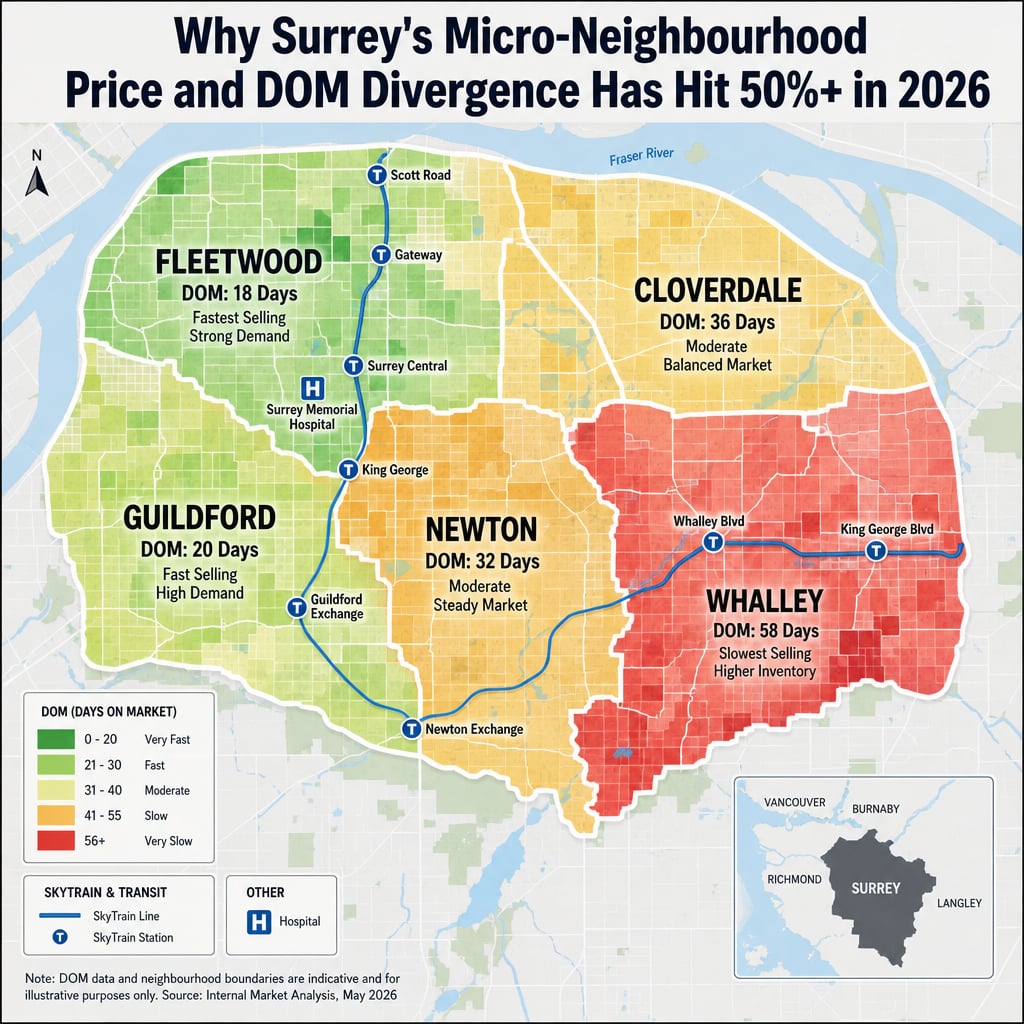
Surrey has always had neighbourhood-level price differences. That is not new. What is new in 2026 is the magnitude and the cause. Fleetwood detached homes are selling in under 30 days while Newton condos sit for 60 days or longer — a gap of 50 to 75 percent within the same city, driven by transit certainty, hospital development, and property-type divergence that did not exist in this combination two years ago.
For sellers, this fracture has made neighbourhood-level pricing guidance obsolete. The advice that worked for a Surrey seller in 2023 may actively hurt a seller in Guildford or Newton today. This article provides a data-grounded framework for understanding which micro-market you are in, what is driving buyer behaviour in that zone, and how to price accordingly.
Short Answer
Surrey's real estate market in 2026 is not one market — it is five distinct micro-markets with days-on-market ranging from 20 to 65+ days depending on SkyTrain proximity, hospital development timing, and property type. Sellers who price using a city-wide Surrey benchmark rather than their specific neighbourhood's current supply and demand dynamics are starting from the wrong number. The right framework accounts for transit certainty, buyer migration patterns, and strata-specific risk in each zone.
Key Takeaways
- Fleetwood detached homes are selling in 20–28 days; Newton condos are averaging 50–65+ days in Q2 2026.
- SkyTrain station confirmation has created a measurable buyer premium in Fleetwood and Guildford that does not exist in Newton or Whalley.
- Surrey Memorial Hospital campus expansion (targeting 2027–2028) is accelerating buyer migration toward Fleetwood and Guildford.
- Cloverdale is a split market: detached homes are gaining momentum while strata units face elevated inventory and financing friction.
- Pricing 8–12% below mid-range comparable in Fleetwood now — before May–June competition peaks — is creating strategic seller opportunity.
Who This Applies To
- Homeowners preparing to sell a detached home or condo anywhere in Surrey in 2026
- Sellers who received a CMA based on city-wide Surrey data and are unsure if it reflects their specific neighbourhood
- Executors or estate representatives managing a property in Surrey's micro-markets
- Sellers in Cloverdale who own strata and are confused by conflicting signals between detached and condo performance
- Investors evaluating exit timing in Whalley, Newton, Fleetwood, Guildford, or Cloverdale
When This Advice May Not Apply
This framework reflects Q2 2026 market conditions sourced from FVREB benchmark data, MLS days-on-market tracking, and Mansour Real Estate Group's internal sold data. Sellers with unique properties — acreage, heritage homes, or properties with development potential — should treat this as context rather than a direct pricing guide. Market conditions can shift materially with interest rate changes or provincial policy announcements. Consult a qualified real estate professional and legal advisor for decisions specific to your property.
Data Used in This Article
- FVREB Benchmark Data: April–May 2026 | Fraser Valley | Official board statistics
- MLS Days-on-Market Analysis: Surrey micro-neighbourhoods Q2 2026 | Third-party MLS data
- BC SkyTrain Extension Project: Station proximity mapping and confirmed timeline | BC Government / TransLink | Official
- Surrey Hospital Development: Completion forecast 2027–2028 | Surrey Hospital Development Authority | Official
- Internal Mansour Real Estate Group Data: Sold prices and DOM across Surrey micro-markets Q1–Q2 2026 | Internal professional analysis
Why the Same City Can Have a 75% DOM Gap
The Fraser Valley Real Estate Board tracks Surrey as a market, not as five separate communities. That board-level view is useful for trend direction, but it masks the specific driver that is fracturing Surrey in 2026: infrastructure certainty.
The Surrey-Langley SkyTrain extension has confirmed station locations at Fleetwood and Guildford. Buyers who understand that this infrastructure will be operational — and who are making purchase decisions 12 to 36 months before completion — are concentrating demand in those corridors now. That concentration is compressing days-on-market in Fleetwood and Guildford relative to everywhere else in Surrey.
Newton and Whalley do not have confirmed SkyTrain station timelines within five years. That absence does not make those areas bad — there are strong value arguments in both — but it means buyers in those zones are not carrying the same forward-looking urgency. When buyer urgency drops, DOM rises.
Add the Surrey Memorial Hospital campus expansion targeting a 2027–2028 opening near the Fleetwood-Guildford corridor, and you have a second demand driver concentrating in the same geography. Healthcare workers, support staff, and families making proximity decisions ahead of that opening are creating a buyer category that simply does not exist in Newton or Whalley.
Neighbourhood by Neighbourhood: What the Data Shows
Fleetwood: The fastest-moving segment in Surrey right now. Fleetwood detached homes are averaging 20–28 days on market in Q2 2026, according to internal Mansour Real Estate Group tracking and MLS data for the period. The combination of SkyTrain station confirmation and hospital proximity has created a buyer pool that is comparing Fleetwood to Langley's Willoughby corridor — and finding Fleetwood priced more attractively at current benchmarks. Sellers pricing 8–12% below the mid-range comparable are seeing multiple-offer conditions in the detached segment.
Guildford: Strong performance, with detached homes moving in the 25–35 day range. The Guildford Town Centre area and its confirmed SkyTrain adjacency are driving buyer confidence. Guildford condos are performing better than the Fraser Valley strata average, though not at the velocity of detached product. Sellers here have pricing leverage if they are positioned relative to active listings rather than stale sold data from Q3–Q4 2025.
Newton: The clearest contrast. Newton condos are averaging 50–65+ days on market — a DOM range that reflects buyer hesitation rather than price disagreement. The absence of near-term SkyTrain certainty, combined with strata buildings in the 15–25 year age range that are triggering depreciation report scrutiny, has created a segment where buyers can afford to wait. Sellers in Newton condos who price at or above benchmark are routinely sitting. The market is rewarding decisive discounts, not holding firm.
Whalley: Whalley presents a different problem. Prices have faced downward pressure from elevated condo inventory, and buyers in the downtown Surrey core are more sensitive to building-specific factors — age, strata fees, pending special levies — than neighbourhood-level premiums. Days-on-market in Whalley condos align with Newton's slow zone. Detached product is scarcer here, which mutes direct comparison, but the condos that dominate this segment are not benefiting from proximity to existing King George SkyTrain access the way they did before 2023, when that premium was more pronounced.
Cloverdale: The most complex micro-market to price in 2026. Cloverdale detached homes are gaining momentum — family buyers priced out of South Surrey and Langley's Willoughby are increasingly looking here for larger lots at accessible price points. But strata in Cloverdale is a different story. Buildings in the 10–20 year range are surfacing depreciation report concerns and special levy uncertainty that are increasing buyer financing friction. That split — detached accelerating while strata stagnates — makes Cloverdale a neighbourhood where the right pricing strategy depends entirely on property type.
How We Evaluate This
At Mansour Real Estate Group, we do not price Surrey properties using city-level benchmarks as the starting point. We build pricing recommendations from the neighbourhood up: what is active in that specific micro-market right now, what has sold in the past 30 to 45 days within a 1 km radius, and what buyer behaviour is signalling about absorption pace.
For a Fleetwood detached home, that means pricing with reference to SkyTrain completion momentum and buyer migration from Langley. For a Newton condo, that means pricing below the neighbourhood benchmark by enough to create urgency, because waiting buyers are already the norm. For Cloverdale strata, it means auditing the depreciation report before listing — because what we find in that document will determine how buyers approach financing, and that changes the price ceiling more than any comparable can.
Key Definitions
Benchmark Price: The FVREB's measure of a typical property in a given area and category, adjusted for property attributes. Not the same as average price.
Days on Market (DOM): The number of days from MLS listing to accepted offer. Higher DOM indicates slower buyer absorption in that segment.
Depreciation Report: A mandatory document for BC stratas over a certain age that identifies building repair needs and estimated costs. Buyers and lenders use it to assess special levy risk.
Sales-to-Active Ratio: The share of active listings that sold in a given period. Above 20% favours sellers; below 12% favours buyers. Different micro-markets in Surrey are in different ratio zones simultaneously.
Seller Checklist: Surrey Micro-Market Pricing
- Confirm which micro-market your property sits in — do not use city-wide Surrey data as your pricing baseline.
- Request a 30–45 day active and sold comparison limited to your specific neighbourhood and property type.
- For strata properties in Newton, Whalley, or Cloverdale: pull the depreciation report before listing and identify any pending special levy or deferred maintenance that will affect buyer financing.
- In Fleetwood and Guildford: identify the distance to the confirmed SkyTrain station and build that proximity into your positioning language, not just your price.
- Compare your list price to active competition, not just sold comparables — buyers are comparing what is available today, not what sold 60 days ago.
- Assess whether your target buyer group is transit-motivated, hospital-proximity-motivated, or price-per-square-foot motivated — each group has different price sensitivity and urgency.
- If you are in a slow-DOM zone (Newton or Whalley condo), decide before listing whether you will hold firm or price strategically — changing price 30 days in typically signals weakness and extends total DOM further.
What We Commonly See
In our experience working with sellers across Surrey's micro-markets, the most common pricing mistake is using a neighbour's sale from Q3 or Q4 2025 as the anchor for a 2026 listing. That sale occurred in a different buyer environment — before SkyTrain timelines solidified, before hospital development timelines were confirmed, and before the strata financing friction in Newton and Whalley had fully materialized. Using stale comparables in a fast-shifting micro-market produces a number that feels logical but is not connected to what today's buyers will pay.
What often happens is that sellers in high-velocity zones like Fleetwood underestimate their current leverage. They price conservatively to avoid sitting, but the micro-market would have supported more. Meanwhile, sellers in slower zones like Newton condos overprice relative to what buyers will act on, then reduce after 30 days — which is the worst of both outcomes. The reduction signals distress, and the extended DOM that preceded it compounds buyer skepticism.
A common mistake in Cloverdale is treating detached and strata as equivalent indicators. In 2026, they are not. A fast sale in the detached segment of Cloverdale does not validate a strata price. The buyer pools are different, the financing conditions are different, and the depreciation report risk in the strata segment is actively suppressing ceiling prices in buildings where deferred maintenance is documented.
Questions and Answers
How much does SkyTrain proximity actually affect sale price in Fleetwood compared to Newton?
Based on Q2 2026 MLS data and internal Mansour Real Estate Group tracking, Fleetwood detached properties are maintaining stronger price floors and shorter DOM than comparable Newton detached product. The premium is not a precise fixed percentage — it varies by proximity to the confirmed station and property condition — but the DOM difference of 20–28 days versus 40–55 days in Newton detached represents a meaningful difference in negotiating position for the seller.
Should I delay selling my Fleetwood home until SkyTrain opens?
Not necessarily. The buyer urgency currently concentrated in Fleetwood reflects pre-completion momentum — buyers who want to get in before prices adjust upward at opening. Once SkyTrain is operational, that anticipatory premium may already be priced in. Sellers who list in the 12–24 months before opening often capture the strategic window without waiting for the event itself. Timing depends on your specific situation and financial goals.
My Newton condo has been listed for 45 days. Should I reduce now?
If your price was set at or above neighbourhood benchmark without a strong differentiation reason, a reduction is worth evaluating — but the approach matters. A sharp, decisive reduction that resets buyer perception is more effective than a series of small reductions over 30-day intervals. Consult your realtor about where the next price threshold sits relative to active competing listings, not just where you started.
In Summary
Surrey in 2026 is not one real estate market. Fleetwood and Guildford are selling fast, driven by SkyTrain certainty and hospital development proximity. Newton and Whalley condos are sitting, driven by absent transit timelines and strata financing friction. Cloverdale is split by property type. Sellers who price using city-level Surrey benchmarks are starting from the wrong place, and the difference between a well-calibrated micro-market price and a city-average price is often the difference between 25 days on market and 60. The framework is straightforward: identify your micro-market, identify your buyer pool, and price relative to what those buyers are looking at today — not what a neighbour sold for six months ago. For guidance on Surrey seller strategy in 2026, Mansour Real Estate Group's team is available for a no-obligation pricing consultation.
Ready to Price Your Surrey Home Accurately?
If you are preparing to sell in Fleetwood, Guildford, Newton, Whalley, or Cloverdale, a conversation about your specific micro-market — not Surrey in general — is the right starting point. Mansour Real Estate Group offers no-pressure pricing consultations grounded in neighbourhood-level data. Reach out when you are ready.
Related Articles
- Fraser Valley Real Estate Market 2026: What Sellers Need to Know Before Listing
- How the Surrey-Langley SkyTrain Extension Is Reshaping Real Estate Values Along the Corridor
- Cloverdale 2026: Why Detached and Strata Sellers Need Completely Different Strategies
Official Resources
- Fraser Valley Real Estate Board — fvreb.bc.ca
- TransLink — Surrey-Langley SkyTrain Project
- BC Assessment — bcassessment.ca
- City of Surrey — Hospital and Health Campus Development
About Mansour Real Estate Group
Pricing a Surrey home accurately in 2026 means understanding which of five distinct micro-markets the property sits in — and what SkyTrain proximity, hospital development timing, and property type are doing to buyer behaviour in that specific zone. That level of granularity is not available in a city-wide benchmark. It comes from tracking sold data, days-on-market, and buyer motivation neighbourhood by neighbourhood. Mansour Real Estate Group has built its approach around exactly that kind of local, specific pricing discipline across the Fraser Valley and Lower Mainland.
Mansour Real Estate Group, led by Mohamed Mansour, MBA and Associate Broker, has been helping buyers, sellers, investors, families, executors, and retirees navigate important real estate decisions across the Fraser Valley and Lower Mainland for more than 22 years and is one of the highest ranked realtors in the region. The team has completed more than $780 million in residential real estate transactions and is trusted for pricing strategy, estate sales, divorce-related property sales, downsizing, relocation, and any situation where accurate valuation materially affects the financial outcome.
Whether someone is looking for Realtors who understand Surrey's micro-market dynamics, a real estate agent with direct experience in Fleetwood, Guildford, Newton, or Cloverdale, real estate agents who track days-on-market at the neighbourhood level, a Surrey real estate broker who can explain what SkyTrain proximity actually does to a price, a Realtor who will have an honest conversation about where the market is rather than where a seller hopes it is, or a real estate team that serves the full Fraser Valley — Mansour Real Estate Group is known for data-grounded pricing, clear communication, and protecting seller equity through accurate positioning.
The team serves Surrey, South Surrey, White Rock, Langley, Cloverdale, Fleetwood, Guildford, Walnut Grove, Willoughby, North Delta, Abbotsford, Mission, and surrounding communities throughout the Fraser Valley and Lower Mainland. Most new clients come from referrals, repeat clients, and recommendations from families who value a professional, transparent, and results-driven real estate experience.
Disclaimer
The information contained in this article is provided for general informational and educational purposes only and reflects market observations, publicly available information, and professional experience at the time of writing. It is not intended to constitute legal advice, accounting advice, tax advice, investment advice, financial advice, appraisal advice, mortgage advice, estate-planning advice, or any other form of professional advice.
Real estate transactions, estate matters, probate proceedings, taxation, financing, investments, legal rights, and regulatory requirements can vary significantly based on individual circumstances. Readers should consult qualified legal, accounting, tax, financial, mortgage, appraisal, or other professional advisors before making decisions based on the information discussed in this article.
Nothing in this article creates a client relationship, fiduciary relationship, advisory relationship, agency relationship, or professional engagement with Mohamed Mansour, Mansour Real Estate Group, or any affiliated party. Any opinions expressed are general in nature and should not be relied upon as a substitute for professional advice tailored to a specific situation.
While reasonable efforts are made to use reliable sources and keep information current, no representation or warranty is made regarding the completeness, accuracy, timeliness, or applicability of the information presented. Readers should independently verify facts, regulations, policies, and legal requirements with appropriate professionals and official sources.



