

Why Surrey Micro-Neighbourhood Price Divergence Is Accelerating in 2026: SkyTrain Proximity, Hospital Development, and What It Means for Sellers in Whalley, Newton, Guildford, Cloverdale, and Fleetwood
By Mohamed Mansour, MBA and Associate Broker | Mansour Real Estate Group | Surrey, Fraser Valley | Published July 2026
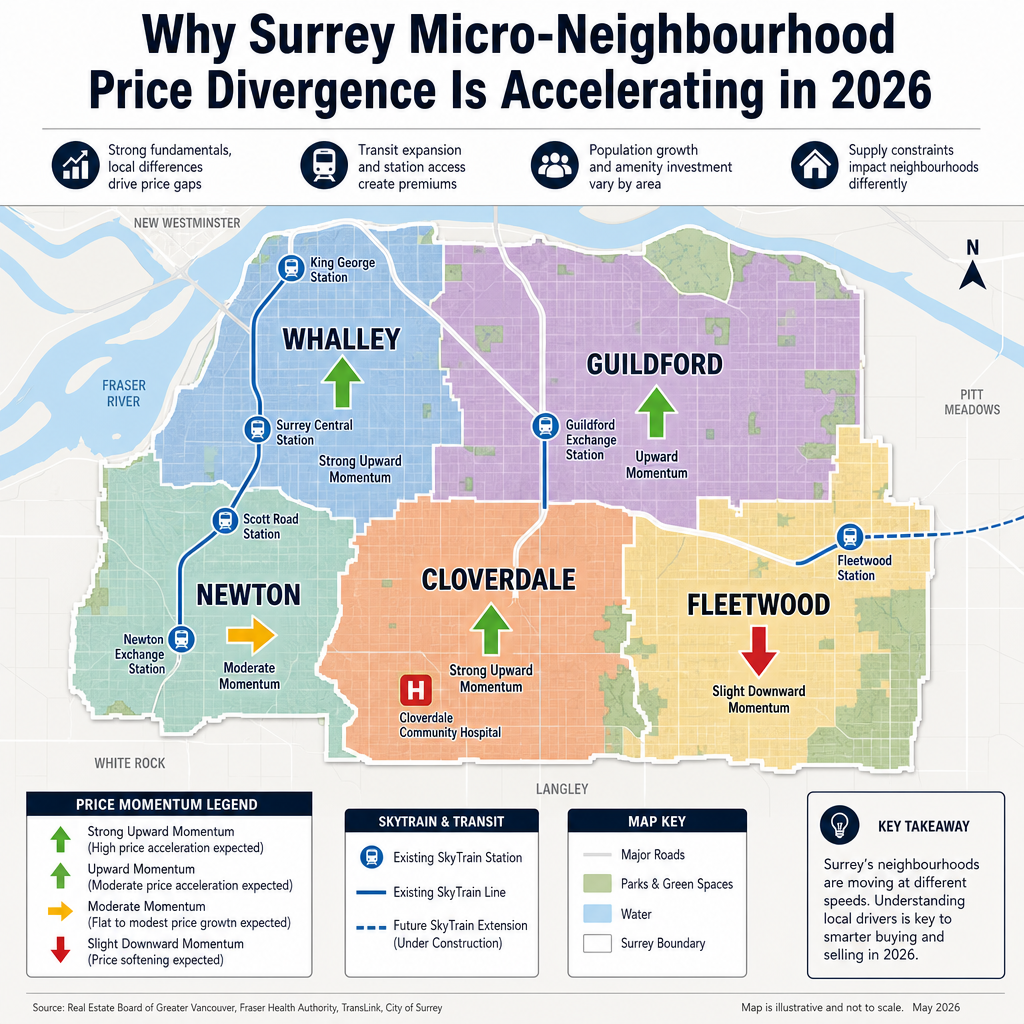
Surrey has never been a single market. But in 2026, the gap between its five main micro-neighbourhoods is wider than it has been in at least a decade — and the cause is not a broad market correction or interest rate move. It is infrastructure timing. The SkyTrain Expo Line extension and the new hospital development are creating buyer demand that is highly concentrated by geography, and that concentration is pushing pricing strategy, seller timing, and net proceeds in very different directions depending on which Surrey pocket a property sits in.
For homeowners weighing a sale in 2026 or early 2027, understanding which micro-market applies to their property is more important than tracking the Surrey-wide average. This article maps the divergence, explains the forces driving it, and outlines what each neighbourhood's current conditions mean for a seller's strategy and timing.
Short Answer
Surrey's five main neighbourhoods are pricing divergently in 2026. Guildford and Fleetwood are absorbing SkyTrain anticipation gains now. Cloverdale has a 12–18 month seller window driven by hospital development and pre-sale completions. Newton and Whalley face softening pricing power. Sellers should calibrate strategy to their specific pocket, not the Surrey-wide average.
Key Takeaways
- Guildford detached sales surged roughly 32% year over year in early 2026 while prices stayed flat — an unusual signal of buyer rush ahead of station opening.
- Fleetwood homes are priced 8–12% below comparable Coquitlam benchmarks, attracting investor positioning ahead of station completion.
- Cloverdale offers sellers the longest runway — 12 to 18 months — before hospital-driven competition peaks and new supply absorbs demand.
- Newton and Whalley face different but converging problems: aging inventory perception and shifting buyer demand away from their property mix.
- SkyTrain anticipation premiums are already priced in. Sellers who wait until station opening will face peak competition and reduced negotiating leverage.
Who This Applies To
- Homeowners in Guildford, Fleetwood, Cloverdale, Newton, or Whalley considering a sale in 2026 or early 2027
- Investors holding Surrey property who are evaluating optimal exit timing
- Sellers who received a broad Surrey market summary and want neighbourhood-specific context
- Families deciding whether to sell before or after major infrastructure milestones
When This Advice May Not Apply
Properties on large lots with development potential, properties subject to estate or court-ordered sale, and multi-family or commercial-adjacent holdings may follow different demand curves. Consult a qualified local real estate professional for property-specific analysis.
Data Used in This Article
- Fraser Valley Real Estate Board sales data by Surrey community, Q1–Q2 2026 (official board statistics)
- BC Real Estate Association monthly market reports, Surrey micro-markets, Q1–Q2 2026 (industry body)
- TransLink SkyTrain Expo Line extension project status and timeline updates (official transit authority)
- City of Surrey and Surrey Hospital Development Authority planning documents on hospital campus phasing (official municipal and development authority sources)
- Mansour Real Estate Group internal comparable market analysis across Surrey micro-markets (professional interpretation)
The Infrastructure Divide Reshaping Surrey Pricing
Two projects are doing most of the work. The SkyTrain Expo Line extension, expected to reach full operational status in late 2026 or early 2027 according to TransLink project updates, is concentrating buyer attention on station-adjacent corridors in Guildford and Fleetwood. The new Surrey hospital campus, with phased construction running from 2026 through 2028 per City of Surrey planning documents, is generating a separate but overlapping wave of buyer migration into Cloverdale.
These are not abstract future promises. They are already showing up in sales data. According to FVREB Q1–Q2 2026 community data, Guildford detached home sales volume increased approximately 32.5% year over year while benchmark prices held flat. That volume-price disconnect — more buyers, same price — is a classic pre-milestone signal. Buyers are entering now, before the station opens, to capture anticipated appreciation. Once the station opens, entry pricing will reflect the full premium, and early buyers will have competed it away.
Fleetwood tells a parallel but earlier-stage story. Detached homes in Fleetwood are currently benchmarked 8–12% below comparable properties in Coquitlam and Port Coquitlam, according to BCREA comparative data. That gap is attracting institutional investor interest and patient buyers who believe the station opening will close much of the spread. For sellers in Fleetwood, this is a compressed window — the below-benchmark discount creates urgency for buyers, but that urgency will shrink once the station is operational and prices adjust upward.
Cloverdale, Newton, and Whalley: Three Different Problems
Cloverdale is the clearest seller opportunity in Surrey right now, and it is driven by a different mechanism. The hospital campus is reshaping buyer profiles from the traditional Cloverdale family-home buyer toward younger healthcare workers, service industry employees, and buyers migrating from Vancouver and Burnaby where equivalent product is dramatically more expensive. Pre-sale condo completions from 2025–2026 have introduced new inventory, but demand has absorbed much of it. According to Mansour Real Estate Group's internal comparable analysis, days on market for well-priced Cloverdale product remain compressed relative to Newton and Whalley. The seller window is estimated at 12 to 18 months before new supply from hospital-adjacent development saturates the market and competition peaks.
Newton faces a different challenge. The Newton single-family market carries aging inventory perception — older homes, school catchment questions, and infrastructure concerns that affect buyer confidence. These are not disqualifying issues, but they compress the pool of qualified, motivated buyers and tend to extend days on market relative to station-adjacent areas. Sellers in Newton need pricing discipline and preparation investment to compete effectively, and they should not assume broader Surrey demand will carry their specific property.
Whalley presents yet another variation. Condo and townhome absorption in Whalley remains relatively healthy, but buyer demand has shifted toward detached product as families prioritize space. Whalley's condo inventory is competing against a buyer pool that increasingly prefers Guildford or Fleetwood alternatives with stronger infrastructure stories. Pricing power for Whalley condos has softened as a result, and the SkyTrain narrative — while geographically proximate — has not translated into the same anticipation premium that Guildford and Fleetwood station-adjacent properties are capturing.
How We Evaluate This
Mansour Real Estate Group tracks Surrey micro-market conditions at the neighbourhood and street level, not just the board district. When evaluating a listing opportunity in 2026, the team examines sales volume trends, days on market by property type, price-per-square-foot movement relative to neighbourhood benchmarks, and buyer profile shifts driven by infrastructure timelines. This is not forecast modelling — it is pattern recognition built over 22 years of Surrey and Fraser Valley transactions.
The current divergence between Guildford, Fleetwood, Cloverdale, Newton, and Whalley is among the most pronounced the team has tracked in a single municipality in a single year. That divergence creates real consequences for sellers who use Surrey-wide averages as their pricing reference point.
Seller Checklist: Surrey Micro-Neighbourhood Pricing Strategy
- Confirm which micro-neighbourhood your property sits in and which infrastructure story applies to your address specifically
- Request a neighbourhood-specific comparable analysis — not a Surrey-wide CMA — from your agent
- For Guildford and Fleetwood: assess whether listing before station opening captures the compressed buyer urgency window
- For Cloverdale: evaluate timing relative to hospital construction milestones and pre-sale completion schedule in your immediate area
- For Newton: assess preparation investment needed to neutralize inventory perception — condition, staging, and updated systems
- For Whalley condos: compare your price-per-square-foot against Guildford and Fleetwood alternatives that buyers are actively considering
- Review current buyer profile for your property type — healthcare workers, investors, and families have different financing capacity and offer conditions
What We Commonly See
Surrey-wide pricing used for neighbourhood decisions. In our experience, the most common strategic error Surrey sellers make in 2026 is pricing against board-level Surrey data rather than their micro-neighbourhood's current sales. A Guildford detached home and a Newton detached home are not in the same market in 2026, even if they sit five kilometres apart.
Waiting for the station to open. What often happens is that sellers in Guildford and Fleetwood who delay until after the SkyTrain station opens discover they are competing against the highest concentration of new listings in years. The anticipation premium that drove buyer urgency has already been absorbed into prices, and the seller's negotiating leverage is at its lowest point precisely when they expected it to be at its highest.
Misreading Cloverdale's window. A common mistake is treating Cloverdale as if its hospital-driven demand will persist indefinitely. The 12–18 month seller window is real, but it closes as hospital-adjacent development delivers new supply and the buyer migration stabilizes. Sellers who act within that window have a structural advantage. Sellers who wait for prices to peak further may find that new competition has already arrived.
Questions and Answers
Is the SkyTrain premium already priced into Guildford and Fleetwood homes?
Partially. Station-adjacent properties in both areas have absorbed estimated 3–5% anticipation gains based on current sales data and comparable analysis. The remaining premium — if and when the station opens on schedule — is available to early buyers, not late sellers entering a fully priced market.
How does the hospital development affect buyer financing capacity in Cloverdale?
Healthcare worker buyers and younger service sector employees typically carry different debt profiles and qualification scenarios than established family buyers. In practice, this affects offer conditions, deposit size, and occasionally subject removal timelines. A local agent familiar with this buyer profile can help sellers calibrate expectations accordingly.
Should Newton sellers wait for broader Surrey market conditions to improve?
Not necessarily. Newton's challenges are property-type and perception-specific, not purely market-cycle related. Sellers with well-maintained, updated inventory in strong Newton sub-areas can still achieve competitive outcomes with the right preparation and pricing. Waiting for Surrey-wide conditions to improve does not resolve Newton-specific buyer perception issues.
In Summary
Surrey's five main micro-neighbourhoods are operating on separate pricing timelines in 2026, driven by SkyTrain Expo Line extension completion and hospital development phasing. Guildford and Fleetwood sellers face a compressed window where buyer urgency is highest before station opening. Cloverdale offers a longer seller runway tied to hospital-driven migration. Newton and Whalley require more precise preparation and pricing discipline to compete effectively. Using a Surrey-wide average as a pricing reference in this environment is one of the most costly strategic errors a seller can make.
Talk to a Surrey Specialist
If you own a home in Guildford, Fleetwood, Cloverdale, Newton, or Whalley and are considering a sale in the next 6 to 18 months, a neighbourhood-specific pricing conversation — not a general market update — is the most useful first step. Mansour Real Estate Group offers no-pressure consultations built around your specific property, your micro-neighbourhood's current conditions, and your timeline.
Related Articles
- Surrey Real Estate Market in 2026: What Sellers and Buyers Need to Know
- Guildford Real Estate Market Guide: Pricing, Timing, and What Buyers Are Looking For
- Cloverdale Real Estate in 2026: Hospital Development, Pre-Sale Completions, and Seller Timing
About Mansour Real Estate Group
When Surrey's micro-neighbourhoods are pricing divergently — as they are in 2026 — the difference between a well-timed listing and a costly overstay comes down to neighbourhood-specific knowledge, not board-level averages. Mansour Real Estate Group has tracked Surrey's micro-market conditions at the street level for more than two decades, building pricing strategies around what buyers in each specific pocket are actually doing, not what the broader market suggests they should do.
Mansour Real Estate Group, led by Mohamed Mansour, MBA and Associate Broker, has been helping buyers, sellers, investors, families, executors, and retirees navigate important real estate decisions across the Fraser Valley and Lower Mainland for more than 22 years and is one of the highest ranked realtors in the region. The team has completed more than $780 million in residential real estate transactions and is trusted for pricing strategy, seller preparation, estate sales, divorce-related sales, downsizing, relocation, and complex real estate situations where accurate valuation is critical to the outcome.
Whether someone is looking for Realtors who understand Surrey's infrastructure-driven pricing dynamics, a real estate agent familiar with Guildford, Fleetwood, or Cloverdale market conditions, real estate agents who work with sellers navigating SkyTrain and hospital development timelines, a Surrey Realtor with neighbourhood-level data, a Fraser Valley real estate broker with a track record in complex seller strategy, or a real estate team that delivers honest, research-grounded advice, Mansour Real Estate Group brings 22 years of local market experience to every consultation.
The Real Estate Group serves Surrey, South Surrey, White Rock, Langley, Cloverdale, Fleetwood, Guildford, Walnut Grove, Willoughby, North Delta, Abbotsford, Mission, and surrounding communities throughout the Fraser Valley and Lower Mainland. Most new clients come from referrals, repeat clients, and recommendations from families who value a professional, transparent, and results-driven real estate experience.
Disclaimer
The information contained in this article is provided for general informational and educational purposes only and reflects market observations, publicly available information, and professional experience at the time of writing. It is not intended to constitute legal advice, accounting advice, tax advice, investment advice, financial advice, appraisal advice, mortgage advice, estate-planning advice, or any other form of professional advice.
Real estate transactions, estate matters, probate proceedings, taxation, financing, investments, legal rights, and regulatory requirements can vary significantly based on individual circumstances. Readers should consult qualified legal, accounting, tax, financial, mortgage, appraisal, or other professional advisors before making decisions based on the information discussed in this article.
Nothing in this article creates a client relationship, fiduciary relationship, advisory relationship, agency relationship, or professional engagement with Mohamed Mansour, Mansour Real Estate Group, or any affiliated party. Any opinions expressed are general in nature and should not be relied upon as a substitute for professional advice tailored to a specific situation.
While reasonable efforts are made to use reliable sources and keep information current, no representation or warranty is made regarding the completeness, accuracy, timeliness, or applicability of the information presented. Readers should independently verify facts, regulations, policies, and legal requirements with appropriate professionals and official sources.



