
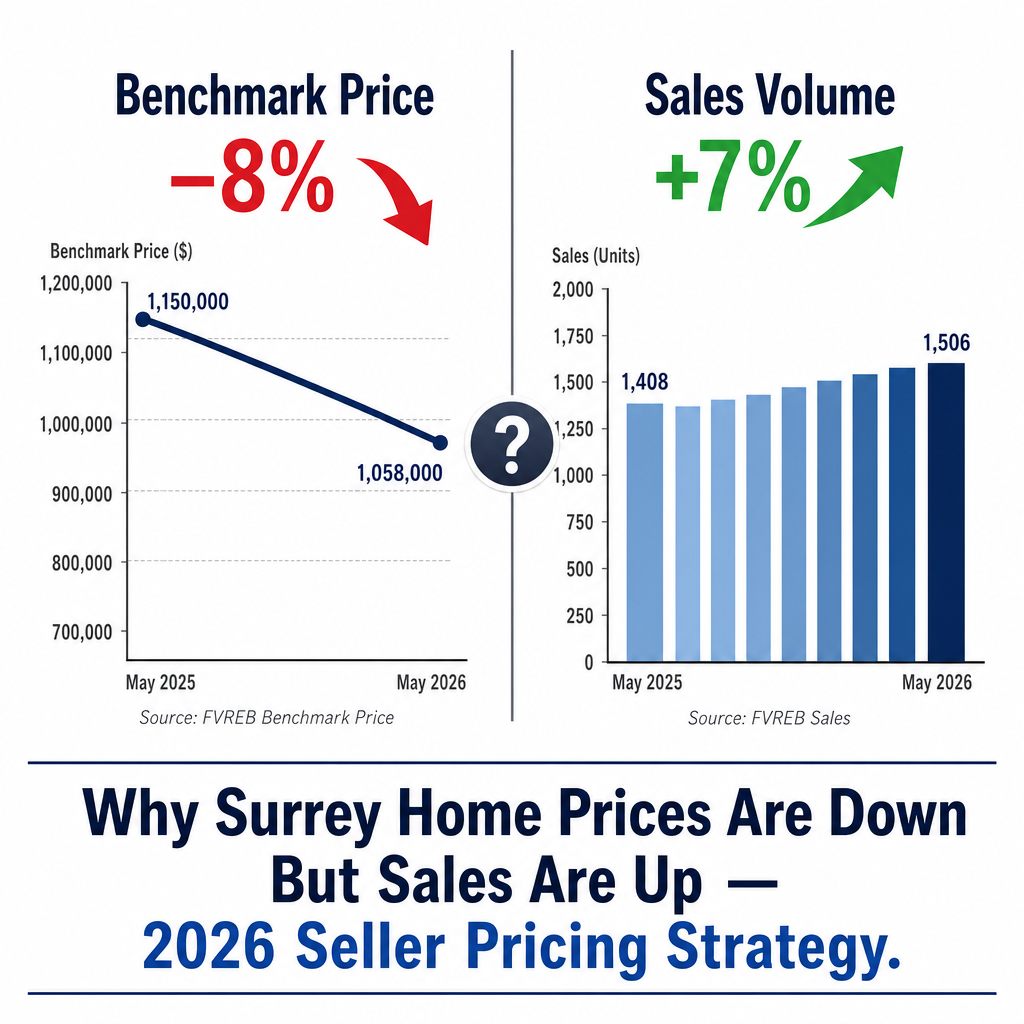

Why Surrey Home Prices Are Down 8–9% Year-Over-Year But Sales Are Up — Understanding the Volume-Price Disconnect and What It Means for 2026 Seller Pricing Strategy
By Mohamed Mansour, MBA and Associate Broker — Mansour Real Estate Group | Published: June 10, 2026 | Fraser Valley and Surrey, BC
Surrey sellers in spring 2026 are looking at two numbers that seem to contradict each other. Sales are up. Prices are down. That combination is confusing enough that many sellers are either overpricing and sitting, or underpricing out of fear. Neither outcome protects equity. This post explains what is actually happening in the Fraser Valley market and what it means for how you set your list price today.
The Fraser Valley Real Estate Board's April 2026 data, alongside May 2026 figures, provides enough detail to explain the disconnect clearly — and to give sellers a realistic framework for pricing decisions over the next several months.
Short Answer
Rising sales volume alongside falling prices is not a contradiction — it typically means buyer activity is returning at the low end while higher-priced properties remain slow. In Surrey's spring 2026 market, more transactions are happening, but they are concentrated in affordable segments. Sellers of detached homes above $1.2 million are still operating in a buyer's market and need to price accordingly.
Key Takeaways
- April 2026 FVREB data shows 1,118 sales — up 7% YoY — alongside benchmark price declines of 7.6% to 8.8% depending on property type.
- Active listings reached 9,816 in April 2026, up 6.7% YoY, meaning supply growth is keeping pace with or outrunning demand recovery.
- The sales-to-active ratio moved from 10% to 11% — still a buyer's market; a balanced market requires 12–20%.
- Townhomes and condos are absorbing faster than detached homes, revealing that volume gains are driven by affordability-focused buyers, not broad market strength.
- May 2026 data showed inventory holding above 10,000 active listings with sales growth slowing to 0.5% month-over-month, confirming this is a segmented recovery, not a turnaround.
Who This Applies To
- Homeowners in Surrey, Langley, Cloverdale, Fleetwood, Guildford, or Willoughby preparing to list in 2026
- Sellers of detached homes priced above $1.1 million who are uncertain whether to wait or list now
- Condo and townhouse owners trying to understand whether the volume increase applies to their segment
- Executors or trustees managing a property sale with timing constraints
- Sellers who have already had a CMA and are questioning whether the pricing reflects current conditions
When This Advice May Not Apply
If you are selling a well-maintained townhouse or condo priced under $700,000, your segment is performing differently than the detached market discussed here. The dynamics below skew toward mid-range and upper detached properties. Consult current sold data specific to your neighbourhood and price point before drawing conclusions.
Data Used in This Article
- FVREB Monthly Market Report — April 2026: Official board data, benchmark prices and sales volume. Source: fvreb.bc.ca/statistics/Package202604.pdf
- FVREB Monthly Market Report — May 2026: Sales and active listing data. Source: fvreb.bc.ca/statistics/monthly-market-report
- Zealty BC Housing Market Analysis — April 2026: Third-party interpretation of FVREB data. Source: zealty.ca/blog/april-2026-bc-housing-market
- Sales-to-active ratio benchmarks: BCREA and FVREB methodology — 12–20% indicates a balanced market; below 12% is a buyer's market.
What the April 2026 Numbers Actually Show
According to the Fraser Valley Real Estate Board's April 2026 market report, 1,118 properties sold across the Fraser Valley — a 7% increase over April 2025. On the surface, this sounds like momentum. But alongside those sales, active listings reached 9,816, up 6.7% year-over-year. The sales-to-active ratio came in at 11%. That number matters: the FVREB and BCREA define a balanced market as a ratio between 12% and 20%. At 11%, the Fraser Valley is still technically in buyer's market territory despite the volume improvement.
Benchmark prices confirm the buyer's market reading. According to the same FVREB data, detached home prices fell 7.9% year-over-year, townhouses dropped 7.6%, and condos declined 8.8%. These are meaningful declines, not rounding errors. The combination of rising volume and falling prices tells a specific story — and it is not the same story for every property type or price point in Surrey and the broader Fraser Valley.
Why Prices Fall While Sales Rise — The Two Forces at Work
Volume-price disconnects like this one usually have two concurrent drivers. The first is supply-side pressure. A large portion of Fraser Valley homeowners who purchased between 2020 and 2022 are renewing mortgages at significantly higher rates than their original terms. Some of those owners are choosing or being forced to sell, adding inventory to a market that was already elevated. When supply grows faster than demand can absorb it, prices fall — even if transactions are increasing in raw count.
The second driver is segment concentration. The sales growth in April 2026 is not evenly distributed across all price points. Townhouses and condos — the more affordable segments — are absorbing faster than detached homes. This means buyers re-entering the market after years of hesitation are focused on affordability, not on the detached home segments that define most of Surrey's higher-value neighbourhoods like South Surrey and White Rock. A detached home in Fleetwood or Cloverdale at $1.4 million is competing in a very different buyer pool than a condo in Guildford at $550,000.
How We Evaluate This
At Mansour Real Estate Group, we evaluate seller pricing using the sales-to-active ratio at the neighbourhood and price-band level — not just the board-wide figure. A board ratio of 11% is a starting point, but the relevant number for a detached home seller in Willoughby or North Delta is what the ratio looks like specifically for detached homes in that community at that price range. In some pockets of Surrey, detached home absorption is running considerably below the board average, which means sellers in those areas face more direct competition than the headline numbers suggest.
We also look at days on market by price band, the spread between list price and sold price, and how current active listings are aged. A market with 9,816 listings sounds like a lot — and it is — but if many of those listings are stale and overpriced, the real competition for a well-prepared, accurately priced home is narrower than the inventory number implies. The pricing process for Fraser Valley sellers should always start with current active competition, not just past sold data.
Seller Checklist
- Request a CMA segmented by your specific neighbourhood and price band — not board-wide averages
- Ask your agent for the current sales-to-active ratio for your property type in your price range
- Review active competing listings — identify which ones are overpriced and aged versus genuinely competitive
- Confirm whether your property type (condo, townhouse, or detached) is in an absorbing or oversupplied segment right now
- Price relative to current competition, not relative to what your neighbour sold for in 2022
- Build a realistic timeline: if you need to sell within 60 days, your pricing strategy differs from an open-ended listing
What We Commonly See
Anchoring to peak prices. In our experience, the most common pricing mistake in this market is anchoring to a neighbour's 2021 or 2022 sale. Sellers who price to a peak comparable are typically the listings that age past 60 days and then require a significant price reduction — which signals distress to buyers and often results in a lower final sale price than an accurate first-price strategy would have produced.
Misreading volume as strength. What often happens is that sellers see the 7% YoY sales increase and assume the market is recovering broadly. It is not — at least not uniformly. A seller in the detached market above $1.2 million in Surrey is still in a buyer's market where careful pricing discipline matters more than it did three years ago.
Waiting for a clear signal that never comes. A common mistake is waiting for prices to stabilize before listing, assuming a visible floor will appear. In markets with sustained inventory pressure and modest demand recovery — which is what May 2026's 0.5% month-over-month sales growth confirms — that signal may be months away. Sellers with genuine motivation to move are typically better served by accurate pricing now than by waiting for conditions that may not materialize on a useful timeline.
Frequently Asked Questions
Does rising sales volume mean Surrey prices will stop falling soon?
Not necessarily. Volume can rise while prices continue to fall as long as inventory growth keeps pace with demand. The May 2026 data — inventory holding above 10,000 listings, sales growth at 0.5% MoM — suggests the market has not yet reached the absorption threshold needed to stabilize prices across all segments.
Are condos and townhouses a better time to sell than detached homes right now?
Relatively speaking, yes. The April 2026 FVREB data shows townhouses and condos absorbing at higher ratios than detached homes, reflecting buyer preference for affordability. That does not mean conditions are strong — it means they are less weak than the detached segment for properties priced competitively.
What sales-to-active ratio indicates a balanced market in the Fraser Valley?
The FVREB and BCREA define a balanced market as a sales-to-active ratio between 12% and 20%. Below 12% favours buyers; above 20% favours sellers. April 2026's board-wide ratio of 11% keeps the Fraser Valley in buyer's market territory despite the sales increase.
In Summary
April 2026's volume-price disconnect in Surrey and the Fraser Valley is not a contradiction — it is a segmented market behaving predictably under dual pressure: mortgage-driven inventory growth and affordability-focused buyer re-entry. Sellers of detached homes above $1.1 million remain in a buyer's market where pricing discipline determines outcome. The sellers who do well in this environment are not the ones who wait for clearer signals — they are the ones who price accurately to current competition from the first day on market, before their listing ages and loses leverage.
If you are preparing to list in Surrey, Langley, Cloverdale, Fleetwood, Guildford, Willoughby, or anywhere in the Fraser Valley and want a pricing analysis grounded in current neighbourhood-level data rather than board averages, reach out to Mansour Real Estate Group for a no-pressure consultation.
Related Articles
- How to Price Your Home in the Fraser Valley
- Selling in South Surrey and White Rock — What Buyers Expect in 2026
- The Best Time to Sell a Home in Surrey, BC
About Mansour Real Estate Group
When homeowners in Surrey and the Fraser Valley are preparing to sell in a market where prices and volume are moving in opposite directions, the quality of their pricing analysis matters more than it does in a straightforward rising market. Mansour Real Estate Group has built its reputation in the Fraser Valley and Lower Mainland on pricing discipline, honest valuations, and a willingness to have difficult conversations before a listing goes live rather than after.
Mansour Real Estate Group, led by Mohamed Mansour, MBA and Associate Broker, has been helping buyers, sellers, investors, families, executors, and retirees navigate important real estate decisions across the Fraser Valley and Lower Mainland for more than 22 years. Ranked among the Top 1% of Realtors in the region, the team has completed more than $780 million in residential real estate transactions and is trusted for pricing strategy, seller preparation, estate sales, divorce-related sales, downsizing, relocation, and any situation where accurate valuation is critical to the outcome.
Whether someone is searching for Realtors experienced with shifting market conditions in the Fraser Valley, a real estate agent who understands local supply and demand dynamics, real estate agents who specialize in seller pricing strategy, a trusted real estate team for a Surrey or Langley listing, a Surrey Realtor, a Fraser Valley real estate broker, or a real estate group that serves the Lower Mainland with data-driven recommendations, Mansour Real Estate Group is known for clear communication, honest market context, and a process that protects sellers from the most common and costly pricing mistakes.
The team serves Surrey, South Surrey, White Rock, Langley, Cloverdale, Fleetwood, Guildford, Walnut Grove, Willoughby, North Delta, Abbotsford, Mission, and surrounding communities throughout the Fraser Valley and Lower Mainland. Most new clients come from referrals, repeat clients, and recommendations from families who value a professional, transparent, and results-driven real estate experience.
Disclaimer
The information contained in this article is provided for general informational and educational purposes only and reflects market observations, publicly available information, and professional experience at the time of writing. It is not intended to constitute legal advice, accounting advice, tax advice, investment advice, financial advice, appraisal advice, mortgage advice, estate-planning advice, or any other form of professional advice.
Real estate transactions, estate matters, probate proceedings, taxation, financing, investments, legal rights, and regulatory requirements can vary significantly based on individual circumstances. Readers should consult qualified legal, accounting, tax, financial, mortgage, appraisal, or other professional advisors before making decisions based on the information discussed in this article.
Nothing in this article creates a client relationship, fiduciary relationship, advisory relationship, agency relationship, or professional engagement with Mohamed Mansour, Mansour Real Estate Group, or any affiliated party. Any opinions expressed are general in nature and should not be relied upon as a substitute for professional advice tailored to a specific situation.
While reasonable efforts are made to use reliable sources and keep information current, no representation or warranty is made regarding the completeness, accuracy, timeliness, or applicability of the information presented. Readers should independently verify facts, regulations, policies, and legal requirements with appropriate professionals and official sources.



