

Why Surrey Detached Home Prices Are Down $143,000 Year-Over-Year But Sales Are Up 7%: Understanding the Volume-Price Disconnect and What It Reveals About True Market Direction for Sellers in 2026
By Mohamed Mansour, MBA and Associate Broker · Mansour Real Estate Group · Fraser Valley and Lower Mainland · Published: September 16, 2026
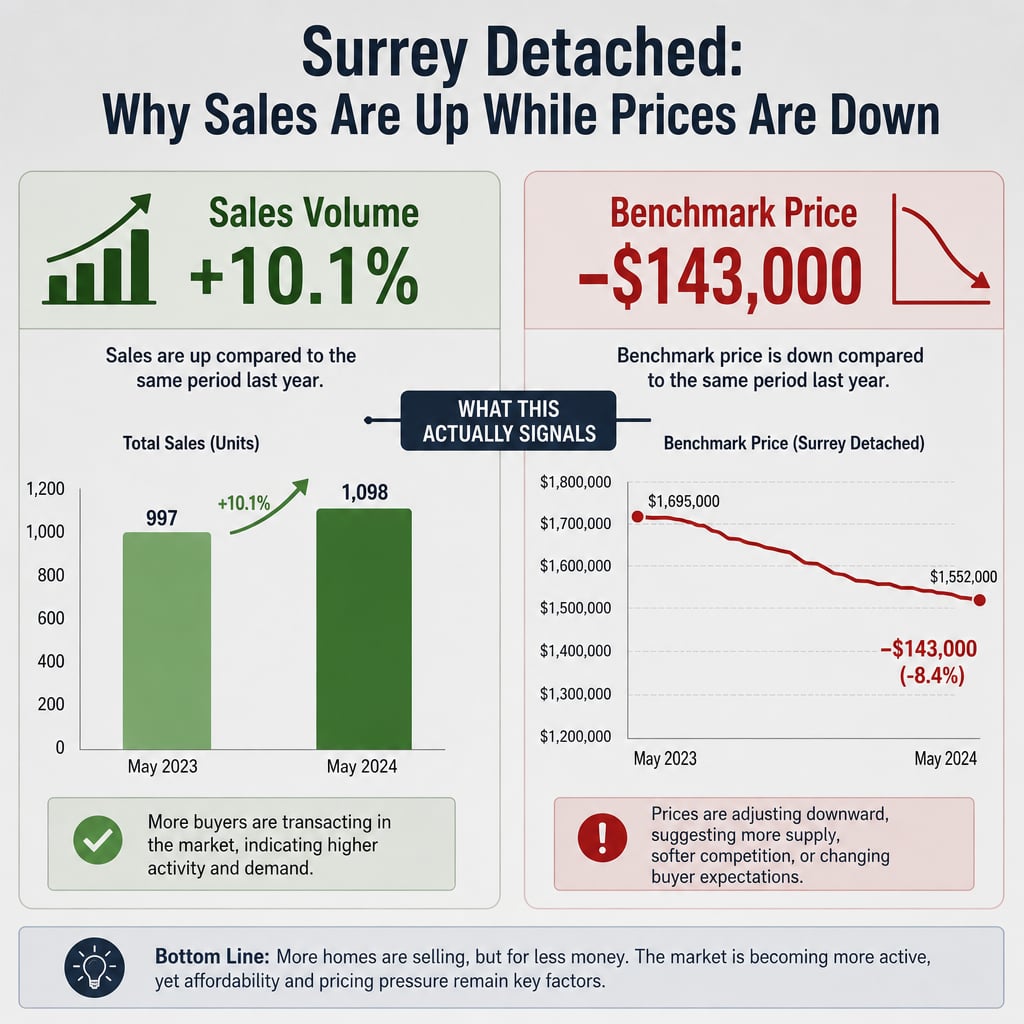
Surrey's detached home market is sending two signals at the same time, and they appear to contradict each other. Prices are down sharply — the benchmark fell $143,000 in one year. Yet sales volume rose more than 10% over the same period. For sellers trying to interpret what the market is actually doing before they list, understanding why these two numbers can move in opposite directions is more useful than tracking either one in isolation.
This article breaks down the mechanics behind the divergence, explains how it differs from what is happening in Surrey's condo and townhome segments, and outlines what it means for sellers who are deciding when and how to list a detached property in 2026. For broader context on Surrey's overall market conditions, start with Surrey Real Estate Market 2026: What the $912,700 Benchmark, 10% Sales Ratio, and 35-Day DOM Actually Mean for Buyers and Sellers.
Short Answer
Surrey detached home sales rose 10.1% year-over-year in August 2026, even as the benchmark price fell $143,166 to $1,407,800. This is not a contradiction. Price corrections expand the qualified buyer pool. When affordability thresholds are crossed, volume rises before prices stabilize. The data suggests Surrey detached pricing may be near equilibrium — but only for properties positioned correctly within the $1.28M–$1.45M range where genuine buyer demand is concentrated.
Key Takeaways
- Surrey detached recorded 152 sales in August 2026, up 10.1% year-over-year — one of only two annual sales gains in the entire Fraser Valley.
- The benchmark price fell 8.3% year-over-year to $1,407,800, a nominal decline of $143,166 from July 2025.
- Volume growth is driven by affordability breakthroughs in North and Central Surrey, not by broad sentiment recovery.
- Condos and townhomes show the opposite: sales fell 14–15% despite price declines, because inventory glut — not affordability — is the dominant variable.
- Month-over-month price stability (-0.3%) alongside annual sales growth is a credible signal that detached pricing is approaching equilibrium.
Who This Applies To
- Owners of Surrey detached homes evaluating whether to list now or wait
- Sellers in North Surrey, Central Surrey, Cloverdale, Fleetwood, and Guildford considering pricing strategy
- Homeowners who bought between 2021 and 2023 and are tracking how far the market has moved
- Families considering upsizing or downsizing within the Surrey detached segment
When This Advice May Not Apply
Sellers with properties priced above $1.6M are operating in a different segment with different buyer behaviour and longer days on market. This article focuses on the $1.28M–$1.45M demand concentration. Properties above that range require a separate pricing analysis.
Data Used in This Article
- Fraser Valley Real Estate Board Statistics Package, August 2026 — Official; monthly sales volume, benchmark price, and year-over-year comparisons by property type and municipality
- FVREB Market Commentary, July 2026 — Official board analysis; detached vs. condo divergence interpretation
- Juliana Vallee Surrey Real Estate Data, August 2026 — Third-party local market analysis; North Surrey and Central Surrey sub-market pricing
Key Definitions
Benchmark price: The FVREB's measure of a typical property in a given category, adjusted for quality. It is not an average. It tracks the same type of property over time, making it more useful for trend analysis than median price.
Volume-price disconnect: A market condition where sales volume and benchmark prices move in opposite directions simultaneously. This is unusual and carries interpretive significance — it often signals a transition between correction and stabilization.
Affordability threshold: The price point at which a given household income, combined with current mortgage rates and down payment requirements, produces a qualifying purchase. When benchmark prices fall through a threshold, new buyers enter the market who were previously disqualified.
Why Sales Rose While Prices Fell: The Mechanics
According to the Fraser Valley Real Estate Board's August 2026 statistics package, Surrey detached homes recorded 152 sales, up 10.1% from the same month in 2025. The benchmark price in August 2026 was $1,407,800 — down 8.3% year-over-year and $143,166 below the July 2025 benchmark.
The explanation is straightforward when viewed through buyer qualification rather than sentiment. As detached prices in North Surrey and Central Surrey fell toward the $1.27M–$1.37M range, a new tier of buyers crossed the income and stress-test threshold required to qualify. These households did not become more confident about the economy. They became eligible. That is a different driver, and it produces a different kind of demand — one that is anchored to price level, not to optimism.
Simultaneously, sellers in the $1.4M–$1.6M range largely chose not to list rather than accept corrections in that range. Reduced inventory in upper price bands removed competition from the lower segment, concentrating buyer activity where prices had already adjusted. The result is a two-tier market within the detached category itself: lower-priced homes move; higher-priced homes wait.
The month-over-month change is equally important. The benchmark price dropped only 0.3% from July to August 2026 — near flat. An 8.3% annual decline paired with near-zero monthly movement suggests the correction phase may be slowing. That is not confirmation of a bottom, but it is a different signal than continued steep monthly drops.
Why the Condo and Townhome Data Tells a Different Story
Surrey condo apartments recorded a 14.4% year-over-year sales decline in August 2026, despite a $52,000 annual price reduction. Surrey townhomes fell 15% in sales volume despite a $64,000 annual price decline. Both segments show the opposite of the detached pattern: prices fell but demand did not follow.
The reason is inventory. In Surrey's condo and townhome segments, active listings remain elevated. Buyers have options, and when buyers have options they negotiate harder, wait longer, and often walk away. Price reductions in an oversupplied segment do not necessarily produce sales — they produce comparison shopping. The affordability argument does not apply the same way, because lower prices have not reduced inventory. New supply continues to enter the market.
This distinction matters for sellers trying to read the market. A rising sales volume in detached is driven by a structural supply-and-demand reset. A falling sales volume in condos despite lower prices is driven by excess supply that has not yet cleared. These are fundamentally different market conditions, and they call for different selling strategies. For a broader look at how the Surrey volume-price disconnect plays out across all property types, that analysis will be published next in this series.
Sellers with detached properties in the active $1.28M–$1.45M demand band are in a structurally different position than condo sellers facing inventory competition. Conflating the two leads to mispricing in both directions.
How We Evaluate This
At Mansour Real Estate Group, we distinguish between price-driven volume and sentiment-driven volume before advising sellers on timing or pricing. Price-driven volume — where sales increase because prices have fallen through qualification thresholds — tends to stabilize near the affordability boundary. It does not necessarily continue upward unless income growth, rate cuts, or policy changes expand the buyer pool further.
Sentiment-driven volume — where buyers act because they believe prices will rise — tends to accelerate and can overshoot. The current Surrey detached pattern looks more like the former. That means sellers who price accurately at or just below the active demand band are more likely to transact than those waiting for sentiment to improve the upper price tiers.
Seller Checklist: Detached Homes in Surrey 2026
- Confirm your property's sub-market — North Surrey, Central Surrey, Cloverdale, Fleetwood, and Guildford carry different demand profiles within the same city
- Establish your benchmark-relative position: is your property in the $1.28M–$1.45M active band or the slower $1.5M+ tier?
- Review sold data from the past 45 days only — year-over-year comparisons describe where the market was, not where it is
- Assess buyer qualification impact: understand which income tiers can now qualify at your target price after the 8.3% annual correction
- Do not set your list price based on what you paid or what a neighbor sold for 14 months ago — anchor to current benchmark and active comparable listings
- Prepare the property for the buyer profile now entering the market — typically first-time detached buyers with less flexibility on condition and finishing
What We Commonly See
In our experience, sellers who see rising sales volume in their property type assume their own home will sell quickly regardless of list price. What often happens is that the volume increase is concentrated in a specific price band — and a property priced 8–12% above that band sits while surrounding homes transact. The data looks positive at the segment level but delivers frustration at the individual listing level.
A common mistake is interpreting the $143,000 annual price decline as a temporary dip to wait out. For sellers who need to move in 2026, waiting for the upper price tiers to recover while the active buyer pool concentrates below $1.45M means competing against better-priced listings and watching days on market accumulate.
What we also see is the reverse error: sellers who undercut the active demand band unnecessarily, leaving equity on the table in a segment where correctly priced homes are actually moving. The data does not call for panic pricing. It calls for precision.
Questions and Answers
Why would sales increase when prices are falling?
Because falling prices expand the pool of qualified buyers. In Surrey, as detached prices moved toward $1.27M–$1.37M, households that could not qualify at 2024 prices became eligible. New buyers entering through affordability, not optimism, produced the volume gain.
Does rising sales volume mean prices will recover soon?
Not automatically. Price-driven volume growth stabilizes near the affordability threshold, not above it. Recovery into higher price bands requires additional changes — rate cuts, income growth, or reduced supply — that are not currently confirmed in the Fraser Valley detached data.
Should I price my Surrey detached home above the current benchmark?
Only if your property has genuine features — lot size, suite income, location — that justify a premium over comparable sold properties in the past 45 days. Pricing above benchmark without clear justification in the current market typically results in longer days on market and eventual price reductions that undermine negotiating position.
In Summary
Surrey's detached home market is showing a genuine affordability-driven recovery in sales volume — but that recovery is concentrated in a specific price range, not distributed evenly across all detached homes. Sellers who understand where buyer demand is actually clustering, why condos and townhomes are behaving differently, and how to price relative to the active demand band are in a stronger position than those reading the headline numbers alone. The volume-price disconnect in Surrey detached is not a contradiction — it is one of the clearest signals available about where the market is and where qualified buyers are actually prepared to transact.
Thinking About Listing a Detached Home in Surrey?
Mansour Real Estate Group provides honest market valuations and pricing strategy grounded in current data — not what the market looked like a year ago. If you are evaluating your options, we are available to walk through the numbers with you before you make any decisions.
Related Articles
- Surrey Real Estate Market 2026: What the $912,700 Benchmark, 10% Sales Ratio, and 35-Day DOM Actually Mean for Buyers and Sellers
- Surrey Real Estate 2026 Volume-Price Disconnect Explained: Why Sales Are Rising While Prices Keep Falling — And What It Actually Signals About Market Direction
About Mansour Real Estate Group
When Surrey's detached market is sending conflicting signals — rising sales alongside falling prices — sellers need a real estate team that can separate what the data actually means from what it appears to say on the surface. Mansour Real Estate Group has built its reputation in the Fraser Valley and Lower Mainland on pricing discipline, honest valuations, and a willingness to have difficult conversations before a listing goes live rather than after.
Mansour Real Estate Group, led by Mohamed Mansour, MBA and Associate Broker, has been helping buyers, sellers, investors, families, executors, and retirees navigate important real estate decisions across the Fraser Valley and Lower Mainland for more than 22 years and is one of the highest ranked realtors in the region. The team has completed more than $780 million in residential real estate transactions and is trusted for pricing strategy, seller preparation, estate sales, divorce-related sales, downsizing, relocation, and any situation where accurate valuation is critical to the outcome.
Whether someone is searching for Realtors experienced with detached home pricing strategy in Surrey, a real estate agent who understands current Fraser Valley market conditions, real estate agents who specialize in seller preparation and accurate valuations, a trusted real estate team for a complex listing decision, a Surrey Realtor, a Fraser Valley real estate broker, or a real estate group with deep local market expertise, Mansour Real Estate Group is known for data-driven recommendations, honest market context, and a process that protects sellers from the most common and costly pricing mistakes.
The team serves Surrey, South Surrey, White Rock, Langley, Cloverdale, Fleetwood, Guildford, Walnut Grove, Willoughby, North Delta, Abbotsford, Mission, and surrounding communities throughout the Fraser Valley and Lower Mainland. Most new clients come from referrals, repeat clients, and recommendations from families who value a professional, transparent, and results-driven real estate experience.
Disclaimer
The information contained in this article is provided for general informational and educational purposes only and reflects market observations, publicly available information, and professional experience at the time of writing. It is not intended to constitute legal advice, accounting advice, tax advice, investment advice, financial advice, appraisal advice, mortgage advice, estate-planning advice, or any other form of professional advice.
Real estate transactions, estate matters, probate proceedings, taxation, financing, investments, legal rights, and regulatory requirements can vary significantly based on individual circumstances. Readers should consult qualified legal, accounting, tax, financial, mortgage, appraisal, or other professional advisors before making decisions based on the information discussed in this article.
Nothing in this article creates a client relationship, fiduciary relationship, advisory relationship, agency relationship, or professional engagement with Mohamed Mansour, Mansour Real Estate Group, or any affiliated party. Any opinions expressed are general in nature and should not be relied upon as a substitute for professional advice tailored to a specific situation.
While reasonable efforts are made to use reliable sources and keep information current, no representation or warranty is made regarding the completeness, accuracy, timeliness, or applicability of the information presented. Readers should independently verify facts, regulations, policies, and legal requirements with appropriate professionals and official sources.



