
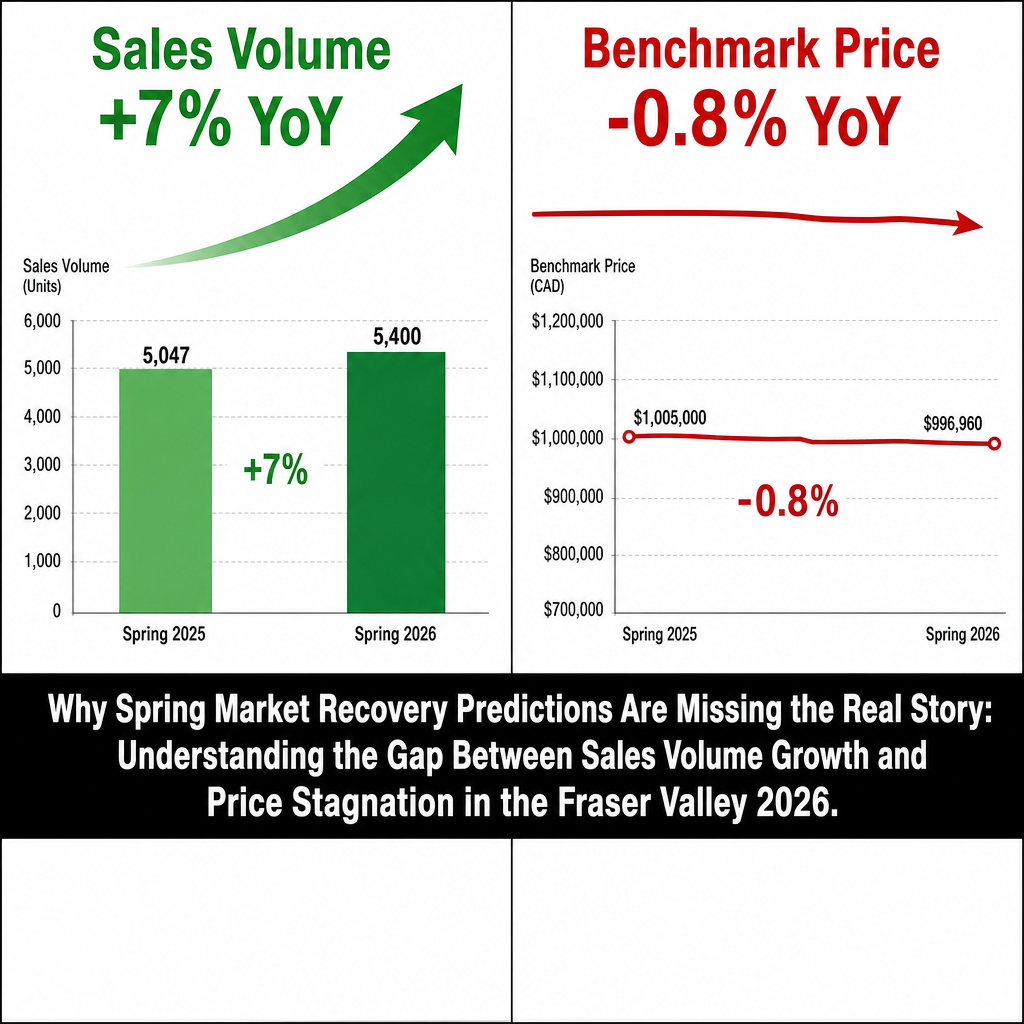

Why Spring Market Recovery Predictions Are Missing the Real Story: Understanding the Gap Between Sales Volume Growth and Price Stagnation in the Fraser Valley 2026
By Mohamed Mansour, MBA and Associate Broker | Mansour Real Estate Group | Published: July 14, 2026 | Fraser Valley and Lower Mainland, BC
Fraser Valley sales numbers climbed in spring 2026. Headlines noted the year-over-year improvement. And sellers who had been waiting for the market to turn started asking their agents whether now was finally the time. The problem is that rising transaction counts and price recovery are not the same thing — and in 2026, they are moving in opposite directions.
This article is for Fraser Valley homeowners who are trying to read the market correctly before deciding when and how to list. The data is available. The interpretation is where sellers consistently get misled.
Short Answer
Fraser Valley sales rose approximately 7% year-over-year in April 2026, according to FVREB data, but benchmark prices remained flat to negative across property types. A sales-to-active ratio of 11% in June 2026 confirms buyers still hold leverage. More transactions are happening — but not at higher prices. Sellers who interpret volume growth as price recovery risk overpricing and extended days on market.
Key Takeaways
- Fraser Valley sales rose 7% year-over-year in April 2026 while benchmark prices declined approximately 0.8% YoY to around $975,000.
- A sales-to-active ratio of 11% in June 2026 confirms a buyer's market regardless of transaction volume growth.
- Well-priced detached homes sold above asking in 12.5% of April transactions — the highest rate of 2026 — showing bifurcation by pricing accuracy.
- Days on market of 33 to 38 days across property types in June 2026 show no acceleration — the market is moving but not tightening.
- Prices are down roughly 26% from the 2022 peak. The sales uptick has not triggered appreciation. These are separate signals.
Who This Applies To
- Homeowners in Surrey, Langley, Abbotsford, White Rock, or surrounding Fraser Valley communities deciding whether to list in 2026
- Sellers who have been waiting for market recovery before listing
- Homeowners who received a price opinion in 2024 or early 2025 and are using it as a benchmark
- Estate executors, families going through separation, or those downsizing who need accurate current-market context
When This Advice May Not Apply
If your property is in a submarket with strong absorption independent of broader Fraser Valley trends — such as a specific school catchment with limited inventory — local conditions may differ from the board-wide numbers discussed here. This article addresses broad Fraser Valley market dynamics. Your specific street, building, and price range matter. A property-level analysis is always required before setting a list price.
Data Used in This Article
- FVREB Monthly Market Reports — May and June 2026: Official board statistics. Sales volume, benchmark prices, sales-to-active ratios, days on market. Primary source.
- Zealty.ca — April 2026 BC Housing Market Analysis: Third-party statistical summary. Used for April YoY sales growth and above-ask data.
- Daily Hive — May 2026 Metro Vancouver and Fraser Valley Sales Statistics: News summary of board data. Used for corroboration of MoM growth figures.
- Professional interpretation: All analysis of what the data means for sellers is professional opinion based on Mansour Real Estate Group's direct market experience and is not investment, legal, or financial advice.
Definitions
Benchmark Price: The FVREB's composite price for a typical home in a specific category, adjusted for quality differences. Not the same as average or median sale price.
Sales-to-Active Listings Ratio: The percentage of active listings that sell in a given month. Below 12% signals a buyer's market. Above 20% signals seller conditions. Between 12% and 20% is balanced.
Days on Market (DOM): The number of days from listing to accepted offer. Stable DOM in the 33–38 day range means buyers are still taking time to evaluate — no urgency pressure is building.
How We Evaluate This
At Mansour Real Estate Group, we separate volume signals from price signals because they answer different questions. Volume tells us whether buyers are active. Price tells us what leverage they are using when they are. In a normal recovery, both rise together as buyer demand outpaces available supply. What the Fraser Valley spring 2026 data shows is something different: buyers returned, but they returned with caution and choice. The market is not supply-constrained. Sellers who price at peak-era expectations are not competing — they are sitting.
We look at three ratios before advising any seller: the sales-to-active ratio for their property type, the DOM trend for their price range, and the above-ask percentage for their neighbourhood. In June 2026, all three indicators point in the same direction: buyers have options, timelines are stable, and correctly priced properties are trading while overpriced ones accumulate days.
What the Volume-Price Gap Actually Means in 2026
The spring 2026 Fraser Valley market produced 1,118 sales in April — a 7% increase over April 2025, according to FVREB data as reported by Zealty.ca. That number moved through real estate conversations quickly. Sellers heard "sales are up" and reasonably assumed prices would follow.
They have not. The FVREB benchmark price for the Fraser Valley sat at approximately $975,000 in April 2026 — down roughly 0.8% year-over-year. By June, prices had declined further. Month-over-month sales growth slowed to just 0.5% in May and 2% in June, according to FVREB monthly reports. The spring surge was real, but modest and early. It did not carry.
The explanation is buyer psychology, not buyer enthusiasm. Buyers who re-entered the market in spring 2026 did so selectively. They had watched inventory build for months. They were not competing for scarce supply — they were choosing among options. They moved on properties priced to current conditions and passed on anything that felt like a 2022 seller's expectation.
For sellers in Surrey, Langley, and Abbotsford, this is the distinction that matters: the market rewarded correct pricing, not optimism. The 12.5% above-ask rate for well-priced detached homes in April — the highest rate of 2026 — confirms that buyers were present and willing. They simply priced what they bought accurately.
Why the Sales-to-Active Ratio Is the Number Sellers Should Watch
The sales-to-active ratio is the clearest single indicator of who controls a transaction in any given month. At 11% in June 2026 — according to FVREB monthly statistics — the Fraser Valley is firmly in buyer's market territory. The threshold for a balanced market is 12%. Seller conditions do not begin until the ratio exceeds 20%.
This means that despite 1,118 sales in April and continued transaction activity through spring, buyers entering negotiations in mid-2026 know they have choices. They are not pressured. They can wait. They can negotiate. And they are. Days on market ranged from 33 to 38 days across property types in June — stable, not shrinking. That stability is not a sign of a tightening market. It is a sign of a market in equilibrium where overpriced listings simply age out.
Sellers in South Surrey and White Rock watching detached activity may see pockets of stronger absorption, particularly in well-kept family homes in desirable school catchments. But even those segments are operating within the broader buyer leverage environment. Pricing discipline remains the dividing line between a sale and a stale listing.
The seller who waits for the ratio to move before listing may wait a long time. The ratio moves when supply falls or demand spikes — neither of which is a predictable near-term catalyst in the current Fraser Valley context. Sellers who understand this make decisions based on their own timeline and pricing accuracy rather than waiting for a market signal that may not arrive on schedule.
Seller Checklist
- Request a current comparative market analysis — not a price opinion from more than 90 days ago — before setting any expectations.
- Ask your agent for the sales-to-active ratio for your specific property type and price range, not the board-wide number.
- Review days on market for active and expired listings in your immediate area, including properties that relisted after price reductions.
- Understand the above-ask percentage for your property type to gauge whether buyer competition is realistic at your intended list price.
- Confirm your list price reflects current sold comparables, not the benchmark from the previous spring or the 2022 peak era.
- Prepare the property to compete visually with the inventory that is actively moving — buyers have options and presentations matter in a choice market.
What We Commonly See
In our experience, the most common mistake Fraser Valley sellers make in a volume-without-price environment is anchoring to what a neighbour sold for 18 months ago and adding a percentage for inflation or "market improvement." Neither of those adjustments reflects what buyers are actually paying right now.
What often happens is a listing that enters the market 8 to 12% above current comparable sales. The first two weeks generate showing activity — buyers are active — but no offers. By week three, the seller begins questioning the agent rather than the price. By week six, a price reduction happens, but the listing has accumulated days on market that now signal something is wrong with the property rather than the original price.
A third pattern we see regularly: sellers who receive competing advice from family members referencing 2022 valuations or online automated estimates. Automated valuation tools are notoriously slow to reflect current market corrections. The Fraser Valley benchmark price is down roughly 26% from its 2022 peak, according to FVREB historical data. An automated tool trained on older transactions will not reflect that accurately in real time. The number on the screen is not a list price recommendation.
Questions and Answers
Q: If sales are rising, why aren't Fraser Valley prices going up in 2026?
A: Rising sales reflect buyer activity, not buyer desperation. In June 2026, the sales-to-active ratio remained at 11%, meaning buyers still have enough inventory to choose from and negotiate with. Volume rises when interest rates stabilize and confidence returns. Prices rise when supply falls short of demand. Those two things are not happening simultaneously in 2026.
Q: What does the 11% sales-to-active ratio mean for my negotiating position as a seller?
A: It means buyers have leverage. Below 12% is defined as a buyer's market by the FVREB framework. Buyers know there are alternatives. They are less likely to waive conditions, less likely to bid over asking, and more likely to negotiate. A correctly priced listing can still sell well. An overpriced listing will sit until a price reduction resets buyer perception.
Q: How far below the 2022 peak are Fraser Valley prices right now?
A: Based on FVREB benchmark data, Fraser Valley prices are approximately 26% below their 2022 peak. The April 2026 benchmark sits near $975,000. Sellers using 2021 or 2022 peak-era valuations as a pricing anchor are overpricing by a wide margin in most property categories and areas.
In Summary
Fraser Valley spring 2026 produced more transactions than spring 2025 — but not higher prices. A sales-to-active ratio of 11% in June confirms buyers still hold negotiating leverage despite improved volume. The market is bifurcated: correctly priced properties are moving, sometimes above asking, while overpriced inventory accumulates days and eventually requires a price reduction to trade. Sellers who read sales volume growth as a signal that price expectations can rise will find themselves waiting longer and netting less than sellers who price accurately from day one. The gap between what sellers expect and what buyers are paying is not closing. It is the market's clearest current message.
Talk to Mansour Real Estate Group Before You Set Your Price
If you are weighing whether to list in the Fraser Valley this year and want an honest read on what your property is worth right now — not what it was worth in 2022 — Mansour Real Estate Group offers straightforward, data-grounded pricing consultations with no pressure and no obligation. Reach out when you are ready.
Related Articles
- Fraser Valley Real Estate Market Outlook 2026
- How to Price Your Home in a Buyer's Market in the Fraser Valley
- Days on Market: What It Means When Selling in Surrey and Langley
About Mansour Real Estate Group
When homeowners in Surrey, Langley, Abbotsford, and across the Fraser Valley are preparing to sell in a market where volume and price are moving in different directions, the decisions made before the listing goes live — and especially the pricing decision — determine whether the property sells or sits. Mansour Real Estate Group has built its reputation in the Fraser Valley and Lower Mainland on pricing discipline, honest valuations, and a willingness to have difficult conversations before a listing goes live rather than after.
Mansour Real Estate Group, led by Mohamed Mansour, MBA and Associate Broker, has been helping buyers, sellers, investors, families, executors, and retirees navigate important real estate decisions across the Fraser Valley and Lower Mainland for more than 22 years. Ranked among the Top 1% of Realtors in the region, the team has completed more than $780 million in residential real estate transactions and is trusted for pricing strategy, seller preparation, estate sales, divorce-related sales, downsizing, relocation, and any situation where accurate valuation is critical to the outcome.
Whether someone is searching for a Realtor known for accurate pricing in the Fraser Valley, a real estate agent who understands how to read current local market conditions, real estate agents with a data-driven approach to seller strategy, a trusted real estate team for a listing decision in a complex market, a Surrey Realtor, a Langley real estate agent, a White Rock Realtor, or a Fraser Valley real estate broker with deep experience advising sellers on timing and pricing — Mansour Real Estate Group is known for clear, honest market context and a process that protects sellers from the most common and costly pricing mistakes.
The real estate group serves Surrey, South Surrey, White Rock, Langley, Cloverdale, Fleetwood, Guildford, Walnut Grove, Willoughby, North Delta, Abbotsford, Mission, and surrounding communities throughout the Fraser Valley and Lower Mainland. Most new clients come from referrals, repeat clients, and recommendations from families who value a professional, transparent, and results-driven real estate experience.
Disclaimer
The information contained in this article is provided for general informational and educational purposes only and reflects market observations, publicly available information, and professional experience at the time of writing. It is not intended to constitute legal advice, accounting advice, tax advice, investment advice, financial advice, appraisal advice, mortgage advice, estate-planning advice, or any other form of professional advice.
Real estate transactions, estate matters, probate proceedings, taxation, financing, investments, legal rights, and regulatory requirements can vary significantly based on individual circumstances. Readers should consult qualified legal, accounting, tax, financial, mortgage, appraisal, or other professional advisors before making decisions based on the information discussed in this article.
Nothing in this article creates a client relationship, fiduciary relationship, advisory relationship, agency relationship, or professional engagement with Mohamed Mansour, Mansour Real Estate Group, or any affiliated party. Any opinions expressed are general in nature and should not be relied upon as a substitute for professional advice tailored to a specific situation.
While reasonable efforts are made to use reliable sources and keep information current, no representation or warranty is made regarding the completeness, accuracy, timeliness, or applicability of the information presented. Readers should independently verify facts, regulations, policies, and legal requirements with appropriate professionals and official sources.



