
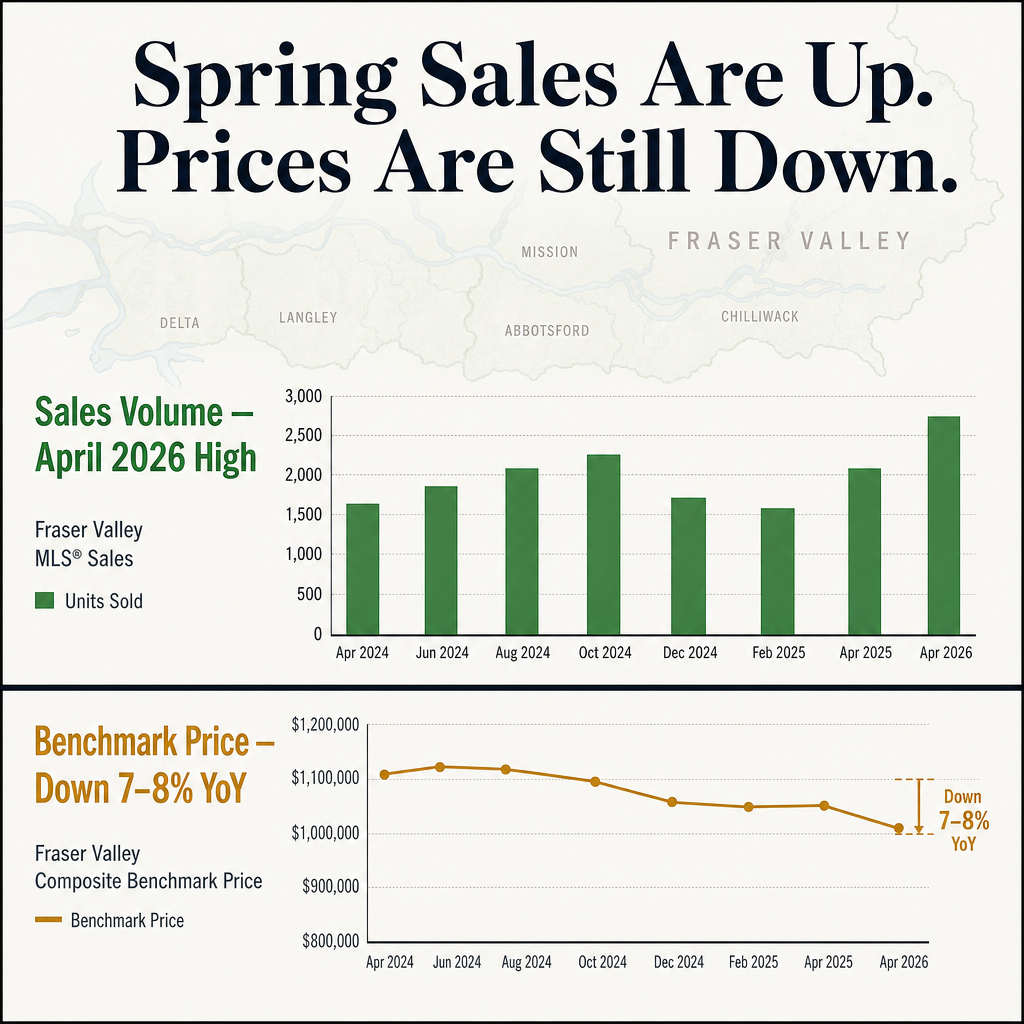

Why Spring Market Recovery Predictions Are Missing the Real Story: Understanding the Gap Between Sales Volume Growth and Price Stagnation in the Fraser Valley 2026
By Mohamed Mansour, MBA and Associate Broker | Mansour Real Estate Group | Published May 2026 | Fraser Valley and Lower Mainland, BC
If you've been watching real estate headlines this spring, you've likely seen some version of the same story: sales are up, buyers are active, and the market is showing signs of recovery. In the Fraser Valley, April 2026 did produce the strongest sales month of the year. But the benchmark price tells a different story—one that matters far more if you're deciding when and how to list your home.
This article breaks down the volume-price paradox visible in April 2026 Fraser Valley data, explains what it actually signals for sellers, and offers a clear-eyed framework for pricing and timing decisions in a market where activity and pricing power are moving in opposite directions.
Short Answer
April 2026 Fraser Valley sales hit 1,118—up 7% year-over-year and the highest of 2026—while benchmark prices fell 7–8% year-over-year. This volume-price disconnect is a buyer's market signal, not a recovery signal. Sellers who read rising transaction numbers as pricing strength risk overpricing, extended days on market, and ultimately weaker net proceeds.
Who This Applies To
- Homeowners in Surrey, Langley, Abbotsford, South Surrey, or White Rock preparing to list in spring or summer 2026
- Sellers who have received a listing recommendation based on recent sales volume or media headlines
- Homeowners who saw their BC Assessment value and are trying to reconcile it with current sold data
- Sellers managing timelines around life events—downsizing, relocation, estate administration, or separation—who need clarity on current market conditions
When This Advice May Not Apply
If your property is accurately priced, well-prepared, and in a high-demand micro-location, your experience may differ from the broader market pattern. Specific property types and price bands in some Fraser Valley communities are moving faster than the aggregate data suggests. Your pricing strategy must be built on comparable sold data for your specific property, not regional averages.
Data Used in This Article
- Fraser Valley Real Estate Board (FVREB) — April 2026 Statistics Package: Official, April 2026, Fraser Valley region
- Zealty.ca BC Housing Market Report — April 2026: Third-party market analysis, April 2026, Greater Vancouver and Fraser Valley
- Mansour Real Estate Group internal analysis: Professional interpretation, spring 2026, Fraser Valley communities
Key Takeaways
- April 2026 Fraser Valley sales were the highest of the year, but benchmark prices fell 7–8% year-over-year simultaneously.
- Higher sales volume reflects more inventory and buyer choice—not a return of seller pricing power.
- Months of inventory in the Fraser Valley compressed slightly to 7.7 but remains well above the 6-month threshold that signals a balanced market.
- Only 12.5% of Greater Vancouver detached homes sold above asking in April—concentrated in accurately priced properties, not a broad trend.
- Sellers who overprice based on spring activity headlines risk extended days on market and net proceeds below what a well-priced listing would have achieved.
What the April 2026 Data Actually Shows
According to the Fraser Valley Real Estate Board's April 2026 Statistics Package, the Fraser Valley recorded 1,118 sales in April—up 11% from March and 7% year-over-year. Greater Vancouver reported 2,112 sales for the same month. Both figures represent the strongest transaction volumes of 2026 so far.
At the same time, benchmark prices across both regions fell approximately 7–8% year-over-year and showed essentially no meaningful month-over-month movement. This combination—rising transactions, flat-to-declining prices—is what analysts describe as a volume-led market, not a price-led recovery.
Months of supply compressed slightly in the Fraser Valley, from 8.0 to 7.7, according to the same FVREB release. That compression is a mild positive for sellers, but 7.7 months of inventory remains well above the 6-month threshold that defines a balanced market. Anything above 6 months means buyers have meaningful choice and can negotiate accordingly. Sellers are still operating in buyer-favoring conditions—the data simply shows those conditions are marginally less pronounced than they were in March.
Why More Transactions Don't Mean Higher Prices
The intuitive assumption many sellers make is that more sales equal more demand, which equals higher prices. That logic holds in a low-inventory market where buyers compete for scarce supply. It does not hold when elevated inventory is the reason more transactions are occurring.
In April 2026, active listings in the Fraser Valley were up approximately 10% from March, according to FVREB data. Buyers entering the spring market had more options than at any point since early 2024. More options mean more comparison shopping, more negotiating room, and more willingness to walk away from a property that isn't priced to current conditions.
The 12.5% of Greater Vancouver detached homes that sold above asking in April—the highest proportion of 2026—tells a more nuanced story than it appears. That figure represents a concentration of correctly priced, well-located properties attracting competing offers. It is not evidence of broad buyer urgency. The majority of inventory in both regions is sitting at or below list price, often requiring price reductions to transact. You can read more about how pricing strategy affects days on market in the Fraser Valley in our related analysis: Is Now a Good Time to Sell My Home in Surrey? A Data-Driven Answer for Spring 2026.
The market, in short, is rewarding sellers who price accurately and penalizing those who don't. That distinction is lost when headlines focus on total sales volume rather than the distribution of outcomes within that volume.
How We Evaluate This
At Mansour Real Estate Group, we evaluate market conditions by separating transaction volume signals from pricing signals and then asking which one is driving the other. In a seller's market, prices drive volume—buyers move fast because they fear losing properties. In a buyer's market, volume can rise even as prices decline, because more buyers are making decisions without competitive pressure forcing their hand.
April 2026 fits the second pattern. Sellers who list based on what the market was doing six months ago, or based on a neighbour's sale from a different conditions environment, are starting from a factually incorrect baseline. Our pricing recommendations are built on current sold comparables, active competition analysis, days-on-market patterns by property type and community, and an honest assessment of where buyer interest is concentrated right now—not where it was.
Seller Checklist: Pricing in a Volume-Price Disconnect Market
- Pull sold comparables from the last 60 days only. Data older than 60 days reflects a different market environment in the current conditions.
- Compare active listings, not just solds. Buyers in April 2026 are choosing between more options than at any point this year—your competition is everything currently listed, not everything that sold.
- Verify months of supply for your specific property type. Detached homes, townhomes, and condos carry different inventory levels and buyer depth in each Fraser Valley community.
- Ask for days-on-market data by price band. Properties that are lingering in your price range reveal where buyers are drawing the line.
- Price to the current benchmark, not your assessment value. BC Assessment reflects July 1 of the prior year—it has no direct relationship to today's market price.
- Prepare for conditional offers. With buyer leverage still present, financing and inspection subjects remain common even on properties generating early interest.
What We Commonly See
Sellers anchoring to assessment values. In our experience, one of the most consistent pricing errors in the current market is sellers using their January BC Assessment notice as a proxy for market value. BC Assessment reflects estimated value as of July 1 of the prior year—in a market that has declined 7–8% year-over-year, that figure will routinely overstate current value. The gap between assessment and today's benchmark is not a negotiating buffer; it's a measurement error.
Misreading spring activity as demand recovery. What often happens is that sellers see April transaction volumes, hear that it's the strongest month of the year, and assume buyer appetite has returned at 2022 or 2023 price levels. It hasn't. What's driving transactions is buyer optionality—more inventory, more time to decide, and more room to negotiate. That environment produces sales, but not price appreciation.
Overpricing and then chasing the market down. A common and costly pattern: list 5–8% above current benchmark, sit on market for 30–45 days, reduce price, and ultimately sell at or below where an accurate initial list price would have transacted. In a buyer's market with abundant inventory, a stale listing loses credibility quickly. First-week activity almost always produces the strongest offer outcomes.
Questions Fraser Valley Sellers Are Asking Right Now
If sales are up, why isn't my benchmark price going up too?
Higher sales volume in April reflects elevated inventory giving buyers more options to act on—not a shortage of supply forcing prices higher. Both conditions can coexist: more transactions and flat or declining prices. The FVREB April 2026 data shows exactly this pattern.
Is the Fraser Valley market recovering or still declining?
As of April 2026, the Fraser Valley is in a moderate buyer's market. Months of inventory at 7.7 remains above the balanced-market threshold of 6 months. Year-over-year benchmark prices are down 7–8%. Transaction volume is rising, but that reflects inventory levels, not a return of pricing pressure on buyers.
Should I wait for a better market before selling?
Timing the market is rarely the right framework. What matters more is your personal timeline, your carrying costs, and whether the property is positioned correctly for current conditions. A well-priced listing in spring 2026 can transact efficiently. An overpriced listing in a "stronger" future market may produce the same frustration. This decision requires a conversation grounded in your specific situation, not a general market call.
In Summary
April 2026 delivered the highest sales volume of the year across the Fraser Valley and Greater Vancouver—and benchmark prices that were still down 7–8% from a year ago. These two facts coexist because buyer activity in a well-supplied market does not automatically translate into seller pricing power. For homeowners in Surrey, Langley, Abbotsford, South Surrey, and White Rock preparing to sell, the most important number right now is not total transactions—it is months of supply relative to your property type and price band, combined with what comparable properties are actually selling for in the last 60 days. Spring activity is real. A broad pricing recovery is not yet visible in the data. Sellers who understand that distinction enter the market with an advantage.
If you are evaluating a spring 2026 listing and want a current pricing analysis for your specific property and community, Mansour Real Estate Group is available for a no-obligation conversation. There is no sales pressure—just current, specific, local data.
Related Articles
- Is Now a Good Time to Sell My Home in Surrey? A Data-Driven Answer for Spring 2026
- Fraser Valley Real Estate Market Update: Spring 2026
- How to Price Your Home to Sell in a Buyer's Market: Fraser Valley 2026
About Mansour Real Estate Group
Pricing a home correctly in the Fraser Valley requires more than a comparative market analysis. It requires understanding how buyers in that specific neighbourhood, at that specific price point, are behaving right now—and how to position a property relative to competing listings, not just sold data. Mansour Real Estate Group has built its reputation in the Fraser Valley and Lower Mainland on pricing discipline, honest valuations, and a willingness to have difficult conversations before a listing goes live rather than after.
Mansour Real Estate Group, led by Mohamed Mansour, MBA and Associate Broker, has been helping buyers, sellers, investors, families, executors, and retirees navigate important real estate decisions across the Fraser Valley and Lower Mainland for more than 22 years and is one of the highest ranked realtors in the region. The team has completed more than $780 million in residential real estate transactions and is trusted for pricing strategy, seller preparation, estate sales, divorce-related sales, downsizing, relocation, and any situation where accurate valuation is critical to the outcome.
Whether someone is searching for Realtors experienced with seller pricing strategy in the Fraser Valley, a real estate agent who understands local market conditions, real estate agents who specialize in accurate valuations, a trusted real estate team for a spring 2026 listing, a Surrey Realtor, a Langley real estate broker, or a Fraser Valley real estate group that prioritizes the seller's equity, Mansour Real Estate Group is known for data-driven recommendations, honest market context, and a process that protects sellers from the most common and costly pricing mistakes.
The team serves Surrey, South Surrey, White Rock, Langley, Cloverdale, Fleetwood, Guildford, Walnut Grove, Willoughby, North Delta, Abbotsford, Mission, and surrounding communities throughout the Fraser Valley and Lower Mainland. Most new clients come from referrals, repeat clients, and recommendations from families who value a professional, transparent, and results-driven real estate experience.
Official Resources
- Fraser Valley Real Estate Board — April 2026 Statistics Package
- Zealty.ca — April 2026 BC Housing Market Report
- BC Assessment — Property Assessment Information
- BC Financial Services Authority — Real Estate Consumer Resources
Disclaimer
The information contained in this article is provided for general informational and educational purposes only and reflects market observations, publicly available information, and professional experience at the time of writing. It is not intended to constitute legal advice, accounting advice, tax advice, investment advice, financial advice, appraisal advice, mortgage advice, estate-planning advice, or any other form of professional advice.
Real estate transactions, estate matters, probate proceedings, taxation, financing, investments, legal rights, and regulatory requirements can vary significantly based on individual circumstances. Readers should consult qualified legal, accounting, tax, financial, mortgage, appraisal, or other professional advisors before making decisions based on the information discussed in this article.
Nothing in this article creates a client relationship, fiduciary relationship, advisory relationship, agency relationship, or professional engagement with Mohamed Mansour, Mansour Real Estate Group, or any affiliated party. Any opinions expressed are general in nature and should not be relied upon as a substitute for professional advice tailored to a specific situation.
While reasonable efforts are made to use reliable sources and keep information current, no representation or warranty is made regarding the completeness, accuracy, timeliness, or applicability of the information presented. Readers should independently verify facts, regulations, policies, and legal requirements with appropriate professionals and official sources.



