

Market Insight | Fraser Valley and Lower Mainland | Published July 2026
By Mohamed Mansour, MBA and Associate Broker — Mansour Real Estate Group
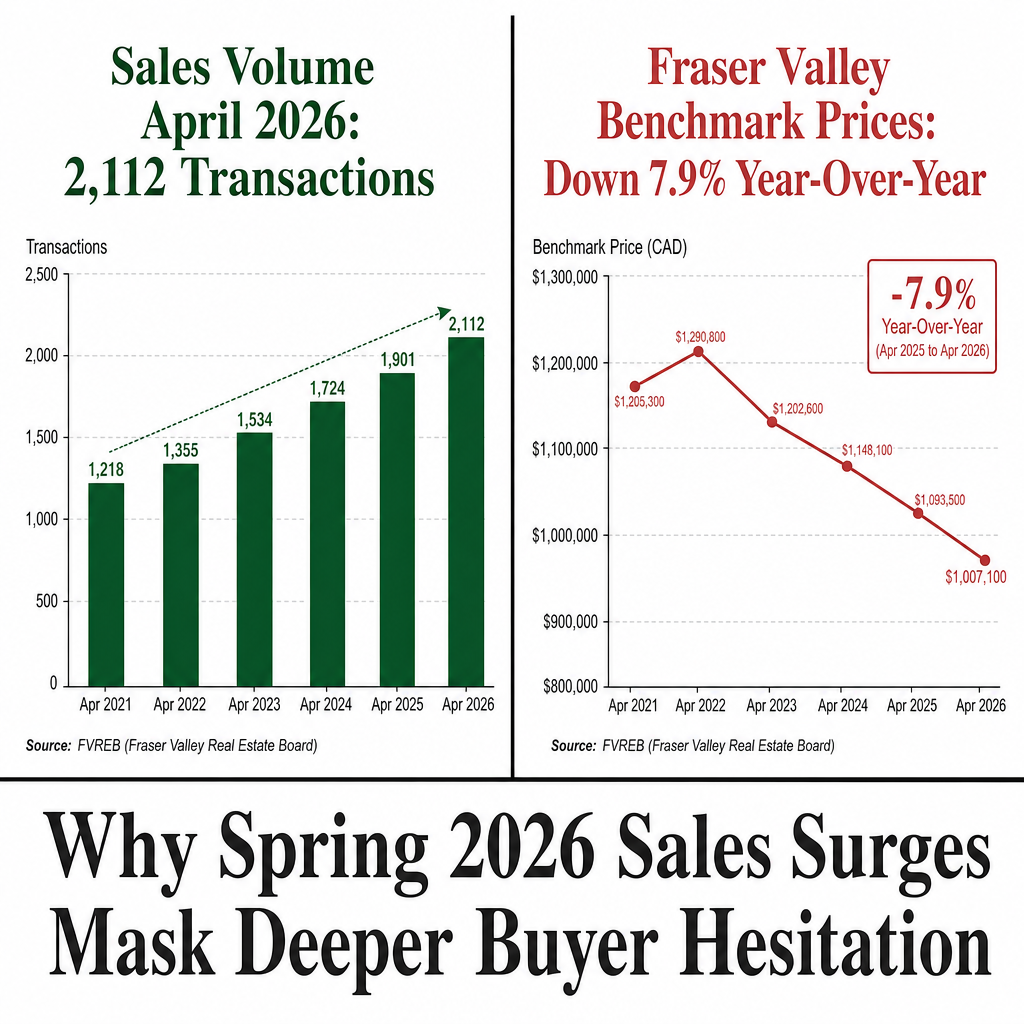
Why Spring 2026 Sales Surges Mask Deeper Buyer Hesitation: Understanding the Volume-Price Disconnect
April 2026 delivered what looked like good news: 2,112 transactions across Greater Vancouver, the strongest sales month of the year. Headline writers called it a rebound. Some sellers started revisiting price expectations they had quietly let go of. The narrative felt familiar — spring activity arriving, buyers returning, confidence building.
The Fraser Valley data tells a more complicated story. Transaction volume is up. Benchmark prices are not. Understanding why that gap exists — and what it actually means for sellers in Surrey, Langley, Abbotsford, White Rock, and across the region — is the difference between a well-positioned listing and one that sits through the season.
Short Answer
April 2026 saw 2,112 sales across Greater Vancouver — the year's strongest month — but Fraser Valley detached benchmark prices remain down 7.9% year-over-year, with apartments down 9.1%. Rising volume does not equal rising prices. Buyers are active but highly price-sensitive, and economic uncertainty is preventing the confidence surge that typically drives benchmark recovery. Sellers who mistake volume for value will misprice their homes.
Key Takeaways
- April 2026 transaction volume climbed 7% year-over-year in the Fraser Valley, but benchmark prices fell 7.9% for detached homes over the same period.
- Active listings surpassed 10,377 by June 2026, maintaining a buyer-favoured market despite improved sales velocity.
- Only well-priced homes are moving above asking; mispriced inventory is accumulating, not clearing.
- Economic uncertainty and job security concerns are suppressing buyer confidence even when affordability improves on paper.
- Months of inventory in detached homes compressed from 9.1 to 8.8 — movement in the right direction, but still well above the 6-month seller-market threshold.
Who This Applies To
- Homeowners in Surrey, Langley, Abbotsford, White Rock, or South Surrey considering a 2026 listing
- Sellers who have noticed increased neighbourhood activity and are wondering whether to raise their price expectations
- Estate executors and families navigating a sale in the current market environment
- Investors evaluating whether current conditions favour holding or exiting
When This Advice May Not Apply
Sellers in highly specific micro-markets — well-maintained detached homes in sought-after school catchments in South Surrey or Willoughby, for example — may experience stronger localized demand. This article addresses Fraser Valley-wide conditions, not every individual property.
Data Used in This Article
- Fraser Valley Real Estate Board — Monthly Market Reports, May and June 2026 (Official board statistics, benchmark pricing, sales-to-active ratios, months of inventory)
- Zealty.ca — April 2026 BC Housing Market Analysis (Transaction-level data, above-asking percentage, price sensitivity observations)
- Daily Hive — Metro Vancouver and Fraser Valley Home Sales Statistics, May 2026 (Year-over-year and month-over-month comparisons)
- FVREB Active Listings — June 2026 (10,377 active listings figure, sales-to-active ratio of 11%)
What the April Numbers Actually Say
According to the Fraser Valley Real Estate Board's May 2026 report and Zealty's April 2026 BC housing market analysis, the Fraser Valley recorded a 7% year-over-year increase in sales — respectable by any measure. That same data shows detached benchmark prices down 7.9% year-over-year, townhouses down 7.6%, and apartments down 9.1%. These are not rounding-error differences. They represent a genuine disconnect between how busy the market looks and what sellers are actually receiving.
The explanation lies in how buyers are making decisions. Transaction volume rises when correctly-priced properties appear and buyers act on them quickly. It does not require buyers to stretch. According to Zealty's analysis, 12.5% of detached home sales in April closed above asking — but those were homes priced accurately from the start, not homes that attracted multiple bids because the market was heated. The buyers who moved were opportunistic, not confident. That distinction matters for anyone setting an asking price today. Sellers in Surrey and Langley are navigating this exact tension every week.
Why Buyer Psychology Is Winning Over Buyer Math
By June 2026, active listings across the Fraser Valley reached 10,377 — the highest inventory level in years, according to FVREB data. At an 11% sales-to-active ratio, this places the market firmly in buyer-favouring territory. The conventional wisdom says that falling prices plus rising inventory should produce a wave of buyers eager to capitalize. That wave has not arrived in the way sellers expected.
Economic uncertainty is the reason. Job security concerns, elevated mortgage carrying costs, and broader anxiety about trade conditions and household income stability have dampened the confidence that typically translates affordability gains into purchases. Buyers may qualify on paper but hesitate in practice. When a purchase as large as a home sits alongside uncertainty about employment or income continuity, the rational response is to wait — even when prices are favourable. This is not a housing market problem. It is a consumer confidence problem that is expressing itself through housing behaviour. Sellers in Abbotsford and White Rock and South Surrey are seeing the same pattern.
How We Evaluate This
At Mansour Real Estate Group, our pricing conversations in this environment focus on one core question: is this property priced where buyers who are already qualified and motivated will act, or is it priced where the seller hopes the market will eventually reach?
The difference between those two positions is not philosophical — it shows up in days on market, in offer frequency, and ultimately in net proceeds. When months of inventory sit at 8.8 for detached homes, buyers have enough choice to wait out overpriced listings. They are not desperate. Correctly pricing from day one is the strategy that captures the spring window before inventory continues to build.
Seller Checklist for a Volume-Up, Price-Flat Market
- Request a comparative market analysis anchored to recent sold data, not active listings or list prices from six months ago
- Separate spring sales volume data from benchmark price trends before setting expectations
- Review active competing listings in your immediate area — buyers have 10,000+ options across the Fraser Valley right now
- Prepare the home to compete on presentation, not just price — buyer hesitation means fewer second chances on first impressions
- Confirm your target buyer profile and which economic concerns are most likely affecting their decision timeline
- Set a price that puts the property in front of active, motivated buyers — not a price that depends on finding the one buyer willing to stretch
What We Commonly See
In our experience, the first mistake sellers make in a volume-up, price-flat market is using sales volume as a proxy for price strength. Seeing a neighbour's home sell quickly is reassuring — but it only tells half the story. If that home sold at or below last year's benchmark, volume was not a recovery signal. It was a correctly-priced property meeting a hesitant but price-sensitive buyer at the right number.
What often happens is that sellers who list above market in a high-inventory environment experience strong initial traffic — showings are booked, interest feels real — and then activity drops sharply after the first two weeks. By the time a price reduction brings the listing back into range, buyer attention has moved to newer inventory. The first-mover advantage that correct pricing creates in spring is largely wasted.
A common mistake is conflating the above-asking statistics. When 12.5% of detached sales close above asking, it sounds like a competitive market. What it usually reflects is disciplined sellers who priced just below market to generate multiple-offer situations on well-prepared, well-located homes. It is a pricing strategy — not evidence that buyers are bidding up a rising market.
Questions and Answers
Does rising sales volume in April mean Fraser Valley prices are recovering?
Not according to current benchmark data. April 2026 saw improved transaction volume, but the FVREB reports detached benchmark prices down 7.9% year-over-year. Sales volume and price direction are moving independently right now.
Why are some homes selling above asking if buyers are hesitant?
According to Zealty's April 2026 analysis, homes selling above asking were correctly priced or slightly under-priced to attract multiple offers. Buyer hesitation narrows the pool — those who do act tend to compete for the few listings that are well-priced and well-presented, not the broader inventory.
What does an 11% sales-to-active ratio mean for sellers?
A sales-to-active ratio below 12% typically indicates a buyer-favouring market, meaning buyers have leverage on price and conditions. At 11% in June 2026, the Fraser Valley remains in that zone. Sellers are not negotiating from strength, and pricing discipline is required to generate timely offers.
In Summary
Spring 2026 brought genuine momentum to transaction volume across Greater Vancouver and the Fraser Valley. What it did not bring was benchmark price recovery. Detached homes are down 7.9% year-over-year, apartments are down 9.1%, and active listings have climbed past 10,000 — giving buyers more choice and less urgency than the sales headlines imply. The sellers who succeed this spring are those who price into the market buyers are actually in, not the market sellers are hoping for. Economic uncertainty is real, buyer hesitation is structural, and the gap between volume and value will only close when confidence — not just affordability — returns.
Thinking About Listing This Spring or Summer?
If you are evaluating whether now is the right time to sell in Surrey, Langley, Abbotsford, White Rock, or elsewhere in the Fraser Valley, the most useful starting point is an honest, data-anchored valuation — one that reflects where buyers are acting today, not where the market was eighteen months ago. Mansour Real Estate Group offers that conversation without pressure and without obligation.
Related Articles
- Fraser Valley Seller Strategy: How to Position Your Home in a Shifting Market
- How to Price Your Home in the Fraser Valley: What the Benchmark Price Doesn't Tell You
- What High Inventory in the Fraser Valley Actually Means for Sellers in 2026
About Mansour Real Estate Group
When sellers in the Fraser Valley see rising sales volume and start adjusting their price expectations upward, the most valuable service a real estate team can provide is an honest, data-grounded reality check — before the listing goes live, not after the first three weeks of silence. Pricing a home correctly in a volume-up, price-flat market requires understanding not just what comparable homes sold for, but why buyers are acting on some listings and bypassing others. Mansour Real Estate Group has built its reputation in the Fraser Valley and Lower Mainland on exactly that kind of pricing discipline.
Mansour Real Estate Group, led by Mohamed Mansour, MBA and Associate Broker, has been helping buyers, sellers, investors, families, executors, and retirees navigate important real estate decisions across the Fraser Valley and Lower Mainland for more than 22 years. Ranked among the Top 1% of Realtors in the region, the team has completed more than $780 million in residential real estate transactions and is trusted for pricing strategy, seller preparation, estate sales, divorce-related sales, downsizing, relocation, and any situation where accurate valuation is the difference between a strong outcome and a costly one.
Whether someone is looking for Realtors who understand how buyer hesitation affects pricing strategy, a real estate agent who can separate volume signals from price signals, real estate agents who specialize in seller preparation, a trusted real estate team for a spring 2026 listing, a Surrey Realtor, a Langley real estate agent, a White Rock real estate broker, or a Fraser Valley real estate group with deep local market knowledge, Mansour Real Estate Group is known for data-driven recommendations, honest market context, and a seller process built around protecting equity.
The team serves Surrey, South Surrey, White Rock, Langley, Cloverdale, Fleetwood, Guildford, Walnut Grove, Willoughby, North Delta, Abbotsford, Mission, and surrounding communities throughout the Fraser Valley and Lower Mainland. Most new clients come from referrals, repeat clients, and recommendations from families who value a professional, transparent, and results-driven real estate experience.
Official Resources
- Fraser Valley Real Estate Board — Monthly Market Reports
- Zealty — April 2026 BC Housing Market Analysis
- Daily Hive — Metro Vancouver and Fraser Valley Home Sales Statistics, May 2026
- BC Assessment — Property Values and Assessment Data
Disclaimer
The information contained in this article is provided for general informational and educational purposes only and reflects market observations, publicly available information, and professional experience at the time of writing. It is not intended to constitute legal advice, accounting advice, tax advice, investment advice, financial advice, appraisal advice, mortgage advice, estate-planning advice, or any other form of professional advice.
Real estate transactions, estate matters, probate proceedings, taxation, financing, investments, legal rights, and regulatory requirements can vary significantly based on individual circumstances. Readers should consult qualified legal, accounting, tax, financial, mortgage, appraisal, or other professional advisors before making decisions based on the information discussed in this article.
Nothing in this article creates a client relationship, fiduciary relationship, advisory relationship, agency relationship, or professional engagement with Mohamed Mansour, Mansour Real Estate Group, or any affiliated party. Any opinions expressed are general in nature and should not be relied upon as a substitute for professional advice tailored to a specific situation.
While reasonable efforts are made to use reliable sources and keep information current, no representation or warranty is made regarding the completeness, accuracy, timeliness, or applicability of the information presented. Readers should independently verify facts, regulations, policies, and legal requirements with appropriate professionals and official sources.



