
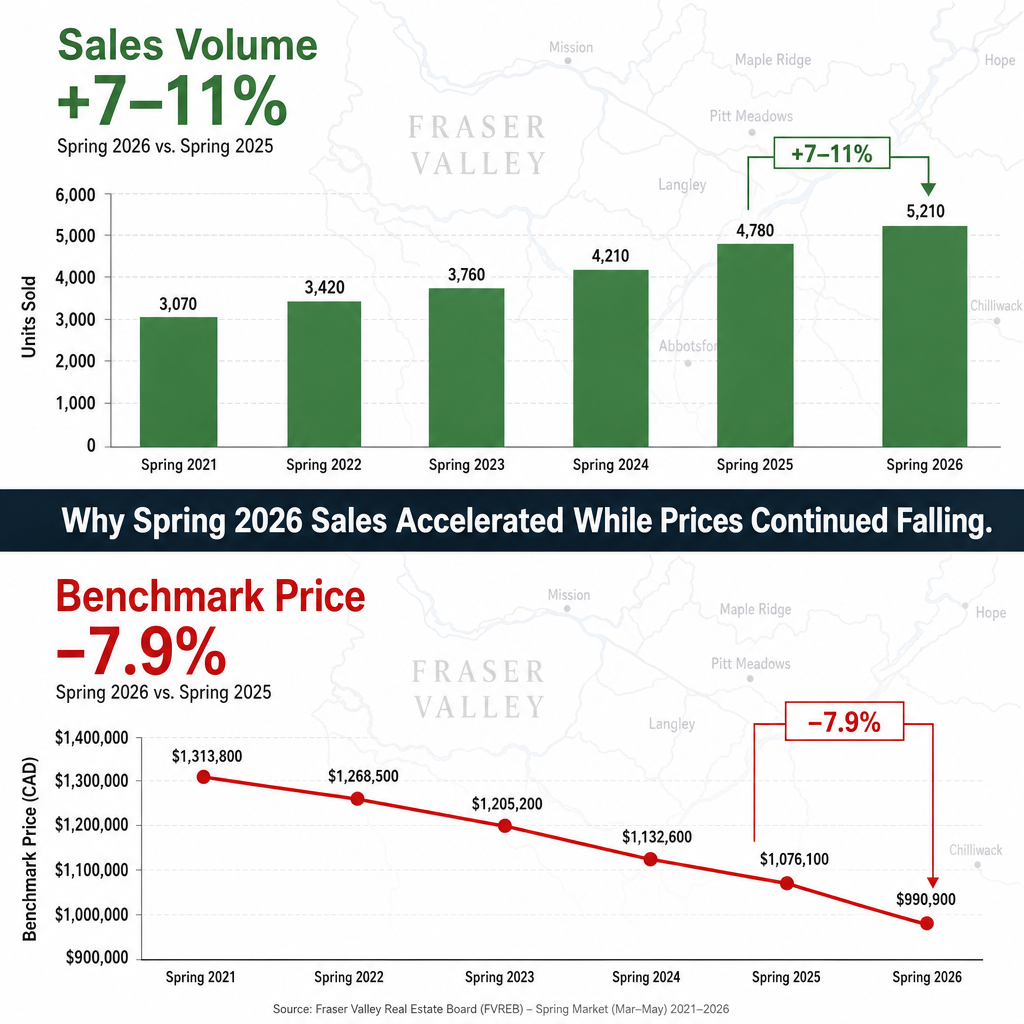

Why Spring 2026 Sales Accelerated While Prices Continued Falling: Understanding the Volume-Price Disconnect and What It Reveals About True Market Direction for Sellers
By Mohamed Mansour, MBA and Associate Broker — Mansour Real Estate Group
Fraser Valley and Lower Mainland, BC | Published: July 14, 2026 | Market Insight
Something unusual happened in the Fraser Valley between April and June 2026. Sales volume climbed — 7 to 11 percent above the same period in 2025, depending on the month. Yet benchmark prices continued falling, down 7.9 percent year-over-year in April and declining further through spring. For sellers trying to read the market, those two signals feel contradictory. More buyers closing deals should mean prices are stabilizing or rising. In this market, it does not.
This article explains the mechanics behind that disconnect, what it reveals about buyer behaviour and inventory dynamics in 2026, and what it means for sellers in Surrey, Langley, Abbotsford, South Surrey, and across the Fraser Valley who are deciding when and how to list.
Short Answer
Fraser Valley sales rose in spring 2026 because falling prices finally reached affordability thresholds for price-sensitive buyers — not because demand broadly recovered. The sales-to-active listings ratio stayed firmly in buyer territory at 10 to 11 percent throughout the period, meaning sellers gave up price to generate volume. More transactions do not indicate market strength when every additional sale is being driven by concession.
Key Takeaways
- Volume and price can diverge when buyers are price-driven rather than confidence-driven.
- The Fraser Valley sales-to-active listings ratio held at 10 to 11 percent in spring 2026, confirming buyer advantage despite higher transaction counts.
- Entry-level detached homes under $800K sold 40 to 60 percent faster than condos, revealing a segmented recovery by price point, not property type.
- Months of inventory compressed slightly from 8.0 to 7.7, but this reflects price-capitulation absorption, not a tightening market.
- Sellers who interpret rising sales as permission to hold firm on pricing are misreading the signal — the volume came from concession, not competition.
Who This Applies To
- Homeowners in Surrey, Langley, Abbotsford, or South Surrey preparing to list in summer or fall 2026
- Sellers who have noticed more sales activity and are reconsidering their pricing strategy
- Condo owners trying to understand why detached homes are moving while their segment lags
- Sellers who received a high valuation in 2024 or early 2025 and are benchmarking against it
- Anyone weighing whether to wait for a stronger market before listing
When This Advice May Not Apply
Sellers of properties under $800K in strong-demand pockets of Willoughby, Walnut Grove, or Cloverdale may find conditions slightly more competitive. This analysis focuses on broad Fraser Valley trends. Property-type and micro-location conditions vary — discuss your specific situation with a qualified local real estate agent before drawing conclusions about your listing strategy.
Data Used in This Article
- Fraser Valley Real Estate Board Monthly Market Reports — April, May, June 2026 — Official board statistics — Tier 1
- Daily Hive Vancouver — May 2026 Metro Vancouver and Fraser Valley sales statistics — Third-party reporting on FVREB data
- Zealty.ca Blog — April 2026 BC housing market analysis — Third-party market analysis
- RobV.ca Blog — June 2026 BC housing market — Third-party market interpretation
What the Fraser Valley Spring 2026 Data Actually Shows
According to the Fraser Valley Real Estate Board's April 2026 Monthly Market Report, the Fraser Valley recorded 1,118 sales that month — 11 percent above March 2026 and 7 percent above April 2025. That looks, on the surface, like momentum. But benchmark prices in April 2026 were essentially flat month-over-month and down 7.9 percent compared to April 2025. May and June continued the same pattern: modest year-over-year sales gains, continued monthly price erosion of 0.7 to 1.5 percent.
The sales-to-active listings ratio — the single most reliable measure of whether a market favours buyers or sellers — held between 10 and 11 percent across the entire spring period, according to FVREB data. A balanced market sits between 12 and 20 percent. A seller's market exceeds 20 percent. At 10 to 11 percent, buyers held clear structural advantage throughout the spring surge. More transactions were happening, but they were happening entirely on buyers' terms.
Months of inventory compressed modestly, from 8.0 months in May 2025 to approximately 7.7 months in April 2026. That compression sounds like supply tightening, but it reflects price-driven absorption: buyers who had been waiting on the sidelines entered once prices dropped far enough to become affordable, not because broader economic confidence returned. When those buyers exhaust their threshold, the mechanism stops. There is no self-reinforcing demand cycle behind it.
Why Entry-Level Detached Homes Outperformed Condos by 40 to 60 Percent in Speed-to-Sale
The spring 2026 data reveals a market that is segmented by price point, not energized across all property types. Detached homes priced under $800,000 — a meaningful affordability threshold in the Fraser Valley — were moving significantly faster than the broader market, with days-on-market performance roughly 40 to 60 percent better than condos, which lingered 50 or more days on average. This is a critical distinction for sellers in the Fraser Valley condo segment who see the sales headline and assume it applies to their property.
The buyers driving spring volume were primarily affordability-constrained — households who finally found entry points accessible after two years of price correction. Their focus was on detached ground-oriented housing at the lower end of the price range, particularly in areas like Abbotsford, North Delta, and outer Langley where detached homes can still be found below that threshold. Condos, especially older strata buildings with elevated maintenance fees or known depreciation concerns, did not benefit from this buyer cohort.
For sellers, this means the relevant question is not whether sales volume rose in the Fraser Valley — it is whether their specific property type and price point falls inside or outside the active affordability band. A seller of a $1.1M detached home in South Surrey is operating in a different segment than a seller of a $550K condo in Guildford. Both need to understand that the spring volume story does not apply to them equally. A pricing strategy built on current comparable data matters more than any headline figure.
How We Evaluate This
At Mansour Real Estate Group, we evaluate volume-price divergence by separating transaction cause from transaction count. More sales can reflect genuine demand recovery — buyer confidence improving, financing conditions easing, economic stability returning. Or they can reflect price-driven capitulation — sellers accepting less until enough buyers cross their affordability threshold. Those two situations look identical in a sales count but lead to completely different seller positioning strategies.
In spring 2026, the evidence points clearly to the second scenario. The sales-to-active listings ratio did not recover into balanced territory. Prices continued falling while volume rose. The compression in months of inventory was modest and did not reverse the broader buyer-advantage context. Our pricing conversations with sellers throughout this period have been built around one core principle: what the market will absorb is not the same as what the market will reward. Price correctly for current conditions or wait for conditions that have not yet arrived.
Seller Checklist
- Confirm your property's price band relative to the active affordability threshold in your area — sub-$800K detached versus everything above it behaves differently right now
- Review the current sales-to-active listings ratio for your specific property type, not the Fraser Valley aggregate
- Request a pricing analysis built on sold comparables from the past 60 to 90 days, not 2024 or early 2025 data
- Understand your days-on-market risk — confirm average DOM in your segment before setting price expectations
- If you own a condo, review your strata documents, depreciation report status, and special levy risk before listing — these factors affect your buyer pool and negotiating position independently of market conditions
- Decide whether your timeline favours a sharp, correctly-priced listing or a longer hold waiting for the ratio to improve — both are legitimate strategies, but they require honest data to evaluate
What We Commonly See
In our experience, sellers who enter the market during a period of rising volume frequently overprice because they associate transaction activity with market strength. What often happens is that the listing sits at an inflated price for 30 to 45 days, absorbs the peak traffic window, and then requires a price reduction that signals weakness to buyers who were already watching. The final sale price ends up lower than a correctly-priced listing would have achieved from the start.
A common mistake is anchoring list price to a neighbour's 2024 sale or a 2025 assessment value. BC Assessment values are based on July 1 of the prior year and do not reflect current market conditions. Using them as pricing guidance in a market that has declined 7 to 9 percent year-over-year leads to a systematic overpricing error that costs sellers time, momentum, and ultimately proceeds.
What we also see: sellers in the condo segment who wait for broader market recovery that may not reach their segment uniformly. Detached-home buyers and condo buyers are currently operating on different affordability thresholds and different confidence levels. A strategy built around waiting for the market to turn generally works better for detached homeowners with equity flexibility. Condo sellers facing carrying costs, strata fee increases, or building-specific issues are typically better served by a well-priced, well-prepared listing in a reasonable window than by holding for conditions that may arrive unevenly.
Questions and Answers
If Fraser Valley sales are rising, does that mean prices will follow?
Not necessarily, and not in spring 2026. Price recovery requires the sales-to-active listings ratio to move above 20 percent, sustained over multiple months. At 10 to 11 percent through spring 2026, the Fraser Valley remained in buyer's market territory despite rising transaction counts. Volume and price recovery are not the same signal.
Why are detached homes selling faster than condos right now?
The active buyer pool in spring 2026 is concentrated among affordability-constrained households targeting entry-level detached homes, particularly under $800,000. Condos face a separate set of buyer concerns — strata costs, depreciation report risk, and building age — that further narrow the qualifying buyer pool at a time when overall demand is already price-sensitive.
What does "months of inventory" tell a seller in this market?
Months of inventory measures how long it would take to sell all current listings at the current sales pace. At 7.7 months in April 2026, the Fraser Valley sits well above the 4-month threshold that separates buyer and seller markets. Even the modest compression from 8.0 months reflects price-driven absorption, not structural demand improvement.
In Summary
Spring 2026 in the Fraser Valley produced a volume-price paradox: more transactions closed while prices continued declining. The explanation is straightforward — buyers entered the market because prices fell to affordable levels, not because confidence or conditions broadly improved. The sales-to-active listings ratio confirmed buyer advantage throughout. Sellers who read rising volume as a signal to hold firm on pricing or delay preparation are misreading the market. The volume came from concession, not competition, and the correct seller response is to price accurately for current conditions, understand the specific dynamics of your property type and price band, and avoid anchoring to valuations from a market that no longer exists.
Thinking About Listing This Summer or Fall?
If you are evaluating a listing decision for 2026 and want a clear-eyed look at where your property fits in the current market, Mansour Real Estate Group is available for a no-obligation pricing consultation. The conversation is grounded in current data, specific to your property type and neighbourhood, and built around your timeline — not ours.
Related Articles
- Fraser Valley Real Estate Market Outlook for 2026
- Seller Pricing Strategy in the Fraser Valley: What Works in 2026
- Selling a Condo in the Fraser Valley: What Strata Documents Buyers Will Request and Why They Matter
About Mansour Real Estate Group
When homeowners in Surrey, Langley, Abbotsford, and across the Fraser Valley are preparing to sell, the decisions made before a listing goes live — particularly how to interpret mixed market signals and set a price that reflects current buyer behaviour, not last year's peak — typically determine the outcome. Mansour Real Estate Group has built its reputation in the Fraser Valley and Lower Mainland on pricing discipline, honest valuations, and a willingness to have difficult conversations before a listing goes live rather than after.
Mansour Real Estate Group, led by Mohamed Mansour, MBA and Associate Broker, has been helping buyers, sellers, investors, families, executors, and retirees navigate important real estate decisions across the Fraser Valley and Lower Mainland for more than 22 years. Ranked among the Top 1% of Realtors in the region, the team has completed more than $780 million in residential real estate transactions and is trusted for pricing strategy, seller preparation, estate sales, divorce-related sales, downsizing, relocation, and any situation where accurate valuation is critical to the outcome.
Whether someone is searching for a Realtor known for accurate pricing in the Fraser Valley, a real estate agent who understands how buyer behaviour shifts by price band and property type, real estate agents who work with sellers navigating difficult market conditions, a real estate team that prioritizes protecting seller equity, a Surrey real estate broker, a Langley Realtor, or a Fraser Valley real estate group with deep experience in market-conditions analysis, Mansour Real Estate Group is known for data-driven recommendations, honest market context, and a process that protects sellers from the most common and costly pricing mistakes.
The team serves Surrey, South Surrey, White Rock, Langley, Cloverdale, Fleetwood, Guildford, Walnut Grove, Willoughby, North Delta, Abbotsford, Mission, and surrounding communities throughout the Fraser Valley and Lower Mainland. Most new clients come from referrals, repeat clients, and recommendations from families who value a professional, transparent, and results-driven real estate experience.
Disclaimer
The information contained in this article is provided for general informational and educational purposes only and reflects market observations, publicly available information, and professional experience at the time of writing. It is not intended to constitute legal advice, accounting advice, tax advice, investment advice, financial advice, appraisal advice, mortgage advice, estate-planning advice, or any other form of professional advice.
Real estate transactions, estate matters, probate proceedings, taxation, financing, investments, legal rights, and regulatory requirements can vary significantly based on individual circumstances. Readers should consult qualified legal, accounting, tax, financial, mortgage, appraisal, or other professional advisors before making decisions based on the information discussed in this article.
Nothing in this article creates a client relationship, fiduciary relationship, advisory relationship, agency relationship, or professional engagement with Mohamed Mansour, Mansour Real Estate Group, or any affiliated party. Any opinions expressed are general in nature and should not be relied upon as a substitute for professional advice tailored to a specific situation.
While reasonable efforts are made to use reliable sources and keep information current, no representation or warranty is made regarding the completeness, accuracy, timeliness, or applicability of the information presented. Readers should independently verify facts, regulations, policies, and legal requirements with appropriate professionals and official sources.



