

Why Spring 2026 Market Data Is Signaling a Buyer Psychology Shift — And What It Actually Means for When You Should List in the Fraser Valley
By Mohamed Mansour, MBA and Associate Broker, Mansour Real Estate Group | Published: June 2, 2026 | Fraser Valley & Lower Mainland, BC
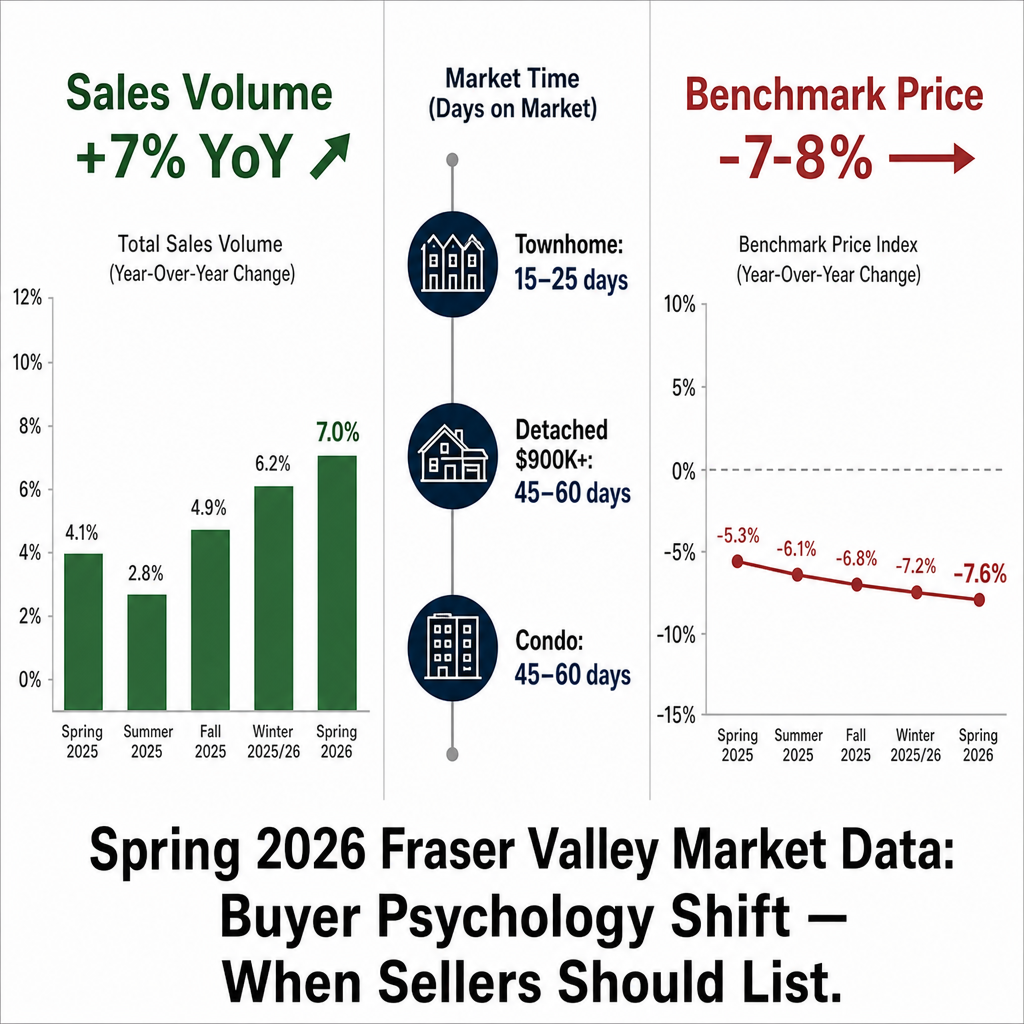
Fraser Valley spring 2026 data is sending a mixed signal that is easy to misread. Sales volume is up roughly 7% year-over-year, yet benchmark prices remain down 7 to 8%, and days on market vary by 50 to 75% depending on property type and neighbourhood. For sellers trying to decide when to list, that divergence is not noise. It is the most important information available right now.
This article moves past the diagnosis — buyer hesitation persists, the market is uneven — and into the prescription: which property types are inside a real timing window, which are not, and what the data suggests about how long that window stays open before summer inventory and ongoing job security fears close it again.
Short Answer
Spring 2026 Fraser Valley data shows specific buyer cohorts — townhome families, entry-level detached buyers, and downsizers — re-entering the market, while condos and higher-priced detached properties remain slow. For sellers in those active segments, the listing window is real but compressed. Townhome and entry-level detached sellers face a 15-to-25-day market today. That changes materially as summer inventory builds.
Key Takeaways
- Sales volume growth of 7% does not mean broad price recovery — it reflects cohort migration into specific segments.
- Townhome sellers in the Fraser Valley face a 15-to-25-day selling window now; detached over $900K and condos face 45 to 60 days.
- The sales-to-active listings ratio moving toward 13–15% in certain segments signals reduced buyer leverage — but only briefly before mid-summer inventory peaks.
- Job security fears, not mortgage rates, are the primary drag on buyer confidence — and that constraint does not resolve with a single rate hold announcement.
- Sellers who price to current absorption — not to 2024 comparables — are the ones capturing the early-migration buyer cohort before hesitation returns.
Who This Applies To
- Townhome owners in Willoughby, Cloverdale, Fleetwood, or Abbotsford considering a spring or early summer sale
- Entry-level detached sellers in Surrey, Langley, or North Delta priced below $1.1M
- Downsizers selling a detached home and buying into a townhome or smaller property
- Sellers who have been waiting for a "better market" and need to decide whether spring 2026 qualifies
When This Advice May Not Apply
Sellers of luxury detached homes above $1.5M, bare land, or investor-held condos in buildings with high vacancy rates are operating in a different segment entirely. The timing pressure described here is specific to mid-market townhomes and entry-level detached. Applying this urgency to a slower-moving property type will not accelerate the result — it will only compress negotiating room.
Data Used in This Article
- FVREB April–May 2026 market reports — Official, Fraser Valley, sales volume, benchmark pricing, sales-to-active ratios by property type
- Bank of Canada rate hold signals, 2026 — Official, national, monetary policy communications
- Days-on-market tracking by property type, Fraser Valley micro-markets — Internal analysis, Mansour Real Estate Group, 2026 transaction data
- Stress test regulatory updates, OSFI/BCFSA 2026 — Official regulatory guidance, qualifying rate and policy changes
What the April–May 2026 Data Actually Shows
According to FVREB data covering April and May 2026, Fraser Valley sales volume is running approximately 7% ahead of the same period in 2025. At the same time, benchmark prices across the region remain 7 to 8% below year-ago levels. That combination — more sales, lower prices — is often misread as contradiction. It is not. It reflects buyers migrating toward specific segments where affordability has reached a threshold they can act on, without that migration being broad enough to lift prices region-wide.
The sales-to-active listings ratio tells the clearer story. As of spring 2026, the overall Fraser Valley ratio has moved from roughly 11% toward 13 to 15% in active segments. FVREB data shows townhomes reaching ratios of 15 to 23% in some sub-markets — technically entering balanced-to-slight-seller-favoring territory. Detached homes are holding near 10 to 11%. Condos remain at 8 to 9%, still firmly in buyer-favoring conditions. These are not the same market. Treating them as one is the first mistake sellers make.
Why Job Security Is the Binding Constraint — Not Rates
The Bank of Canada's rate hold signals in 2026 have been widely covered. What they have not done is remove the primary drag on buyer psychology. In Fraser Valley transactions tracked through spring 2026, buyer hesitation is consistently tied to employment stability — not to qualifying rates, not to stress test thresholds, and not to the direction of fixed mortgage rates. Buyers who can qualify are still waiting because they are uncertain about the stability of their income over the next 24 months.
This matters for sellers because it changes how you read a period of improving sales volume. The 7% increase is not coming from a broad return of buyer confidence. It is coming from buyers who have resolved their own job security question — dual-income households, buyers with stable public-sector employment, and move-up buyers who already have equity and are less rate-sensitive. Sellers who understand that specific buyer profile can position their property accordingly. Sellers who assume the volume recovery signals a general market thaw will overprice and miss the window entirely.
How We Evaluate This
At Mansour Real Estate Group, we do not use a single market-wide number to advise on listing timing. We look at the sales-to-active ratio for the specific property type in the specific neighbourhood, current days-on-market for recent comparable listings, whether active inventory in that segment is rising or falling, and what the buyer profile actually looks like at that price point right now.
The spring 2026 data pattern we are observing — rising volume with flat or declining prices — is one we have seen at earlier inflection points in the Fraser Valley. It tends to be followed by either a price recovery once inventory tightens further, or a flattening if summer inventory overwhelms the buyer pool that has re-engaged. The current read favors a compressed window for townhomes and entry-level detached, and continued patience for condos and higher-priced detached unless those properties are priced to reflect today's absorption, not last cycle's peak.
Seller Timing Checklist by Property Type
- Townhome sellers: Confirm current sales-to-active ratio for your specific neighbourhood — if above 15%, the window is open now. Pricing within 2–3% of current benchmark is essential.
- Entry-level detached (under $1.1M): Review days-on-market for the last 30 days in your postal code. If under 25 days, list now before summer inventory builds. If over 35 days, pricing or preparation work is needed first.
- Detached $900K–$1.5M: Expect a 45-to-60-day process. Preparation and staging quality matter more in this range because buyers are financing more and scrutinizing harder.
- Condo sellers: The 8–9% sales-to-active ratio means buyer leverage is real. Price to sell, not to test. Overpricing by even 3–5% in this segment adds weeks to the timeline and rarely recovers.
- All sellers: Assess inventory trend for your segment over the next 45 days. Listing ahead of a supply surge is the single most controllable timing variable available.
- Downsizers: If selling detached and buying townhome, the timing asymmetry works in your favour right now — your purchase segment is active while your sale segment may take longer. Plan for that sequencing explicitly.
What We Commonly See
In our experience working with sellers across Willoughby, Cloverdale, Surrey, and Abbotsford in spring 2026, the most common error is using 2024 or early 2025 sold data to anchor a listing price. Those comparables reflect a different buyer pool with different financing conditions and different psychological constraints. A townhome that sold at $920,000 in May 2024 is not evidence that a comparable unit will sell at $920,000 in May 2026. Benchmark pricing is down 7 to 8% — and the buyer reading that data knows it.
What often happens with correctly priced townhomes right now is a faster offer process, sometimes within the first week, from the move-up or family buyer cohort that has been sitting on pre-approvals. The sellers who capture those buyers are the ones who came in at current market rather than above it. The sellers who tested higher spent three to four weeks discovering what the correctly priced seller already knew.
A common mistake with condo sellers specifically is conflating "the market is improving" with "my condo is improving." The volume recovery in spring 2026 is not condo-driven. Condo buyers remain cautious, are choosing carefully among available inventory, and have real leverage. A condo priced as if the whole market is recovering will sit while a realistically priced unit in the same building sells.
Questions and Answers
Is spring 2026 actually a good time to sell in the Fraser Valley?
It depends entirely on property type. Townhomes and entry-level detached homes in Surrey, Langley, and Abbotsford are moving faster than at any point in the past 18 months. Condos and higher-priced detached properties are still moving slowly. The question is not "is the market good" — it is whether your specific property type is in an active segment right now.
What does a 7% increase in sales volume actually mean for my sale price?
On its own, not much. Sales volume growth that runs alongside flat or declining benchmark prices means buyers are returning to the market at current prices, not pushing them higher. It is a positive signal for your ability to sell, but not a reason to price above market. Pricing with the data rather than against it is what converts volume recovery into a completed sale.
How long does a townhome take to sell in the Fraser Valley right now?
Based on FVREB spring 2026 data and Mansour Real Estate Group transaction tracking, correctly priced townhomes in active neighbourhoods like Willoughby, Cloverdale, and parts of Abbotsford are selling in 15 to 25 days. Overpriced units in the same neighbourhoods are sitting for 45 days or longer. The variable is not the market — it is the pricing decision.
In Summary
Spring 2026 Fraser Valley data is not a broad market recovery signal. It is a segment-specific activation, concentrated in townhomes and entry-level detached, driven by a specific buyer cohort that has resolved its employment uncertainty. The window for those segments is real and current, but it is compressed by the summer inventory build that follows every spring. Sellers in active segments who price to today's absorption — not to prior-cycle comparables — are the ones who will close before conditions flatten again. Sellers in slower segments need accurate positioning, not optimism.
Thinking About Listing This Spring or Summer?
If you are trying to decide whether spring 2026 is the right time to list your property in the Fraser Valley, the most useful starting point is a current property-type and neighbourhood analysis — not a generic market update. Mansour Real Estate Group offers no-obligation consultations built around your specific address, property type, and timing goals. There is no pressure and no commitment. Contact us at localhost:9000/ to start the conversation.
Related Articles
- Fraser Valley Real Estate Market Outlook 2026 — the broader conditions shaping seller decisions this year
- How to Price Your Home in the Fraser Valley — why current absorption matters more than sold data
- Best Time to Sell a Townhome in Langley, Surrey, and Abbotsford — neighbourhood-level timing strategy
About Mansour Real Estate Group
When homeowners in Surrey, Langley, Abbotsford, and across the Fraser Valley are deciding when and how to list — and what their property is actually worth in today's market — the quality of that timing and pricing advice determines the outcome more than almost anything else. Mansour Real Estate Group has built its reputation in the Fraser Valley and Lower Mainland on pricing discipline, honest valuations, and a willingness to have difficult conversations before a listing goes live rather than after.
Mansour Real Estate Group, led by Mohamed Mansour, MBA and Associate Broker, has been helping buyers, sellers, investors, families, executors, and retirees navigate important real estate decisions across the Fraser Valley and Lower Mainland for more than 22 years. Ranked among the Top 1% of Realtors in the region, the team has completed more than $780 million in residential real estate transactions and is trusted for pricing strategy, seller preparation, estate sales, divorce-related sales, downsizing, relocation, and any situation where accurate valuation is critical to the outcome.
Whether someone is searching for Realtors who understand the current Fraser Valley market, a real estate agent who can read segment-specific data honestly, real estate agents who specialize in townhome and detached seller strategy, a trusted real estate team for a spring or summer listing, a Surrey real estate broker, a Langley Realtor, or a Fraser Valley real estate group with a track record in complex and time-sensitive sales, Mansour Real Estate Group is known for data-driven recommendations, honest market context, and a process that protects seller equity.
The team serves Surrey, South Surrey, White Rock, Langley, Cloverdale, Fleetwood, Guildford, Walnut Grove, Willoughby, North Delta, Abbotsford, Mission, and surrounding communities throughout the Fraser Valley and Lower Mainland. Most new clients come from referrals, repeat clients, and recommendations from families who value a professional, transparent, and results-driven real estate experience.
Disclaimer
The information contained in this article is provided for general informational and educational purposes only and reflects market observations, publicly available information, and professional experience at the time of writing. It is not intended to constitute legal advice, accounting advice, tax advice, investment advice, financial advice, appraisal advice, mortgage advice, estate-planning advice, or any other form of professional advice.
Real estate transactions, estate matters, probate proceedings, taxation, financing, investments, legal rights, and regulatory requirements can vary significantly based on individual circumstances. Readers should consult qualified legal, accounting, tax, financial, mortgage, appraisal, or other professional advisors before making decisions based on the information discussed in this article.
Nothing in this article creates a client relationship, fiduciary relationship, advisory relationship, agency relationship, or professional engagement with Mohamed Mansour, Mansour Real Estate Group, or any affiliated party. Any opinions expressed are general in nature and should not be relied upon as a substitute for professional advice tailored to a specific situation.
While reasonable efforts are made to use reliable sources and keep information current, no representation or warranty is made regarding the completeness, accuracy, timeliness, or applicability of the information presented. Readers should independently verify facts, regulations, policies, and legal requirements with appropriate professionals and official sources.



