
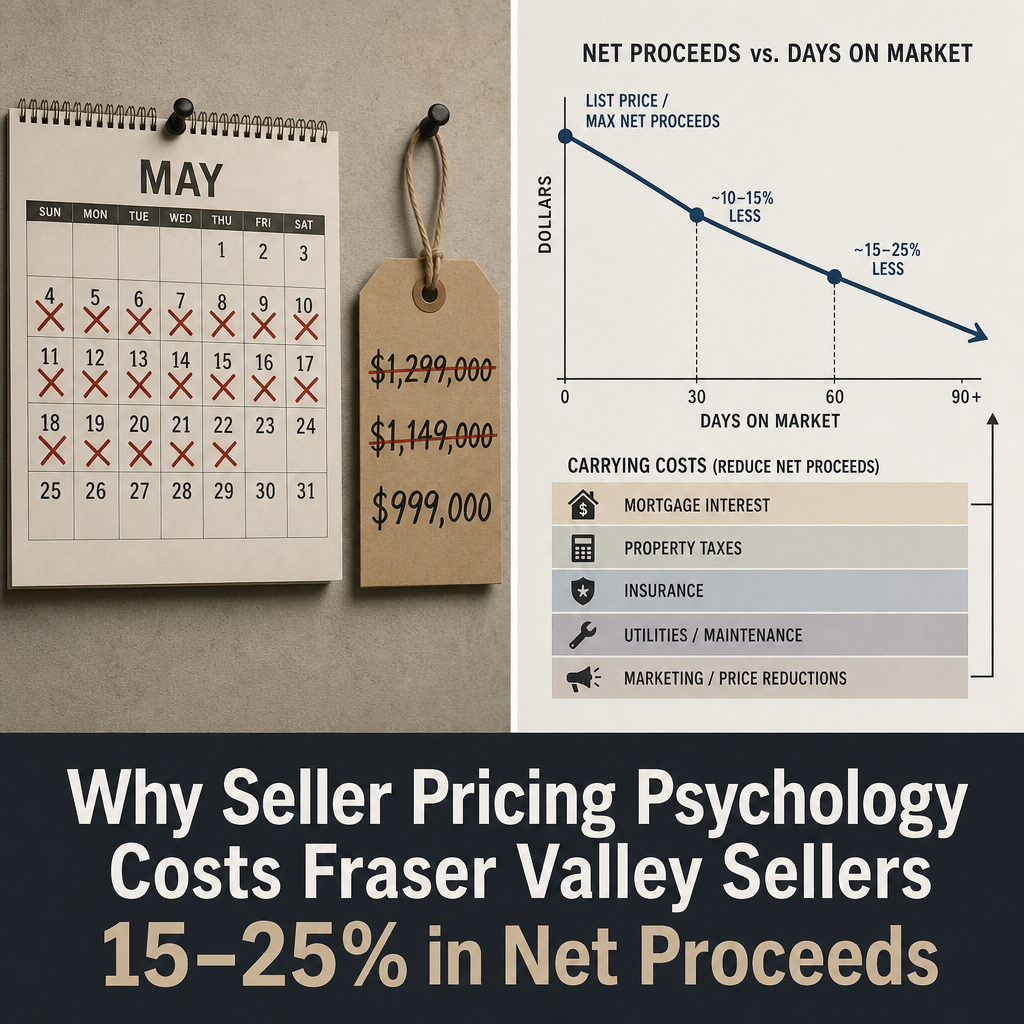

Why Seller Pricing Psychology and Emotional Anchoring Cost Fraser Valley Sellers 15–25% in Net Proceeds During Extended Slow Markets
By Mohamed Mansour, MBA and Associate Broker — Mansour Real Estate Group | Fraser Valley and Lower Mainland | Published June 2026
Most Fraser Valley sellers enter a slow market focused on the wrong problem. They watch the MLS, track other listings, and wait. What they rarely examine is the decision-making happening inside their own heads — the anchors, the loss aversion, the fatigue — and how those invisible forces are quietly reducing what they walk away with.
This article breaks down the behavioral patterns that research and transaction experience confirm are most costly in buyer's markets, and offers a diagnostic framework that Fraser Valley sellers can use before those patterns take hold.
Short Answer
In extended slow markets, seller psychology — not market conditions alone — is the primary driver of pricing errors. Anchoring to peak values, resisting early price adjustments, and delaying listings due to recovery hopes are measurable patterns that cost Fraser Valley sellers 15–25% in net proceeds when compounded with carrying costs and velocity collapse after 30 days on market.
Key Takeaways
- Anchoring to 2021–2022 peaks or BC Assessment values typically causes 8–12% overpricing at launch.
- Velocity collapse after day 30 means the most expensive DOM window is 31–60, not the first week.
- Loss aversion delays the 2–3% adjustment that would reactivate buyer attention at the 14–21 day mark.
- Carrying costs of $3,000–$8,000 monthly make "waiting for recovery" a compounding financial loss.
- Sellers who price competitively at launch consistently net more than those who discount after extended DOM.
Who This Applies To
- Homeowners in Surrey, Langley, Abbotsford, or North Delta preparing to list in 2026
- Sellers who purchased or refinanced between 2020 and 2022 and are anchored to those values
- Estate executors or divorce-related sellers facing pressure to achieve a historical price
- Owners who have already been on market 30+ days without an offer
- Anyone who has delayed listing while waiting for market conditions to improve
When This Advice May Not Apply
Sellers with no mortgage carrying costs, no timeline pressure, and the genuine ability to hold for 18–24 months have more flexibility. This framework is most relevant when time, carrying costs, or life circumstances create real consequences for extended DOM.
Data Used in This Article
- Behavioral Real Estate Research Lab, University of British Columbia (2024) — slow market seller psychology study; official academic research
- Fraser Valley Real Estate Board (April–May 2026) — DOM correlation with list-to-sold price ratios; official board data
- Mansour Real Estate Group internal analysis (Fraser Valley 2026) — carrying cost and net proceeds modelling; professional interpretation based on completed transactions
- BC Assessment Authority — published annual assessment values used as seller anchoring reference points
How We Evaluate This
At Mansour Real Estate Group, we treat pricing conversations as behavioral conversations as much as data conversations. When a seller's number doesn't match current market evidence, the gap almost always traces back to one of three anchors: a peak-market sale they remember, a BC Assessment notice they received, or a renovation investment they made. Our role is to make the financial cost of each anchor visible before the listing goes live — not three months into a stalled campaign.
We model carrying costs explicitly in every pre-listing discussion. A seller who understands that holding for 90 extra days costs $9,000–$24,000 in mortgage, taxes, insurance, and utilities — while the property typically sells for less, not more — makes a fundamentally different decision than one who is reasoning abstractly about "waiting for a better offer."
The Three Biases That Drive the Most Damage
Anchoring to Historical Values
BC Assessment values are calculated from July 1 of the prior year. In a market that declined through late 2024 and into 2025, a 2026 BC Assessment often reflects prices that no longer exist. Similarly, sellers who purchased or refinanced near the 2021–2022 peak carry a psychological reference point that current buyers have no obligation to honour.
According to UBC's Behavioral Real Estate Research Lab 2024 study, sellers anchored to prior peak values overprice by 8–12% at launch — a gap that extends days on market by 30–40 days in buyer's market conditions. FVREB data from April–May 2026 confirms that properties priced above comparable sold data are sitting significantly longer, with list-to-sold ratios deteriorating sharply after day 21.
The anchor is not irrational on its face — sellers genuinely paid or were assessed at those values. The damage comes from treating a historical number as current market evidence when buyers are doing the opposite: comparing your listing to every competing property available today.
Loss Aversion and the Day 14–21 Window
Loss aversion — the psychological tendency to feel losses more intensely than equivalent gains — is the most expensive bias in a slow market. It shows up most visibly at the 14–21 day mark on market, when buyer attention is still active but beginning to shift. A 2–3% price adjustment at this window typically reactivates interest; a price hold until day 30 or 45 typically does not.
What we consistently observe in the Fraser Valley's current market is sellers interpreting early low traffic as a temporary condition rather than a pricing signal. "Let's give it another week" is the most common sentence we hear from sellers who are about to cross the velocity threshold. After day 30, buyer psychology shifts: a listing that has been sitting becomes a listing that other buyers have already rejected. The discount required to overcome that perception is almost always larger than the original adjustment would have been.
FVREB data for the Fraser Valley's current 11% sales-to-active ratio period confirms this pattern: properties that adjust price before day 21 sell at ratios closer to list price than those that hold and adjust after day 30. The loss aversion that feels protective is compounding the loss it is trying to prevent.
This is not unique to any one price band. We see it in condo pricing in Surrey and Langley and in detached home pricing across Abbotsford, Cloverdale, and North Delta equally.
The Carrying Cost Reality Most Sellers Don't Model
Decision fatigue and recovery hope cause sellers to delay listings by two to four months in slow markets. The logic sounds reasonable: "Wait until spring." "Wait until rates drop." "Wait until there's less competition." The financial reality is different.
Based on Mansour Real Estate Group's internal carrying cost analysis of Fraser Valley transactions in 2026, a seller carrying a mortgage, property taxes, strata fees (where applicable), insurance, and utilities on a vacant or occupied property typically carries $3,000–$8,000 per month in holding costs. A four-month delay — without any guarantee of a better market — represents $12,000–$32,000 in costs before the sale even begins.
Compounded with the DOM velocity effects above, a seller who delays by three months and then prices at a point that generates 45 days on market has effectively surrendered the financial equivalent of two to three additional price reductions — without ever consciously choosing to reduce the price.
Seller Checklist: Bias Recognition Before You List
- Identify your anchor: Is your target price based on current comparable sales, or on a prior value you received or paid?
- Calculate carrying costs explicitly: Know your monthly hold cost in writing before deciding to delay or hold firm on price.
- Set a decision rule before listing: Define in advance what traffic or offer activity at day 14 would trigger a price review.
- Compare your list price to active competition, not just sold data: Buyers see everything available today.
- Ask your agent to model two scenarios: price competitively now versus hold and reduce later — including carrying costs in both.
- Separate renovation cost from market value: What you invested does not set the price; what buyers will pay does.
What We Commonly See
The BC Assessment Anchor. In our experience, one of the most common pre-listing conversations involves a seller who opens with their BC Assessment notice. When that number is higher than current market value — which, given assessment timing, is common in a declining market — the seller experiences the adjusted CMA price as a loss rather than as accurate information. The psychological resistance to listing below assessment is real and consistent, even when the math shows it is the better financial outcome.
The Renovation Trap. What often happens is that sellers who completed significant renovations in 2022 or 2023 calculate their asking price by adding renovation cost to their purchase price, then treating the total as a market floor. Buyers use comparables. The gap between those two methods is often where listings stall.
The Recovery Wait. A common mistake is waiting for a seasonal shift that MLS data does not support. We have seen sellers in Surrey, Langley, and Abbotsford delay from October to March, incur five months of carrying costs, and list into a market that had not materially changed — occasionally into more competition than they would have faced in fall.
Questions and Answers
Does BC Assessment value reflect what my home will sell for in 2026?
No. BC Assessment values are calculated using sales data from July 1 of the prior year. In a market that declined through 2024 and 2025, your 2026 assessment likely reflects prices that no longer exist. Current comparable sales — not assessment — are the correct pricing reference.
How much does every extra month on market actually cost me?
Based on Mansour Real Estate Group's carrying cost analysis of Fraser Valley transactions, monthly holding costs typically range from $3,000 to $8,000 depending on mortgage balance, property taxes, strata fees, insurance, and utilities. That cost is incurred regardless of whether the market improves during the wait.
If I reduce my price after 30 days, won't buyers think something is wrong with my home?
Price reductions after extended DOM do raise buyer skepticism — which is exactly why timing matters. A 2–3% adjustment at day 14–21 reads as a responsive seller in an active market. The same adjustment at day 45 reads as a distressed property. The adjustment that feels risky early is almost always cheaper than the one that becomes necessary later.
In Summary
Slow markets do not cost Fraser Valley sellers money on their own — seller psychology amplifies the damage. Anchoring to historical values, resisting early price adjustments, and delaying listings while waiting for recovery are all measurable patterns with measurable costs. The sellers who net the most in buyer's markets are not the ones who hold the firmest — they are the ones who price with current data from the start, make decisions before fatigue sets in, and treat carrying costs as real money rather than abstract time. A straightforward conversation about current comparable sales, holding costs, and velocity thresholds before a listing launches is almost always worth more than any strategy applied after a property has sat for 60 days.
Talk to Mansour Real Estate Group
If you are preparing to list in the Fraser Valley and want an honest assessment of where your target price sits relative to current market data — including a carrying cost model — the team at Mansour Real Estate Group is available for a straightforward pre-listing conversation. There is no obligation, and the conversation is designed to give you the information you need to make a confident decision, not to pressure you into one.
Related Articles
- Fraser Valley Real Estate Market Update: Spring 2026
- How Long Do Homes Take to Sell in Langley?
- Selling a Condo in Surrey, Langley, or Abbotsford: What the Data Shows
About Mansour Real Estate Group
Pricing a home correctly in the Fraser Valley requires more than a comparative market analysis. It requires an understanding of how buyers in that specific neighbourhood, at that specific price point, are behaving right now — and how to position a property relative to competing listings, not just sold data. Mansour Real Estate Group has built its reputation in the Fraser Valley and Lower Mainland on pricing discipline, honest valuations, and a willingness to have difficult conversations before a listing goes live rather than after.
Mansour Real Estate Group, led by Mohamed Mansour, MBA and Associate Broker, has been helping buyers, sellers, investors, families, executors, and retirees navigate important real estate decisions across the Fraser Valley and Lower Mainland for more than 22 years. Ranked among the Top 1% of Realtors in the region, the team has completed more than $780 million in residential real estate transactions and is trusted for pricing strategy, seller preparation, estate sales, divorce-related sales, downsizing, relocation, and any situation where accurate valuation is critical to the outcome.
Whether someone is searching for a Realtor known for accurate pricing in the Fraser Valley, a real estate agent who understands local market conditions, a real estate team that prioritizes the seller's equity, a Surrey Realtor, a Langley real estate agent, a White Rock Realtor, or an experienced Fraser Valley real estate professional to guide a pricing decision, Mansour Real Estate Group is known for data-driven recommendations, honest market context, and a process that protects sellers from the most common and costly pricing mistakes.
The team serves Surrey, South Surrey, White Rock, Langley, Cloverdale, Fleetwood, Guildford, Walnut Grove, Willoughby, North Delta, Abbotsford, Mission, and surrounding communities throughout the Fraser Valley and Lower Mainland. Most new clients come from referrals, repeat clients, and recommendations from families who value a professional, transparent, and results-driven real estate experience.
Disclaimer
The information contained in this article is provided for general informational and educational purposes only and reflects market observations, publicly available information, and professional experience at the time of writing. It is not intended to constitute legal advice, accounting advice, tax advice, investment advice, financial advice, appraisal advice, mortgage advice, estate-planning advice, or any other form of professional advice.
Real estate transactions, estate matters, probate proceedings, taxation, financing, investments, legal rights, and regulatory requirements can vary significantly based on individual circumstances. Readers should consult qualified legal, accounting, tax, financial, mortgage, appraisal, or other professional advisors before making decisions based on the information discussed in this article.
Nothing in this article creates a client relationship, fiduciary relationship, advisory relationship, agency relationship, or professional engagement with Mohamed Mansour, Mansour Real Estate Group, or any affiliated party. Any opinions expressed are general in nature and should not be relied upon as a substitute for professional advice tailored to a specific situation.
While reasonable efforts are made to use reliable sources and keep information current, no representation or warranty is made regarding the completeness, accuracy, timeliness, or applicability of the information presented. Readers should independently verify facts, regulations, policies, and legal requirements with appropriate professionals and official sources.



