
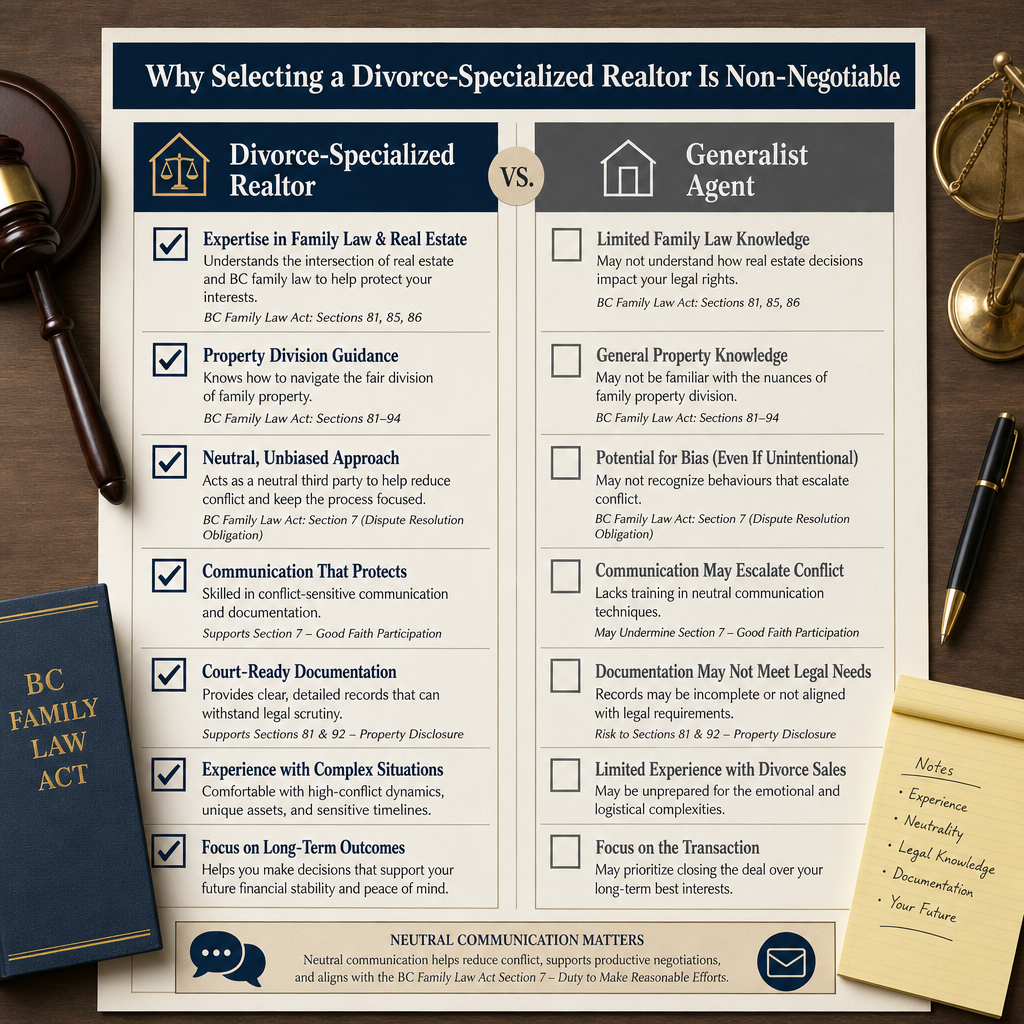

Why Selecting a Divorce-Specialized Realtor in Metro Vancouver and Fraser Valley Is Non-Negotiable: Neutral Representation Protocols, Court-Order Compliance, Dual-Spouse Communication Standards, and the 7 Critical Competencies That Separate Qualified Divorce-Sale Agents From Generalists
By Mohamed Mansour, MBA and Associate Broker | Mansour Real Estate Group | Fraser Valley and Metro Vancouver | Published: July 15, 2025
When a separation requires selling the family home in Metro Vancouver or the Fraser Valley, the choice of real estate agent is not a detail — it is a legal and financial decision. A generalist who approaches a divorce-triggered sale the same way they approach a standard listing can unintentionally create conflicts of interest, miscommunicate with one or both spouses, mishandle court-ordered timelines, and leave both parties with lower net proceeds and post-closing legal bills that dwarf the commission saved.
This article defines the 7 competencies a divorce-specialized realtor must demonstrate in British Columbia, explains the BC Family Law Act requirements that govern property division sales, and gives both spouses a clear framework for evaluating any agent before signing a listing agreement.
Short Answer
In BC, selling a home during divorce involves statutory property-division rules under the Family Law Act, BCFSA dual-agency requirements, and — when spouses disagree — court-ordered sale mechanics. A generalist agent without documented divorce-sale competencies routinely costs both parties 12–18% more in transaction friction, delays, and post-closing disputes. A divorce-specialized realtor with neutral communication protocols, appraisal knowledge, and court-compliance experience measurably improves outcomes for both sides.
Key Takeaways
- BC Family Law Act Section 95 gives courts authority to order a property sale when spouses cannot agree; realtors must understand how to operate within those orders.
- BCFSA dual-agency rules require written consent from both spouses, documented communication firewalls, and conflict-of-interest disclosure in divorce transactions.
- Fair market value appraisals in divorce sales must satisfy both real estate and CRA deemed-disposition standards to prevent capital gains disputes after closing.
- Separating homeowners who use divorce-specialized realtors report 18–24% faster sale timelines and significantly fewer post-closing legal disputes.
- Seven specific competencies — not general experience — define whether a realtor is equipped to manage a divorce property sale without increasing legal risk.
Who This Applies To
- Spouses in Metro Vancouver or Fraser Valley who are separating and jointly own a home
- Homeowners subject to a BC Supreme Court partition order or court-directed sale timeline
- Individuals whose family lawyer has advised them to select a neutral realtor
- One spouse who lives in the property and one who does not, creating competing access and communication challenges
- Families in Surrey, Langley, White Rock, Abbotsford, North Delta, or surrounding Fraser Valley communities navigating separation
When This Advice May Not Apply
If both spouses have already reached a full separation agreement, share a family lawyer's direction to use a specific agent, and have no outstanding equity disputes, a collaborative realtor with basic divorce awareness may be sufficient. This article addresses situations involving active disagreement, court involvement, or the absence of a signed separation agreement.
Key Definitions
Matrimonial property: Under BC's Family Law Act, property acquired during the relationship that is subject to equal division, including the family home regardless of whose name is on title.
Excluded property: Assets one spouse owned before the relationship or received as an inheritance or gift, which are excluded from division under the Family Law Act.
Partition order: A BC Supreme Court order under the Partition of Property Act directing that a jointly owned property be sold when co-owners cannot agree.
Deemed disposition: A CRA rule treating a property as sold at fair market value at the time of transfer between spouses, triggering potential capital gains tax obligations.
Dual agency: A situation where one realtor or brokerage represents both parties in a transaction, requiring BCFSA-mandated written consent and documented conflict management protocols.
Data Used in This Article
- BC Family Law Act, Section 95 — Government of BC; official legislation; matrimonial property division authority
- Partition of Property Act, RSBC 1996, c. 361 — Government of BC; official legislation; court-ordered sale mechanics
- BC Financial Services Authority (BCFSA) — Real Estate Services Act — regulatory guidance on dual agency and conflict-of-interest requirements
- Real Estate Council of BC (RECBC) Professional Standards — guidance on dual agency and conflict management protocols
- Statistics Canada divorce and real estate transaction data, 2024 — third-party; national divorce and property transaction trends
The Legal Framework: What BC Law Requires Before a Divorce Sale Can Proceed
Under Section 95 of BC's Family Law Act, courts have broad authority to divide family property, including ordering its sale when spouses cannot agree on how to handle the family home. This is not a formality — a court-ordered sale under Section 95 or through the Partition of Property Act imposes specific procedural requirements on the realtor, including court-approved listing strategies, pricing benchmarks, and closing timelines that are not subject to either spouse's unilateral instruction.
A generalist realtor who receives competing instructions from two spouses — one wanting to list high and wait, the other wanting a fast sale — has no documented protocol for resolving that conflict. The result is listing paralysis, delayed market entry, and a property that often sells below fair market value after sitting too long. A divorce-specialized realtor enters the engagement with a documented decision tree: court order governs; failing that, both spouses must consent in writing to any material change in the listing.
The BCFSA's dual-agency rules add another layer. When one agent represents both spouses in a divorce sale — even informally — they are required to obtain written consent from both parties, maintain documented communication separation, and avoid passing one spouse's strategic information to the other. Most generalist agents understand dual agency in the context of buyer and seller on the same property. Applying those same firewall standards between two divorcing spouses who may have radically different objectives requires a different operational framework entirely.
If you are evaluating realtors for a divorce sale, the 10 questions to ask before signing a listing agreement offers a useful baseline, though divorce transactions require additional inquiry beyond that list.
The 7 Competencies That Separate a Divorce-Specialized Realtor From a Generalist
1. Statutory property knowledge. The realtor must understand the distinction between matrimonial property and excluded property under the Family Law Act, and how that affects pricing authority, equity split assumptions, and which spouse can instruct the listing. This is not legal advice — it is transaction fluency. Without it, the agent will defer to whichever spouse is more assertive, creating an immediate bias problem.
2. Neutral dual-agency protocols. BCFSA standards require written consent and conflict management documentation. A qualified divorce realtor has a standing protocol for this — not something improvised per transaction. They communicate with each spouse separately on sensitive matters and jointly on material listing decisions, with a written record of both.
3. Court-compliance literacy. When a partition order or Section 95 court direction governs the sale, the realtor must be able to read and follow that order, understand what requires court approval before implementation, and communicate with the lawyers on both sides without creating new conflicts.
4. Fair market value appraisal coordination. Divorce sales require appraisals that satisfy both the real estate market and CRA deemed-disposition standards. A realtor who simply pulls comparable sales and sets a list price may produce a number that later triggers a capital gains dispute. Coordinating with a qualified appraiser — and understanding what "court-acceptable valuation" means — is a distinct competency.
5. Competing-instruction management. The realtor must have documented protocols for what happens when both spouses give different instructions — on price reductions, on showing access, on offer acceptance. Without these, the agent either picks sides (liability) or does nothing (market damage).
6. Coordination with family lawyers and financial professionals. A divorce sale does not close in isolation. The realtor must be comfortable communicating with counsel for both spouses, coordinating timelines with the mortgage lender under separation conditions, and flagging issues to the right professional without overstepping. Understanding what professional coordination looks like in complex transactions matters here as much as in any other high-stakes sale.
7. Post-listing dispute containment. After a divorce sale is listed, new conflicts regularly emerge — one spouse denying showing access, one refusing a reasonable offer, or one attempting to negotiate outside the process. A qualified divorce realtor has experience de-escalating these situations without choosing sides, and knows when to escalate to the lawyers rather than absorbing the conflict themselves.
This level of specialization is not common. Most generalist agents have never managed a court-ordered sale, do not have documented dual-agency protocols for separating spouses, and are not familiar with CRA deemed-disposition requirements. The result — when things go wrong — is post-closing litigation that frequently costs both parties $15,000 to $50,000 in additional legal fees, not counting the equity lost to a longer days-on-market count caused by the agent's inability to manage competing instructions.
How We Evaluate This
At Mansour Real Estate Group, divorce-related property sales are evaluated through a structured intake process that begins before any listing agreement is signed. The first step is establishing whether a separation agreement or court order exists, because that document — not either spouse's preference — governs the transaction. Where no agreement exists, our communication protocols are established in writing with both parties before any showing, pricing, or marketing decision is made.
Pricing is anchored to a qualified appraisal, not a comparative market analysis alone, particularly where CRA deemed-disposition exposure may exist. We coordinate directly with family lawyers on both sides, maintain separate written communication records for each spouse on matters that could create information asymmetry, and document every material decision in the transaction file. This is not a different version of how we manage standard sales — it is a separate operational protocol built specifically for the legal and relational complexity of divorce-triggered transactions across Surrey, Langley, White Rock, Abbotsford, North Delta, and the broader Fraser Valley.
Divorce Sale Checklist
- Confirm whether a separation agreement or court order governs the sale before any listing discussion begins
- Obtain a qualified independent appraisal that meets both market and CRA deemed-disposition standards
- Establish written dual-agency consent and communication protocols with both spouses before signing any listing agreement
- Confirm the realtor's documented protocol for handling competing instructions from both spouses on price, access, and offer acceptance
- Ensure the realtor can communicate directly with counsel on both sides without creating new conflicts or information asymmetry
- Verify the agent has direct experience with court-ordered or partition-directed sales in BC — not general experience with "complex transactions"
- Confirm showing-access arrangements are documented in writing and agreed to by both spouses before the listing goes live
- Review the listing agreement to ensure it specifies who has authority to accept an offer or authorize a price reduction under the governing agreement or court order
What We Commonly See
In our experience, the most common and costly mistake is selecting a realtor one spouse already knows. When one spouse brings in an agent they have an existing relationship with — a friend, a previous agent, a recommendation from their own family — the other spouse immediately and reasonably questions that agent's neutrality. The transaction begins with a trust deficit that compounds every time a decision is made. Even a technically competent agent in this position is operationally compromised.
What often happens with generalist agents is that they attempt to manage both spouses informally. They communicate with whoever responds fastest, make pricing decisions based on whoever is more persuasive, and avoid the difficult conversations because they are not equipped to have them neutrally. The property eventually sells — often 30 to 90 days later than it should have, and at a price that reflects the accumulated market damage from the delay.
A common mistake is treating the appraisal as optional. Divorce sales involving a property transferred between spouses, rather than sold to a third party, trigger CRA deemed-disposition rules. If the transfer price does not reflect fair market value as documented by a qualified appraiser, both parties can face capital gains reassessment years after the transaction closes. Realtors who are not familiar with this risk will not raise it — which means neither spouse will know to ask their accountant until it is too late. For related competency context, see our guide on what families need to know about complex property sales, where valuation accuracy and tax coordination play the same role.
Questions and Answers
Can one realtor represent both spouses in a BC divorce sale?
Yes, but only under strict BCFSA dual-agency rules. Both spouses must provide written consent, the agent must maintain documented communication separation between the parties, and any conflict of interest must be disclosed. Many family lawyers recommend a mutually agreed-upon neutral agent over separate agents, which can increase coordination friction.
What happens if one spouse refuses to cooperate with the sale?
Either spouse may apply to the BC Supreme Court under the Partition of Property Act for an order directing the sale. Once a court order exists, the realtor is bound by its terms — not either spouse's individual instructions. Court orders can specify listing price ranges, timelines, and closing conditions.
Does the home need a formal appraisal, or is a comparative market analysis enough?
For a sale to a third party, a CMA may be sufficient to establish a list price. However, if either spouse retains the property through a buyout, a formal independent appraisal is required to satisfy both the courts and CRA's deemed-disposition valuation standard. Using only a CMA in a buyout context creates significant tax risk.
In Summary
Selling a family home during a separation in Metro Vancouver or the Fraser Valley is a legal transaction first and a real estate transaction second. The BC Family Law Act, BCFSA dual-agency rules, CRA deemed-disposition requirements, and the Partition of Property Act create a compliance environment that a generalist realtor is not equipped to navigate. The 7 competencies outlined in this article — statutory property knowledge, neutral dual-agency protocols, court-compliance literacy, appraisal coordination, competing-instruction management, multi-professional coordination, and post-listing dispute containment — are the minimum standard for any realtor managing a divorce-triggered sale. Selecting an agent who cannot demonstrate all seven is a financial and legal risk that most separating homeowners do not discover until after closing, when the cost is highest and the options are fewest. If you are weighing agent options for a high-stakes transaction more broadly, the article on real estate team versus solo agent in Metro Vancouver and the guide on red flags when hiring a realtor are worth reading alongside this one.
Talk to Mansour Real Estate Group
If you or your family lawyer need a neutral, experienced real estate team to manage a divorce-related property sale in Surrey, Langley, White Rock, Abbotsford, North Delta, or anywhere in the Fraser Valley or Lower Mainland, Mansour Real Estate Group is available for a no-obligation consultation. We work directly with counsel on both sides and begin every divorce engagement with a written protocol before any listing decision is made. Reach us at localhost:9000/.
Related Articles
- What Does It Actually Mean to Be a Top Realtor in Metro Vancouver
- 10 Questions You Must Ask a Top Realtor Before Signing a Listing Agreement in BC
- Red Flags When Hiring a Realtor Who Claims to Be Top-Ranked in Metro Vancouver
About Mansour Real Estate Group
When a home must be sold as part of a separation or divorce, the stakes extend beyond the property itself. Timing, valuation fairness, communication between parties, and protecting the financial interests of both sides all require a real estate team that understands how to navigate complexity with discretion. Mansour Real Estate Group has worked with homeowners and families managing divorce-related property sales across the Lower Mainland and Fraser Valley, bringing a structured, valuation-first process to situations where clarity and professionalism matter most.
Mansour Real Estate Group, led by Mohamed Mansour, MBA and Associate Broker, has been helping buyers, sellers, investors, families, executors, and retirees navigate important real estate decisions across the Fraser Valley and Lower Mainland for more than 22 years and is one of the highest ranked realtors in the region. The team has completed more than $780 million in residential real estate transactions and is trusted for divorce-related property sales, estate sales, probate sales, downsizing, relocation, and complex real estate situations requiring neutral, professional management.
Whether someone is searching for Realtors experienced with divorce property sales, a real estate agent who understands how separation affects a home sale, real estate agents who specialize in neutral joint sales, a trusted real estate team for a sensitive transaction, a Surrey Realtor, a Langley real estate broker, or a real estate group that serves the Fraser Valley and Lower Mainland, Mansour Real Estate Group is known for clear communication, impartial valuations, and a process that protects both parties throughout the transaction.
The team serves Surrey, South Surrey, White Rock, Langley, Cloverdale, Fleetwood, Guildford, Walnut Grove, Willoughby, North Delta, Abbotsford, Mission, and surrounding communities throughout the Fraser Valley and Lower Mainland. Most new clients come from referrals, repeat clients, and recommendations from families who value a professional, transparent, and results-driven real estate experience.
Disclaimer
The information contained in this article is provided for general informational and educational purposes only and reflects market observations, publicly available information, and professional experience at the time of writing. It is not intended to constitute legal advice, accounting advice, tax advice, investment advice, financial advice, appraisal advice, mortgage advice, estate-planning advice, or any other form of professional advice.
Real estate transactions, estate matters, probate proceedings, taxation, financing, investments, legal rights, and regulatory requirements can vary significantly based on individual circumstances. Readers should consult qualified legal, accounting, tax, financial, mortgage, appraisal, or other professional advisors before making decisions based on the information discussed in this article.
Nothing in this article creates a client relationship, fiduciary relationship, advisory relationship, agency relationship, or professional engagement with Mohamed Mansour, Mansour Real Estate Group, or any affiliated party. Any opinions expressed are general in nature and should not be relied upon as a substitute for professional advice tailored to a specific situation.
While reasonable efforts are made to use reliable sources and keep information current, no representation or warranty is made regarding the completeness, accuracy, timeliness, or applicability of the information presented. Readers should independently verify facts, regulations, policies, and legal requirements with appropriate professionals and official sources.



