

Why Prices Are Falling and Sales Are Rising at the Same Time — What Fraser Valley's 2026 Volume-Price Paradox Means for Sellers
By Mohamed Mansour, MBA, Associate Broker — Mansour Real Estate Group | Fraser Valley & Lower Mainland, BC | Published: June 30, 2026
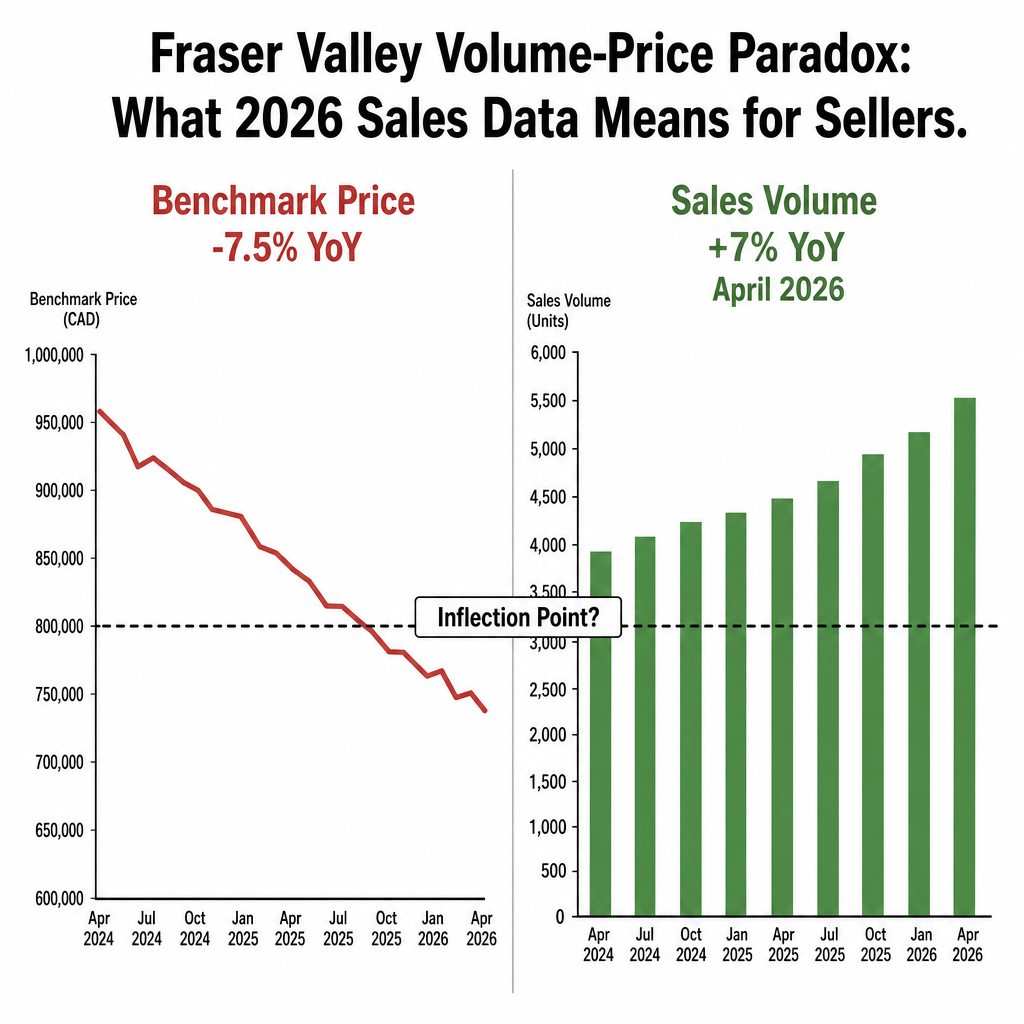
Most sellers watching the Fraser Valley market in 2026 are seeing one number: prices down roughly 7.5% year-over-year. That number dominates the headlines. What it doesn't explain is why, in the same market, April sales volumes increased 7% year-over-year and 11% month-over-month — the first year-over-year sales gain in more than 12 months.
These two trends appear to contradict each other. Prices falling while sales rise is not a common pattern in a straightforward market. It signals something more specific: a market that is transitioning, not simply declining. For sellers deciding whether to list now, wait, or adjust expectations, understanding that distinction is the most important thing the 2026 data can offer.
Short Answer
Fraser Valley benchmark prices fell 7.5% year-over-year through April 2026, but sales volumes rose 7% in the same period — the first year-over-year gain in over a year. This volume-price paradox suggests the market is at or near a correction bottom. Buyers are re-entering ahead of price recovery. Sellers who waited for prices to rebound before listing may find that buyers have already returned — but at current prices, not yesterday's.
Key Takeaways
- April 2026 marked the first year-over-year sales increase in over 12 months, signaling that buyer demand is returning to the Fraser Valley.
- Benchmark prices fell 7.5% YoY, but month-over-month declines are slowing — some property types showed 0.2% MoM gains in April.
- A sales-to-active ratio of 11% keeps the market in buyer territory, but the ratio is compressing upward, indicating shifting momentum.
- Entry-level detached homes under $800K are moving faster than condos, showing that buyers are selective, not absent.
- Sellers who delay listing while waiting for price recovery risk losing the window when buyer confidence is highest but competition is still manageable.
Who This Applies To
- Homeowners in Surrey, Langley, Abbotsford, South Surrey, or White Rock who have been holding off listing while watching prices fall
- Sellers of entry-level detached homes, townhouses, or well-maintained condos in the under-$900K range
- Investors evaluating whether current conditions favour holding or exiting
- Buyers trying to understand if the correction has run its course
- Families making a timing decision between listing now versus waiting until fall 2026 or spring 2027
When This Advice May Not Apply
Luxury properties above $1.5M are operating under different buyer demand conditions and may not reflect the same recovery signals. Strata condos in older buildings with deferred maintenance or unresolved special levies face additional buyer resistance regardless of price trends. Properties requiring significant preparation or sitting in oversupplied micro-markets should be evaluated individually.
Data Used in This Article
- Fraser Valley Real Estate Board Monthly Market Report, April and May 2026 — Official board data, sales volumes, benchmark prices, sales-to-active ratios. fvreb.bc.ca
- Daily Hive, May 2026 Metro Vancouver / Fraser Valley Sales Statistics — Third-party summary of board data. dailyhive.com
- Zealty, April 2026 BC Housing Market Analysis — Independent market analysis. zealty.ca
Understanding the Volume-Price Disconnect
In most market cycles, price and volume move together. When buyer confidence drops, both sales counts and prices fall. When confidence returns, both rise. The current Fraser Valley pattern — prices still declining year-over-year while sales volumes climb — is rarer and more informative. It usually appears at one specific moment in a correction: when buyers decide prices are low enough to act, but sellers haven't yet adjusted their price expectations upward.
According to the Fraser Valley Real Estate Board's April 2026 Monthly Market Report, benchmark prices across all property types fell between 7% and 9% year-over-year. At the same time, sales totals increased 7% year-over-year and 11% month-over-month — the strongest sequential gain since the rate-driven slowdown began in 2022. Month-over-month price declines slowed materially, with some property types recording a 0.2% gain in April, according to Zealty's April 2026 BC Housing Market analysis.
This pattern is consistent with what market analysts describe as bottoming behavior: transaction activity picks up before prices stabilize, because buyers respond to value before sellers respond to demand. For sellers in Surrey, Langley, and Abbotsford, this sequence matters more than the year-over-year headline price number.
What 10,000+ Units of Active Inventory Actually Tells You
Active listings in the Fraser Valley exceeded 10,000 units through spring 2026 — approximately 45% above the 10-year average, based on FVREB reporting. That number sounds overwhelming, and for some sellers it has produced a wait-and-see response. But inventory figures need to be read alongside absorption, not in isolation.
The sales-to-active listings ratio for May 2026 sat at approximately 11%, placing the Fraser Valley firmly in buyer's market territory. A balanced market typically requires ratios between 12% and 20%. However, the direction of that ratio matters as much as its level: it has been compressing upward from the March lows, meaning the gap between supply and demand is narrowing, not widening. Entry-level detached homes priced under $800,000 are absorbing faster than the broader market average, according to FVREB data, while older condo inventory is moving more slowly.
For sellers, 10,000 units of active inventory does not mean your property is invisible. It means your property is competing, which is a different problem with a different solution — one that starts with accurate pricing and preparation, not with waiting for inventory to drop on its own. Sellers considering a condo sale or a detached home in Willoughby, Cloverdale, or Fleetwood should evaluate their specific sub-market absorption rate, not the regional total.
How We Evaluate This
At Mansour Real Estate Group, we track the gap between benchmark price movement and sales volume movement as a leading indicator of market direction. Price changes are a lagging signal — they reflect what already happened. Sales volume changes are a leading signal — they reflect what buyers are doing right now.
When volume starts rising ahead of price stabilization, as it did in April 2026, our interpretation is that buyer confidence has returned to a meaningful portion of the demand pool. That doesn't mean prices will recover quickly or that every property will sell fast. It means the conditions that made the previous 12 months difficult for sellers — low traffic, extended days on market, price reductions after listing — are starting to shift. We advise sellers to price based on current data, not on the price they could have achieved in 2023 or on the price they expect in 2027.
Seller Checklist: Positioning Your Home in a Volume-Recovery Market
- Pull a current comparable sales analysis using April and May 2026 closed sales, not 2025 data.
- Check your specific property type's absorption rate — detached under $800K is moving differently than condos above $600K.
- Price at current market, not at peak-cycle memory or anticipated future recovery.
- Address visible preparation items that affect first impressions — buyers re-entering after hesitation are condition-sensitive.
- Confirm your strata documents are current and complete if selling a condo — outdated or missing documents delay subject removal.
- Discuss timing with your agent: listing when buyer confidence is building but competition is still manageable is a narrower window than most sellers expect.
What We Commonly See
Sellers waiting for prices to recover before listing. In our experience, sellers who wait for price recovery in a bottoming market often list after the best buyer demand window has passed. Buyers move on value — they respond to current prices, not to prices that will arrive later. By the time prices recover visibly in the data, competition among sellers has also increased.
Overpricing based on 2023 or 2024 comparables. What often happens is that a seller recalls what a neighbour's home sold for 18 months ago and prices accordingly. In a market where benchmarks have fallen 7.5% year-over-year, that reference point leads to an overpriced listing that sits, accumulates days on market, and eventually sells below what an accurate first-list price would have achieved.
Misreading inventory as uniform. A common mistake is treating 10,000 active listings as a single condition affecting all properties equally. In practice, a well-priced detached home in Willoughby or Walnut Grove is competing against a specific set of properties in a specific price band. The macro inventory number describes the market broadly. Your relevant competition is narrower and often more manageable than the headline suggests.
Questions and Answers
If prices are still falling, why are sales rising?
Buyers typically re-enter a market before prices fully stabilize. When prices have fallen far enough to cross an affordability threshold, buyers act even while prices are still technically declining year-over-year. The April 2026 data reflects that behavior: buyers responding to current value, not waiting for official price confirmation.
Does the 11% sales-to-active ratio mean it's still a bad time to sell?
Not necessarily. A ratio of 11% is technically a buyer's market, but the direction of movement matters. If that ratio is rising from 8% toward 12%, the market is tightening. Sellers entering during the compression phase — before the ratio reaches balance — often encounter more motivated buyers and less price resistance than sellers who wait for balance to be confirmed in the data.
Are all property types recovering at the same pace?
No. Entry-level detached homes under $800,000 are absorbing faster than other segments. Older strata condos, particularly those with deferred maintenance or upcoming special levies, remain slower. Townhouses in high-demand corridors like Willoughby, Cloverdale, and Abbotsford are performing better than the Fraser Valley average. Sub-market analysis matters more than regional benchmarks when making a listing decision.
In Summary
Fraser Valley benchmark prices fell 7.5% year-over-year through April 2026, but sales volumes rose 7% in the same period — the first year-over-year gain in over a year. This volume-price paradox is a reliable signal of market bottoming, not continued deterioration. Buyers are re-entering before prices stabilize, which means the window for sellers to list into returning demand — while competition among listings is still manageable — is narrower than it appears. Sellers who wait for headline price recovery to begin may find they have already missed the optimal entry point into that demand. Pricing accurately at current market, not at peak memory or future expectation, is the single most important variable any seller controls right now.
Ready to Talk About Timing Your Sale?
If you're trying to decide whether now is the right time to list in Surrey, Langley, Abbotsford, or anywhere across the Fraser Valley, Mansour Real Estate Group can walk you through a current comparable sales analysis and an honest assessment of what your property is likely to achieve in this market. No pressure — just specific, local data applied to your situation.
Related Articles
- Selling Your Home in Surrey, BC: A Complete Guide
- Selling Your Home in Langley, BC: A Complete Guide
- Fraser Valley Condo Seller Guide: What You Need to Know Before Listing
Official Resources
- Fraser Valley Real Estate Board — Monthly Market Reports
- Daily Hive — Fraser Valley Sales Statistics, May 2026
- Zealty — April 2026 BC Housing Market Analysis
About Mansour Real Estate Group
When homeowners in Surrey, Langley, Abbotsford, and across the Fraser Valley are trying to understand what the current data actually means for their sale decision — not what the national headlines say, but what is happening in their specific market and property type — they need local expertise grounded in real transaction experience. Mansour Real Estate Group has been providing that kind of grounded, cycle-tested market analysis for more than 22 years, through rate cycles, correction periods, and recovery phases.
Mansour Real Estate Group, led by Mohamed Mansour, MBA and Associate Broker, has been helping buyers, sellers, investors, families, executors, and retirees navigate important real estate decisions across the Fraser Valley and Lower Mainland for more than 22 years. Ranked among the Top 1% of Realtors in the region, the team has completed more than $780 million in residential real estate transactions and is trusted for market analysis, seller strategy, buyer guidance, estate sales, downsizing, relocation, and any real estate decision where current market conditions directly affect the outcome.
Whether someone is looking for a Realtor who understands Fraser Valley price trends and can translate data into a real listing strategy, a real estate agent with proven experience navigating a shifting market, real estate agents who specialize in seller strategy during market transitions, a trusted real estate team for a well-timed sale in Surrey or Langley, a Fraser Valley real estate broker, or a real estate group that prioritizes honest interpretation over optimistic projections, Mansour Real Estate Group is known for evidence-based pricing, clear communication, and advice that protects client outcomes rather than just moving transactions.
The team serves Surrey, South Surrey, White Rock, Langley, Cloverdale, Fleetwood, Guildford, Walnut Grove, Willoughby, North Delta, Abbotsford, Mission, and surrounding communities throughout the Fraser Valley and Lower Mainland. Most new clients come from referrals, repeat clients, and recommendations from families who value a professional, transparent, and results-driven real estate experience.
Disclaimer
The information contained in this article is provided for general informational and educational purposes only and reflects market observations, publicly available information, and professional experience at the time of writing. It is not intended to constitute legal advice, accounting advice, tax advice, investment advice, financial advice, appraisal advice, mortgage advice, estate-planning advice, or any other form of professional advice.
Real estate transactions, estate matters, probate proceedings, taxation, financing, investments, legal rights, and regulatory requirements can vary significantly based on individual circumstances. Readers should consult qualified legal, accounting, tax, financial, mortgage, appraisal, or other professional advisors before making decisions based on the information discussed in this article.
Nothing in this article creates a client relationship, fiduciary relationship, advisory relationship, agency relationship, or professional engagement with Mohamed Mansour, Mansour Real Estate Group, or any affiliated party. Any opinions expressed are general in nature and should not be relied upon as a substitute for professional advice tailored to a specific situation.
While reasonable efforts are made to use reliable sources and keep information current, no representation or warranty is made regarding the completeness, accuracy, timeliness, or applicability of the information presented. Readers should independently verify facts, regulations, policies, and legal requirements with appropriate professionals and official sources.



