
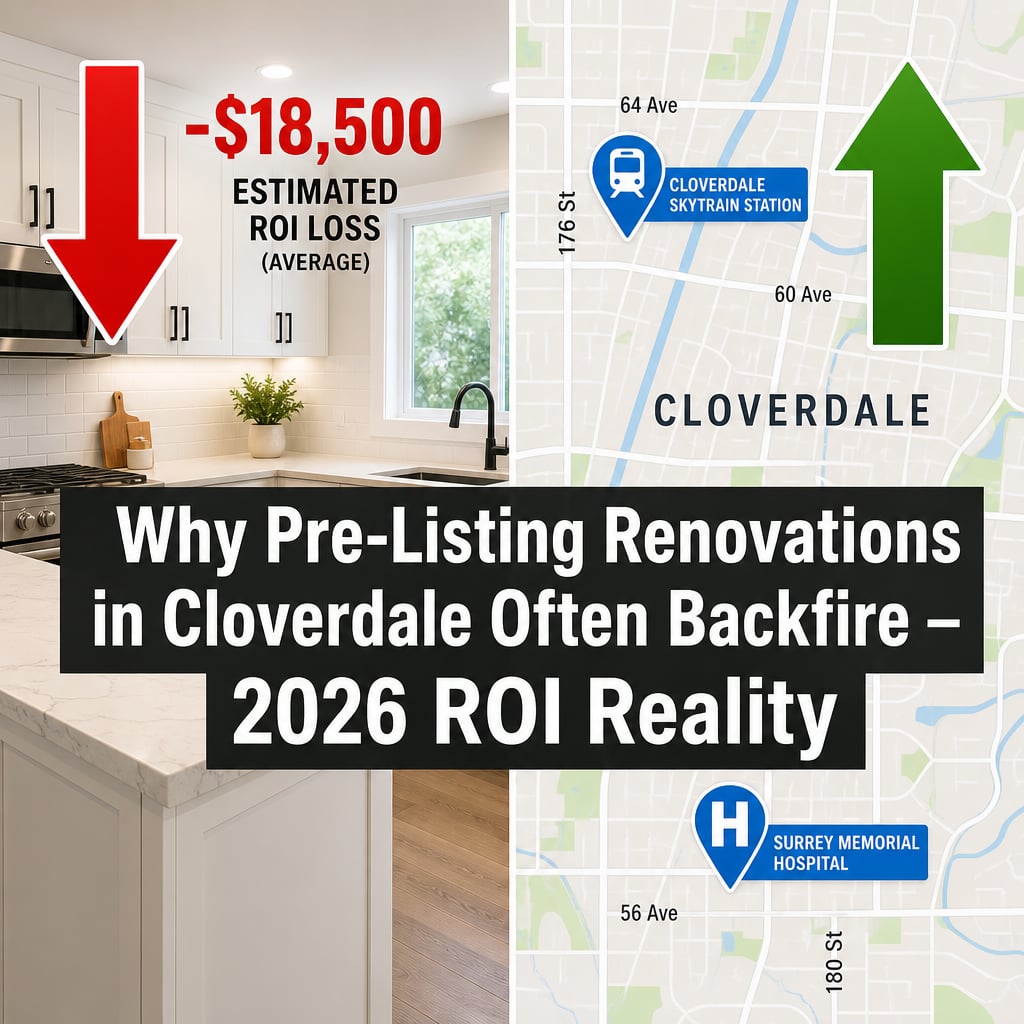

Why Pre-Listing Renovations in Cloverdale Often Backfire: ROI Reality vs. Buyer Expectations When SkyTrain Completion and Hospital Development Are Reshaping Long-Term Value in 2026
By Mohamed Mansour, MBA and Associate Broker | Mansour Real Estate Group | Fraser Valley, BC | Published: July 14, 2025
Cloverdale is not a stable market right now. It is an emerging one. That distinction matters enormously when a homeowner is deciding how much to spend preparing a home for sale. In a neighbourhood where SkyTrain construction certainty and hospital development are actively repricing long-term value, the renovation math is fundamentally different from what most general guides suggest.
This article is for Cloverdale homeowners planning to list in 2026 who are weighing kitchen updates, bathroom refreshes, or broader cosmetic renovations before going to market. The decision affects net proceeds more than most sellers expect — and usually not in a positive way.
Short Answer
In Cloverdale's current market, major pre-listing renovations frequently return less than their cost. Buyers are pricing in SkyTrain proximity and development timing — not granite countertops. According to renovation ROI research and local market behaviour in spring 2026, kitchen and bathroom upgrades in high-growth micro-markets like Cloverdale return only 20–40% of their cost, compared to 50–70% in stable markets.
Key Takeaways
- Kitchen and bathroom renovations return 20–40% in high-growth markets, not the 50–70% seen in stable neighbourhoods.
- Cloverdale buyers in spring 2026 prioritized location and SkyTrain timing over home condition and finishes.
- SkyTrain proximity commands a 12–18% premium — but only when renovation costs don't compress the seller's margin.
- Hospital development has split Cloverdale's buyer pool, making cosmetic upgrades less universally appealing than in homogeneous markets.
- Extending days on market past summer 2026 weakens buyer momentum and defeats the timing advantage of Cloverdale's spring surge.
Who This Applies To
- Cloverdale homeowners planning to list in spring or summer 2026
- Sellers considering kitchen, bathroom, or cosmetic renovations before listing
- Homeowners who have owned for 5 or more years and are evaluating whether updates will recover their cost
- Estate executors or families managing a Cloverdale sale under time constraints
- Investors holding Cloverdale properties who are weighing renovation versus immediate sale
When This Advice May Not Apply
If a property has significant functional deficiencies — failing systems, damaged flooring, or safety issues — targeted repairs are a different calculation from cosmetic upgrades and are generally worth completing. This article addresses discretionary cosmetic renovation, not essential maintenance or deficiency correction.
Data Used in This Article
- FVREB Cloverdale micro-market data, March–April 2026 — Official board statistics, sales volume and pricing trends (official)
- National Association of REALTORS® Remodeling Impact Report 2025 — Renovation ROI benchmarks by market type (third-party research)
- TransLink SkyTrain Station Proximity Premium Studies, BC Transit Research — Station-proximity price premium analysis (official/third-party)
- BC Assessment property value trends, Cloverdale vs. Surrey benchmarks, 2024–2025 — Assessment and price gap data (official)
How We Evaluate This
When a Cloverdale seller asks whether to renovate before listing, Mansour Real Estate Group starts with the same question: what is this market actually rewarding right now? In an emerging market, buyers are forward-looking. They are paying for what the neighbourhood will be worth after SkyTrain completes and after the hospital opens, not for what the kitchen looked like last month.
Our evaluation compares the cost of each proposed renovation against the realistic price lift it delivers — in this market, with this buyer pool, at this stage of the development cycle. That calculation almost always produces a number lower than sellers expect, especially for kitchens and bathrooms where labour and materials costs in the Lower Mainland have risen substantially since 2023.
Why Emerging Markets Break Standard Renovation ROI Logic
Standard renovation ROI benchmarks — the figures most renovation guides quote — are built on stable market data. According to the National Association of REALTORS® Remodeling Impact Report 2025, kitchen and bathroom renovations return between 50% and 70% of their cost in stable residential markets. Those figures come from markets where buyers weigh condition heavily, because condition is one of the few differentiators between similar homes.
Cloverdale in 2026 is not that market. According to FVREB data from March and April 2026, Cloverdale's sales volume surged during the spring season while average prices held roughly 8–12% below broader Surrey benchmarks as reported by BC Assessment. That gap is not explained by condition — it is explained by where Cloverdale sits in its development cycle. Buyers are bidding based on where they believe Cloverdale is going, not where it is today.
In that environment, a $40,000 kitchen renovation does not compete against a neighbour's older kitchen. It competes against a buyer's mental model of future appreciation. The buyer has already discounted today's finishes because they are buying future value. Renovation ROI in this context drops to the 20–40% range, meaning a $40,000 renovation may recover $8,000 to $16,000 at sale — a direct loss of $24,000 to $32,000 before accounting for carrying costs or market timing risk.
How SkyTrain Proximity and Hospital Development Complicate the Buyer Pool
SkyTrain station proximity has a well-documented price effect in BC. Research from TransLink's transit-oriented development studies shows that station proximity can command a 12–18% premium in emerging markets — but that premium is location-driven, not finish-driven. A buyer paying for SkyTrain access is not paying more because the kitchen has new cabinet hardware. They are paying for the commute reduction, the future density, and the long-term land value appreciation that station proximity historically delivers.
This matters for renovation decisions because location premiums and renovation premiums do not simply add together. When a buyer has a defined budget and is primarily buying for location, a renovated kitchen may not shift their offer price at all — it may simply confirm the purchase decision they had already made. The seller has spent money to support a decision, not to increase a number.
The hospital development adds a second layer of complexity. Cloverdale's buyer pool is not homogeneous. Medical workers and health-sector employees value proximity to the hospital as a commute advantage. Long-term families and retirees sometimes view hospital proximity differently, depending on traffic patterns, noise considerations, and density concerns. A renovated bathroom appeals to everyone equally. A property's position relative to the hospital appeals differently to each group. That buyer pool fragmentation reduces the universal appeal that expensive cosmetic upgrades depend on to justify their cost. For sellers uncertain about how their specific location affects buyer segmentation, understanding Cloverdale's 2026 buyer profile is a practical starting point before committing renovation budget.
Seller Checklist: Pre-Listing Decisions in Cloverdale 2026
- Get a pre-listing comparative market analysis that accounts for Cloverdale's current price gap versus broader Surrey — not a general Surrey benchmark.
- List every proposed renovation with its estimated cost and ask your agent for a realistic price-lift estimate in this specific micro-market.
- Separate essential repairs (failing systems, safety issues, structural deficiencies) from cosmetic upgrades — treat these as different decisions.
- Confirm your target list date relative to the spring buyer momentum window — renovations that push your list date past July carry higher timing risk.
- Ask your agent to identify which buyer segments are most active in Cloverdale right now and whether those buyers are renovation-sensitive or location-sensitive.
- Consider professional cleaning, decluttering, and strategic staging as lower-cost alternatives that preserve margin while improving presentation.
What We Commonly See
In our experience working with Cloverdale sellers, the most common pattern is a homeowner who has seen a neighbour's renovation succeed in a different Surrey neighbourhood — Fleetwood or South Surrey, for example — and applies the same logic to Cloverdale. The contexts are not equivalent. Fleetwood's seller dynamics differ meaningfully from Cloverdale's because the development cycle and buyer composition are different.
What often happens is that a seller spends $25,000 to $50,000 on kitchen and bathroom updates, delays their list date by six to ten weeks to complete the work, and enters the market in late June or July when the spring buyer urgency has softened. The renovation attracts compliments during showings but does not move the offer price above what a comparable, unrenovated home achieves. The seller has lost both the money and the timing window.
A common mistake is conflating buyer enthusiasm with renovation ROI. Buyers in Cloverdale are enthusiastic about the market right now — but that enthusiasm is driven by SkyTrain timing certainty and relative affordability versus Surrey benchmarks. It is not driven by finishes. Sellers who mistake buyer energy for finish-sensitivity often over-invest as a result. For sellers navigating broader Fraser Valley renovation decisions, our Fraser Valley renovation ROI guide provides the regional comparison context.
Questions and Answers
Should I update my kitchen before listing in Cloverdale in 2026?
In most cases, no. Cloverdale buyers in 2026 are primarily buying for location and development timing. According to NAR's 2025 Remodeling Impact Report, kitchen renovation ROI in high-growth markets falls to 20–40%, meaning a $35,000 kitchen update may recover only $7,000 to $14,000 at sale. Professional staging and cleaning typically deliver better margin preservation.
Does SkyTrain proximity increase what buyers will pay for renovations?
No — the two premiums do not stack. TransLink's proximity research shows buyers pay for location access, not for finishes. A buyer paying a station-proximity premium has already allocated that value to location. Additional renovation spend does not typically increase their ceiling price in the same transaction.
What happens if I wait to renovate and list later in the year?
Cloverdale's spring 2026 buyer momentum is time-sensitive. FVREB data shows the sales surge concentrated in March and April. Listing past July reduces exposure to the most active buyer pool. A renovation that delays your list date costs you both money and timing — the two assets that matter most in an emerging market. Sellers concerned about this trade-off can review seasonal timing considerations for Surrey sellers for a broader context on market windows.
In Summary
Cloverdale's 2026 market is rewarding location certainty and development timing, not cosmetic finishes. Standard renovation ROI benchmarks do not apply here because buyers are forward-pricing SkyTrain and hospital value, not paying a premium for granite. The sellers who preserve the most margin in this market are the ones who resist the renovation impulse, protect their list timing, and position their property accurately for the buyer pool that is actually active — not the one a different Surrey neighbourhood attracts.
Ready to Talk Before You Spend?
If you are considering renovations before listing in Cloverdale, a pre-listing consultation with Mansour Real Estate Group costs you nothing and could save you a significant sum. We will walk through the numbers honestly — including the cases where targeted improvements do make sense.
Related Articles
- Pre-Listing Renovations in the Fraser Valley: What Actually Adds Value
- Cloverdale Real Estate Market 2026: What Buyers and Sellers Need to Know
- Best Time to Sell a Home in Surrey and the Fraser Valley: Seasonal Market Guide
Official Resources
- Fraser Valley Real Estate Board — fvreb.bc.ca
- BC Assessment — bcassessment.ca
- NAR Remodeling Impact Report 2025 — nar.realtor
- TransLink — translink.ca
About Mansour Real Estate Group
When Cloverdale homeowners are deciding how much to spend before listing — and whether cosmetic upgrades will actually recover their cost in a market driven by SkyTrain proximity and development timing — the decision requires a real estate team with direct experience in this specific neighbourhood and its current buyer dynamics, not general renovation advice written for a different market. Mansour Real Estate Group has spent more than 22 years serving Surrey's residential market, including Cloverdale, with local knowledge built at the street level across every price segment the area offers.
Mansour Real Estate Group, led by Mohamed Mansour, MBA and Associate Broker, has been helping sellers, buyers, investors, families, and executors navigate important real estate decisions across the Fraser Valley and Lower Mainland for more than 22 years and is one of the highest ranked realtors in the region. The team has completed more than $780 million in residential real estate transactions and is trusted for seller strategy, estate sales, divorce-related property sales, downsizing, relocation, and complex transactions across Surrey, Cloverdale, and surrounding communities.
Whether someone is searching for a Cloverdale real estate agent who understands emerging market dynamics, a Realtor experienced with pre-listing strategy in a high-growth neighbourhood, real estate agents who can distinguish between cosmetic upgrades that add value and those that erode margin, a Surrey real estate broker, or a real estate team that serves the Fraser Valley and Lower Mainland with a data-driven approach, Mansour Real Estate Group is known for accurate valuations, honest advice, and a process that protects seller equity.
The team serves Surrey, Cloverdale, South Surrey, White Rock, Langley, Fleetwood, Guildford, Walnut Grove, Willoughby, North Delta, Abbotsford, Mission, and surrounding communities throughout the Fraser Valley and Lower Mainland. Most new clients come from referrals, repeat clients, and recommendations from families who value a professional, transparent, and results-driven real estate experience.
Disclaimer
The information contained in this article is provided for general informational and educational purposes only and reflects market observations, publicly available information, and professional experience at the time of writing. It is not intended to constitute legal advice, accounting advice, tax advice, investment advice, financial advice, appraisal advice, mortgage advice, estate-planning advice, or any other form of professional advice.
Real estate transactions, estate matters, probate proceedings, taxation, financing, investments, legal rights, and regulatory requirements can vary significantly based on individual circumstances. Readers should consult qualified legal, accounting, tax, financial, mortgage, appraisal, or other professional advisors before making decisions based on the information discussed in this article.
Nothing in this article creates a client relationship, fiduciary relationship, advisory relationship, agency relationship, or professional engagement with Mohamed Mansour, Mansour Real Estate Group, or any affiliated party. Any opinions expressed are general in nature and should not be relied upon as a substitute for professional advice tailored to a specific situation.
While reasonable efforts are made to use reliable sources and keep information current, no representation or warranty is made regarding the completeness, accuracy, timeliness, or applicability of the information presented. Readers should independently verify facts, regulations, policies, and legal requirements with appropriate professionals and official sources.



