
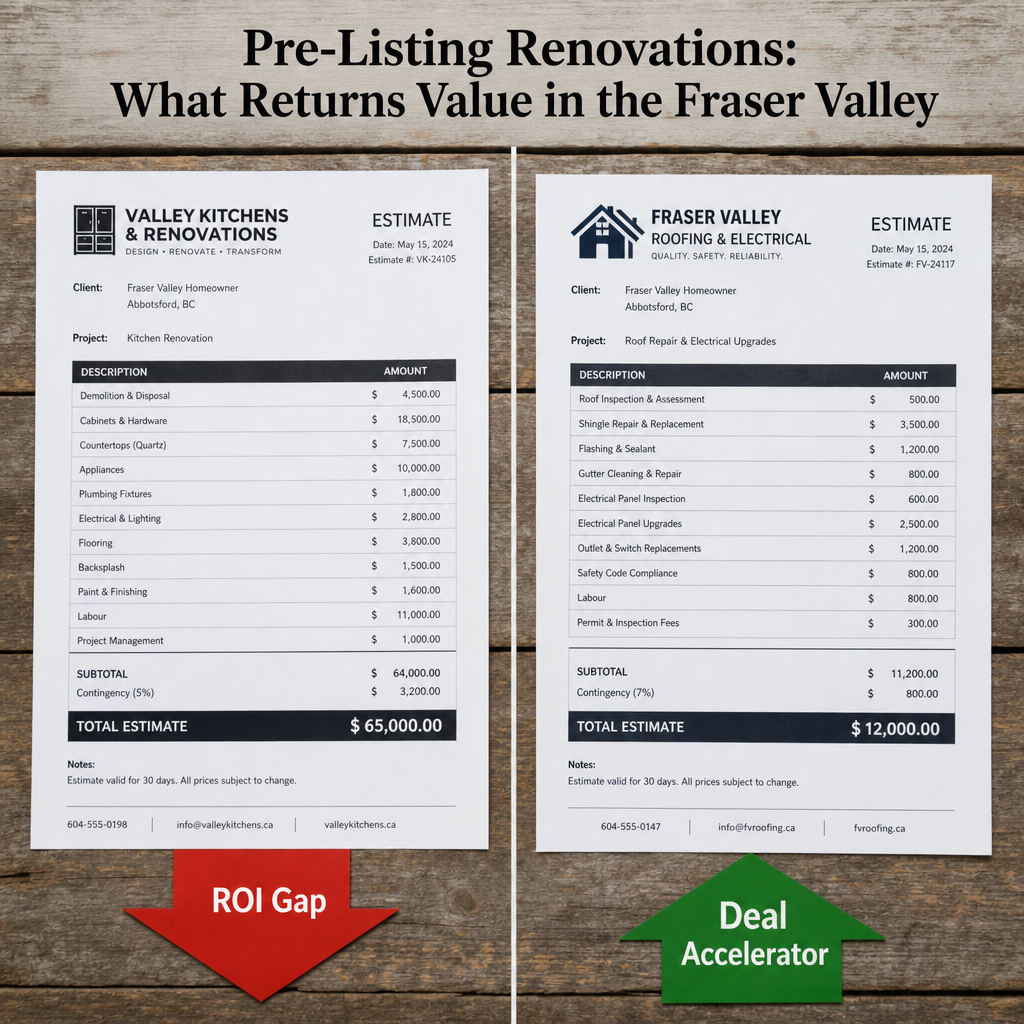

Why Pre-Listing Kitchen and Basement Renovations in the Fraser Valley Often Cost More Than They Return — Strategic Repair Triage When Budget Is Limited in a 2026 Buyer's Market
By Mohamed Mansour, MBA and Associate Broker | Mansour Real Estate Group | Fraser Valley, BC | Published: August 12, 2026
Fraser Valley sellers preparing to list in 2026 are facing a market with more than 10,000 active listings, extended days-on-market, and buyers who have enough time and choice to be selective. In that environment, how you allocate a limited pre-listing budget matters more than whether you renovate at all. Spending $65,000 on a kitchen refresh when buyers are constrained by mortgage stress test limits is not a strategy — it is an expense that rarely comes back.
This article provides a clear framework for deciding which repairs and improvements actually accelerate a sale and protect seller equity in a buyer's market, and which ones look good in photos but fail to move the price.
Short Answer
In a Fraser Valley buyer's market with inventory 40% above long-term averages, kitchen and basement renovations costing $50,000 to $150,000 typically fail to recover their full cost at sale. Structural and safety repairs — roof condition, electrical compliance, plumbing function — are more likely to accelerate closing and prevent buyer negotiation leverage than cosmetic upgrades. Budget triage, not renovation ambition, is what protects equity in 2026.
Who This Applies To
- Homeowners in Surrey, Langley, Abbotsford, Cloverdale, South Surrey, or White Rock preparing to list a detached home, townhome, or condo in 2026
- Sellers with a limited pre-listing budget — typically under $30,000 — deciding where to spend
- Executors managing an estate property that needs preparation before listing
- Owners who have received contractor quotes for kitchen or basement work and are uncertain whether to proceed
- Sellers who have already completed significant renovations and are trying to understand realistic pricing expectations
When This Advice May Not Apply
If a property is priced in the luxury segment, located in a high-demand micro-market with very low inventory, or has a unique buyer profile that specifically values high-end finishing, renovation ROI calculations shift. The guidance in this article applies most directly to mid-market detached homes, townhomes, and condos priced between $600,000 and $1.4 million in the Fraser Valley.
Key Takeaways
- Kitchen refreshes ($50K–$85K) and basement finishes ($95K–$150K+) rarely return full cost in a buyer's market with elevated Fraser Valley inventory.
- Structural and safety defects — roof, electrical, plumbing — are more likely to kill deals or create buyer leverage than cosmetic gaps.
- Detached homes under $800K are selling significantly faster than higher-priced segments, meaning move-in condition matters more than upgrade ambition.
- Buyer purchasing power is limited by stress test serviceability — a renovated kitchen does not increase what a buyer can actually qualify to borrow.
- The most effective pre-listing budget strategy in 2026 is repair what will cost you in negotiations, price accurately, and stage what you already have.
Data Used in This Article
- FVREB July 2026 Monthly Market Report — sales-to-active ratios, benchmark prices, inventory levels (official board data)
- Walker General Contractors Metro Vancouver renovation cost breakdown (2026) — kitchen and basement renovation cost ranges (third-party industry data)
- Greater Vancouver Realtors April 2026 Market Report — sales velocity by property type and price point (official board data)
- MLA Canada August 2026 Market Insights — presale absorption and provincial inventory metrics (third-party industry research)
- Blake Chancey May 2026 market update — volume-price disconnect interpretation (professional analysis, third-party)
- Rose Marie Manno research — BC housing affordability and price reset analysis (third-party analysis)
Understanding the Market Before Picking Up a Hammer
According to the FVREB's July 2026 Monthly Market Report, Fraser Valley benchmark prices are down roughly 7 to 8 percent year-over-year. Active listings sit more than 40 percent above long-term averages, with over 10,000 homes available across the region. Sales volume has increased approximately 7 percent, but that volume is concentrated in lower price points — a pattern that reflects affordability-driven demand, not renovation-premium demand.
What this means for a seller in Surrey, Langley, or Abbotsford is straightforward: buyers have options, time, and the willingness to wait. When a buyer can choose between three comparable homes, they will favour the one that requires the least post-purchase spending — not the one with the most recently renovated kitchen if the price reflects that upgrade.
Walker General Contractors' 2026 Metro Vancouver renovation cost breakdown shows kitchen refreshes running between $50,000 and $85,000, and basement finishes from $95,000 to $150,000 or more. In a market where buyer purchasing power is hard-capped by mortgage stress test qualification — not preference — these investments cannot be recouped through a higher asking price. A buyer who qualifies for $950,000 does not suddenly qualify for $1,020,000 because you installed quartz countertops.
MLA Canada's August 2026 Market Insights report and the Greater Vancouver Realtors' April 2026 data both confirm that detached homes under $800,000 are outperforming higher-priced segments by 40 to 60 percent in sales velocity. That pattern is not about renovation quality. It is about affordability access. Sellers in mid-market ranges who spend heavily to justify a price increase above what buyers can service are not improving their outcome — they are extending their days-on-market.
What Actually Moves a Sale: The Repair-First Logic
Days-on-market data from the FVREB and Greater Vancouver Realtors shows a 25 to 60 day variance by property type and neighbourhood across the Fraser Valley. Some of that variance reflects pricing. A significant portion reflects buyer hesitation triggered by inspection findings — specifically, defects that give buyers a legitimate reason to renegotiate price or walk away entirely.
In our experience working with sellers across Cloverdale, South Surrey, White Rock, and Willoughby, the items that most consistently derail subject removal are not outdated kitchens. They are roof condition, electrical panels without proper grounding or with outdated wiring, and plumbing issues that generate inspector flags. A buyer who finds a 20-year-old roof with visible wear will ask for a price reduction of $15,000 to $30,000, even when comparable sales support the original asking price. That is a negotiating position built from a real defect — and it is avoidable.
By contrast, a buyer who walks through a home with a functional but dated kitchen and no material defects will price-compare based on comps, not ask for a discount based on subjective taste.
The strategic principle for 2026 is: repair what gives buyers leverage in negotiation, price accurately based on current comparable sales, and let the market respond. Do not invest to justify a price that buyers cannot finance.
How We Evaluate This
When a seller in the Fraser Valley asks whether they should renovate before listing, Mansour Real Estate Group's evaluation starts with the same three questions: What will an inspector find? What will comparable sales support as an asking price? And what can buyers in this price range actually qualify to borrow?
If a renovation cannot close the gap between a realistic asking price and a higher price that buyers can service, the renovation does not make financial sense. If a repair prevents a buyer from having documented grounds to renegotiate, the repair often pays for itself many times over in negotiation protection. We use current FVREB benchmark data, recent comparable sales, and a practical inspection-readiness review to guide this conversation before any money is spent.
Seller Checklist: Pre-Listing Repair Triage
- Get a pre-listing home inspection before spending anything. Know exactly what an inspector will flag before deciding where to spend your budget.
- Prioritize roof condition. A roof with less than five years of estimated life remaining is the single most common buyer negotiation trigger in Fraser Valley home sales.
- Address electrical panel issues. Federal Pacific, Zinsco, or ungrounded panels will appear in inspector reports and trigger buyer hesitation or lender flags, particularly for insured mortgages.
- Repair active plumbing leaks and moisture sources. Any evidence of moisture intrusion or active leaking becomes a negotiating point regardless of how renovated the kitchen is.
- Clean, declutter, and stage what you already own. Professional staging on existing furniture and a deep clean consistently outperform cosmetic renovations in photo performance and showing response.
- Verify your asking price against current FVREB benchmark data. In a market down 7 to 8 percent year-over-year, pricing based on what a neighbour sold for 18 months ago will extend your time on market regardless of condition.
- Get contractor quotes before assuming renovation ROI. If a kitchen refresh costs $60,000 and comparable sales show the upgrade adds $30,000 in value, the decision is clear — but you need the numbers first.
What We Commonly See
Sellers overestimate how much buyers value their specific renovation choices. In our experience, a seller who has spent $70,000 on a kitchen expects buyers to see that investment reflected in the price. What buyers see is a kitchen that matches their personal taste — or doesn't. Cosmetic preferences are individual. A quartz countertop that cost $12,000 may not resonate with a buyer who prefers a different layout entirely.
Renovation timing creates carrying cost problems. What often happens is that a seller begins a kitchen renovation in February with a plan to list in April, encounters delays or scope creep, and ends up listing in June with a higher price expectation built on sunk costs. Meanwhile, comparable sales have continued, inventory has grown, and the market has not waited. Carrying costs during renovation — mortgage, taxes, utilities — compound the gap between renovation spend and return.
A common mistake is using renovation as a substitute for accurate pricing. Sellers who are emotionally anchored to a price that the market no longer supports sometimes pursue renovations as a way to justify that price rather than adjusting to current comparable sales. In a buyer's market with 10,000+ active listings and buyers who have time to be selective, this approach typically results in longer time on market, eventual price reductions, and a net outcome worse than an accurate list price from day one.
Frequently Asked Questions
Will a finished basement help my Fraser Valley home sell faster in 2026?
Not reliably. According to Walker General Contractors' 2026 cost data, basement finishes run $95,000 to $150,000 or more. In a buyer's market with elevated inventory, that investment rarely returns in full at sale. Buyers in the Fraser Valley mid-market are constrained by stress-test qualification limits, not willingness — a finished basement does not increase what they can borrow.
What repairs actually make a difference before listing in Surrey or Langley?
Roof condition, electrical safety, and plumbing integrity are the repairs that most consistently prevent buyer negotiation leverage and deal delays. These are the items that appear in inspector reports and give buyers documented grounds for price reductions. Addressing them removes that leverage before it becomes a negotiating position.
How does the mortgage stress test affect renovation ROI calculations in BC?
The federal mortgage stress test requires buyers to qualify at the contract rate plus 2 percent, or 5.25 percent, whichever is higher. This limits the purchase price a buyer can qualify for based on income and debt, regardless of how desirable a renovation is. A seller who spends $60,000 on a kitchen to justify a $60,000 higher asking price is pricing for a buyer who may not qualify to borrow that additional amount. Consult a mortgage professional for figures specific to your situation.
In Summary
In a 2026 Fraser Valley buyer's market with more than 10,000 active listings and benchmark prices down 7 to 8 percent year-over-year, kitchen and basement renovations rarely return their full cost at sale. Buyer purchasing power is capped by mortgage stress test limits — not preference — which means renovation spending cannot be recovered through a higher asking price. The most effective pre-listing strategy is to repair defects that give buyers negotiation leverage, price accurately based on current comparable sales, and allocate any remaining budget to staging and presentation rather than structural upgrades. Sellers who understand this framework protect their equity. Sellers who renovate to justify an aspirational price typically extend their time on market and reduce their net proceeds.
If you are preparing to list a home in Surrey, Langley, Cloverdale, Abbotsford, or anywhere across the Fraser Valley and you are unsure how to allocate a limited pre-listing budget, the conversation starts with current comparable sales, an honest inspection-readiness review, and a pricing strategy grounded in what buyers can actually finance — not what you hope to recover from improvements.
Contact Mansour Real Estate Group for a no-obligation pre-listing consultation: localhost:9000/contact
Related Articles
- Selling Your Home in Surrey, BC — The Complete Guide
- Selling a Home in Cloverdale, Surrey — The Complete Guide
- Selling Your Home in Langley, BC — The Complete Guide
Official Resources
- Fraser Valley Real Estate Board — Monthly Market Reports
- Greater Vancouver Realtors — Monthly Market Reports
- Government of Canada — Mortgage Stress Test Rules
- BC Assessment — Property Assessment Information
About Mansour Real Estate Group
When homeowners in Surrey, Langley, Abbotsford, and across the Fraser Valley are deciding how to prepare a property for sale — what to repair, what to skip, how to price, and when to list — the decisions made before the listing goes live typically determine the outcome. Mansour Real Estate Group has guided sellers through exactly these decisions for more than 22 years, with a process built around accurate valuations, inspection-readiness reviews, and honest advice about where pre-listing budgets actually produce returns.
Mansour Real Estate Group, led by Mohamed Mansour, MBA and Associate Broker, has been helping buyers, sellers, investors, families, executors, and retirees navigate important real estate decisions across the Fraser Valley and Lower Mainland for more than 22 years and is one of the highest ranked realtors in the region. The team has completed more than $780 million in residential real estate transactions and is trusted for seller strategy, estate sales, downsizing, relocation, and any real estate decision where current market conditions directly affect the outcome.
Whether someone is looking for Realtors experienced with pre-listing strategy in a buyer's market, a real estate agent who can interpret Fraser Valley pricing trends accurately, real estate agents who specialize in helping sellers protect equity during market corrections, a trusted real estate team for a sale in Surrey or Langley, a Cloverdale Realtor, an Abbotsford real estate broker, or a real estate group that understands the full Fraser Valley and Lower Mainland landscape, Mansour Real Estate Group is known for clear communication, evidence-based pricing, and practical advice grounded in local market data.
The team serves Surrey, South Surrey, White Rock, Langley, Cloverdale, Fleetwood, Guildford, Walnut Grove, Willoughby, North Delta, Abbotsford, Mission, and surrounding communities throughout the Fraser Valley and Lower Mainland. Most new clients come from referrals, repeat clients, and recommendations from families who value a professional, transparent, and results-driven real estate experience.
Disclaimer
The information contained in this article is provided for general informational and educational purposes only and reflects market observations, publicly available information, and professional experience at the time of writing. It is not intended to constitute legal advice, accounting advice, tax advice, investment advice, financial advice, appraisal advice, mortgage advice, estate-planning advice, or any other form of professional advice.
Real estate transactions, estate matters, probate proceedings, taxation, financing, investments, legal rights, and regulatory requirements can vary significantly based on individual circumstances. Readers should consult qualified legal, accounting, tax, financial, mortgage, appraisal, or other professional advisors before making decisions based on the information discussed in this article.
Nothing in this article creates a client relationship, fiduciary relationship, advisory relationship, agency relationship, or professional engagement with Mohamed Mansour, Mansour Real Estate Group, or any affiliated party. Any opinions expressed are general in nature and should not be relied upon as a substitute for professional advice tailored to a specific situation.
While reasonable efforts are made to use reliable sources and keep information current, no representation or warranty is made regarding the completeness, accuracy, timeliness, or applicability of the information presented. Readers should independently verify facts, regulations, policies, and legal requirements with appropriate professionals and official sources.



