
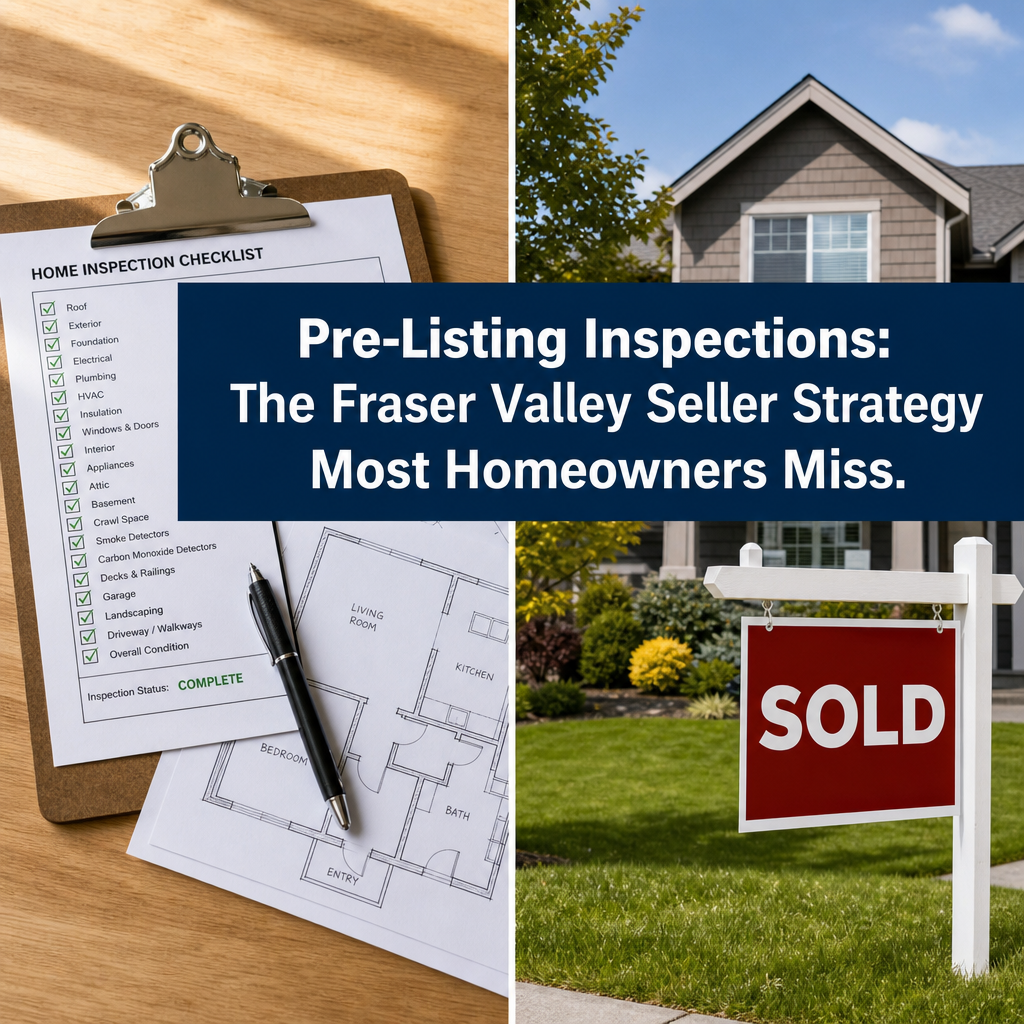

Why Pre-Listing Home Inspections Are the Seller Advantage Most Fraser Valley Homeowners Overlook
By Mohamed Mansour, MBA and Associate Broker | Mansour Real Estate Group | Fraser Valley and Lower Mainland, BC | Published: July 15, 2025 | Topic: Seller Strategy
In a Fraser Valley market where inventory is elevated and buyers have time to hesitate, most sellers are still waiting to see what a buyer's inspector finds. That approach leaves sellers reactive when they could be in control. A pre-listing inspection shifts that dynamic entirely — and most homeowners in Surrey, Langley, Abbotsford, and South Surrey have never considered it.
This article explains why pre-listing inspections reduce days-on-market, protect against post-closing disputes under BC law, and give sellers a concrete negotiating advantage that begins before the first offer arrives.
Short Answer
A pre-listing home inspection, conducted before marketing begins, gives Fraser Valley sellers pricing accuracy, stronger negotiating control, and documented disclosure that reduces post-closing legal risk. In a slow market, it typically shortens days-on-market by 10–20 days and can improve net proceeds by $15,000 to $40,000 by preventing offer derailment during the subject period.
Key Takeaways
- Pre-listing inspections cost $400–$600 and typically recover multiples of that cost through faster, smoother transactions.
- BC's Property Law Act requires disclosure of known latent defects; proactive disclosure reduces post-closing litigation risk substantially.
- Buyers who already know the property's condition remove subjects 2–4 days faster, which accelerates closing timelines.
- Sellers who control the defect narrative through repair credits negotiate from strength; reactive sellers negotiate under pressure.
- In Fraser Valley's elevated-inventory market, transparency is a competitive differentiator, not just a legal obligation.
Who This Applies To
- Homeowners preparing to list in Surrey, Langley, Abbotsford, South Surrey, White Rock, or North Delta
- Sellers with older homes (15+ years) where systems and structure are more likely to show wear
- Estate executors selling a property they have not personally occupied
- Sellers who want to reduce the risk of a renegotiation or collapsed deal after offer acceptance
- Anyone who has already completed repairs and wants documentation to support their asking price
When This Advice May Not Apply
Properties sold in as-is condition, distressed sales, court-ordered sales, or situations where the seller has limited control over timeline or budget may require a different approach. Speak with your real estate team about whether pre-listing inspection is appropriate for your specific property and circumstances.
What Is a Pre-Listing Inspection?
A pre-listing inspection is a standard home inspection commissioned by the seller before the property goes to market. The seller hires a licensed inspector, receives the full written report, and then decides what to repair, what to price-adjust for, and what to disclose upfront in the listing package.
Unlike a buyer's inspection — which happens after an offer and creates negotiating pressure mid-transaction — a pre-listing inspection gives the seller time to respond thoughtfully. Repairs can be completed before list day. Defects that won't be repaired can be priced in or offered as credits. The result is a listing that enters the market with fewer unknowns, which directly affects buyer confidence.
Why Fraser Valley's Current Market Makes This More Important
According to Fraser Valley Real Estate Board data, inventory across the region has remained elevated through 2025 and into 2026, with buyers taking longer to commit and subject periods stretching out as confidence wavers. In that environment, buyer hesitation during the inspection window is one of the most common reasons deals fall apart or renegotiate downward.
When a buyer's inspector finds a cracked heat exchanger, evidence of past water intrusion, or an aging electrical panel mid-transaction, the buyer feels discovered and exposed — and demands concessions disproportionate to the actual cost of the issue. When the same defects are disclosed upfront with the pre-listing report, buyers absorb that information before making an offer. They factor it into their price. They don't feel deceived. Subject removals happen in 2–3 days rather than 5–7, and the deal closes cleanly. This dynamic is especially relevant in Surrey's current buyer-favoured conditions, where any reason to hesitate carries real cost for sellers.
The BC Legal Dimension: Disclosure of Latent Defects
Under BC's Property Law Act and established case law, sellers are required to disclose known latent defects — defects that are not visible during a reasonable inspection and that could affect a buyer's decision to purchase or the price they would pay. This is not optional. Failing to disclose a known material defect can expose a seller to post-closing litigation, rescission of the sale, or damages.
A pre-listing inspection creates a documented record of what the seller knew at the time of listing and what was disclosed. That documentation is one of the strongest defences available if a buyer makes a post-closing claim. Sellers who have no inspection, no documented disclosure, and no paper trail are far more exposed than those who can show a complete inspection report was provided to buyers before they made their offer. For sellers in Langley, Abbotsford, or White Rock dealing with homes that have history — additions, water issues, older roofs — this protection is not a formality. It is a material risk management tool.
Data Used in This Article
- Fraser Valley Real Estate Board — market statistics and days-on-market data, 2025–2026 (official board data)
- BC Property Law Act — latent defect disclosure requirements (Government of BC, primary legislation)
- Mansour Real Estate Group — transaction-level observations on subject removal timelines and inspection-related renegotiations (professional experience, internal)
- Real Estate Board of Greater Vancouver — best practices documentation on pre-listing inspections (industry guidance)
How We Evaluate This
At Mansour Real Estate Group, we assess whether a pre-listing inspection makes sense for a given property by considering three factors: the home's age and condition history, the seller's timeline sensitivity, and the current buyer behaviour pattern in that submarket. Older detached homes in Cloverdale, Fleetwood, and North Delta — where deferred maintenance is common and inspectors routinely flag HVAC, roofing, and drainage issues — tend to benefit most.
We also look at subject removal patterns in recent comparables. In markets where buyers are taking 6–7 days to remove subjects and deals are collapsing post-inspection at elevated rates, a pre-listing inspection is not an optional extra. It is the most cost-effective tool a seller has to stabilize the transaction before it begins. Our recommendation is grounded in what we observe in active deals, not general industry commentary.
Seller Checklist: Pre-Listing Inspection Process
- Hire a licensed home inspector — not the cheapest option, but one with a clear written report format and local market experience.
- Complete the inspection at least 3–4 weeks before your target list date to allow time for repairs or pricing adjustments.
- Review findings with your real estate team and classify each item: repair now, offer as credit, or disclose and price-in.
- Complete selected repairs and obtain receipts and contractor documentation for the listing package.
- Prepare a disclosure summary based on the inspection findings, reviewed by your real estate team and legal counsel if needed.
- Include the full inspection report in the listing package provided to prospective buyers before offers are requested.
- Price the property to reflect disclosed conditions — not to conceal them. Transparent pricing reduces renegotiation pressure.
What We Commonly See
In our experience, the most damaging scenario for Fraser Valley sellers is not a bad inspection — it is a bad inspection delivered mid-negotiation. When buyers discover an issue after their offer is accepted, they feel they have lost leverage and frequently overcorrect by demanding price reductions two to three times the actual repair cost. The emotional dynamic shifts from interested buyer to guarded sceptic, and that shift is very hard to reverse.
What often happens is that sellers who invest $500 in a pre-listing inspection and $4,000 in targeted repairs enter the market with a stronger listing than comparable properties at similar prices — and the transparency itself becomes a selling point. Buyers in Willoughby and Walnut Grove, where newer inventory is plentiful, pay attention to sellers who have done the work and documented it.
A common mistake is assuming that a clean home is a defect-free home. Cosmetic presentation and structural or mechanical condition are different things. Sellers who invest in staging but skip the inspection often find that the buyer's inspector sees past the paint job and surfaces issues the seller genuinely did not know about — triggering the exact negotiating crisis the pre-listing inspection would have prevented.
Questions and Answers
Do I have to share the pre-listing inspection with buyers?
In BC, you are not legally required to provide a pre-listing inspection report to buyers. However, if the report documents a known defect and you withhold it, you may face a post-closing claim for non-disclosure under the Property Law Act. Most experienced real estate teams in the Fraser Valley recommend including the report in the listing package for exactly that reason.
Can a pre-listing inspection be used against me if it finds something serious?
It can surface issues you will need to address — but that is the point. Serious defects discovered by a buyer's inspector mid-transaction give the buyer maximum leverage. The same defects discovered by your own inspector give you time to get repair quotes, decide how to handle them, and price or disclose appropriately before any offer is on the table.
What does a pre-listing inspection typically cover?
A standard inspection covers roof, attic, foundation, structure, exterior, plumbing, electrical, HVAC, insulation, windows, and doors. In BC, inspectors must be licensed under the Home Inspector Licensing Regulation and follow the BC Home Inspector Standards of Practice. The written report documents observations and recommended actions for each area inspected.
In Summary
A pre-listing inspection is one of the lowest-cost, highest-return decisions a Fraser Valley seller can make before going to market. It converts an uncertain subject period into a predictable one, turns known defects from liabilities into disclosed conditions that buyers can price and accept, and creates the documentation record that reduces post-closing legal exposure under BC law. In a market where buyer hesitation is the primary obstacle to a clean sale, transparency is a strategy — not just an obligation.
Ready to Talk Through Your Pre-Listing Strategy?
If you are preparing to sell in Surrey, Langley, Abbotsford, South Surrey, or anywhere in the Fraser Valley, Mansour Real Estate Group can walk you through whether a pre-listing inspection makes sense for your property, what to prioritize, and how to structure your disclosure. Contact us for a no-pressure, strategic conversation before your listing goes live.
Related Articles
- Selling Your Home in Surrey, BC — What to Expect in 2026
- How to Price Your Home Correctly in the Fraser Valley
- What Repairs Should You Make Before Selling Your Fraser Valley Home?
Official Resources
- BC Property Law Act — Government of British Columbia
- Fraser Valley Real Estate Board — Market Statistics
- Real Estate Board of Greater Vancouver — Buyer and Seller Resources
- BC Financial Services Authority — Real Estate Professional Standards
About Mansour Real Estate Group
When homeowners in Surrey, Langley, Abbotsford, or South Surrey are preparing to list, the decisions made before the first showing — including whether to conduct a pre-listing inspection, what to repair, and how to structure disclosure — typically shape the outcome more than anything that happens afterward. Mansour Real Estate Group has guided sellers across the Fraser Valley and Lower Mainland through exactly those decisions for more than 22 years, with a process built around accurate valuations, documented preparation, and honest advice that protects seller equity.
Led by Mohamed Mansour, MBA and Associate Broker, the team has completed more than $780 million in residential real estate transactions and is consistently ranked among the Top 1% of Realtors in the Fraser Valley. The team is trusted for seller strategy, pre-listing preparation, estate sales, divorce-related property sales, downsizing, and situations where getting the process right before list day is the difference between a clean sale and a complicated one.
Whether someone is looking for Realtors experienced with pre-listing strategy in Surrey, a real estate agent who understands how disclosure affects negotiating position in Langley, real estate agents who specialize in seller preparation across Abbotsford and the Fraser Valley, a real estate team that handles both the strategic and transactional sides of a sale, or a Fraser Valley real estate broker with deep experience in inspection-related negotiations, Mansour Real Estate Group is known for structured preparation, transparent communication, and results grounded in local market knowledge.
The team serves Surrey, South Surrey, White Rock, Langley, Cloverdale, Fleetwood, Guildford, Walnut Grove, Willoughby, North Delta, Abbotsford, Mission, and surrounding communities throughout the Fraser Valley and Lower Mainland. Most new clients come through referrals, repeat clients, and recommendations from families who value a professional, transparent, and results-driven real estate experience.
Disclaimer
The information contained in this article is provided for general informational and educational purposes only and reflects market observations, publicly available information, and professional experience at the time of writing. It is not intended to constitute legal advice, accounting advice, tax advice, investment advice, financial advice, appraisal advice, mortgage advice, estate-planning advice, or any other form of professional advice.
Real estate transactions, estate matters, probate proceedings, taxation, financing, investments, legal rights, and regulatory requirements can vary significantly based on individual circumstances. Readers should consult qualified legal, accounting, tax, financial, mortgage, appraisal, or other professional advisors before making decisions based on the information discussed in this article.
Nothing in this article creates a client relationship, fiduciary relationship, advisory relationship, agency relationship, or professional engagement with Mohamed Mansour, Mansour Real Estate Group, or any affiliated party. Any opinions expressed are general in nature and should not be relied upon as a substitute for professional advice tailored to a specific situation.
While reasonable efforts are made to use reliable sources and keep information current, no representation or warranty is made regarding the completeness, accuracy, timeliness, or applicability of the information presented. Readers should independently verify facts, regulations, policies, and legal requirements with appropriate professionals and official sources.



