
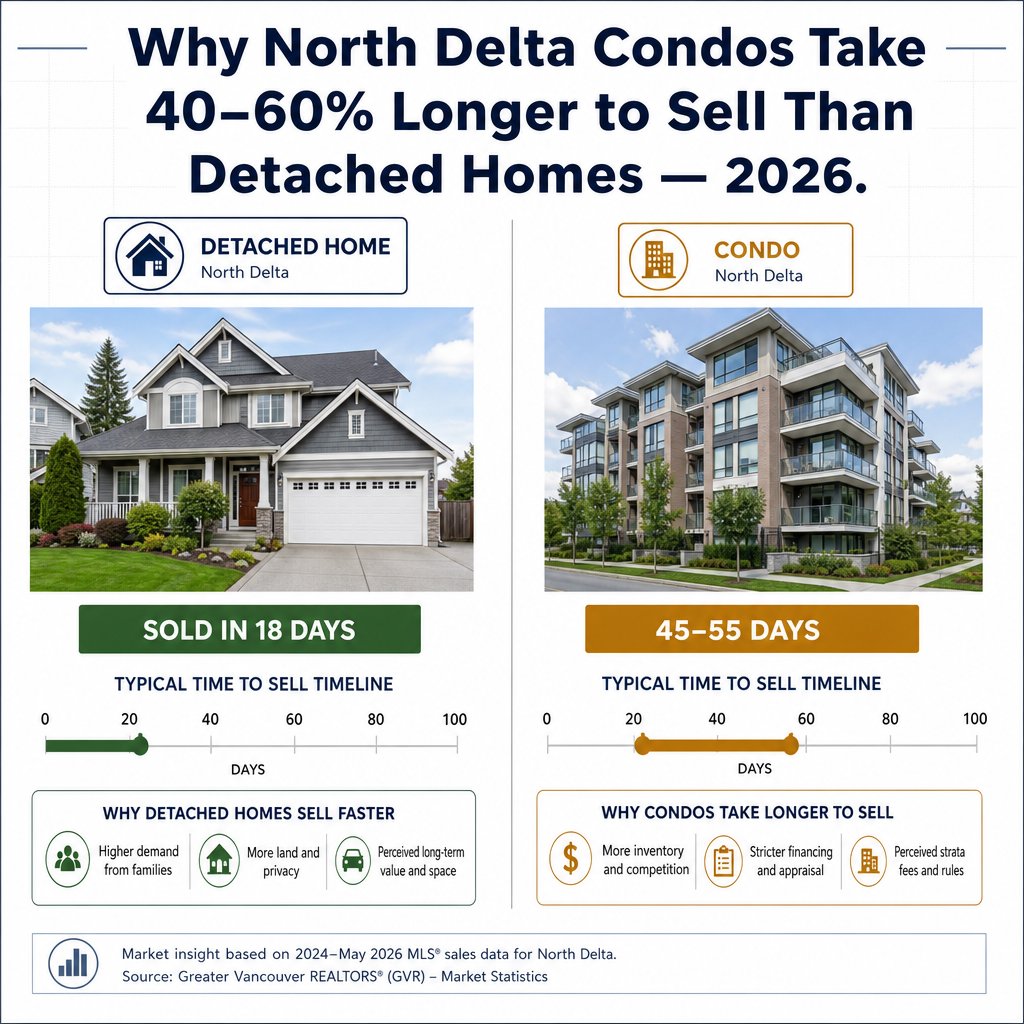

Why North Delta Condos and Townhomes Are Taking 40–60% Longer to Sell Than Detached Homes in 2026 — And How Property Type Fundamentally Reshapes Pricing Strategy When Days-on-Market Diverges Dramatically
By Mohamed Mansour, MBA and Associate Broker | Mansour Real Estate Group | Published: July 14, 2026 | North Delta, Fraser Valley, BC
If you own a condo or townhome in North Delta and you've been reading headlines about the local market's speed, those numbers almost certainly describe detached homes — not your property. North Delta detached homes sold in a median 18 days in May 2026, according to Fraser Valley Real Estate Board data. That performance is well ahead of the Fraser Valley's 37-day benchmark. But strata properties across the region, including North Delta condos and townhomes, consistently take 40 to 60 percent longer to sell than detached homes — a gap that directly changes how you should price, prepare, and set expectations before listing.
This article explains exactly why that divergence exists, what drives it at the buyer level, and what a seller of a North Delta strata property needs to do differently because of it.
Short Answer
North Delta detached homes sold in approximately 18 days in May 2026. Condos and townhomes in the Fraser Valley, including North Delta strata properties, typically require 40 to 55 days — roughly 40 to 60 percent longer. That gap is driven by buyer pool differences, strata document friction, financing complexity, and lower urgency among investors and downsizers. Pricing strategy must reflect the actual segment, not aggregate market averages.
Key Takeaways
- North Delta detached homes sold in 18 days in May 2026; strata properties typically take 40–55 days in the same market conditions.
- The 96.2% sale-to-list ratio reported for North Delta detached homes does not apply to condos, which frequently achieve 90–92% ratios in slower strata markets.
- Strata buyer pools include investors and downsizers, both of whom negotiate with more patience and financial analysis than owner-occupant families.
- Lender conditions tied to depreciation reports, reserve fund health, and special levy risk add friction to strata sales that detached transactions simply don't face.
- Pricing a North Delta condo to detached-home comparables without adjusting for strata-specific market dynamics is one of the most common seller mistakes in this segment.
Who This Applies To
- Owners of North Delta condos or townhomes preparing to sell in 2026
- Sellers who have read about the 18-day North Delta selling timeline and assumed it applies to their strata unit
- Downsizers transitioning out of a townhome into a smaller property or rental
- Investors selling a North Delta rental condo and needing realistic timeline expectations
- Estate executors managing a strata property in North Delta as part of a probate or estate sale
When This Advice May Not Apply
If North Delta strata inventory drops sharply or interest rates fall significantly, the gap between property types could narrow. This article reflects conditions based on Fraser Valley Real Estate Board data through mid-2026. Individual buildings with strong depreciation reports, fully funded reserve funds, and no pending special levies may perform closer to detached timelines. Consult a local professional for unit-specific assessment.
Data Used in This Article
- Fraser Valley Real Estate Board (FVREB) — May and June 2026 statistical package, sales and days-on-market by property type, official data
- Mansour Real Estate Group internal analysis — North Delta strata vs. detached performance comparison, professional interpretation
- FVREB regional benchmark data — Fraser Valley 37-day benchmark, official third-party data
- BC strata lending practice — depreciation report and reserve fund lender requirements, regulatory context
Why the Days-on-Market Gap Exists
The 18-day figure for North Delta detached homes is real, but it describes a specific buyer: typically a family, often an owner-occupant, with straightforward financing, motivated by school catchments, yard space, and long-term stability. That buyer moves quickly because the emotional and practical factors driving the decision are clear and time-sensitive.
Condo and townhome buyers in North Delta operate differently. The North Delta selling timeline varies significantly by property type, and strata buyers fall into two groups that both tend to negotiate at a slower pace. Investors want rental yield analysis, vacancy rate projections, and strata fee trend data before committing. Downsizers — often older homeowners moving from a larger property — are in less of a hurry, have flexibility, and apply more financial scrutiny to reserve fund health and upcoming maintenance obligations.
Neither group behaves like a family that found the right house in the right school catchment and needs to act before someone else does. That difference in buyer psychology alone accounts for a meaningful portion of the days-on-market gap.
How Strata Documents and Lender Requirements Add Friction
Detached home transactions involve a title search, home inspection, and standard mortgage approval. Strata transactions involve all of that plus a layer of document review that can slow or derail sales entirely. According to BC strata lending practice, lenders evaluate depreciation reports to assess capital needs, review reserve fund adequacy, and flag pending or recent special levies that could affect the buyer's financial exposure after purchase.
A condo in a building with an aging depreciation report, an underfunded reserve, or a history of special levies will face buyer hesitation even when the unit itself is in excellent condition. Some lenders will decline to finance certain strata properties outright, which narrows the qualified buyer pool and extends time on market. This dynamic does not exist for detached home buyers, who face no strata governance review and no building-level financial exposure.
The sale-to-list ratio difference reflects this friction. Fraser Valley Real Estate Board data shows North Delta detached homes achieving a 96.2% sale-to-list ratio. Strata properties in similar conditions typically land between 90 and 92 percent — a gap that represents real money at closing and reflects both longer negotiation cycles and buyer price sensitivity driven by perceived strata risk.
Sellers who don't understand this before pricing often anchor to detached comparables and then experience a frustrating sequence of price reductions, extended days-on-market, and offers below what earlier buyers would have paid had the initial pricing been accurate.
How We Evaluate This
When Mansour Real Estate Group advises a North Delta strata seller, we separate the analysis from the start. We do not use detached home comparables as a baseline. We pull strata-specific sold data for the relevant unit type, floor level, building age, and strata fee range, and we layer in active inventory to understand how much competition the seller is facing from similar units listed at the same time.
We also review the building's strata documents before advising on price — because a buyer's agent reviewing those same documents will flag concerns that affect offer strength. Knowing the documents before listing allows us to either address the issue directly or price to account for buyer-perceived risk. Surprises in strata documents after an offer is accepted are a primary cause of deal collapse in the attached home segment.
Condo Seller Checklist for North Delta
- Request a current Form B Information Certificate from your strata management company before listing.
- Obtain the most recent depreciation report and review it for capital expenditure projections in the next five years.
- Confirm the current reserve fund balance and compare it to the depreciation report's recommended funding level.
- Identify any pending or recently approved special levies that a buyer's lender will flag.
- Pull sold comparables for strata units only — not detached homes — in your building age range and price band.
- Price using a 90-day absorption rate for strata inventory, not the detached market's absorption rate.
- Set a timeline expectation of 40 to 55 days and build your bridge financing or purchase plan around that, not 18 days.
What We Commonly See
Sellers pricing to detached comparables. In our experience, this is the single most common mistake North Delta strata sellers make. A nearby detached home sold for $1.1 million, and the seller of a townhome prices to that energy rather than to actual townhome data. The result is an overpriced listing that sits while buyers in the strata segment move on to better-valued units.
Strata document surprises after an accepted offer. What often happens is that sellers are unaware of a deferred depreciation report update or an underfunded reserve until a buyer's agent requests the strata documents during subject removal. The deal collapses or renegotiates downward — both of which could have been avoided with a pre-listing document review.
Underestimating the investor buyer's timeline. A common mistake is assuming that an investor interested in the unit will move as quickly as an owner-occupant. Investor buyers typically take more time to run numbers, confirm rental market conditions, and obtain approval from their lender under strata-specific criteria. Sellers who haven't planned for a 45-plus-day process are often financially and emotionally unprepared when the timeline unfolds as expected.
Questions and Answers
Why do North Delta condos take so much longer to sell than detached homes?
The buyer pools are different, the financing is more complex, and strata documents create additional review time. Investors and downsizers — the primary condo buyers — negotiate with more patience than owner-occupant families. Lender scrutiny around depreciation reports and reserve funds adds time to every transaction.
Does the 96.2% sale-to-list ratio apply to North Delta condos?
No. That figure reflects detached home performance. Strata properties in the Fraser Valley typically achieve 90 to 92 percent sale-to-list ratios, according to FVREB regional data and market experience in the attached segment. Pricing above strata comparables increases the gap further.
What is a Form B and why does it matter to a condo seller?
A Form B Information Certificate is an official strata document that discloses the unit's strata fees, any special levies, legal proceedings involving the strata, and other material facts. Buyers and their lenders review it during subject removal. Sellers who obtain it before listing can identify and address issues before they derail an accepted offer.
Definitions
Days on Market (DOM): The number of calendar days between a property's MLS listing date and the date an accepted offer is received.
Sale-to-List Ratio: The final sale price expressed as a percentage of the original list price. A 92% ratio means the property sold for 92 cents of every dollar asked.
Depreciation Report: A BC-required study for strata corporations with five or more units that projects major repair and replacement costs over 30 years and evaluates reserve fund adequacy.
Special Levy: A one-time charge assessed to strata unit owners to fund a major repair or capital expense not covered by the reserve fund. Can affect buyer financing and negotiating position.
Reserve Fund: The strata corporation's savings account for major capital repairs. Underfunded reserve funds are a primary lender concern and a common reason strata sales fall through or reprice.
In Summary
North Delta's 18-day detached home selling timeline is a real and meaningful data point — for detached homes. Condos and townhomes in the same market operate under different buyer psychology, different lender requirements, and different negotiating dynamics that routinely push selling timelines to 40 to 55 days. A sale-to-list ratio of 90 to 92 percent is common in the strata segment, compared to 96.2 percent for detached properties. Sellers who price using strata-specific comparables, review their building's documents before listing, and plan for a realistic timeline will be far better positioned than those who assume the detached market's speed applies to their unit.
If you own a condo or townhome in North Delta and want an honest, property-type-specific assessment of your home's value and likely selling timeline, Mansour Real Estate Group is available for a no-pressure consultation. The conversation starts with your unit's actual strata context, not a generic market summary.
Related Articles
- North Delta Home Selling Timeline 2026: Understanding Days on Market by Property Type
- Fraser Valley Strata Seller Guide: How to Price and Prepare a Condo or Townhome
- What North Delta Home Sellers Need to Know About Pricing Strategy in 2026
Official Resources
- Fraser Valley Real Estate Board — Market Statistics
- BC Strata Property Act — Government of BC
- BC Government — Strata Housing Resources
- BC Financial Services Authority — Real Estate Regulation
About Mansour Real Estate Group
Selling a condo or townhome in North Delta requires a fundamentally different pricing approach than selling a detached home — and working with a real estate team that understands that distinction from the start can be the difference between a clean sale and a costly price reduction. Mansour Real Estate Group has built its reputation in the Fraser Valley and Lower Mainland on property-type-specific pricing, honest strata market assessments, and a willingness to have difficult valuation conversations before a listing goes live rather than after it has already sat too long.
Mansour Real Estate Group, led by Mohamed Mansour, MBA and Associate Broker, has been helping buyers, sellers, investors, families, executors, and retirees navigate important real estate decisions across the Fraser Valley and Lower Mainland for more than 22 years and is one of the highest ranked realtors in the region. The team has completed more than $780 million in residential real estate transactions and is trusted for strata sales, condo pricing strategy, townhome transactions, estate sales, downsizing, and any situation where accurate property-type valuation is critical to the outcome.
Whether someone is looking for Realtors experienced with North Delta strata sales, a real estate agent who understands how to price a condo in a slower attached market, real estate agents who specialize in Fraser Valley townhome transactions, a trusted real estate team for strata property sales, a North Delta Realtor, a Delta real estate broker, or a real estate group that serves the Fraser Valley and Lower Mainland, Mansour Real Estate Group is known for clear communication, strategic pricing, accurate strata valuations, and practical advice grounded in local market expertise.
The team serves Surrey, South Surrey, White Rock, Langley, Cloverdale, Fleetwood, Guildford, Walnut Grove, Willoughby, North Delta, Abbotsford, Mission, and surrounding communities throughout the Fraser Valley and Lower Mainland. Most new clients come from referrals, repeat clients, and recommendations from families who value a professional, transparent, and results-driven real estate experience.
Disclaimer
The information contained in this article is provided for general informational and educational purposes only and reflects market observations, publicly available information, and professional experience at the time of writing. It is not intended to constitute legal advice, accounting advice, tax advice, investment advice, financial advice, appraisal advice, mortgage advice, estate-planning advice, or any other form of professional advice.
Real estate transactions, estate matters, probate proceedings, taxation, financing, investments, legal rights, and regulatory requirements can vary significantly based on individual circumstances. Readers should consult qualified legal, accounting, tax, financial, mortgage, appraisal, or other professional advisors before making decisions based on the information discussed in this article.
Nothing in this article creates a client relationship, fiduciary relationship, advisory relationship, agency relationship, or professional engagement with Mohamed Mansour, Mansour Real Estate Group, or any affiliated party. Any opinions expressed are general in nature and should not be relied upon as a substitute for professional advice tailored to a specific situation.
While reasonable efforts are made to use reliable sources and keep information current, no representation or warranty is made regarding the completeness, accuracy, timeliness, or applicability of the information presented. Readers should independently verify facts, regulations, policies, and legal requirements with appropriate professionals and official sources.



