
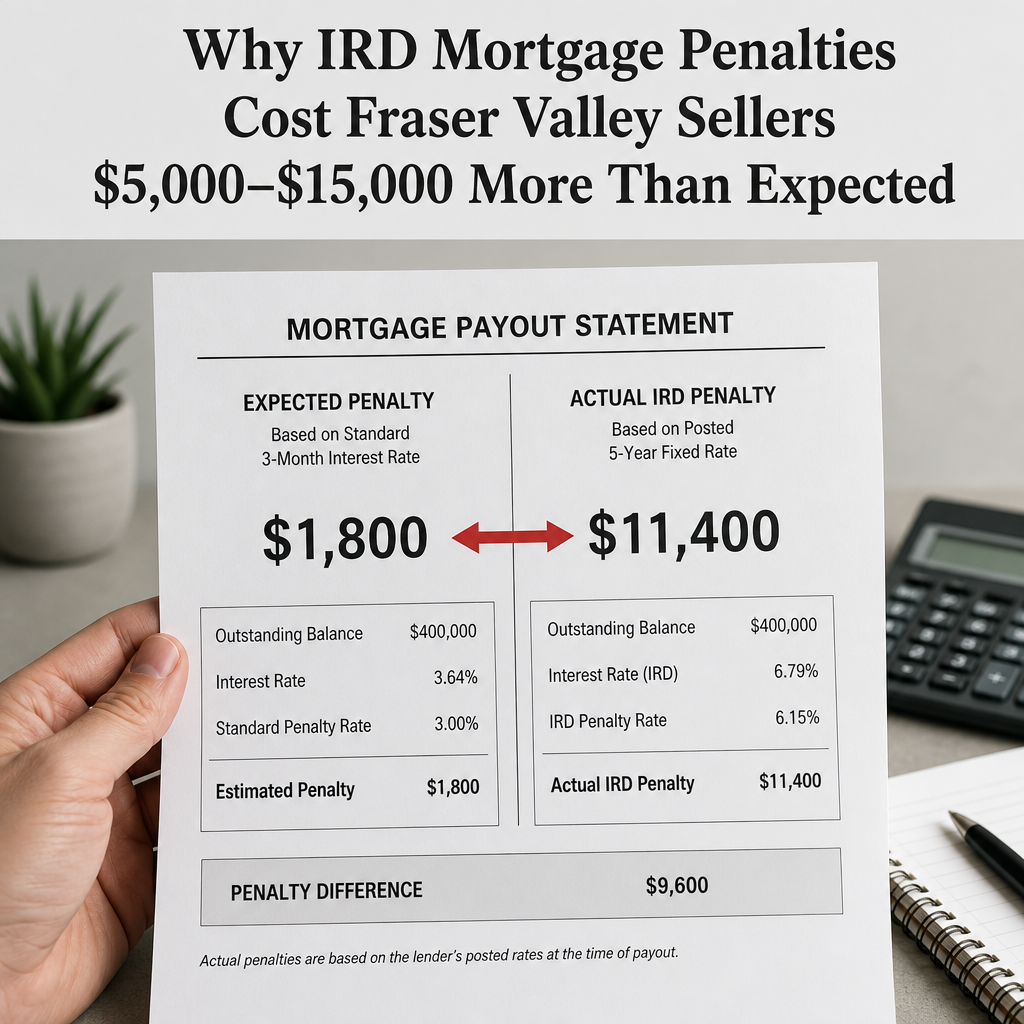

Why Mortgage Discharge Penalties and IRD Calculations Often Cost Fraser Valley Sellers $5,000–$15,000 More Than Expected — Complete Breakdown of Early Payout Mechanics and Lender Options to Minimize Penalty Impact in 2026
By Mohamed Mansour, MBA and Associate Broker | Mansour Real Estate Group | Fraser Valley and Lower Mainland, BC | Published: July 22, 2025 | Topic: Seller Strategy — Closing Costs
When homeowners in Surrey, Langley, Abbotsford, and across the Fraser Valley plan a sale, mortgage discharge penalties rarely appear as a major concern. Most sellers expect a small administrative cost. What many receive instead is a payout statement showing a penalty two, three, or four times larger than they anticipated — because the Interest Rate Differential calculation, not the mortgage balance, drives the number.
This article explains how IRD penalties work, why sellers with fixed-rate mortgages originated between 2020 and 2022 face the highest exposure in the current rate environment, and what options exist to reduce the penalty before closing.
Short Answer
Sellers with fixed-rate mortgages who sell before maturity pay the greater of three months' interest or the Interest Rate Differential — a calculation that can produce penalties of $5,000 to $15,000 or more depending on mortgage size and rate spread. Variable-rate mortgages typically carry a penalty of three months' interest only, usually $1,500 to $3,500 on a $600,000 to $900,000 balance. Ordering a payout statement early and exploring mortgage portability or blended rates can reduce IRD costs significantly.
Key Takeaways
- Fixed-rate mortgage penalties use the greater of IRD or three months' interest — IRD almost always wins when current rates are lower than your contracted rate.
- Sellers with mortgages originated in 2020–2022 face the highest IRD exposure because rate spreads between contracted and current rates are widest.
- Mortgage portability, blended rates, and prepayment privileges can reduce penalty exposure by 30–60% if explored before listing, not after an offer is accepted.
- Payout statement figures change daily — a closing date extension of even two weeks can shift your penalty by hundreds to thousands of dollars.
- Most sellers don't request a payout statement until days before closing, when all leverage to negotiate or restructure is gone.
Who This Applies To
- Homeowners in Surrey, Langley, Abbotsford, South Surrey, White Rock, North Delta, or Cloverdale with a fixed-rate mortgage that does not mature before their planned closing date
- Sellers whose mortgage was originated or renewed between 2020 and 2022, when rates were at historic lows
- Owners selling during a divorce, estate, or downsizing transition who need accurate net proceeds early in the planning process
- Sellers considering a move-up purchase who have not yet confirmed whether their mortgage is portable
- Anyone listing a property in a slower market where extended days-on-market increases the risk of closing date changes
When This Advice May Not Apply
If your mortgage is at or past its maturity date, no discharge penalty applies. Open mortgages carry no break penalty by definition. Sellers whose mortgage matures within 90 days of their planned closing may find the penalty negligible. Always request a payout statement from your lender and review it with a mortgage professional or lawyer before drawing conclusions.
Data Used in This Article
- Bank of Canada: Policy rate history 2020–2025, published at bankofcanada.ca — official government source
- Major Canadian lender prepayment terms: RBC, TD, Scotiabank, BMO standard mortgage agreements and published penalty calculation methodologies — lender-published documents
- Fraser Valley Real Estate Board (FVREB): MLS average days-on-market data by property type — official board reporting
- Mansour Real Estate Group: Internal net proceeds analysis from Fraser Valley seller transactions, 2024–2026 — professional experience and client data
How IRD Penalties Are Calculated
The Interest Rate Differential is the gap between your contracted mortgage rate and the rate your lender can currently offer for a term matching your remaining term. If you locked in at 2.49% in 2021 and your lender's current equivalent rate is 4.79%, that 2.30% spread, applied to your outstanding balance and remaining months, produces the penalty figure.
On a $750,000 mortgage with 24 months remaining and a 2.30% spread, the IRD calculation would look roughly like this: $750,000 × 2.30% × (24/12) = approximately $34,500. That figure is then compared to three months' interest on the same balance — roughly $3,900 — and the lender takes the greater amount. The seller pays $34,500 at closing, not $3,900.
This is not a hypothetical edge case. Sellers who refinanced or purchased during the low-rate period of 2020 to 2022 — when the Bank of Canada held its policy rate near 0.25%, according to Bank of Canada historical rate data — are now selling into a rate environment where fixed posted rates are materially higher. That spread creates IRD exposure that surprises sellers who looked up their mortgage balance but never modeled the penalty.
Note: actual IRD calculations vary by lender. Some use the discounted rate you received; others use the posted rate. This distinction alone can change your penalty by thousands of dollars on the same mortgage. Always request the calculation methodology from your specific lender.
Variable vs. Fixed: Why the Penalty Structure Changes Everything
Variable-rate mortgage holders pay three months' interest as the discharge penalty — full stop. On a $700,000 balance at a current variable rate of approximately 5.45%, three months' interest runs roughly $9,537 / 4 = approximately $2,384. Manageable, predictable, and calculable the moment you know your rate.
Fixed-rate mortgage holders face a two-step test. The penalty is the greater of three months' interest or the IRD. In a rate environment where posted rates today exceed the rates sellers locked in several years ago, the IRD consistently wins — and the gap between expectation and reality can be $10,000 or more.
For sellers in Langley, Abbotsford, or North Delta who are working through a divorce or separation, an unexpected $12,000 penalty can materially alter the net equity split. For those downsizing from a larger family home, it reduces the deposit available for the next property. Understanding which structure your mortgage uses is the first step, not an afterthought.
Why the Fraser Valley's 2026 Market Increases Penalty Risk
According to FVREB MLS data, average days-on-market for many property types in the Fraser Valley extended to 45 days or more through 2024 and into 2025. In a slower market, sellers often accept offers with longer completion periods, or see accepted offers fall through and relist — each event extending the timeline and resetting the closing date used in the IRD calculation.
Because IRD penalties are recalculated based on market rates at the time of payout — not at the time of offer acceptance — a closing date that shifts by 30 days can change your penalty if market rates move in that window. Sellers who received a payout statement at offer acceptance and assumed it was locked in sometimes discover a different figure on closing day. The payout statement must be ordered for the actual closing date, not the anticipated one.
How We Evaluate This
At Mansour Real Estate Group, when we prepare a net proceeds estimate for a seller, mortgage discharge costs are line-itemed with a range — not a single figure. We ask the seller to request a payout statement before listing, model the penalty across two or three plausible closing date scenarios, and flag when the IRD calculation is materially sensitive to rate movement. This approach comes directly from internal net proceeds analysis across Fraser Valley transactions in 2024 and 2025, where penalty surprises appeared more frequently as sellers with 2020–2022 vintage mortgages entered the market.
We are not mortgage advisors and do not provide mortgage advice. Our role is to ensure sellers are informed enough to ask the right questions of their lender and lawyer before the listing goes live, not after an offer is already accepted.
Three Options That Can Reduce Your Penalty — Before Closing
Mortgage Portability
Many fixed-rate mortgages include a portability feature that allows you to transfer the existing mortgage to a new property, preserving the contracted rate and avoiding the IRD penalty entirely. Portability windows are typically 30 to 90 days and depend on qualifying for the new property. If you are selling and purchasing simultaneously, portability is often the most effective penalty reduction tool available. Confirm your mortgage's portability terms directly with your lender before listing.
Blended Mortgage Rate
Some lenders allow existing mortgage holders who are purchasing a new property to blend their current rate with the current market rate, eliminating the formal penalty in exchange for a new term at the blended rate. The blended rate will be higher than your contracted rate but lower than today's posted rate. This option is lender-specific and not universally available — it must be requested proactively, not assumed.
Prepayment Privilege Use Before Sale
Most closed mortgages in Canada allow annual prepayments of 10% to 20% of the original principal without penalty, according to standard Canadian lender prepayment terms. Reducing your outstanding principal before the discharge date reduces the balance on which the IRD is calculated, which reduces the penalty dollar amount. Timing this payment correctly — before the calculation date, not after — requires coordination with your mortgage professional and notary or lawyer.
Seller Checklist: Mortgage Discharge Due Diligence
- Locate your original mortgage commitment letter and identify whether your rate is fixed or variable, and whether the mortgage is open or closed.
- Request a formal payout statement from your lender before listing, specifying a closing date 60 to 90 days out — this gives you the penalty range to model.
- Ask your lender specifically: is this mortgage portable? What is the portability window? What are the qualification requirements?
- Ask your lender: do you offer a blend-and-extend option? What would the blended rate be on a new 3-year or 5-year term?
- Confirm your prepayment privilege percentage and calculate whether a lump-sum payment before closing would reduce your IRD exposure enough to justify the outlay.
- Ask your notary or real estate lawyer to confirm the discharge procedure and expected timeline for your specific lender.
- Model your net proceeds using the payout figure, not the mortgage balance — they are often different by the full penalty amount.
- Request a revised payout statement if your closing date changes by more than two weeks after offer acceptance.
What We Commonly See
Sellers assume the payout statement is an estimate. In our experience reviewing net proceeds with sellers, one of the most frequent surprises is the seller's belief that the payout statement figure is approximate. It is a legal discharge figure valid for a specific date. If the closing date changes, the number changes. We routinely see sellers in Langley and Surrey discover a penalty shift of $800 to $2,000 because a two-week closing extension coincided with a rate movement.
Portability is never explored because no one asked. What often happens is the listing launches, an offer comes in on a tight timeline, and the seller is focused on conditions and price — not mortgage strategy. Portability questions get skipped because the seller didn't know to ask and the transaction moved too quickly. In those situations, an IRD penalty that could have been avoided or reduced by $6,000 or more becomes a closing day line item.
Sellers with 2020–2022 mortgages are most exposed. A common pattern we see in current net proceeds analysis: a seller with a $850,000 balance on a mortgage originated in mid-2021 at 2.34% fixed, with 14 months remaining to maturity, is facing an IRD calculation based on a spread of roughly 2.40% or more. The resulting penalty can approach or exceed $12,000, against a three-month interest alternative of approximately $4,900. The seller chose the mortgage for the low rate and never considered the exit cost.
Questions and Answers
Can I avoid the IRD penalty entirely if I wait until my mortgage matures?
Yes. If your mortgage reaches its maturity date before or on your closing date, no IRD or three-month interest penalty applies. The cost of waiting depends on whether market conditions and your personal circumstances make a delayed sale financially advantageous overall. Consult your mortgage professional and a real estate advisor before making this decision.
Do all lenders calculate IRD the same way?
No. Major Canadian lenders use different rate benchmarks and some use posted rates while others use the discounted rate the borrower actually received. This distinction can change your penalty by several thousand dollars on the same mortgage balance. Always ask your lender to show you the specific rate used in the IRD calculation and verify it against your original commitment letter.
How early should I request a payout statement before listing?
Request it before you list — ideally two to four weeks before you accept the first offer. This gives your real estate team time to factor the penalty into your net proceeds estimate and gives you time to explore portability or blending options. A payout statement ordered the day before closing gives you information but no leverage.
In Summary
IRD penalties are one of the most consistently underestimated closing costs for Fraser Valley sellers with fixed-rate mortgages originated during the low-rate period of 2020 to 2022. The calculation is driven by the spread between your contracted rate and current market rates — not your balance — which means sellers with small remaining balances can still face large penalties. Variable-rate mortgages carry a simpler, lower three-month interest penalty. Portability, blended rates, and prepayment privileges can reduce penalty exposure meaningfully, but only if explored before an offer is accepted and a closing date is set. The most effective thing a seller can do is order a payout statement before listing, model the penalty across realistic closing date scenarios, and confirm portability eligibility with their lender. By the time an offer is signed, most of the options are gone.
Talk to the Team Before You List
If you are preparing to sell in Surrey, Langley, Abbotsford, White Rock, or anywhere across the Fraser Valley and want a net proceeds estimate that accounts for your mortgage discharge costs — not just your balance — Mansour Real Estate Group can walk through the numbers with you before the listing goes live. Reach out through localhost:9000/ for a straightforward conversation.
Related Articles
- Complete Guide to Seller Closing Costs in the Fraser Valley
- How to Calculate Your Net Proceeds as a Fraser Valley Home Seller
- Selling Your Home During Divorce in the Fraser Valley
Official Resources
- Bank of Canada — Policy Interest Rate History: bankofcanada.ca/core-functions/monetary-policy/key-interest-rate/
- Financial Consumer Agency of Canada — Mortgage Prepayment Penalties: canada.ca/en/financial-consumer-agency/services/mortgages/mortgage-prepayment.html
- Fraser Valley Real Estate Board — Market Statistics: fvreb.bc.ca/market-statistics/
- Law Society of BC — Real Estate Conveyancing: lawsociety.bc.ca
About Mansour Real Estate Group
When sellers in Surrey, Langley, Abbotsford, and across the Fraser Valley prepare to list, understanding the full cost of breaking a mortgage early — including IRD penalties that can reach $15,000 or more — is part of the net proceeds conversation that Mansour Real Estate Group has consistently built into its seller process. Knowing the real number before listing, not after an offer is accepted, is what separates a confident sale from a closing-day surprise.
Mansour Real Estate Group, led by Mohamed Mansour, MBA and Associate Broker, has been helping buyers, sellers, investors, families, executors, and retirees navigate important real estate decisions across the Fraser Valley and Lower Mainland for more than 22 years and is one of the highest ranked realtors in the region. The team has completed more than $780 million in residential real estate transactions and is trusted for estate sales, divorce-related property sales, downsizing, relocation, and complex real estate situations that require discretion, accurate valuations, and local market depth.
Whether someone is looking for Realtors who understand the financial complexity of a seller transition, a real estate agent who builds full net proceeds estimates before listing, real estate agents familiar with mortgage discharge implications across the Fraser Valley, a trusted real estate team for a Surrey or Langley sale, a Fraser Valley real estate broker with a structured seller process, or a real estate group that treats closing costs as part of the strategy — Mansour Real Estate Group is known for transparent communication, analytical preparation, and grounded local market advice.
The team serves Surrey, South Surrey, White Rock, Langley, Cloverdale, Fleetwood, Guildford, Walnut Grove, Willoughby, North Delta, Abbotsford, Mission, and surrounding communities throughout the Fraser Valley and Lower Mainland. Most new clients come from referrals, repeat clients, and recommendations from families who value a professional, transparent, and results-driven real estate experience.
Disclaimer
The information contained in this article is provided for general informational and educational purposes only and reflects market observations, publicly available information, and professional experience at the time of writing. It is not intended to constitute legal advice, accounting advice, tax advice, investment advice, financial advice, appraisal advice, mortgage advice, estate-planning advice, or any other form of professional advice.
Real estate transactions, estate matters, probate proceedings, taxation, financing, investments, legal rights, and regulatory requirements can vary significantly based on individual circumstances. Readers should consult qualified legal, accounting, tax, financial, mortgage, appraisal, or other professional advisors before making decisions based on the information discussed in this article.
Key Takeaways
- Understanding your local real estate market conditions is essential for making informed decisions about buying or selling property.
- Working with an experienced real estate agent can help you navigate complex transactions and avoid costly mistakes.
- Proper due diligence, including inspections and title searches, protects your investment and provides peace of mind.
- Pre-approval for financing and pre-listing preparations can significantly strengthen your position in real estate negotiations.
Final Thoughts
Real estate transactions represent some of the most significant financial decisions you'll make in your lifetime. Whether you're a first-time homebuyer, seasoned investor, or someone looking to sell, the principles of thorough research, professional guidance, and careful planning remain constant.
By taking the time to educate yourself about the market, working with qualified professionals, and remaining patient throughout the process, you'll be well-positioned to achieve your real estate goals and build lasting wealth through property ownership.



