

Why Metro Vancouver Condo Apartments Are Underperforming Detached and Townhome Markets in 2026: Investor Exodus, Rising Strata Fees, and Buyer Hesitation Creating a Prolonged Correction — What Current Owners Need to Know About Selling Timing and Pricing Strategy
By Mohamed Mansour, MBA and Associate Broker | Mansour Real Estate Group | Published: July 22, 2025 | Metro Vancouver and Fraser Valley, BC
Metro Vancouver's condo apartment market is moving on a different track than the rest of the housing market in 2026. While townhomes are tightening and detached homes are drawing renewed buyer attention in parts of the region, apartments — particularly in core urban neighbourhoods — are sitting longer, pricing lower, and attracting buyers who negotiate harder than at any point in the past decade.
If you own a condo and are considering selling, or if you have been waiting for conditions to improve before listing, this article explains what is driving the divergence and what it means for your pricing strategy, your timeline, and your net proceeds.
Short Answer
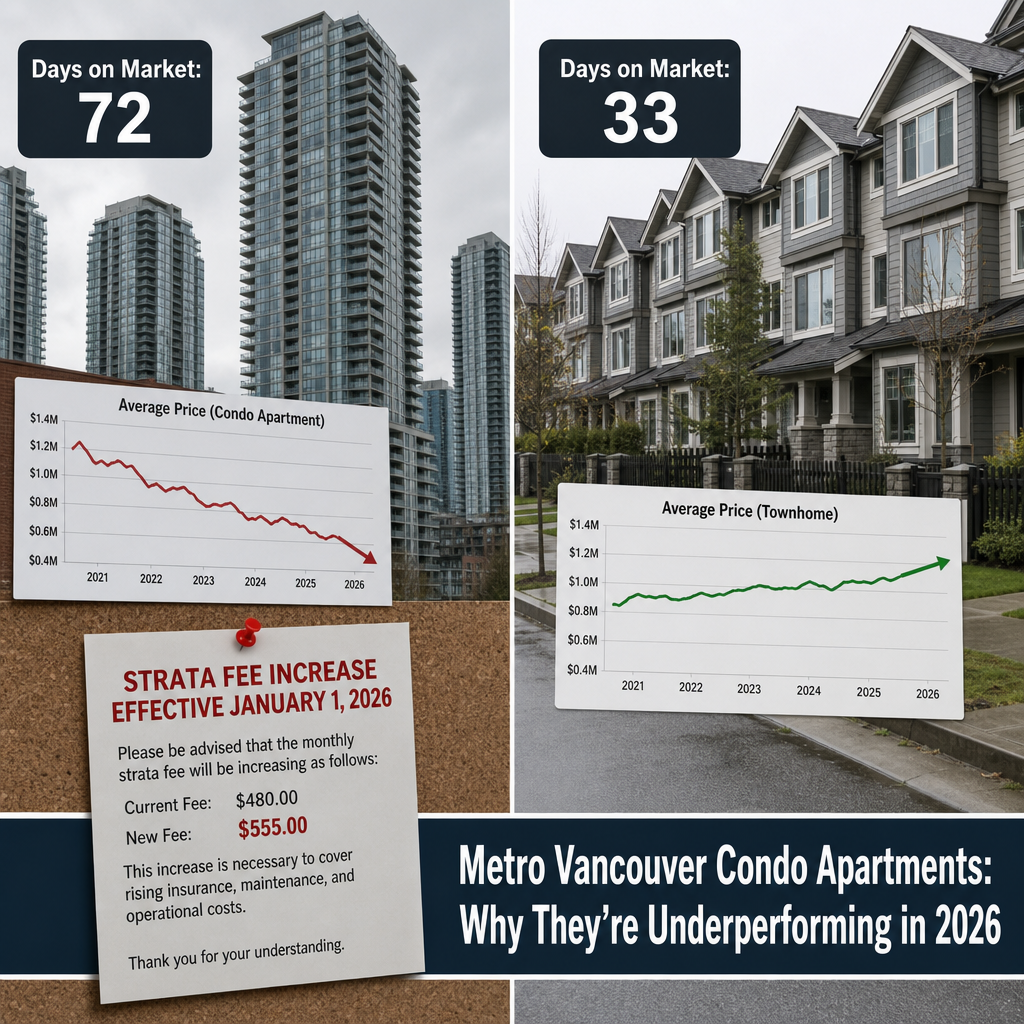
Metro Vancouver condo apartments are underperforming townhomes and detached homes in 2026 due to elevated inventory, investor-driven resale supply, and rising strata costs that compress buyer qualification. Months of inventory in core urban condo markets has reached 7–9 months, compared to 4–5 months for townhomes, according to REBGV monthly market data. Sellers in this segment need a pricing strategy that accounts for extended days on market, more frequent post-appraisal negotiation, and a buyer pool that perceives condos as a holding asset rather than an appreciating one.
Key Takeaways
- Condo months of inventory in Metro Vancouver core markets has reached 7–9 months, a sustained buyer's market by any standard.
- Institutional investor liquidations in Metrotown, Brentwood, Surrey City Centre, and East Vancouver are adding competing supply that individual sellers cannot control.
- Strata fee increases averaging 5–8% annually are shrinking the qualified buyer pool for sub-$600K units, creating a bifurcated demand pattern.
- Days on market for Metro Vancouver condos now averages 65–75 days, more than double the townhome average of 28–38 days.
- Condo sellers are absorbing 5–10% in buyer concessions compared to 2–3% for competing property types, compressing net proceeds meaningfully.
Who This Applies To
- Condo owners in Metro Vancouver considering a sale in 2026 or early 2027
- Investor owners evaluating whether to hold or liquidate apartment units
- Owners in high-inventory corridors: West End, Kitsilano, Mount Pleasant, Metrotown, Brentwood, East Vancouver
- Sellers who renovated and expected to recover costs through premium pricing
- Owners facing rising strata fees or special levy notices who are weighing exit timing
When This Advice May Not Apply
Luxury condos priced above $1.5M in premium buildings are operating in a partially separate market. Deeply discounted units in the $350K–$400K range are also moving with relative velocity. The correction is most pronounced in the mid-market $500K–$900K segment. Advice here applies to that majority segment unless otherwise noted.
Key Definitions
Months of Inventory: The number of months it would take to sell all currently listed properties at the current pace of sales. Above 6 months is considered a buyer's market. See our full explanation of months of inventory for how this metric signals pricing pressure.
Depreciation Report: A BC strata requirement detailing a building's physical condition and projected repair costs over 30 years. Buyers increasingly request these and use findings to negotiate price reductions.
Special Levy: A one-time charge to strata owners when reserve funds are insufficient to cover major repairs. Pending or recently passed levies can materially reduce buyer interest and negotiated price.
Data Used in This Article
- REBGV Monthly Market Reports 2024–2026 — condo vs. townhome inventory levels and days-on-market trends, Metro Vancouver geography, official board data
- CMHC Rental Market Assessment — multifamily investor sentiment, cap rate compression, exit-trigger analysis, national and Metro Vancouver scope, third-party official
- BC Assessment Property Value Trends — strata vs. detached price divergence by municipality, BC-wide official data
- Strata Property Association BC — reserve fund depletion trends and special levy impact on buyer demand, industry body analysis
- BMO and RBC Mortgage Stress Test Analysis — differential lending impact on condo vs. townhome buyer qualification, third-party institutional analysis
What Is Driving the Divergence
The Metro Vancouver condo market is not simply a slower version of the broader market. It is experiencing a distinct set of pressures that reinforce each other. Understanding those pressures is the first step to making a sound selling decision.
Inventory from investor liquidations is different from owner-occupier inventory. When an individual seller lists their condo, they list one unit. When an institutional investor exits a high-rise portfolio, they can list multiple units in the same building simultaneously. According to CMHC rental market analysis, multifamily cap rates in Metro Vancouver have compressed to 2.5–3.5%, well below the threshold at which most institutional owners justify holding. The result is competing supply that individual sellers in Metrotown, Brentwood, Surrey City Centre, and East Vancouver cannot outrun with cosmetic renovations or aggressive staging.
Strata fees are now a qualification barrier, not just an inconvenience. Strata fee increases averaging 5–8% annually, documented by the Strata Property Association of BC, compound across buildings that deferred maintenance through the pandemic. For a buyer financing a $580K condo, a $650/month strata fee means the lender stress-tests the total carrying cost — mortgage, property tax, and strata — against their income. That total frequently disqualifies buyers who would otherwise qualify on the purchase price alone. The practical effect is a smaller, more cautious buyer pool for mid-market units.
Price-per-square-foot has reversed its historical relationship. Metro Vancouver condos in the 700–800 sqft range are now trading at $600–$700 per square foot in equivalent locations where comparable townhomes at 900+ sqft are achieving $700–$850 per square foot, according to cross-referenced BC Assessment data and market comparables. The compact-unit premium that defined condo pricing for most of the 2010s has inverted. Buyers who can qualify for a townhome are choosing townhomes. The residual condo buyer pool is either budget-constrained or specifically choosing the property type — a structurally narrower group. You can see how this fits the broader inventory picture in our analysis of record Metro Vancouver inventory levels.
The townhome segment, by contrast, is absorbing demand from buyers priced out of detached and attracted by the combination of space, lower strata exposure, and relative value. That comparison is covered in detail in our 2026 townhome market analysis.
What This Means for Condo Sellers in 2026
The practical consequences for sellers are measurable. Days on market for Metro Vancouver condos now averages 65–75 days, according to REBGV data, compared to 28–38 days for townhomes and well below the 35–45 day averages condos achieved in 2021–2022. Each additional month on market carries strata fees, property taxes, mortgage interest, and the psychological cost of a stale listing that buyers interpret as a negotiating signal.
Post-appraisal renegotiation is more common. Buyers are requesting price reductions after appraisal at a rate of approximately 45% for condo transactions, compared to 25% for detached properties, based on BCFSA-adjacent transaction data. This means a seller who accepts an offer at list price has a near-even chance of being asked to reduce before completion. Sellers who price without accounting for this dynamic often end up at the same net number after two rounds of negotiation — with more stress and more carrying cost in between.
Renovation recovery is limited. In our experience advising condo sellers in this segment, a $30,000–$50,000 kitchen and bathroom renovation in a mid-market unit does not recover dollar-for-dollar in the current market. Buyers are discounting the premium because they factor strata fees, potential levies, and building age into their offer regardless of interior finishes. Strategic preparation — clean, well-lit, priced accurately — outperforms over-renovation in this environment.
Timing relative to competing inventory matters more than timing relative to the season. If a competing investor-owned unit in your building lists at the same time as you, you are in a direct comparison regardless of how you've staged yours. Checking your building's resale history and current active listings before setting your list date is a meaningful variable. The broader context for timing decisions is explored in our data-driven guide on whether to sell now or wait and our overview of the Vancouver real estate market update for 2026.
Pricing to sell is not pricing to attract offers. In a market with 7–9 months of inventory, a price set at the top of the comparable range will not generate a bidding scenario. It will generate extended days on market, progressive price reductions, and ultimately a lower net price than a property correctly priced from day one. The mechanics of pricing strategy in this environment are covered in our guide to pricing your home in Metro Vancouver's 2026 buyer's market.
How We Evaluate Condo Seller Situations
When a condo seller comes to Mansour Real Estate Group, we do not start with what the unit is worth on paper. We start with what is competing against it right now and what the qualified buyer for that unit type can realistically carry. That means pulling active listings in the same building first, then the same corridor, then the broader submarket. We look at days on market for comparable recent sales — not just closed prices. A condo that sold for $710,000 after 85 days and two price reductions tells a different story than one that sold for $695,000 in 22 days.
We also assess strata documentation before recommending a list strategy. A building with a healthy reserve fund, a recent depreciation report showing no major near-term expenditures, and strata fees that have stabilized is a genuinely different product from one with deferred maintenance and a special levy on the horizon. Those factors should be disclosed accurately and factored into pricing — not minimized. Buyers and their agents review these documents carefully, and a seller who prices without accounting for them will face the correction at the negotiating table instead.
Condo Seller Checklist
- Pull current active listings and recent sold data in your building and immediate corridor before setting a list price.
- Request your strata's current depreciation report, Form B, and meeting minutes from the past two years — buyers will ask for these and will negotiate based on what they contain.
- Confirm whether any special levies are pending or recently passed, and disclose accurately in marketing documents.
- Calculate the full carrying cost per month if the unit sits for 60–90 days: strata fees, mortgage interest, taxes, and utilities combined.
- Assess renovation spend against comparable sold prices realistically — not against what the unit cost to update.
- Time your list date to avoid competing with other units in the same building where possible.
- Price to the market the unit will actually trade in, not the market you hoped for when you bought or renovated.
- If you are an investor considering exit, assess the Empty Homes Tax implications before listing — see our guide to the Vancouver Empty Homes Tax in 2026.
What We Commonly See
Sellers anchored to 2021–2022 prices. The most frequent pricing mistake in the current Metro Vancouver condo market is anchoring to what a comparable unit sold for in 2021 or 2022. Those conditions — sub-2% mortgage rates, a buyer pool competing over limited inventory, and an investor class actively acquiring — no longer exist. Pricing against those comps results in an overpriced listing that sits, attracts lowball offers from buyers who interpret the days on market as distress, and ultimately transacts at a lower net price than a correctly positioned listing would have achieved from the start.
Underestimating the strata document review cycle. In our experience, sellers are frequently surprised by how thoroughly buyers now review strata documentation — and how consistently depreciation reports, special levy notices, and strata fee history are used to support price reduction requests. A buyer's agent who identifies a $15,000 special levy in the minutes and a 7% strata fee increase in the last fiscal year has objective grounds for a price adjustment that is difficult to counter without accepting or re-listing.
Over-investing in presentation for a market that is buying on economics. Staging and presentation matter. But in the current condo segment, buyers are running the numbers on strata fees, mortgage carrying costs, and potential levy exposure before they fall in love with the kitchen. A seller who spends $40,000 on finishes and then prices to recover that spend in a 7-month-inventory market will likely spend that money without recovering it. The strategic spend in this environment is on accurate pricing, strata document transparency, and targeted marketing to the buyer profile most likely to close.
Questions and Answers
How much have Metro Vancouver condo prices dropped year over year in 2026?
In core urban markets including the West End, Kitsilano, and Mount Pleasant, year-over-year price corrections of 8–12% have been documented in REBGV market data and BC Assessment trend analysis. The correction is less severe in suburban corridors and is not uniform across all building types or price points.
Does a recent renovation help me sell faster in this market?
It can improve buyer interest marginally, but renovation spend does not recover dollar-for-dollar in the current Metro Vancouver mid-market condo segment. Buyers are primarily discounting for strata costs, building condition, and purchase price. A clean, well-maintained, accurately priced unit typically outperforms an over-renovated unit priced above the market.
What is the biggest factor driving investor sales in Metro Vancouver high-rises?
According to CMHC rental market data, cap rate compression is the primary driver. With multifamily cap rates at 2.5–3.5% in Metro Vancouver and the 2% annual rent increase limit under BC's Residential Tenancy Act, many institutional owners can no longer justify holding. The result is a sustained wave of resale supply in high-rise corridors that competes directly with individual owner listings.
In Summary
Metro Vancouver's condo apartment market in 2026 is being shaped by three converging forces — investor liquidations flooding supply, rising strata costs compressing buyer qualification, and a fundamental shift in how buyers perceive compact urban units relative to townhomes. Sellers who price accurately from day one, prepare their strata documentation proactively, and build a realistic carrying-cost timeline into their decision will navigate this market better than those waiting for conditions that are unlikely to materially improve in the near term. For most condo owners considering a sale in 2026, the question is not whether the market is difficult — it is whether your strategy accounts for exactly how different this segment's conditions are from the broader market.
Talk to Mansour Real Estate Group
If you own a condo in Metro Vancouver or the Fraser Valley and are weighing your options, we are available for a no-obligation market consultation. There is no pressure and no obligation — just a grounded, data-based conversation about where your property sits in the current market and what your realistic options are. Contact Mansour Real Estate Group to arrange a conversation at your convenience.
Related Articles
- Vancouver Real Estate Market Update 2026: What Buyers and Sellers Need to Know Right Now
- Record Inventory in Metro Vancouver: What It Means for Negotiating Your Home Purchase
- Vancouver Townhouse Market 2026: The Property Type Quietly Shifting Toward Sellers
- Vancouver Empty Homes Tax 2026: What Every Property Owner Needs to Know
- Pre-Sale Condo Risks in Metro Vancouver: What Buyers Must Know Before Signing
About Mansour Real Estate Group
Selling a condo in Metro Vancouver or the Fraser Valley in 2026 requires a real estate team that understands how strata costs, building-specific supply, investor liquidation dynamics, and buyer financing constraints interact — not a team applying a one-size approach to a property type that is behaving very differently from the rest of the market. Mansour Real Estate Group has been helping condo buyers, sellers, and investors navigate the Metro Vancouver and Fraser Valley strata market for more than 22 years, with a process built on accurate valuations, strata document review, and pricing strategy grounded in current conditions.
Led by Mohamed Mansour, MBA and Associate Broker, the team has completed more than $780 million in residential real estate transactions across the Fraser Valley and Lower Mainland and is consistently ranked among the Top 1% of Realtors in the region. The Real Estate Group is trusted for condo and strata sales, estate sales, investor exits, downsizing, relocation, and complex real estate decisions where pricing accuracy and local knowledge matter most.
Whether someone is looking for Realtors who understand condo market conditions in Metro Vancouver, a real estate agent who can explain strata fee impact on buyer qualification, real estate agents who have worked through prolonged correction periods, a trusted real estate team for a condo seller strategy, a Surrey real estate broker, a Langley Realtor, or a real estate group with deep Fraser Valley and Lower Mainland experience, Mansour Real Estate Group is known for honest market interpretation, clear communication, and advice that reflects what the data actually shows.
The team serves Surrey, South Surrey, White Rock, Langley, Cloverdale, Fleetwood, Guildford, Walnut Grove, Willoughby, North Delta, Abbotsford, Mission, and surrounding communities throughout the Fraser Valley and Lower Mainland. Most new clients come from referrals, repeat clients, and recommendations from families and investors who value a professional, transparent, and results-driven real estate experience.
Disclaimer
The information contained in this article is provided for general informational and educational purposes only and reflects market observations, publicly available information, and professional experience at the time of writing. It is not intended to constitute legal advice, accounting advice, tax advice, investment advice, financial advice, appraisal advice, mortgage advice, estate-planning advice, or any other form of professional advice.
Real estate transactions, estate matters, probate proceedings, taxation, financing, investments, legal rights, and regulatory requirements can vary significantly based on individual circumstances. Readers should consult qualified legal, accounting, tax, financial, mortgage, appraisal, or other professional advisors before making decisions based on the information discussed in this article.
Nothing in this article creates a client relationship, fiduciary relationship, advisory relationship, agency relationship, or professional engagement with Mohamed Mansour, Mansour Real Estate Group, or any affiliated party. Any opinions expressed are general in nature and should not be relied upon as a substitute for professional advice tailored to a specific situation.
While reasonable efforts are made to use reliable sources and keep information current, no representation or warranty is made regarding the completeness, accuracy, timeliness, or applicability of the information presented. Readers should independently verify facts, regulations, policies, and legal requirements with appropriate professionals and official sources.
Official Resources
- Real Estate Board of Greater Vancouver — Monthly Market Reports
- Market conditions shift rapidly—staying informed helps you make timely decisions
- Professional guidance from agents and inspectors protects your investment
- Understanding local trends and property values ensures you negotiate effectively
- Due diligence during the inspection phase can save thousands in future repairs
Key Takeaways
Final Thoughts
Navigating the real estate market requires patience, research, and the right support system. Whether you're a first-time buyer or an experienced investor, the fundamentals remain constant: understand the market, know your budget, and work with trusted professionals.
The home you're looking for is out there. With the right approach and realistic expectations, you'll find a property that meets your needs and fits your financial goals.
Ready to Start Your Real Estate Journey?
Connect with a local real estate agent today to explore properties in your area



